
Are Ceramic Implants Safer Than Titanium? A Specialist’s Perspective on Biological Compatibility
- Dr Samintharaj Kumar

- Apr 14
- 12 min read
The material we've called the clinical gold standard for four decades might not be the most harmonious choice for your unique physiology. When patients ask me, are ceramic implants safer than titanium, they're usually expressing a deep-seated desire for a solution that respects their body's natural chemistry. You want a smile that feels natural without the worry of systemic inflammation or metal sensitivities. It's a valid concern, especially since a 2019 study published in the Journal of Clinical Medicine indicated that approximately 0.6% to 5% of the population may experience a titanium hypersensitivity.
In my clinical experience at Nuffield Dental, the choice between materials is a decision rooted in biological compatibility and long-term health outcomes. I'll provide a comprehensive clinical comparison of these two materials to help you understand which one best supports your long-term biological health. We'll examine the structural integrity of zirconia, the risk of peri-implantitis, and how my philosophy of total rehabilitation prioritises your body's immune response for a truly seamless transformation.
Key Takeaways
Discover the historical evolution of dental materials and why the shift toward metal-free zirconia represents a significant milestone in biocompatible innovation.
Evaluate the scientific evidence surrounding the question, "are ceramic implants safer than titanium," by understanding the nuances of osseointegration and bio-inert responses.
Compare the mechanical properties of both materials, balancing the structural ductility of medical-grade titanium against the superior aesthetic and soft-tissue benefits of modern ceramics.
Understand the vital role of 3D CBCT imaging and surgical execution in ensuring that the safety and longevity of an implant are dictated by clinical precision.
Learn how my patient-centred philosophy at Nuffield Dental integrates biological testing to select the most appropriate material for your long-term health and quality of life.
Table of Contents The Evolution of Dental Materials: Why the Debate Over Safety Matters Understanding Biocompatibility: From Titanium Integration to Ceramic Innovation Comparing Clinical Outcomes: Strength, Aesthetics, and Long-Term Stability The Precision of Placement: How Technology Dictates Safety Beyond Material Choice My Perspective: Choosing the Right Path for Your Total Oral Rehabilitation
The Evolution of Dental Materials: Why the Debate Over Safety Matters
In my clinical experience, the foundation of modern restorative dentistry rests upon a discovery made in 1952. Since the first human application in 1965, medical-grade titanium has dominated the field. It provided a predictable solution for tooth loss, yet the conversation is shifting. Today, patients often ask me: are ceramic implants safer than titanium? This question reflects a broader movement toward biological dentistry and a deeper scrutiny of what we place inside the human body. The Evolution of Dental Materials reveals a transition from simple mechanical replacement to sophisticated biological integration.
To better understand this concept, watch this helpful video:
When evaluating if ceramic implants are safer than titanium, we must look beyond the surface. Safety in implantology involves three pillars: biocompatibility, structural integrity, and the host response. As a clinician and founder, I view safety as the long-term harmony between a synthetic material and living tissue. Patients are increasingly seeking metal-free options for total oral rehabilitation, driven by a desire for holistic wellness and concerns regarding metal sensitivities. This shift has turned what was once a niche alternative into a primary consideration for modern dental care.
The Standard: Medical-Grade Titanium
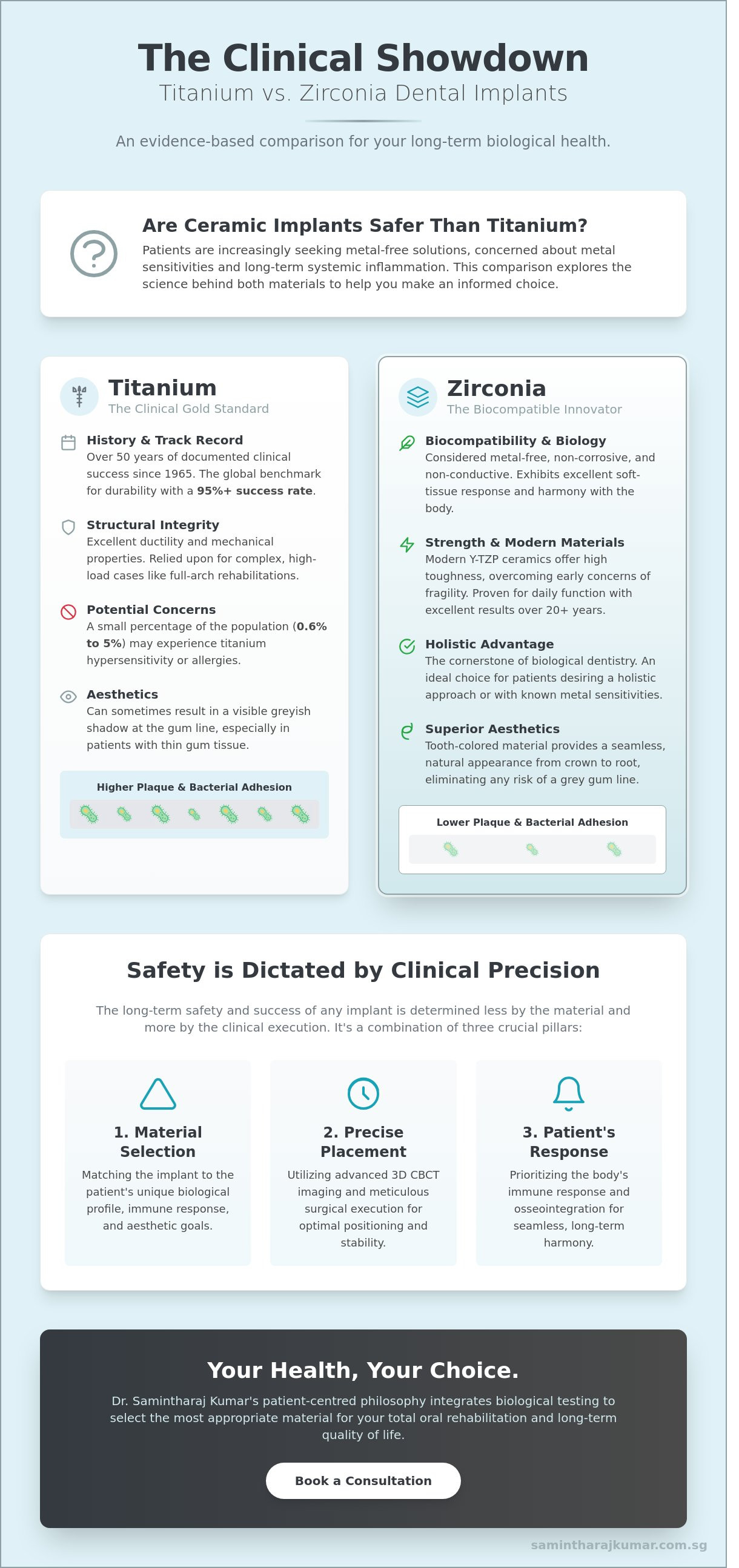
Titanium's role in osseointegration is supported by over 50 years of documented clinical success. Its ability to fuse with bone is remarkable; it creates a stable foundation even in challenging environments. In my practice, I rely on titanium for complex cases like zygomatic implants where structural load is significant. Its mechanical properties are well-understood, maintaining success rates above 95 percent across five decades of use. It remains the global benchmark for durability in full-arch rehabilitations.
The Challenger: Zirconia Ceramic
Zirconia is often misunderstood. While it originates from Zirconium, the oxidation process transforms it into a ceramic that doesn't behave like a metal in the oral environment. It's non-corrosive and non-conductive. This makes it a cornerstone of biological dentistry. Initially, some feared ceramic was too fragile, but modern Y-TZP (Yttria-stabilised tetragonal zirconia polycrystal) offers the toughness required for daily function. It provides a seamless, natural appearance that is particularly beneficial for patients with thin gum tissue.
Biocompatibility: Both materials are highly accepted by the body, but zirconia exhibits lower bacterial adhesion.
Aesthetics: Ceramic offers a tooth-coloured finish, eliminating the risk of a grey shadow at the gum line.
Longevity: Titanium has more long-term data, while zirconia has shown excellent results over the last 20 years.
The choice between these materials isn't about one being inherently "dangerous" and the other "safe." Instead, it's about matching the material to the patient's unique biological profile and aesthetic goals. The best outcomes begin with understanding the root cause of a patient's concerns.
Understanding Biocompatibility: From Titanium Integration to Ceramic Innovation
In my clinical experience, the success of any dental restoration hinges on how harmoniously the material interacts with living tissue. Osseointegration is the foundational process where living bone cells attach directly to the implant surface, creating a permanent bond. While titanium has been the reliable gold standard since the 1960s, we are seeing a shift toward zirconia due to its unique biological profile. Understanding Biocompatibility requires us to distinguish between bio-inert materials, which the body simply tolerates, and bio-active materials that actively encourage tissue integration. Zirconia sits in a favourable position because it is chemically non-reactive, meaning it does not trigger the same level of foreign body response as some metallic alloys.
From a biological perspective, the immune system treats every implant as a foreign object. A healthy response leads to stable integration, but a chronic inflammatory response can lead to implant failure. When patients ask are ceramic implants safer than titanium, I explain that safety is often a matter of individual systemic compatibility. Ceramic is inherently non-corrosive and non-conductive, which reduces the immunological "noise" the body has to manage. This makes it an excellent choice for those seeking to minimize their body's inflammatory burden.
The Science of Metal Sensitivities
Titanium is generally well-tolerated, yet a 2011 study indicated that approximately 0.6% of the population may have a specific titanium allergy. I often recommend MELISA testing for patients with histories of metal hypersensitivity to ensure we aren't introducing a systemic stressor. Beyond allergies, we must consider Galvanic corrosion. This occurs when different metals in the mouth, such as a gold crown and a titanium post, create electrical micro-currents in saliva. These currents can lead to the release of metal ions into the surrounding gum tissue, potentially triggering local inflammation or a persistent metallic taste. By using ceramic, we eliminate these electrical interactions entirely.
Ceramic and Soft Tissue Health
Zirconia offers a distinct advantage for the soft tissue. The gums tend to adhere more tightly to ceramic surfaces than to metal, creating a superior biological seal against bacteria. Zirconia is also remarkably smooth. Research shows it attracts significantly less plaque than titanium, which is a critical factor in preventing peri-implantitis, an inflammatory condition that can lead to bone loss.
From an aesthetic standpoint, ceramic eliminates "grey gum" syndrome. This happens when the dark shadow of a titanium post shows through thin gingival tissue, a common concern for patients with high smile lines. As a clinician and founder, I believe that true health includes the confidence that comes from a natural, seamless appearance. Choosing the right material is about more than just a missing tooth; it's about your long-term systemic health and quality of life. The best outcomes begin with understanding the root cause of your dental needs.
Comparing Clinical Outcomes: Strength, Aesthetics, and Long-Term Stability
In my clinical experience, the choice between materials is never a simple binary. It's a calculated decision based on the physics of the human bite and the unique biology of the patient's soft tissue. When patients ask if are ceramic implants safer than titanium, they're often focused on longevity and the risk of mechanical failure. Titanium is ductile; it possesses a slight flexibility that allows it to absorb the shock of mastication. Ceramic, specifically Zirconia, is incredibly rigid. This rigidity is a clinical advantage for stability but requires precise surgical handling to manage biting loads effectively.
Mechanical Reliability and Biting Forces
Titanium has been the cornerstone of implantology for over 50 years because it withstands extreme pressure without fracturing. In full-arch rehabilitation, where we replace an entire row of teeth, titanium's resilience is essential. For posterior regions where biting forces can exceed 800 Newtons, I often rely on titanium's proven track record. The Precision of Placement: How Technology Dictates Safety highlights why material selection must match the intended clinical site to ensure long-term success.
Modern Zirconia manufacturing has mitigated many early concerns regarding breakage. We now use Yttria-stabilised tetragonal zirconia polycrystal (Y-TZP), which has reduced fracture rates to below 0.5% in most recent five-year clinical studies. As a clinician and founder, I've observed that "Teeth in a Day" protocols still favour titanium for its immediate load-bearing capacity, while ceramic is often better suited for delayed loading in the front of the mouth where aesthetic demands are highest.
Aesthetic Superiority of Ceramic
From a biological perspective, the "aesthetic zone" is where ceramic truly shines. Zirconia is naturally tooth-coloured and light-transmitting. It mimics the optical properties of a natural tooth root. This is critical for patients with thin gingival biotypes, where the gum tissue is less than 2mm thick. In these cases, a titanium post might cast a subtle grey shadow through the gum tissue, whereas ceramic maintains a vibrant, healthy pink appearance.
One-Piece Designs: These ceramic systems eliminate the microscopic gap between the implant and the abutment, significantly reducing bacterial colonisation and the risk of peri-implantitis.
Two-Piece Systems: These allow for greater prosthetic flexibility during a Smile Makeover, making it easier to achieve the perfect alignment of the final crown.
Long-Term Stability: Clinical data shows that ceramic surfaces often attract less plaque than metal, which can lead to better bone preservation in patients prone to inflammation.
My perspective is that the best outcomes begin with understanding the root cause of a patient's concerns. Whether we choose the ductility of titanium or the bio-aesthetics of ceramic, the goal is a seamless transformation that restores both function and confidence. The right diagnosis changes everything.
The Precision of Placement: How Technology Dictates Safety Beyond Material Choice
In my clinical experience, the question of whether are ceramic implants safer than titanium often misses the most vital factor: the precision of the surgical intervention. While material biocompatibility is a significant consideration, the safety of any implant is ultimately dictated by its placement within the unique biological architecture of your jaw. A perfectly biocompatible material placed in an unstable environment will still face a high risk of failure.
I utilise high-resolution 3D CBCT imaging to assess bone density and nerve proximity with sub-millimetre accuracy. This technology removes the element of human guesswork from the equation. At my practice, AI-assisted diagnostics now allow us to identify the precise root cause of tooth loss, such as specific patterns of bone resorption, before we even consider the implantation stage. This ensures we aren't simply treating a symptom but are planning for a lifetime of stability.
Digital Workflow and Guided Surgery
I use digital impressions to plan the exact trajectory of every implant within a virtual environment. This digital workflow allows for guided surgery, which is far less invasive than traditional methods. By using a custom-made surgical guide, I can place the implant through a tiny opening, which reduces trauma to the soft tissue and significantly accelerates the healing process. We also integrate AI to monitor long-term implant health, allowing us to detect minute changes in bone levels years before they would be visible on a standard X-ray.
Preparing the Biological Foundation
The success of an implant depends entirely on the quality of its foundation. When bone volume is insufficient, a bone graft is often required to ensure long-term safety and structural integrity. I believe in a holistic approach where we address systemic factors like smoking or diabetes, as these conditions impact the vascular health necessary for both titanium and ceramic materials to thrive.
Complex cases, particularly those requiring zygomatic protocols or full-arch reconstructions, demand a level of specialist expertise that general dentistry cannot provide. As a clinician and founder, I view every procedure as a critical step in a "Total Rehabilitation" journey. My goal is to ensure that the technology we use serves the biological needs of the patient, creating a seamless transition from tooth loss to a restored quality of life.
The best outcomes begin with
.
My Perspective: Choosing the Right Path for Your Total Oral Rehabilitation
In my clinical experience, the choice of implant material is never a simple binary decision. I have seen the transformative power of both titanium and zirconia in restoring not just a smile, but a patient's sense of self. When patients ask me whether are ceramic implants safer than titanium, I explain that safety is defined by individual biological compatibility. My role as a specialist is to bridge the gap between advanced material science and your personal health history.
At Nuffield Dental, we adhere to a philosophy of patient-centred selection. We don't guess; we assess. By utilizing biological testing where appropriate, we ensure the chosen material supports your systemic health. As a clinician and founder, I believe the future of implantology lies in this bespoke approach, moving steadily toward metal-free solutions as our technological capabilities expand. This evolution is driven by a commitment to long-term quality of life and the restorative confidence that only a healthy, integrated smile can provide.
When I Recommend Ceramic Implants
I frequently recommend ceramic (zirconia) implants for patients who present with documented metal sensitivities or those who seek a holistic, metal-free lifestyle. From a biological perspective, ceramic is highly bio-inert and demonstrates a lower affinity for bacterial plaque than traditional materials. This characteristic is a significant priority for systemic wellness, as it reduces the risk of peri-implant inflammation.
In the aesthetic zone, particularly for front-tooth replacement, ceramic is often my preferred choice. Its white, opaque nature prevents the "grey shadow" effect that can occur when titanium is placed behind thin gum tissues. For patients with a high smile line, this choice ensures a seamless, natural transition that maintains its beauty for decades.
When Titanium Remains Essential
Despite the rise of zirconia, titanium remains the gold standard for structural integrity in complex rehabilitations. Its role is particularly vital when managing bone healing in wisdom tooth extraction sites or executing full-mouth protocols. Titanium’s versatility and mechanical strength are currently unmatched in certain high-load scenarios.
Zygomatic and Pterygoid Systems: These advanced protocols, which provide life-changing results for patients with severe bone loss, still rely on the proven structural properties of titanium.
Clinical Longevity: Titanium has over 50 years of documented success, providing a predictable foundation for complex surgical cases.
Structural Resilience: In full-arch rehabilitation, the balance of innovation and proven durability is essential for long-term stability.
The journey to total oral health is unique for every individual. Whether we choose ceramic for its bio-inert properties or titanium for its mechanical excellence, the goal remains the same: a functional, beautiful result that lasts a lifetime. The best outcomes begin with understanding the root cause.
Defining Your Path to Total Rehabilitation
Choosing the right material for your smile is a decision that impacts your quality of life for decades. When considering if are ceramic implants safer than titanium, it's vital to look beyond the material to the surgical precision involved. While titanium has been a reliable clinical standard since 1965, ceramic innovations now offer a biocompatible, metal-free alternative for those prioritising holistic health or specific aesthetic outcomes.
As a clinician and founder, I've seen that the most successful transformations happen when we combine material science with advanced AI-assisted diagnostic protocols. This technology allows me to plan your treatment with a level of accuracy that traditional methods simply can't match. Whether I'm implementing Zygomatic implant systems for complex bone loss or ceramic for a seamless finish, my commitment is to your long-term stability and comfort.
The best outcomes begin with understanding the root cause. Explore our specialised approach to dental implants. I look forward to helping you reclaim the confidence you deserve through a personalised, expert-led journey.
Frequently Asked Questions
Are ceramic dental implants truly metal-free?
Ceramic implants made from Zirconia are considered metal-free in a clinical context. While Zirconium is a transition metal on the periodic table, the oxidation process transforms it into Zirconia, a ceramic with entirely different biocompatible properties. In my clinical experience, this crystalline structure ensures no metal ions are released into the surrounding soft tissue, which is a primary concern for patients with sensitivities.
Can I be allergic to titanium dental implants?
Titanium hypersensitivity is a documented clinical reality affecting approximately 0.6% of the population, according to a 2008 study in the Journal of Oral & Maxillofacial Implants. Patients with existing sensitivities to nickel or cobalt often show a higher predisposition. If you've experienced unexplained rashes or implant failure previously, it's vital we investigate your biological compatibility before proceeding with a new procedure.
How much longer do titanium implants last compared to ceramic?
Many patients ask me, are ceramic implants safer than titanium in the long run? Titanium implants have a clinical track record spanning over 50 years, with success rates often exceeding 95% over a decade. Ceramic alternatives have shown promising results in the last 15 years, but we don't yet have the half-century of data available for titanium to make a definitive comparison on longevity.
Do ceramic implants break more easily than titanium?
Modern Zirconia implants are incredibly robust, though they possess lower fracture toughness than titanium. Research indicates that early ceramic designs had higher failure rates, but current Yttria-stabilised versions are engineered to withstand significant biting forces. I find that with precise surgical placement and proper occlusal loading, the risk of breakage is negligible for the vast majority of patients.
Is the cost of ceramic implants significantly higher than titanium?
Ceramic implants generally involve higher manufacturing costs due to the complex sintering processes required to create medical-grade Zirconia. Industry reports suggest that the components and laboratory fees for ceramic systems can be 30% to 50% higher than standard titanium equivalents. While I don't provide fixed estimates without a consultation, the investment reflects the specialised material science and the intricate surgical expertise required for placement.
Can I replace my existing titanium implants with ceramic ones?
It's possible to replace titanium with ceramic, but I only recommend this if there's a clear clinical indication like an allergy or peri-implantitis. Removing a well-integrated titanium implant involves significant bone loss, which may necessitate complex grafting procedures. From a biological perspective, if your current implants are healthy and functional, the risks of replacement often outweigh the aesthetic or biocompatibility benefits.
Which material is better for patients with gum disease history?
Ceramic implants often demonstrate a superior soft tissue response because they accumulate less bacterial biofilm than titanium. A 2016 study published in the International Journal of Oral & Maxillofacial Implants found that Zirconia surfaces show reduced bacterial adhesion. For patients with a history of periodontitis, this biological advantage helps maintain healthier gingival margins and may reduce the long-term risk of inflammation.
How do I know if I have a metal sensitivity before surgery?
I recommend the MELISA (Memory Lymphocyte Immunostimulation Assay) test to accurately identify metal hypersensitivity before we proceed with surgery. This blood test measures how your white blood cells react to specific metals, including titanium and its common alloys. Obtaining this data allows us to make an informed, evidence-based decision about your treatment plan, ensuring your long-term health and peace of mind.


Comments