
Long-Term Consequences of Missing Teeth: What Changes Over Time?

Could one missing tooth affect more than your smile? The long term consequences of missing teeth can include changes to the jawbone, the way your teeth meet and how comfortably you chew. These changes are not inevitable. Their likelihood depends on factors such as which tooth is missing and the health of your remaining teeth and gums.
It’s understandable to wonder whether a gap needs attention, particularly if it isn’t painful. I’m Dr Samintharaj Kumar, founder of Nuffield Dental. In my clinical experience, the visible space is only part of the picture. Over time, neighbouring teeth may shift, chewing can feel different, and some people notice changes in speech, appearance or jaw comfort. These effects vary, so a missing tooth does not mean you will develop every possible complication.
I’ll explain how tooth loss may affect bone, bite and everyday function, which changes are worth discussing with a dentist, and how an individual assessment can clarify your options. The first step is to look beyond the gap and understand how it fits into your overall oral health. Precision in planning begins with seeing the whole picture.
Table of Contents
What are the long-term consequences of missing teeth?
The effects of a missing tooth vary. A gap may influence chewing, nearby teeth or the jawbone, but it does not affect everyone in the same way. Further problems are possible, not inevitable.
It’s understandable to have questions about changes in your appearance or eating, or to be unsure whether a gap needs attention. Tooth loss is the absence of one or more teeth. Possible downstream effects include changes to oral function or structure, but these are not guaranteed. One missing tooth is different from several gaps or complete tooth loss, so the implications depend on the individual.
For a broader overview of long-term consequences of missing teeth, including potential functional and structural effects, you may find this video helpful:
Why the effects of a missing tooth differ between people
In my clinical experience, the gap alone doesn’t tell the whole story. A front tooth and a back tooth serve different roles in appearance and chewing. The number and position of missing teeth, the way the remaining teeth meet, and your existing oral health all influence what you may notice.
One missing tooth may have little obvious effect for a time, while several missing teeth can make comfortable chewing more challenging. Complete tooth loss creates a different pattern of support and function. The timing and extent of any changes can’t be predicted from the gap alone. There is no fixed progression that applies to everyone.
Which parts of oral health may be affected?
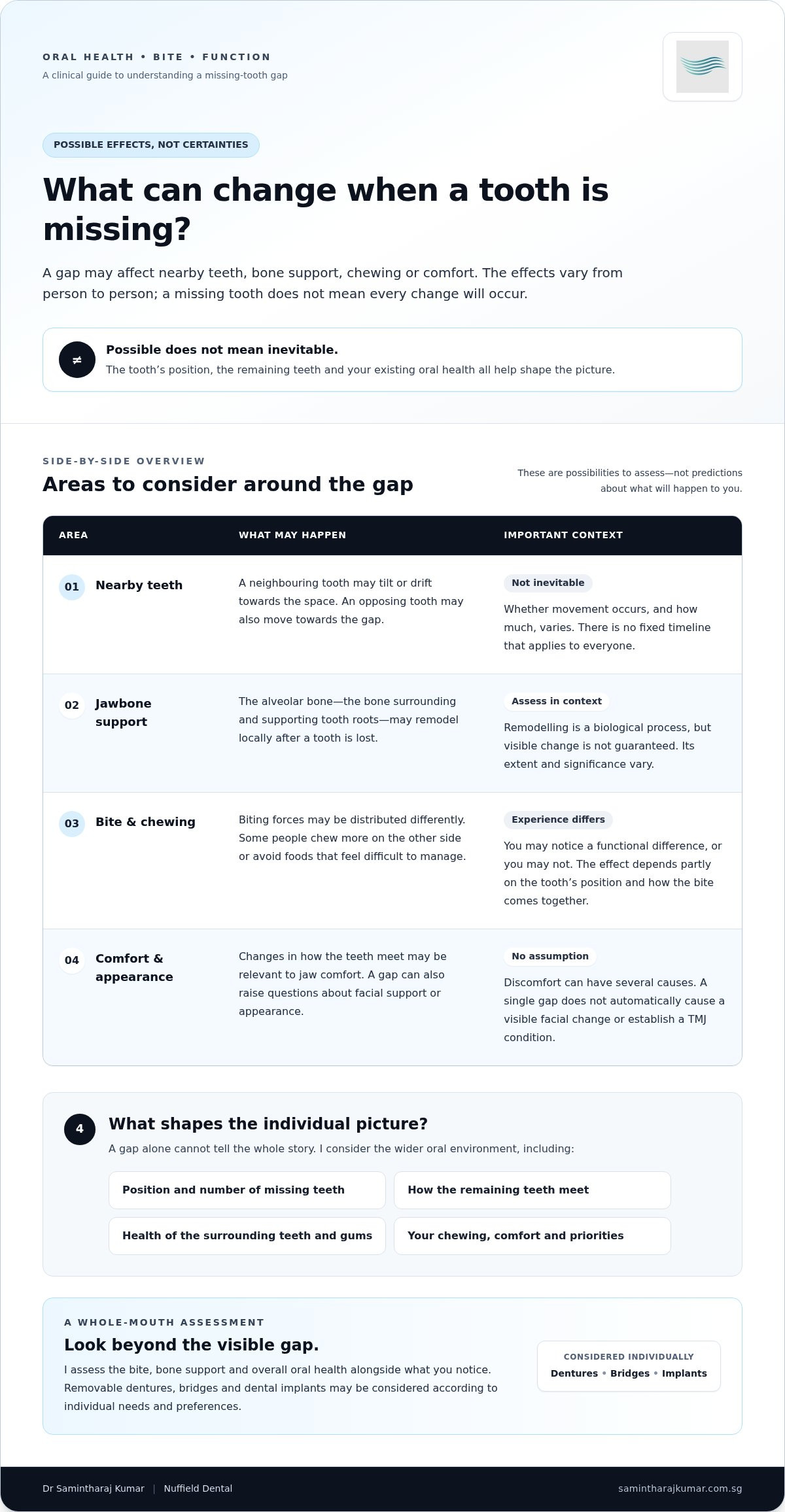
Teeth work together to distribute forces when you bite. A gap can alter that balance. Depending on its location and the surrounding teeth, neighbouring teeth may move towards the space, or an opposing tooth may gradually extend into it. These are possibilities, not certainties.
Chewing, the position of other teeth, jawbone support and appearance are connected, but not every area changes for every person. Changes in the bite or bone need individual assessment rather than assumption. If you want to understand how missing teeth fit into a wider functional picture, I discuss this in my guide to dental implant treatment and total oral rehabilitation.
The long term consequences of missing teeth are best considered in context. I look beyond the visible gap to assess the whole bite, oral health and your priorities. This provides a clearer basis for understanding what, if anything, may need attention.
How can missing teeth change the bite, jawbone and chewing function?
Your teeth share the work of biting and chewing. When a tooth is missing, the forces that once passed through it may be distributed differently across the remaining teeth. The effect depends on the tooth’s position, the opposing teeth and the way your bite comes together.
What may happen to the teeth around an untreated gap?
In some cases, a neighbouring tooth may tilt or drift towards the space. The opposing tooth may also move towards the gap because it no longer meets a tooth in the usual way. These movements are not inevitable, and their extent varies. I assess the whole bite rather than assume a particular pattern or timeline from the gap alone.
The alveolar bone is the part of the jawbone that surrounds and supports the tooth roots. After a tooth is lost, the local bone may remodel because it no longer receives the same stimulation from that tooth. This is a biological process, not a guarantee of visible change. The degree of remodelling and its practical significance need to be considered in the context of your mouth.
How can tooth loss affect chewing and jaw comfort?
Some people adapt by chewing more on the other side or avoiding foods that feel difficult to manage. This can change how chewing forces are shared, although you may not notice a clear functional difference. If your chewing feels different, describe when and where you notice it during a dental assessment.
Changes in how the teeth meet may be relevant to jaw comfort, but discomfort can have several causes. A missing tooth alone cannot establish that someone has a temporomandibular joint (TMJ) condition. I consider the bite alongside the wider clinical picture before drawing conclusions.
Teeth, bone and facial support are connected, but a single gap does not automatically lead to an obvious change in face shape. For related context, I explain how dental structure affects face shape.
In my clinical experience, the useful question is not simply whether a tooth is missing, but how that space relates to your comfort, bite and oral health. A careful assessment can clarify what is happening and whether a next step is appropriate.
Do missing teeth always cause bone loss, facial changes or other problems?
No. A missing tooth does not mean that bone loss, a visible change in facial appearance or other complications will inevitably follow. These are possible effects, not predictions for every person. The long term consequences of missing teeth depend on the individual oral environment, and some changes may be difficult to identify without an examination.
It’s important to distinguish a change around the missing tooth from a broader change in the face. Bone remodelling can occur locally where a tooth has been lost, but visible facial changes are not inevitable. They may be more relevant when several teeth are missing and support has changed across a wider area. Appearance is also influenced by factors beyond tooth loss. A gap alone cannot establish what has happened or what may happen next.
Which factors influence the effects of tooth loss?
In my assessment, I consider more than the space left by a tooth. Its location and how many teeth are missing matter, as do the time since tooth loss and the condition of the remaining teeth. Gum health, bone support, the relationship between the upper and lower teeth, and existing restorations all help shape the clinical picture.
These factors interact. For example, the implications of a single gap may differ from those of several missing teeth, particularly if the remaining teeth or gums have other concerns. There is no reliable way to infer an individual’s outcome from one feature alone. An individual clinical assessment can clarify how these considerations apply to you.
What should readers understand about bone and facial changes?
Local changes in the jawbone and broader changes in facial support are not the same thing. The first may be considered when evaluating the site of a missing tooth; the second cannot be assumed from a gap. If dental implant treatment is being considered, bone support is one part of planning, alongside overall oral health and function. My guide to sinus lift surgery and bone support for implant planning explains this in more detail.
I avoid treating every possible consequence as inevitable. My aim is to understand what is present, distinguish it from what is merely possible, and discuss appropriate next steps in light of your priorities. If you’re uncertain about a gap or have noticed a change, an individual dental assessment can help bring the picture into focus.
What should you do if you have a missing tooth?
A missing tooth doesn’t automatically mean you need a replacement, but it is worth understanding how the gap relates to your oral health and function. Take a calm, practical approach: notice what has changed, then have the area assessed so decisions are based on findings rather than assumptions.
A useful sequence is:
1. Note the gap. Consider which tooth is missing and whether the area affects your smile or daily comfort.
2. Observe functional changes. Notice whether chewing feels different, your bite seems altered, or nearby teeth appear to have shifted. These observations are useful context, not a diagnosis.
3. Arrange a dental assessment. A clinician can examine the gap, your remaining teeth and overall oral health, then explain whether monitoring or discussing treatment options is appropriate.
The long term consequences of missing teeth can’t be determined by symptoms or appearance alone. A visible gap doesn’t show the condition of the supporting bone, and discomfort doesn’t identify its cause. An assessment helps distinguish what is present from what may simply be possible.
What happens during an assessment for missing teeth?
I begin by reviewing relevant medical and dental history, then consider the missing tooth, the condition of your remaining teeth and how your bite functions. Gum health and bone support are also part of the overall picture. Clinical examination, and diagnostic imaging when appropriate, can provide additional information to guide planning.
The findings inform a discussion, not an automatic treatment decision. I explain the options that may be relevant, their potential benefits and limitations, and how they relate to your priorities. Your goals matter: restoring chewing comfort, addressing an appearance concern or understanding whether a gap can be monitored are different considerations. Precision comes from assessing the whole mouth and making the reasoning clear.
When is a dental review especially important?
Consider arranging an assessment if chewing becomes difficult, your bite feels different, you notice new discomfort, or neighbouring teeth appear to be changing position. Concerns about appearance are also valid reasons to discuss the gap, even if it isn’t painful. These signs don’t prove that tooth loss is the cause, and they don’t mean surgery is required. They are reasons to have the situation understood.
My approach is to help you make an informed decision, not to presume that every missing tooth needs the same response. If you’d like to understand what an individual evaluation involves, arrange a dental assessment. The right diagnosis is the foundation for a considered next step.
How can a treatment plan address the long-term consequences of missing teeth?
Replacing a missing tooth isn’t automatic, and no single approach is right for everyone. I consider how the gap affects function, the health of the remaining teeth and gums, and what matters to you. The aim is to make a considered decision, not to treat a possibility as a certainty.
How do tooth-replacement approaches differ?
Broadly, options may include a removable denture, a bridge or a dental implant. A removable denture is taken out for cleaning. A bridge is a fixed restoration that spans a gap, while an implant is placed in the jaw to support a replacement tooth. Each involves different planning considerations, and these general descriptions alone don’t determine which approach is suitable.
The number and position of missing teeth can shape the options discussed. So can the condition of neighbouring teeth, gum health, available bone support, bite relationships and your preferences. Planning for one missing tooth is not necessarily the same as considering several gaps or wider rehabilitation. I specialise in ceramic dental implants, but this treatment is considered in the context of an individual assessment, not as an automatic recommendation.
These approaches shouldn’t be ranked universally. The relevant question is how each may fit your oral health, functional needs and priorities, including its limitations. A treatment plan should explain those trade-offs in clear, patient-centred terms.
What can patients expect from specialist-led planning?
I approach planning in stages:
Assessment: Review the missing tooth or teeth, remaining oral structures, bite and relevant health history.
Diagnosis: Clarify the findings and identify which factors are relevant to function and oral health.
Discussion: Consider appropriate options, their potential benefits and limitations, and how they relate to your goals.
Agreed plan: Decide on a next step together, with room for questions and a clear understanding of the reasoning.
Biological considerations matter, but so do everyday goals: chewing comfortably, maintaining oral health or addressing concerns about appearance. My role is to make the clinical picture understandable so you can take part in the decision with confidence.
The long term consequences of missing teeth are not identical for everyone, and treatment should reflect that. My philosophy has always been to begin with diagnosis, then plan with precision. Explore my approach to dental implant rehabilitation to learn more about how I consider treatment within a broader view of oral function and long-term care.
Take a considered next step for your oral health
The long term consequences of missing teeth are not the same for everyone. A gap may affect the bite, chewing or supporting bone, but these changes aren’t inevitable. What matters is understanding your own oral health rather than assuming what might happen.
In my clinical experience, a careful assessment should look beyond the space itself. It considers how your teeth meet, the condition of the surrounding tissues and your priorities. Replacing a tooth is not automatic; removable dentures, bridges and dental implants each involve different considerations.
My specialist practice includes complex dental implantology and oral surgery, with a focus on full mouth rehabilitation. Ceramic dental implants are also a primary part of my clinical work. I consider them within an individual plan, guided by diagnosis, function and patient preferences, not as a universal solution.
If you’re uncertain about a missing tooth or have noticed a change in chewing or comfort, a clearer understanding can help you consider your options with confidence. Explore my approach to dental implant rehabilitation. Thoughtful planning begins with the right diagnosis, a positive first step towards informed decisions about your long-term oral health.
Frequently Asked Questions
Can one missing tooth affect other teeth?
Yes, a missing tooth can sometimes affect the position or workload of nearby teeth, although this doesn’t happen to everyone. Neighbouring teeth may tilt or drift towards the gap, and an opposing tooth may move towards the space. The likelihood depends on the tooth’s position, your bite and the condition of the surrounding teeth. I assess these factors together rather than predict change from the gap alone.
Do missing teeth always cause jawbone loss?
No. Bone can remodel in the area where a tooth has been lost, but the extent and significance vary, and visible change isn’t guaranteed. The jawbone surrounding tooth roots supports them, so its condition may be relevant if replacement is being considered. An examination, and imaging when appropriate, can help me assess bone support. The long term consequences of missing teeth need to be understood in the context of your individual oral health.
Can missing teeth change the shape of your face?
They can contribute to changes in facial support, particularly when several teeth are missing and the changes affect a broader area. However, a single gap doesn’t mean your face will visibly change. Appearance is influenced by several factors, and local bone remodelling is not the same as an overall facial change. I consider the number and position of missing teeth, bone support and wider oral health before drawing conclusions.
How do missing teeth affect chewing?
A missing tooth may make chewing less comfortable or efficient, depending on its location and how your remaining teeth meet. Some people adapt by chewing on the other side or avoiding certain foods; others notice little difference. If you find yourself changing how you eat, mention this during a dental assessment. I’ll consider your bite and the surrounding teeth rather than assume the gap is the only possible cause.
Can missing teeth affect speech?
They can sometimes affect speech, depending on which tooth is missing and how you form particular sounds. Front teeth, for example, help shape airflow and tongue placement for some speech sounds. Not everyone notices a difference, and a change in speech can have causes other than tooth loss. If you’ve noticed a persistent change since losing a tooth, I can assess the gap and discuss what may be contributing.
Is it too late to replace a tooth that has been missing for years?
Not necessarily. The time since tooth loss alone doesn’t determine whether replacement is possible, but the condition of the gums, remaining teeth, bite and available bone support may influence planning. I assess these factors before discussing options. In some cases, further evaluation or preparation may be relevant. A clinical examination helps clarify which approaches could be considered for your needs and goals, without assuming a particular treatment is suitable in advance.
What is the best way to replace missing teeth?
There isn’t one best option for everyone. Removable dentures, bridges and dental implants differ in how they replace teeth and what planning they involve. The number and position of missing teeth, oral health, bone support, bite function and your preferences all matter. I discuss the potential benefits and limitations of relevant approaches so the decision reflects your circumstances. Ceramic dental implants may also be considered where appropriate, following individual assessment.


Comments