
Physiotherapy Exercises for TMJ Pain Relief: A Surgeon’s Guide to Jaw Rehabilitation
- Dr Samintharaj Kumar

- Jul 2
- 12 min read
What if the persistent clicking in your jaw isn't a sign of permanent structural failure, but rather a signal that your neuromuscular system needs recalibration? I've met many patients who feel trapped by the physical discomfort of a locking jaw and the mental toll of not knowing if they're causing long-term damage. It's a common struggle. The sea of conflicting advice online often only adds to that anxiety. When seeking tmj treatment singapore, it's vital to move beyond temporary fixes and focus on the underlying biological mechanics of the joint.
In my clinical experience, the path to recovery begins with understanding how your jaw functions as a complex, living system. I'll share a series of clinically-validated exercises designed to alleviate tension and improve your range of motion immediately. We'll examine the science of jaw rehabilitation from a specialist's perspective, giving you a clear roadmap for your recovery. By the end of this guide, you'll have a practical plan for daily relief and a better understanding of when it's time to consult a specialist for more advanced care.
Table of Contents
The Biology of Jaw Tension: Why TMJ Pain Occurs
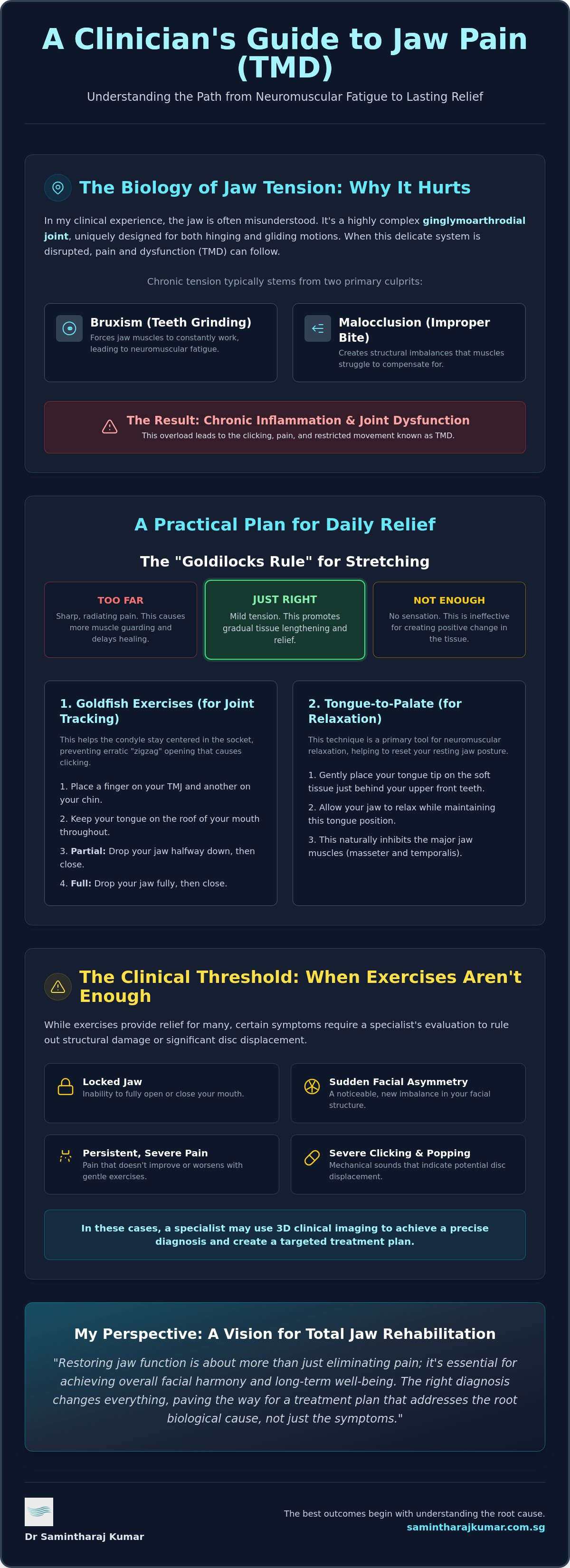
In my clinical experience, patients often view the jaw as a simple hinge. In reality, the temporomandibular joint is one of the most complex structures in the human body. Scientifically, it's classified as a ginglymoarthrodial joint. This means it possesses the unique ability to both rotate like a hinge and glide forward, allowing for the intricate movements required for speech and mastication. When this delicate system is disrupted, it leads to Temporomandibular Joint Dysfunction (TMD), a condition that can significantly diminish one's quality of life.
From a biological perspective, chronic tension usually stems from two primary culprits: bruxism (teeth grinding) and malocclusion (an improper bite). These factors force the muscles of the jaw to work overtime to compensate for structural imbalances. Over time, this leads to neuromuscular fatigue and localised inflammation within the joint capsule itself. If you're seeking tmj treatment singapore, understanding this biological load is the first step toward lasting relief.
To better understand this concept, watch this helpful video:
The clicking sound many of my patients describe is typically related to the articular disc. This small, fibrous pad sits between the condyle of the mandible and the skull, acting as a shock absorber. When the disc is displaced, the click occurs as the jaw bone slips back onto the disc during movement. It's a mechanical sign that the joint is under stress. Addressing the root cause of this displacement is essential before beginning any exercise programme, as repetitive movement on an inflamed joint can sometimes exacerbate the issue.
Neuromuscular Recalibration Explained
When you experience chronic pain, your nervous system adopts protective movement patterns. Your muscles effectively learn to move in ways that avoid discomfort, even if those patterns are inefficient or damaging. Physiotherapy for the jaw isn't just about strength; it's about retuning the muscles of mastication to function in harmony again. As a clinician and founder, I believe that the right diagnosis changes everything. We aim to reset these neural pathways, allowing for smoother, pain-free articulation.
When to Consult a Specialist
While gentle stretches provide relief for many, certain symptoms require a more intensive clinical approach. If you experience a locked jaw where you cannot open or close your mouth fully, or if you notice sudden facial asymmetry, it's time to seek professional intervention. You might wonder what kind of doctor treats tmj when conservative methods fail. In complex cases, we often utilise 3D clinical imaging to assess structural damage that isn't visible during a standard oral examination. Effective tmj treatment singapore relies on this precision to ensure we aren't just treating symptoms, but restoring the entire functional unit.
Gentle Stretches for Immediate TMJ Relief
In my clinical experience, many patients attempt to "push through" the pain during rehabilitation. I teach my patients the "Goldilocks Rule": stretches should feel like mild tension, never sharp or radiating pain. If you feel a sharp sensation, you've gone too far. For those seeking tmj treatment singapore, the goal is gradual tissue lengthening and joint decompression, not brute force. Forcing an inflamed joint only leads to further muscular guarding and delayed healing.
I often begin with Goldfish exercises to improve joint tracking. Place your index finger on the temporomandibular joint and your other index finger on your chin. Drop your lower jaw halfway down and then close. Next, repeat the movement but open your mouth fully. The key is to keep your tongue on the roof of your mouth throughout the movement. This ensures the condyle stays centred within the socket, preventing the erratic "zigzag" opening that often causes clicking.
The Tongue-to-Palate Technique
I frequently recommend the tongue-to-palate technique as a primary tool for neuromuscular relaxation. Gently place the tip of your tongue on the roof of your mouth, specifically on the soft tissue just behind your upper front teeth. This position naturally inhibits the masseter and temporal muscles, which are the primary culprits in jaw clenching. It's a simple yet profound way to reset your resting jaw position throughout the day. I suggest performing this 6 times per session, 6 times a day, to create a new, healthier muscle memory.
Cervical Alignment and Jaw Health
From a biological perspective, your jaw doesn't exist in isolation; it's tethered to the cervical spine. Forward head posture, common in our digital age, significantly increases the load on the temporomandibular joint by stretching the infrahyoid muscles. This is why I integrate chin tucks into my protocols. By pulling the chin back to align the ears directly over the shoulders, we reduce the mechanical strain on the facial muscles. It's fascinating to observe how how dental structure affects face shape and posture simultaneously. As discussed by Johns Hopkins on TMD Treatment, a comprehensive approach that includes postural correction often yields more sustainable results. If you find that these gentle adjustments don't provide sufficient relief, it's often a sign that the underlying cause requires a formal TMJ pain management assessment.
Advanced Strengthening: The Rocabado and Kraus Methods
Once we've established a foundation of pain-free mobility, we transition to the active strengthening phase. In my clinical experience, this is where long-term stability is truly forged. We move beyond simple relaxation into neuromuscular conditioning, using protocols that have become global standards in Physiotherapy for TMJ. For patients seeking comprehensive tmj treatment singapore, these advanced methods provide the structural support needed to prevent future relapse.
Strengthening the jaw requires a delicate balance. The goal isn't to build bulk, but to improve the endurance and coordination of the muscles of mastication. I've found that resisted opening and closing exercises are particularly effective for this. By applying gentle thumb pressure against the bottom of your chin while attempting to open your mouth, you engage the suprahyoid muscles. This resistance must be light; the jaw should not move or deviate. Similarly, resisted closing involves placing your thumbs on the chin and resisting the upward movement of the jaw. These exercises train the joint to stay centred, ensuring that the condyle and disc move in harmony.
Side-to-side, or lateral, resistance is equally vital for joint capsule stability. By placing your hand against the side of your jaw and gently pushing against it without allowing the jaw to shift, you strengthen the lateral pterygoid muscles. I always emphasise slow, rhythmic movements. Rapid or jerky motions can trigger protective muscle spasms, which undo the progress made in the earlier stages of rehabilitation.
Implementing the Rocabado 6x6 Routine
The Rocabado protocol is a cornerstone of my rehabilitation philosophy. It consists of six specific exercises performed six times each, six times a day. As a clinician and founder, I appreciate the structured nature of this routine; it provides patients with a clear, manageable framework for recovery.
Step 1: Maintain the tongue rest position on the palate while breathing deeply through the nose.
Step 2: Perform controlled jaw openings, ensuring the tongue never loses contact with the roof of the mouth.
Step 3: Use rhythmic stabilisation by applying resistance in various directions while keeping the jaw in a neutral, resting position.
This repetition is designed to override old, painful habits with new, functional patterns.
Kraus Exercises for Muscle Conditioning
From a biological perspective, Kraus exercises focus on isometric contractions. This means the muscle is under tension, but the joint itself does not move. I've observed that isometrics are exceptionally useful during the acute phase of inflammation. By engaging the muscles without the friction of joint movement, we increase local blood flow and facilitate the removal of inflammatory byproducts. Integrating these into a daily routine allows for steady conditioning without the risk of irritating a sensitive articular disc. The best outcomes begin with understanding the root cause, and these exercises provide the stability necessary for a permanent return to function.
The Clinical Threshold: When Exercises Are Not Enough
While the exercises I've detailed are powerful tools for many, they're not a panacea for every patient. In my clinical experience, there is a distinct threshold where functional rehabilitation meets structural reality. It's important to distinguish between functional disorders, which involve muscle habits, and structural disorders, which involve physical damage to the joint's anatomy. If your symptoms are purely muscular, physiotherapy often provides a complete resolution. However, when the joint's physical architecture is compromised, a different approach is required.
Consider the case of a severely displaced articular disc that has become deformed or physically blocked. You cannot exercise a mechanical obstruction back into its correct anatomical position through stretching alone. Similarly, when the bone has begun to change shape due to chronic inflammation, the focus of tmj treatment singapore must shift. We move from simple muscle retraining to more sophisticated clinical interventions. For these complex cases, I often employ minimally invasive procedures like arthrocentesis. This involves flushing the joint to remove inflammatory byproducts and "unlock" the disc, providing the biological reset the joint needs to heal.
Structural Limitations of Physiotherapy
Degenerative joint diseases, such as osteoarthritis, present a significant structural challenge. When the condyle has undergone significant erosion, the joint's "glide" is physically interrupted by rough surfaces. Furthermore, severe malocclusion can create a permanent state of joint overload that no amount of tongue-to-palate positioning can overcome. If you find that your range of motion hasn't improved after six weeks of consistent exercise, it's a clear signal to consult a tmj specialist singapore for a definitive diagnosis. We use 3D imaging to see what exercises cannot touch.
A Combined Approach to Care
I don't view surgery and physiotherapy as competing paths; I see them as partners in a comprehensive journey. From a biological perspective, the most successful outcomes often involve using physiotherapy as both a pre-surgical and post-surgical tool. By relaxing the muscles before a procedure, we ensure a more predictable surgical environment. Following intervention, exercises are vital to maintain the new structural alignment.
As a clinician and founder, I'm focused on the synergy between different dental disciplines. This might mean using dental implants to restore the correct bite height, which in turn reduces the load on the TMJ. We aim for total jaw rehabilitation that addresses functional aesthetics and long-term quality of life. The right diagnosis changes everything, especially when your recovery requires more than just home care. If you aren't seeing the progress you expect, it may be time to consider professional TMJ pain management to address the structural root cause.
My Perspective: A Vision for Total Jaw Rehabilitation
In my clinical experience, the most successful outcomes occur when a patient transitions from being a passive recipient of care to an empowered participant in their own recovery. I don't just see a set of symptoms; I see a person seeking to reclaim their daily comfort. When discussing tmj treatment singapore, I often remind my patients that the jaw is not an isolated hinge. It is the foundation of facial harmony and a critical component of systemic health. This perspective is what drives our approach to rehabilitation.
As a clinician and founder, I am deeply invested in the future of TMJ care. We are moving toward a new era where AI-assisted diagnostics allow us to predict joint loading patterns with unprecedented accuracy. This technological leap, combined with the principles of biological dentistry, ensures that our interventions are as minimally invasive as they are effective. I believe in the principle of "ethical scale." This means that as we grow our clinical institutions, we must never compromise the meticulous, personalised care that complex oral health issues demand.
The Philosophy of Biological Dentistry
From a biological perspective, we must treat the whole person rather than just the painful joint. TMJ pain is frequently a physical manifestation of wider systemic issues, including chronic stress, poor sleep hygiene, and inflammatory responses. My commitment to innovation in oral and maxillofacial surgery involves looking beyond the joint capsule to understand how a patient's lifestyle and biology intersect. We aren't just fixing a mechanical issue; we are restoring a biological balance that supports long-term well-being.
Closing Thoughts on the Patient Journey
The patient journey is a path toward functional excellence. A structured exercise programme, while requiring discipline, builds a legacy of health that prevents the recurrence of debilitating pain. I've seen the transformative power of this approach time and again. Restoring the jaw's natural rhythm does more than stop a click; it renews a person's confidence and their ability to engage with the world without hesitation. The best outcomes begin with understanding the root cause. The right diagnosis changes everything, providing the clarity needed to move from persistent pain to profound personal impact.
Your Path to Lasting Jaw Comfort
Achieving relief from jaw tension is a journey of neuromuscular recalibration. By implementing the stretches and strengthening protocols we've discussed, you're taking an active role in your own rehabilitation. It's vital to recognise when structural complexities require professional intervention. As a Specialist in Oral and Maxillofacial Surgery and the Founder of Dr Samintharaj Kumar, I've seen how the right diagnosis transforms the recovery process for those seeking tmj treatment singapore. Whether your path involves conservative management or advanced clinical procedures, the goal remains the same: restoring your functional excellence and facial harmony.
I believe that every patient deserves a clear, evidence-based roadmap to recovery. As an expert in full mouth rehabilitation, I focus on the long-term biological impact of every treatment we provide. You don't have to navigate persistent clicking or locking alone. The best outcomes begin with understanding the root cause. Explore our approach to jaw rehabilitation.
Your recovery is possible. With the right combination of daily discipline and specialist insight, you can return to a life free from the constraints of jaw pain. A future of comfortable, pain-free movement is within your reach.
Frequently Asked Questions
How long does it take for TMJ exercises to start working?
In my clinical experience, most patients in Singapore observe a noticeable reduction in symptoms within 3 to 6 weeks of consistent practice. The exact timeline depends on the severity of your joint inflammation and your adherence to the prescribed routine. It's a biological process of neuromuscular retraining, so patience is essential. If you don't see progress within this window, it may indicate a structural issue that requires more advanced tmj treatment singapore.
Can physiotherapy exercises make my TMJ pain worse?
Exercises can exacerbate pain if they're performed with excessive force or incorrect technique. I always advise my patients to stay within their pain-free range of motion, following the "Goldilocks Rule" of gentle tension. If you experience sharp or radiating pain, you should stop immediately. This is why a proper diagnosis is vital; exercising an acutely inflamed joint without professional guidance can lead to further muscular guarding and discomfort.
How often should I perform these jaw stretches?
I typically recommend the Rocabado 6x6 routine, which involves performing six repetitions of each exercise, six times per day. This specific frequency is designed to provide consistent input to your nervous system, helping to override old clenching habits. Consistency is far more important than intensity. Short, frequent sessions throughout the day are much more effective for muscle conditioning than one long, strenuous session that might overwork the joint.
Is it normal for my jaw to click while doing these exercises?
While clicking is common, it shouldn't be the goal of your rehabilitation. If your jaw clicks during a specific movement, I suggest reducing your range of motion until the click disappears. As your coordination improves and inflammation subsides, the clicking often diminishes naturally. However, if the clicking is accompanied by new or increasing pain, it's a clear sign that the joint is under undue mechanical stress and needs professional review.
Should I use heat or ice before starting my TMJ physiotherapy?
I generally recommend applying moist heat to the jaw for about 10 minutes before starting your exercises. Heat increases local blood flow and relaxes the muscles of mastication, making your stretches significantly more effective. Ice is better suited for acute flare-ups or after a session if you feel increased inflammation. From a biological perspective, heat prepares the tissues for rehabilitation, while ice helps manage the inflammatory response.
What happens if exercises do not relieve my jaw tension?
If conservative exercises fail to provide relief, it often suggests a structural problem, such as a displaced disc or degenerative joint disease. In these cases, we move toward more specialised tmj treatment singapore. This might include minimally invasive procedures like arthrocentesis to flush the joint or, in complex cases, total jaw rehabilitation. The best outcomes begin with understanding the root cause through advanced clinical imaging rather than continuing with ineffective exercises.
Can jaw exercises help with morning headaches caused by clenching?
Yes, specific jaw exercises can significantly reduce the frequency of morning headaches. These headaches are often the result of nocturnal bruxism, which leaves the temporal muscles fatigued and inflamed by dawn. By retraining these muscles to rest in a neutral, relaxed position, we can lower the overall tension. However, I often find that combining these exercises with a custom-made night guard provides the most comprehensive protection for your teeth and joints.
Is a referral needed to start TMJ treatment in Singapore?
You generally don't need a formal doctor's referral to see a private physiotherapist for jaw pain in Singapore. However, as a clinician and founder, I strongly recommend a specialist consultation before beginning any intensive programme. A definitive diagnosis ensures that you aren't inadvertently exercising a joint that has significant structural damage. Starting with a clear clinical roadmap is the most efficient way to achieve long-term relief and avoid unnecessary setbacks.


Comments