
Recovery from Pinhole Surgery vs Grafting: A Surgeon’s Perspective on Gum Restoration
- Dr Samintharaj Kumar

- 2 days ago
- 12 min read
What if the path to a restored smile didn't require the scalpels or sutures traditionally associated with gum repair? Many of my patients feel a genuine sense of dread when they consider traditional grafting, particularly the discomfort of harvesting tissue from the palate. You're likely looking for a way to fix receding gums and "long teeth" without the anxiety of a lengthy, painful recovery or significant time away from your career.
In my clinical experience, the most vital question to address is, "am I a candidate for pinhole gum surgery?" While every mouth is different, understanding the biological "why" behind healing is the first step toward a successful outcome. I've written this guide to help you discover the distinct differences in how your body responds to the minimally invasive Pinhole Surgical Technique compared to conventional grafting methods. We will examine how preserving your natural blood supply ensures tissue stability and why a specialist-led approach can transform your recovery from a period of endurance into a journey of quiet, rapid restoration.
Table of Contents
Understanding Gum Recession: The Clinical Need for Restoration
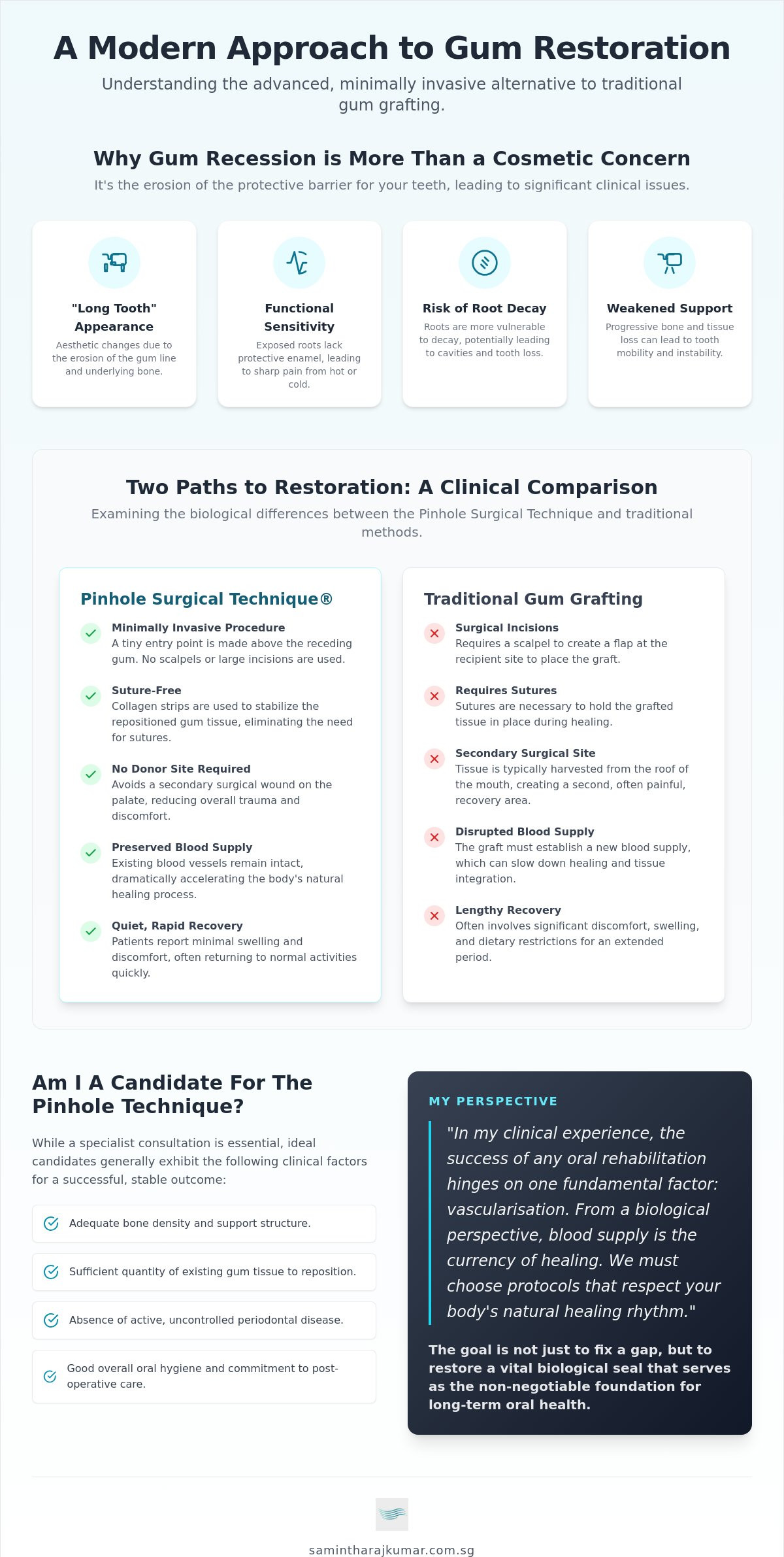
Periodontal recession is far more than a "receding hairline" for your teeth. It's the erosion of the protective gingival barrier that shields your dental roots from the harsh environment of the mouth. In my clinical experience, recession is rarely an isolated event. It's often the first visible sign of a deeper structural imbalance within the oral ecosystem. When patients sit in my chair and ask, "am I a candidate for pinhole gum surgery?" I always start by explaining that we aren't just fixing a gap. We're restoring a vital biological seal.
This seal is essential for protecting the underlying alveolar bone. When the gum tissue retreats, the bone often follows suit, leading to the aesthetic "long tooth" appearance. This isn't merely a concern for your mirror. Exposed roots lack the protective enamel of the crown, making them highly susceptible to functional sensitivity and rapid decay. A comprehensive approach to Understanding Gum Recession involves looking at both the structural loss and the long-term stability of the tooth.
To better understand the criteria for this procedure and see if you might be suitable, watch this helpful video:
The Science of Tissue Loss
From a biological perspective, tissue loss often stems from aggressive mechanical trauma or chronic inflammation. This disrupts the "biological width," the precise dimension of soft tissue that the body requires to maintain a healthy attachment to the tooth. For decades, traditional grafting remained the historical gold standard. It was effective, but it required a "donor site," usually the roof of your mouth. This added a layer of surgical trauma and a secondary recovery zone that many patients found daunting, leading them to delay necessary care.
Clinical Consequences of Delay
Delaying treatment carries heavy clinical costs that go beyond sensitivity. Without the gingival barrier, you face an increased risk of root caries and progressive tooth mobility as the supporting structures weaken. There's also a profound psychological toll. A declining smile often leads to a loss of confidence in social or professional settings. As a clinician and founder, I see gum health as the non-negotiable foundation for any successful cosmetic dentistry singapore. You cannot build a lasting aesthetic masterpiece on an unstable biological site. Addressing the root cause early is the only way to ensure functional excellence and long-term well-being.
The Biological Science of Healing: Pinhole vs. Grafting
In my clinical experience, the success of any oral rehabilitation hinges on one fundamental factor: vascularisation. From a biological perspective, blood supply is the currency of healing. Traditional grafting, while a reliable method for decades, often disrupts this currency. It requires a "donor site," typically the palate, which creates a secondary recovery zone. This means your body must manage two surgical wounds simultaneously, splitting its regenerative resources between the harvest site and the restoration site.
Many patients come to me asking, "am I a candidate for pinhole gum surgery?" because they are wary of this invasive double-trauma approach. The CHAO Pinhole Surgical Technique offers a sophisticated alternative by repositioning existing tissue through a tiny entry point, rather than using scalpels or sutures. We then use specialised collagen strips to facilitate rapid tissue stabilisation and growth. These strips act as a biological scaffold, encouraging your body to secure the new gum position without the need for external tissue transfers.
Vascularisation and Tissue Integration
The primary advantage of the Pinhole technique lies in the difference between primary and secondary healing. Because we don't sever the tissue's connection to the underlying bone, the existing blood supply remains intact. This preservation leads to significantly less post-operative swelling and a much faster integration period. In modern minimally invasive periodontics, we use advanced bio-materials to support this process, ensuring that the repositioned tissue receives immediate nourishment. This is particularly vital if the recession was originally caused by chronic Periodontal (Gum) Disease, where the tissue's health may already be compromised.
The Donor Site Factor
One of the most frequent complaints regarding traditional grafts is the "pizza burn" sensation on the roof of the mouth. This discomfort often outweighs the soreness at the actual site of the recession. By eliminating the need to harvest tissue from the palate, Pinhole surgery reduces the overall surgical footprint. This has a direct impact on your immune system’s recovery response. Instead of fighting on two fronts, your body can focus all its healing energy on a single, minimally disturbed area. This focus is what allows for the rapid, often overnight, recovery times that my patients value. Choosing a path that respects your body's natural rhythm is the first step, and understanding the biological foundation of your care ensures a more predictable result.
Clinical Comparison: Recovery Timelines and Expectations
Time is the most valuable asset my patients possess. When individuals ask me, "am I a candidate for pinhole gum surgery", they are often weighing the clinical benefits against the potential disruption to their professional and social lives. In my clinical experience, the recovery from Pinhole surgery is not just faster; it's a fundamentally different experience for the body than traditional grafting. The absence of scalpels and sutures transforms the post-operative phase from one of "healing a wound" to one of "nurturing a restoration."
The first 24 hours are focused entirely on stability and comfort. At Dr Samintharaj Kumar, we employ advanced protocols to minimise post-operative swelling, ensuring that the initial inflammatory response is controlled. While a traditional graft patient is managing a sutured donor site on the palate, a Pinhole patient is often surprised by the lack of traditional surgical pain. From Day 1 to 7, we enter the critical window for collagen integration. This is when the specialised collagen strips begin to anchor the repositioned tissue to the underlying bone. By the 48-hour mark, most of my Pinhole patients feel confident returning to social engagements, a feat rarely possible with conventional methods.
The Pinhole Recovery Milestones
The most rewarding moment for many patients is the immediate aesthetic improvement visible before they even leave the clinical suite. The "long tooth" appearance is corrected instantly as the gums are gently moved to their ideal position. Because there are no incisions, dietary restrictions are minimal; you can typically return to a relatively normal, albeit soft, diet within a day. The average downtime for Pinhole surgery is significantly shorter due to the lack of sutures, which eliminates the irritation and "pulling" sensation often associated with traditional gum repair.
The Grafting Recovery Milestones
Traditional grafting requires a more patient approach to the recovery calendar. There is usually a mandatory 2-week wait where we must carefully manage sutures and protect the delicate graft site from any movement. During this time, I recommend more stringent physical activity restrictions to prevent blood pressure spikes that could compromise the graft's blood supply. You will also notice a distinct aesthetic transition; the donor tissue may initially look slightly different in colour or texture as it integrates with the site. While this eventually blends, it requires a period of maturation that Pinhole surgery largely bypasses. Understanding these milestones is essential for choosing the path that aligns with your lifestyle and long-term health goals.
My Perspective: Choosing the Right Protocol for Stability
As a clinician and founder, I have always believed that the most successful surgical outcomes are those that respect the body’s natural rhythm. My philosophy at Nuffield Dental isn't merely about applying the latest technology; it's about clinical discernment. I prioritise procedures that offer the highest degree of stability with the least amount of biological cost. In my clinical experience, the best outcomes begin with understanding the root cause of recession, whether it's mechanical trauma, genetic predisposition, or the aftermath of periodontal disease. Without addressing the "why", any restoration is simply a temporary fix.
When a patient asks me, "am I a candidate for pinhole gum surgery", my assessment goes beyond the visual gap. I look for healthy bone levels and a stable oral environment that can support the repositioned tissue. Patient selection is the cornerstone of clinical mastery. For those who meet the criteria, Pinhole surgery is the ideal clinical choice because it avoids the inflammatory cascade triggered by larger incisions. This stability is particularly critical when we are integrating gum health into a wider dental implant singapore strategy. A dental implant is only as secure as the soft tissue envelope surrounding it; healthy, thick gums are the guardian of your long-term investment.
A Philosophy of Minimal Intervention
I've found that "less is more" in oral surgery often leads to far more predictable long-term results. By minimising trauma, we preserve the microscopic architecture of the tissue. In our practice, the role of AI and advanced diagnostics is central to this precision. We use high-resolution imaging to plan the exact movement of tissue before we even begin. This allows me to balance clinical mastery with patient comfort, ensuring that even the most complex procedures feel manageable and secure for the individual.
The Future of Periodontal Care
We are moving beyond the era of traditional "cutting and stitching" toward sophisticated regenerative techniques. Modern protocols like Pinhole surgery reduce the psychological barrier to seeking essential treatment, which is a significant victory for public health. My commitment to maintaining global standards in clinical excellence means constantly evolving our approach to include bio-materials that mimic natural tissue growth. I want my patients to feel that they aren't just undergoing a procedure, but are participating in a visionary programme of total oral rejuvenation. If you are ready to explore how these advanced protocols can protect your smile, understanding your specific needs is the first step toward lasting oral health.
Total Oral Rehabilitation: The Impact on Quality of Life
In my clinical experience, the most profound transformations I witness aren't just measured by millimetres of gum coverage, but by the restoration of a patient’s spirit. Healthy gums serve as the structural foundation for what I call the facial envelope. When gum tissue recedes, it doesn't just expose the roots; it compromises the soft tissue support of the lips and cheeks. This loss of volume often contributes to a prematurely aged appearance, where the lower third of the face begins to lose its youthful definition. Understanding the relationship between gum health and preventing facial collapse with dental implants is essential for anyone seeking a comprehensive approach to structural rejuvenation.
When patients ask me, "am I a candidate for pinhole gum surgery", they are often looking for a way to reclaim their confidence without the burden of traditional surgery. Restoring the gumline allows individuals to smile, speak, and eat without the constant hesitation or functional discomfort caused by sensitivity. From a biological perspective, we are doing more than correcting an aesthetic flaw; we are re-establishing a protective barrier that guards your systemic health. The right diagnosis and technique change everything for the patient journey, turning a source of anxiety into a catalyst for personal renewal.
Structural Harmony and Aesthetics
In the world of specialist dentistry, we often discuss "Pink Aesthetics." This refers to the symmetry, colour, and contour of the gums, which are just as vital to a beautiful smile as the teeth themselves. Even the most perfect ceramic crowns will look out of place if the gum architecture is uneven or receded. As a clinician and founder, I view gum restoration as a tool for achieving a balanced facial profile. By repositioning the tissue to its natural height, we create a harmonious frame that supports the teeth and enhances the overall vitality of the face. This synergy is the hallmark of high-tier oral rehabilitation.
Long-term Health and Longevity
Proactive, biological gum management is the most effective way to prevent future tooth loss. By addressing recession early through minimally invasive protocols, we preserve the alveolar bone and the integrity of the dental arch. There is also a well-documented systemic link between periodontal health and total body wellness; chronic inflammation in the mouth can have far-reaching consequences for your overall health. I believe that the best outcomes begin with a foundation of clinical trust and expertise, ensuring that your care is part of a long-term vision for longevity. My goal is to provide more than a procedure; I want to offer a legacy of health that allows you to age with grace and functional excellence. The best outcomes begin with understanding the root cause.
Restoring Your Smile with Biological Precision
Choosing between traditional grafting and modern Pinhole surgery is a decision that impacts both your immediate comfort and your long-term oral health. As a clinician and founder, I've seen how the CHAO Pinhole Surgical Technique transforms the patient experience by respecting the body's natural healing rhythm. By preserving the existing blood supply and eliminating the need for a secondary donor site, we achieve a stable, aesthetic result with minimal disruption to your life. This approach ensures that your gum restoration serves as a durable guardian for your teeth and facial structure.
Determining the answer to "am I a candidate for pinhole gum surgery" is the first step in a journey toward total oral rehabilitation. At Nuffield Dental, my focus remains on delivering specialist-led clinical excellence that prioritises functional aesthetics and patient well-being. I believe that every individual deserves a restoration that feels as natural as it looks. The best outcomes begin with understanding the root cause. Explore our approach to gum restoration.
I look forward to helping you rediscover the confidence of a healthy, vibrant smile through the power of modern biological dentistry. The right diagnosis changes everything.
Frequently Asked Questions
Is Pinhole surgery really less painful than traditional gum grafting?
Yes, Pinhole surgery is significantly more comfortable because it's a scalpel-free and suture-free technique. In my clinical experience, the primary source of pain in traditional grafting is the donor site on the palate. By eliminating the need to harvest tissue from the roof of your mouth, I can ensure a recovery that feels less like healing from surgery and more like a gentle tissue adjustment. Most patients only require mild over-the-counter relief for a day or two.
How long does the Pinhole procedure take to perform in a specialist setting?
In my specialist setting, the procedure typically takes between one and two hours to complete. The exact duration depends on the number of teeth requiring restoration and the complexity of the site. Because the technique is minimally invasive, I can often treat multiple quadrants in a single session. This efficiency is a core part of my approach to total oral rehabilitation, allowing you to achieve a comprehensive result in a single visit.
Will I need to take significant time off work after Pinhole gum surgery?
Most of my patients find they can return to work and social activities within 24 to 48 hours. Unlike traditional grafting, which often requires a week or more of downtime to manage sutures and swelling, the Pinhole technique causes minimal disruption. This rapid recovery is one of the most frequent reasons patients ask me, "am I a candidate for pinhole gum surgery." It allows you to prioritise your health without sacrificing your professional commitments.
Can Pinhole surgery be used for all types of severe gum recession?
Pinhole surgery is highly effective for many cases, but it isn't a universal solution for every type of severe tissue loss. From a biological perspective, we require a certain level of underlying bone support and healthy, infection-free tissue to ensure the repositioned gums stay in place. If your recession is caused by advanced periodontitis with significant bone loss, I may recommend traditional grafting or regenerative therapies to rebuild your foundation first.
How do the long-term results of Pinhole compare to traditional grafting?
Long-term clinical data indicates that Pinhole surgery offers tissue stability comparable to traditional grafting, with success rates often exceeding 90% over several years. The key to this longevity is the biological integration of the collagen strips I use to secure the tissue. Once these strips facilitate new attachment to the bone, the results are permanent as long as you maintain excellent oral hygiene and address any underlying mechanical causes of recession.
What is the cost difference between Pinhole surgery and grafting in Singapore?
The cost of Pinhole surgery is generally comparable to traditional grafting, though it involves specialised instruments and advanced bio-materials. While conventional grafting might seem less expensive initially, it often requires more follow-up appointments and a longer recovery period. In my practice, I view the investment in Pinhole surgery as a way to access a premium, minimally invasive experience that saves you time and reduces post-operative discomfort.
Can I have Pinhole surgery if I already have dental implants?
Yes, you can certainly undergo Pinhole surgery if you already have dental implants. In fact, I frequently use this technique to enhance the "pink aesthetics" and soft tissue health around existing implants. Healthy, thick gum tissue is vital for protecting the implant from bacteria and ensuring its long-term stability. It's a sophisticated way to refine your oral rehabilitation and protect the investment you've made in your smile.
What happens if I choose not to treat my receding gums now?
Choosing to delay treatment often leads to a progressive cycle of bone loss and root caries. As the protective gingival barrier retreats, your tooth roots become exposed to bacteria and temperature changes, leading to sensitivity and decay. In my clinical experience, early intervention is always the most predictable path. Ignoring recession now only makes future restoration more complex and invasive. The best outcomes begin with understanding the root cause today.

Comments