
Replacing Molars: Compare Implants, Bridges and Dentures

The best options for replacing molars include dental implants, fixed bridges and removable partial dentures. A missing molar can affect chewing, and nearby teeth may shift over time.
You may first want to fill the gap and restore a comfortable bite. Molars do much of the heavy chewing, so a missing tooth can also affect your bite and the teeth around it.
I’ll explain how implants, fixed bridges and removable partial dentures compare, including how each works in practice. I’ll also look at how a missing molar can affect chewing and tooth position, helping you understand the factors behind a considered replacement decision.
Table of Contents
Dental implants
I compare implants with bridges and partial dentures by looking at oral health, function and the surrounding teeth. If a damaged molar remains restorable, a root canal and crown may preserve it instead of replacing it.
Implant-Supported Crowns
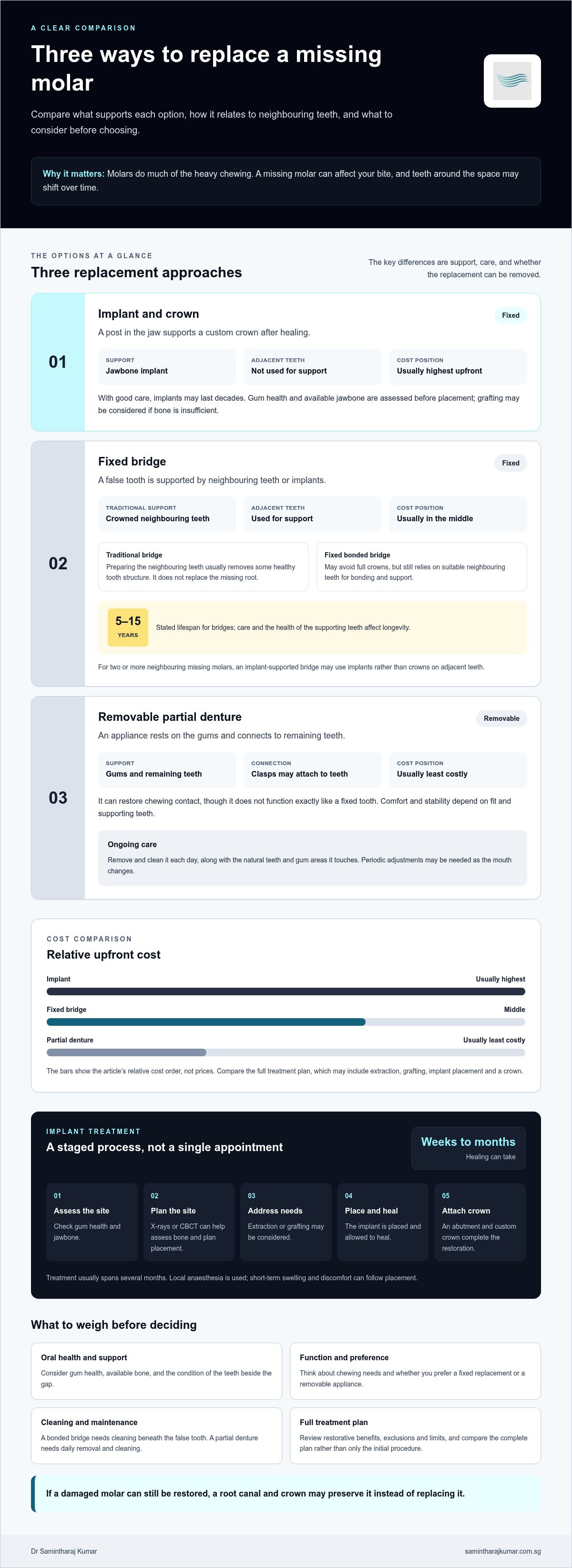
A molar implant consists of a post placed in the jaw and, after healing, an abutment and custom crown. Unlike a bridge, it does not rely on adjacent teeth for support; unlike a partial denture, it stays in place. There is no single success rate that applies to every patient. With good care, implants may last decades.
Bone and Gum Requirements
Before planning implant placement, a dentist assesses gum health and the jawbone at the missing tooth’s site. Active gum disease should be treated first. X-rays or a CBCT scan can help evaluate bone volume and plan placement. If there is not enough bone, grafting may be considered. Placing graft material during an extraction can help preserve the site for a future implant.
Implant Surgery and Recovery
Implant treatment is planned in stages: assess the site, address any extraction or grafting needs, place the implant, allow it to heal, then attach the crown. Local anaesthesia is used. Healing can take weeks to months, and treatment usually spans several months. Short-term swelling and discomfort can follow placement. Care instructions and simple pain control are used during recovery.
Implant Costs and Insurance
Implants usually have the highest upfront cost of these options, bridges fall in the middle, and partial dentures are usually least costly. A treatment plan may include extraction, grafting, implant placement and a crown. Review your policy’s restorative benefits, exclusions and limits, and compare the full treatment plan rather than only the initial procedure.
When considering the options, weigh gum health, available bone, adjacent teeth, chewing needs and budget.
Fixed dental bridges
I explain a fixed bridge as a false tooth supported either by neighbouring teeth or dental implants. If you’re looking for an affordable, qualified dentist, I recommend comparing treatment plans that clarify the supporting teeth, materials, care needs and overall cost.
Traditional Dental Bridges
A traditional dental bridge places a false tooth in the gap, supported by crowns on the teeth beside it. Preparing those neighbouring teeth usually involves removing some healthy tooth structure, so their condition matters. Unlike an implant, a traditional bridge does not replace the missing tooth’s root or prevent bone loss at that site.
A traditional design commonly uses two crowns to anchor the replacement tooth. Bridges are stated to last 5-15 years, although care and the health of the supporting teeth affect longevity. If a supporting tooth develops a serious, non-restorable cavity, extraction may mean the bridge can no longer remain in place.
Fixed Bonded Bridges
A fixed bonded bridge may be considered when natural teeth are present on both sides of the gap. It uses a metal or porcelain framework bonded to the backs of those teeth. Unlike a conventional bridge, it can avoid full crowns, but it still relies on neighbouring teeth for support.
Clean beneath the false tooth with a proxy brush or water flosser to remove trapped food and plaque. This type of bridge depends on suitable teeth for bonding, so their position and condition are important when assessing whether they can support the replacement.
Implant-Supported Bridges
An implant-supported bridge may be considered for two or more neighbouring missing molars when implants can support the replacement. It uses implants rather than crowns on adjacent teeth for support, unlike a traditional bridge.
I also explain how this fixed bridge differs from implant-supported dentures, which may be removable. The design depends on the number and position of missing teeth, available bone and cleaning needs. I consider these factors when assessing molar replacement options.
Removable partial dentures
A removable partial denture replaces one or more missing molars when other natural teeth remain. It rests on the gums and connects to remaining teeth, often with clasps. Unlike a fixed bridge, it can be removed for cleaning. It may suit someone seeking a less costly replacement, but comfort and stability depend on its fit and supporting teeth.
For example, a partial denture can fill a gap at the back of the mouth while preserving natural teeth elsewhere. It can restore chewing contact, though it does not function exactly like a fixed tooth. A dentist assesses the gap, gums and remaining teeth, then designs the appliance to fit around them.
Because the mouth can change, a removable partial denture may need periodic adjustments. Changes in fit can affect how it rests on the gums or connects to teeth. If chewing feels uncomfortable or the denture moves, arrange a dental assessment rather than trying to reshape it yourself.
Complete dentures serve a different purpose: they replace a full set of teeth in an arch, while partial dentures fit around remaining natural teeth. Neither is fixed like a bridge. Traditional dentures may loosen over time, making eating and speaking more difficult, and can contribute to bone shrinkage and deterioration of muscle tissue.
Daily cleaning is essential for partial denture care. Remove and clean the appliance each day, along with the natural teeth and gum areas it touches. This helps clear food trapped around clasps and beneath the denture, where debris can collect against remaining teeth.
When comparing a removable partial denture with a bridge or implant, consider more than the initial expense. Think about whether you prefer a removable appliance, the condition of the teeth that would support it, and whether you can clean it consistently. A dentist can assess the fit and advise whether it needs adjustment as your mouth changes.
Effects of a missing molar on chewing and neighboring teeth
Molars handle much of the forceful chewing, so losing one can change how you use your bite. You may favour the opposite side or avoid foods that are difficult to chew. This can place extra stress on the teeth still doing the work.
A missing molar can affect more than chewing. Adjacent teeth may drift into the gap, creating crowding, instability and areas that are harder to clean. Food trapped between shifted teeth can contribute to sensitivity or cavities. The opposing tooth may also move downwards when it no longer meets another tooth during biting.
Bone changes also matter. Without normal chewing force through the missing tooth’s root, the jawbone at that site can shrink. A traditional bridge replaces the visible tooth but not its root, while a dental implant can help maintain bone width and height. These differences are among the factors considered when planning a replacement.
People sometimes delay treatment because replacement seems expensive or the gap feels manageable. Consider whether chewing has changed, or whether teeth are moving or food is getting trapped. A dentist can assess your bite, neighbouring teeth and bone, then compare a bridge, implant or removable partial denture based on those findings.
A partial denture is removable, so daily cleaning includes both the appliance and the teeth it contacts. A fixed option does not need to be taken out, but each design has different support and care needs. Keep the gap and any areas where food gets trapped clean, and attend dental reviews if your bite changes.
For a first molar, which carries substantial chewing force, the functional impact may differ from a far-back tooth without an opposing partner. Note which foods feel harder to manage and whether you favour one side. To discuss how a missing molar affects your bite, arrange a dental assessment.
Dr Samintharaj Kumar: Ceramic Dental Implants
Ceramic Dental Implants with Dr Samintharaj Kumar offer a tooth-replacement option to consider when a missing molar affects chewing or the surrounding bite. In my clinical experience, the first step is understanding the whole site, including gum health, available jawbone, adjacent teeth and how your teeth meet.
An implant-supported crown replaces the missing tooth without relying on neighbouring teeth for support. Whether this approach is suitable depends on the condition of the site and your wider dental needs. Dr Samintharaj Kumar assesses these factors before discussing a treatment plan, so the decision considers function and long-term oral health, not just the visible gap.
If you’re weighing replacement options for a missing molar, contact Dr Samintharaj Kumar to discuss your situation.
Make your next decision with clarity
The best options for replacing molars are not simply the treatments that fill a gap. Start by considering what your bite needs, how the surrounding teeth are coping and what matters most to you over time. This helps turn a broad comparison into a considered treatment decision.
My work includes Dental Implants and Ceramic Dental Implants. For people facing more extensive tooth loss, full-arch rehabilitation and same-day restorations may also be relevant. Each approach serves a different clinical situation, and suitability depends on the condition of your teeth, gums and jawbone.
If you’re ready to explore your options, contact Dr Samintharaj Kumar to discuss your dental needs. A thoughtful plan starts with understanding the whole picture, and that is a positive first step towards restoring comfort and function.
Frequently Asked Questions
What Are the Tooth Replacement Options Available?
The main choices are to preserve a damaged tooth, replace an individual tooth, or replace several teeth together. A restorable molar may be treated with a root canal and crown; a missing tooth can be replaced with an implant, bridge or partial denture. If an entire arch has lost its teeth, complete dentures or implant-supported full-arch treatment may be considered. The best options for replacing molars depend on the extent of tooth loss and your oral health.
What are the options for replacing a missing molar?
For a missing molar, options include an implant with a crown, a fixed bridge or a removable partial denture. The tooth’s location matters: a missing wisdom tooth that had no useful opposing tooth generally does not need replacement. For another molar, consider whether it meets an opposing tooth during chewing and whether the gap affects your bite or traps food.
How do dental implants, bridges, and partial dentures compare for replacing molars?
The options differ in how they are supported and maintained. An implant replaces the tooth independently, a conventional bridge relies on neighbouring teeth, and a partial denture can be removed for cleaning. If adjacent teeth are healthy, preserving them may be a factor when comparing designs. Also consider daily cleaning habits, comfort preferences and the condition of the jawbone.
How much does a molar implant, bridge, or partial denture cost in the United States?
There is no single cost that applies to every United States treatment plan. In general, implants have the highest upfront cost, bridges fall in the middle, and removable partial dentures are usually least costly. The total depends on the treatment required, such as extraction, grafting, the number of replacement teeth and the final restoration. Compare written treatment plans by the steps included, not just the initial procedure.
Does dental insurance cover molar replacement, and what are typical coverage limits?
Coverage and limits depend on the terms of your dental plan, so there is no universal limit to quote. Review the policy’s benefits for implants, bridges and dentures, along with exclusions, annual maximums, waiting periods and any pre-authorisation requirements. Check how the plan treats each stage, such as extraction and restoration, as benefits may differ by procedure. The policy document is the clearest guide to your coverage.
How does a dentist decide between an implant, bridge, and partial denture?
A dentist considers gum health, available jawbone, the condition of adjacent teeth and how your bite functions. Imaging can help assess bone and plan implant placement; active gum disease needs treatment before replacement decisions. The number and position of missing teeth matter too. For example, a bridge depends on suitable supporting teeth, while a removable partial denture must fit around the teeth that remain.


Comments