
Restoring Facial Volume with Dental Reconstruction: A Surgeon’s Perspective on Structural Rejuvenation

If you've noticed your cheeks appearing sunken or your jawline losing its once-defined edge, you might assume that skin-deep treatments are the only solution. However, in my clinical experience, these changes are often symptomatic of a deeper structural issue: the gradual loss of bone and dental support. Restoring facial volume with dental reconstruction is about more than just a beautiful smile. It's about rebuilding the architectural scaffold that supports your entire face. I understand how distressing it is to see premature wrinkles or thinning lips that don't reflect how you feel inside.
From a biological perspective, when we lose teeth, the underlying bone begins to resorb, causing the lower face to physically shorten and collapse. In this article, I'll explain the science behind this process and how advanced restorative techniques provide a permanent, stable foundation. We will explore how modern protocols achieve structural harmony to restore your natural proportions and facial balance. My goal is to help you understand how we can return the confidence in your appearance and the functional excellence you deserve through a long-term, visionary approach to care.
Key Takeaways
Discover why facial aging often stems from underlying bone resorption rather than just skin laxity, and why identifying this root cause is essential for lasting rejuvenation.
Learn the science of restoring facial volume with dental reconstruction by using dental implants that act as biostimulators to preserve and maintain your jawbone's structural integrity.
Understand my clinical philosophy of viewing full-arch rehabilitation as a form of "internal plastic surgery" that provides the necessary scaffold for facial muscles and skin.
Explore advanced surgical protocols, such as Zygomatic and Pterygoid implants, which allow for successful restoration even in cases of severe bone atrophy.
Gain insights into why choosing a specialist with a background in complex oral and maxillofacial protocols is vital for achieving a harmonious and predictable outcome.
Table of Contents
The Hidden Architecture: How Tooth Loss Triggers Facial Collapse
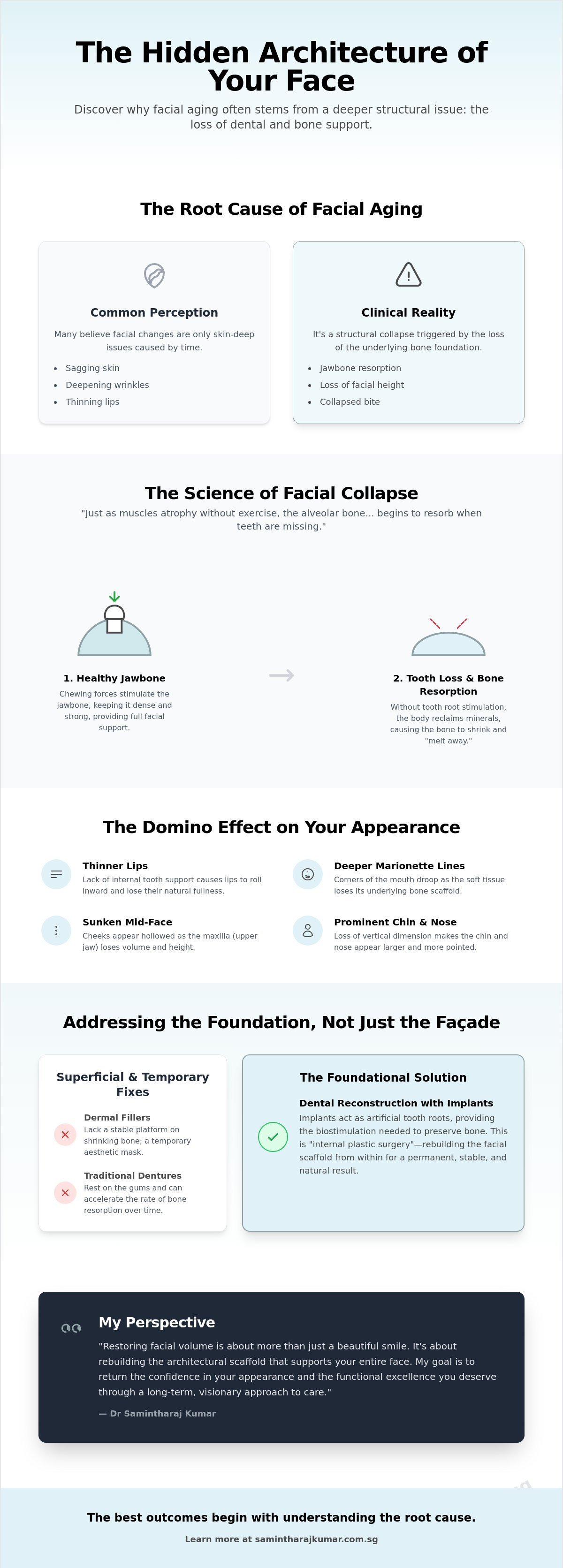
In my clinical experience, patients often visit me concerned about sagging skin or deep folds around the mouth, attributing these changes solely to the natural passage of time. While skin elasticity does decrease with age, the most profound changes often occur beneath the surface. What many perceive as simple ageing is actually a clinical condition known as facial collapse. This phenomenon involves a significant loss of vertical dimension and bone height, typically triggered by The Hidden Architecture: How Tooth Loss Triggers Facial Collapse, which fundamentally alters the skeletal support of the face.
From a biological perspective, our jawbone is living tissue that requires constant mechanical stimulation to remain healthy. Just as muscles atrophy without exercise, the alveolar bone that surrounds your teeth begins to resorb when those teeth are missing. Without the functional load of chewing, the body essentially reclaims the minerals from the jaw, leading to a visible sunken appearance in the mid-face. This is where the role of restoring facial volume with dental reconstruction becomes vital. We aren't just replacing teeth; we're preserving the very foundation of your facial features.
To better understand how these structural changes impact your appearance, watch this helpful video:
The visible consequences of this bone loss are often quite distressing for patients. Common indicators include:
Lips that appear significantly thinner due to a lack of internal support.
Deepening marionette lines and folds around the corners of the mouth.
A sunken mid-face appearance that makes the nose and chin appear more prominent.
Increased facial tension and discomfort in the jaw joints.
These aren't just aesthetic concerns; they're signals that the structural harmony of your face is shifting. When the underlying bone is gone, the soft tissues have nothing to drape over, resulting in the characteristic collapse that many mistake for a purely dermatological issue.
The Domino Effect of Bone Resorption
The loss of even a single tooth can trigger a destructive chain reaction. Once the root is gone, the surrounding bone begins to melt away, often affecting the stability of adjacent teeth. In my practice, I frequently see how traditional dentures can actually accelerate this process. Because they sit on top of the gums and apply constant, unnatural pressure, they can speed up bone resorption rather than preventing it. This is why dermal fillers often fail to provide a lasting solution. You can't fix a foundation problem by simply painting the walls. If the underlying bone is missing, fillers have no stable platform to rest upon, making restoring facial volume with dental reconstruction the only definitive long-term path.
Identifying the 'Collapsed Bite' Syndrome
Another critical factor is the collapsed bite, where a reduced bite height affects the muscles of mastication and creates chronic facial tension. When your teeth no longer meet at the correct height, your jaw must over-close, which puts immense strain on the TMJ and surrounding tissues. This loss of occlusal precision can make the face look shorter and more aged. Achieving structural accuracy is paramount, and I often refer to my perspective on how dentists measure bite alignment to ensure we're rebuilding your smile on a mathematically sound foundation. The goal is to restore the resting position of the jaw to its natural, youthful state.
Reconstructing the Foundation: Permanent Solutions for Volume Loss
To address the skeletal deficit I discussed previously, we must look at solutions that integrate with the body on a cellular level. In my clinical experience, dental implants are the only intervention that truly acts as a biostimulator. By mimicking the function of natural tooth roots, they signal the jawbone to remain dense and strong, effectively halting the resorption process. This is the cornerstone of restoring facial volume with dental reconstruction; we're essentially engineering a permanent scaffold that supports your face from the inside out.
From a biological perspective, I frequently favour ceramic dental implants for this task. While titanium has long been the industry standard, zirconia offers a level of biocompatibility and aesthetic integration that is superior for the smile zone. These materials don't just look like natural teeth. They encourage healthier gum attachment, which is vital for long-term stability and maintaining the natural contours of your cheeks and lips. When we rebuild the dental arch, we're providing the necessary projection to smooth out fine lines and restore the youthful fullness that bone loss often takes away.
Ceramic Implants and Tissue Health
The choice of material has a profound impact on the final aesthetic. Unlike metal alternatives, zirconia is naturally white and opaque, which eliminates the risk of a grey line appearing at the gum margin over time. This is particularly important for patients with thin gum tissue. Because ceramic is highly resistant to plaque accumulation, it promotes exceptional tissue health. This ensures that the soft tissues around the implant remain vibrant and supportive, contributing to an overall sense of facial harmony that feels entirely natural.
All-on-4: Restoring the Vertical Dimension
For patients facing more extensive tooth loss, protocols like All-on-4 are transformative. These systems allow us to restore the entire lower third of the face by strategically tilting implants to maximise existing bone. This often bypasses the need for extensive bone grafting, which can be a significant relief for many. By re-establishing the correct vertical dimension, we provide immediate structural support for the lips and cheeks. Choosing the Right Specialist for Complex Reconstruction is essential here, as it requires a deep understanding of both oral and maxillofacial anatomy to ensure the new teeth align perfectly with your facial midline.
The transition from a temporary to a final prosthesis is a journey of refinement. We meticulously adjust the bite and the volume of the restoration to ensure it complements your unique facial features. If you are curious about how these advanced protocols might apply to your situation, understanding the root cause of your structural changes is always the first step toward a successful and lasting transformation.
My Perspective: The Intersection of Oral Surgery and Facial Aesthetics
As a clinician and founder, I don't see my role as merely fixing teeth. I see it as restoring the architectural integrity of the human face. In my clinical experience, the most successful outcomes occur when we stop treating the mouth in isolation. When I'm restoring facial volume with dental reconstruction, I'm essentially performing a form of 'internal plastic surgery'. We're rebuilding the skeletal scaffold that dictates how your skin drapes and how your muscles move. It's a holistic puzzle where the TMJ, the masticatory muscles, and the dermal layers must all be considered simultaneously to achieve a result that looks as natural as it feels.
A truly visionary approach to care requires looking past the surface. While dental implants provide the hard-tissue support, we must also address the soft-tissue environment. For instance, chronic bruxism can overwork the masseter muscles, leading to a widened, squared jawline that detracts from a rejuvenated appearance. In such cases, I often integrate Botox for teeth grinding as a secondary tool. This helps relax the neuromuscular system, allowing the new dental structure to settle while softening the facial profile. My philosophy is simple: the right diagnosis changes everything. We must start with the bone, not the surface.
The Role of Non-Surgical Rejuvenation
Once we've established a stable foundation, we can look at the finishing touches. I often integrate facial aesthetic rejuvenation with our complex surgical plans to provide a comprehensive transformation. This isn't about overfilling or creating an artificial look. It's about using aesthetic treatments to complement the new dental structure. By balancing functional excellence with natural-looking beauty, we ensure that the lips and cheeks are perfectly supported by the underlying reconstruction. This synergy between surgery and aesthetics is what defines a high-tier clinical outcome.
Visionary Care: AI and Precision Diagnostics
Achieving this level of precision requires the best technology available. We utilize 3D CBCT imaging to map your existing bone architecture with sub-millimetre accuracy. This allows us to explore various surgical options for facial reconstruction before we even begin the procedure. By employing AI-assisted diagnostics, we can predict the facial outcome post-reconstruction with remarkable clarity. This digital workflow ensures that every implant is placed with the final facial proportion in mind. It removes the guesswork, replacing it with a predictable, science-led path toward restoring facial volume with dental reconstruction.
Case Study: Restoring Volume in Severe Bone Atrophy
I recently treated a patient who had lived with total tooth loss for over two decades. The mid-face collapse was significant; the upper lip had virtually disappeared into the mouth, and the cheeks lacked any projection. Conventional dentures were no longer an option because the alveolar bone had resorbed almost entirely. This case illustrates the profound impact of restoring facial volume with dental reconstruction when standard methods fail. In my clinical experience, these patients often feel they've reached a dead end, but modern surgical innovation offers a predictable way back to both function and aesthetics.
My strategy for this case was to bypass the missing jawbone entirely. Instead of months of painful bone grafting, we utilised Zygomatic and Pterygoid implants. These advanced systems anchor into the denser, stable bone of the cheek and the back of the skull. This approach allowed us to rebuild the skeletal foundation in a single day, providing the necessary projection to lift the soft tissues of the mid-face. The transformation wasn't just about teeth; it was about reclaiming the patient's natural facial proportions.
Step 1: The Comprehensive Evaluation
We began with a high-resolution 3D CBCT scan to map the remaining skeletal structure with sub-millimetre precision. It's essential to assess the degree of bone resorption and the current state of the TMJ before any surgical intervention. Using digital smile design protocols, we mapped out the new facial proportions. This allowed us to show the patient exactly how the reconstruction would support her lips and cheeks. Ensuring clinical and aesthetic alignment at this stage is vital for a successful outcome.
Step 2: The Surgical Execution
The surgery involved the precise placement of Zygomatic implants into the cheekbones to provide a rock-solid foundation. By utilising these stable structures, we achieved the immediate stability required for a Teeth in a Day procedure. This meant the patient could leave the clinic with a fixed, functional set of teeth. I also paid close attention to managing the soft tissue, ensuring a seamless transition between the natural gums and the new prosthesis for a truly lifelike result.
Step 3: The Final Transformation
The delivery of the final bridge was a pivotal moment. This prosthesis was meticulously designed to restore natural lip support and cheek volume, effectively reversing the "sunken" look. The long-term impact on the patient's quality of life was profound. She regained her self-esteem and the ability to eat and speak without hesitation. Reflecting on this case, the principle is clear: structural support is the true key to facial rejuvenation. If you're facing similar challenges, understanding your surgical options is the first step toward a transformative result.
Choosing the Right Specialist for Complex Reconstruction
When we discuss restoring facial volume with dental reconstruction, we're moving beyond the scope of general dentistry. This level of rehabilitation requires a surgeon who understands the deep skeletal architecture of the face. In my clinical experience, the difference between a functional success and a truly life-changing aesthetic outcome lies in the surgeon's mastery of both oral and maxillofacial protocols. Institutional heritage and a commitment to global standards are not just accolades. They are guarantees of safety and quality. I believe that a surgeon who acts as an educator and innovator in the field brings a level of meticulous care that generalist practices simply cannot match. Board certification and a proven track record with Zygomatic implants are non-negotiable benchmarks for this level of work.
Questions to Ask Your Surgeon
Before committing to a complex procedure, it's vital to vet your specialist's experience thoroughly. You should inquire about their specific history with full-mouth rehabilitation and severe bone loss cases. Ask if they've handled patients involving significant mid-face collapse. Inquire about the longevity and biocompatibility of their chosen materials. In my clinical experience, zirconia is the gold standard for those seeking a metal-free, highly aesthetic result that integrates seamlessly with the body. You should also understand the technology behind the diagnosis. We use sub-millimetre 3D mapping to ensure every implant is placed with absolute accuracy. If a clinic isn't using AI-assisted diagnostics, they're missing a critical layer of safety and predictability. Precision matters.
The Patient Journey at Nuffield Dental
As a clinician and founder, I've built Nuffield Dental on a foundation of technical excellence and compassionate care. We understand that the decision to undergo surgery is often accompanied by anxiety. That's why our rhythm of care is steady and reassuring. From the initial 3D scan to the final delivery of your new smile, we guide you with measured confidence. Our commitment to biological dentistry means we consider your overall well-being, not just your oral health. We aren't just building teeth. We're rebuilding a legacy of health. We use advanced digital workflows to ensure your results are both functional and harmonious. The transformation we aim for is profound. It's about a rejuvenated face and a restored sense of self.
Structural rejuvenation is a significant journey. It requires a visionary approach that respects the biological complexity of the human face. By focusing on restoring facial volume with dental reconstruction, we address the skeletal root cause of ageing rather than just the surface symptoms. This long-term thinking prioritises your quality of life and functional excellence for years to come. The right diagnosis changes everything. The best outcomes begin with understanding the root cause.
Reclaiming Structural Harmony for Lasting Rejuvenation
As a clinician and founder, I've seen how structural support defines the human face. True rejuvenation isn't found in surface-level treatments. It's found in rebuilding the bone and dental foundation that supports your unique features. We've explored how advanced protocols like Zygomatic implants and All-on-4 provide a permanent scaffold for the cheeks and lips. By prioritising ceramic dental implants and utilising AI-assisted diagnostics, we ensure every restoration is as biocompatible as it is precise. Restoring facial volume with dental reconstruction is a profound journey of renewal that goes beyond aesthetics. It's about functional excellence and the confidence to live without compromise. The future of your facial harmony depends on addressing the root cause today.
Your journey toward a restored, youthful profile begins with a commitment to excellence and a specialist who understands the intricate architecture of your smile. I look forward to helping you rediscover your confidence.
Frequently Asked Questions
Can dental implants really make me look younger?
Yes, dental implants can significantly rejuvenate your appearance by providing the essential internal support your facial soft tissues require. When teeth are lost, the jawbone resorbs, causing the lower face to collapse and appear prematurely aged. In my clinical experience, restoring facial volume with dental reconstruction fills out the lower third of the face, lifting the cheeks and lips back to a more youthful and natural position.
What is the difference between a facelift and dental reconstruction for volume loss?
A facelift primarily addresses skin laxity by tightening the surface layers, whereas dental reconstruction restores the underlying skeletal volume. If your facial aging is caused by bone loss in the jaw, a facelift may look unnatural because the foundation remains missing. From a biological perspective, we must rebuild the hard tissue scaffold first to ensure that any soft tissue changes appear balanced and harmonious.
Is dental reconstruction possible if I have been told I have 'no bone' left?
Yes, advanced surgical protocols now allow us to help patients who were previously told they were not candidates for implants. By utilising Zygomatic dental implants, we can anchor the restoration into the stable bone of the cheekbones. This technique bypasses the need for extensive bone grafting in the upper jaw. In my practice, we specialise in these complex cases to ensure every patient has a permanent solution.
How long does the process of restoring facial volume take?
The initial structural transformation can often occur in a single day through our "Teeth in a Day" protocol. This provides immediate support for your facial features. However, the full biological integration of the implants usually takes three to six months. During this period, we refine the final prosthesis to ensure the most precise fit and optimal aesthetic outcome for your unique and individual facial proportions.
Will dental implants help with wrinkles around my mouth?
Yes, dental implants help reduce the appearance of marionette lines and perioral wrinkles by providing necessary projection to the lips. When the teeth and bone are missing, the skin around the mouth folds inward. By restoring facial volume with dental reconstruction, we push the soft tissues back into their original position. This naturally smooths out deep folds and restores a fuller, more youthful lip contour for the patient.
Are ceramic implants better for restoring facial aesthetics than titanium?
Ceramic implants offer distinct aesthetic advantages, particularly in the "smile zone," because of their natural white colour and superior biocompatibility. Unlike titanium, zirconia does not show through thin gum tissue as a dark shadow or grey line. These materials encourage healthy gum attachment, which is essential for maintaining the natural, plump contours of the soft tissues around your new teeth over the long term.
How do I know if my facial aging is caused by my teeth?
You may notice your chin appearing closer to your nose or your lips losing their fullness despite using dermal fillers. These are classic signs of a reduced vertical dimension caused by tooth loss or worn-down teeth. As a clinician and founder, I recommend a 3D CBCT scan to accurately assess your bone levels. This diagnostic step confirms whether your aesthetic concerns stem from a skeletal foundation deficit.
What is the recovery time for a full-mouth reconstruction?
Most patients return to their normal daily routines within a few days, though initial soft tissue healing takes about one to two weeks. You might experience some swelling or bruising, which is a natural part of the surgical healing process. While you will have functional teeth immediately, I advise a softer diet for the first few months while the implants undergo osseointegration and integrate fully with your jawbone.


Comments