
Talking to Your Partner About the Cost of Dental Implants: A Surgeon’s Perspective
- Dr Samintharaj Kumar

- Jul 9
- 12 min read
Choosing to invest in dental implants isn't a discretionary lifestyle purchase; it's a critical decision for your future biological stability. In my clinical experience, many patients hesitate because they're anxious about talking to your partner about the cost of implants, fearing they might seem self-indulgent or financially reckless. It's completely natural to feel protective of your family's financial security, especially when a clinical solution is positioned at a premium level.
I understand that explaining complex surgical needs to a loved one can be daunting. I've written this guide to help you frame this decision as a vital health necessity rather than a cosmetic luxury. You'll learn how to articulate the science of bone preservation and the long-term ROI of oral health. My goal is to give you the confidence to discuss these technical needs clearly, ensuring your partner understands why this investment is essential for your long-term well-being and functional excellence. By the end of this article, you'll have a clear strategy to move forward with a partner who is fully supportive of your restorative journey.
Table of Contents
The Financial Conversation: Moving from Price to Value
In my clinical experience, the initial "sticker shock" is often the first hurdle patients face when considering restorative surgery. It is a natural reaction. Specialist dental implantology involves advanced diagnostics, high-tier materials, and a level of surgical precision that carries a significant entry point. However, as a clinician and founder, I encourage you to shift your perspective. There is a fundamental difference between a price and an investment. A price is a one-time transaction for a commodity; an investment is a deliberate choice to protect a biological asset that yields health dividends for decades.
To help clarify the distinction between immediate costs and long-term confidence, I recommend watching this brief explanation of the patient journey:
Total oral rehabilitation is not merely about filling a gap in your smile. It requires a sophisticated clinical approach that respects the principles of Biological Dentistry. This philosophy focuses on how your oral health impacts your entire systemic wellness. When we utilise high-quality protocols, as detailed in this Dental Implant Overview, we aren't just replacing teeth. We are restoring the structural integrity of your jaw and preventing the cascade of health issues that follow tooth loss.
Why this conversation is essential for your recovery
I have observed that talking to your partner about the cost of implants is about more than just the family bank balance. It is about emotional alignment. Clinical data suggests that patients with strong domestic support systems experience lower post-surgical stress levels. This physiological calm directly improves the speed of healing and the success of osseointegration. By being transparent about the financial commitment, you're inviting your partner to be a stakeholder in your longevity. It's a proactive step toward ensuring you can both enjoy a high quality of life as you age together.
Identifying the "Hidden Costs" of cheaper alternatives
Choosing a lower-cost, temporary fix often leads to financial leakage over time. Temporary solutions frequently result in:
The recurring expense of denture adhesives and professional relines.
The cost of replacing bridges or dentures every five to seven years.
The emotional toll of lost confidence during social interactions.
Dietary restrictions that lead to poor nutritional intake and systemic decline.
From a biological perspective, dental implant singapore provides a permanent, biocompatible solution that integrates with your bone, effectively halting the "hidden" cost of progressive bone loss. The best outcomes begin with understanding the root cause of these long-term expenses.
The Biological Perspective: What Happens if You Delay?
Delaying tooth replacement is a gamble with your anatomy. In my clinical experience, the most profound changes happen beneath the surface, where the eye cannot see. Alveolar bone resorption begins almost immediately after a tooth is extracted. Without the functional stimulation of a root, the jawbone effectively "forgets" its purpose and begins to shrink. This process is silent but relentless. When talking to your partner about the cost of implants, it helps to frame the procedure as a way to stop this bone loss before it compromises your entire facial profile.
A single missing tooth can destabilise your entire arch. Healthy adjacent teeth will naturally tilt and drift toward the empty space, creating "food traps" and misaligning your bite. This instability often leads to further tooth loss and chronic TMJ discomfort. There is also the systemic dimension to consider. Chronic oral inflammation is a known risk factor for cardiovascular issues. The mouth is the gateway to the body, and its health is inextricably linked to your heart and metabolic systems. As a clinician and founder, I prioritise long-term wellness, which is why I often point patients toward resources like the FDA on Dental Implant Safety to understand the rigorous standards we uphold.
Structural Rejuvenation and Facial Harmony
Your teeth provide the essential scaffolding for your face. When bone is lost, the distance between your nose and chin decreases, resulting in the "collapsed bite" look that ages a person prematurely. Implants serve as internal pillars, supporting the soft tissues of the lips and cheeks. I've detailed this in my article on how dental structure affects face shape, which illustrates how we achieve facial harmony through meticulous restoration. By replacing the root, we maintain the bone height and prevent the skin from sagging, effectively providing a natural, internal "lift."
The "Cost of Inaction" framework
The "wait and see" approach is often the most expensive strategy in dentistry. Talking to your partner about the cost of implants is also a discussion about risk management. If you wait until the bone has significantly receded, you may require a sinus lift surgery or a complex bone graft to restore the foundation. Early intervention allows us to utilise the bone you already have, making the process simpler and more predictable. From a biological perspective, maintaining your natural jawbone density is far more efficient than trying to rebuild it years later. The right diagnosis changes everything.
Comparing Clinical Solutions: Ceramic vs. Titanium
Material selection is a pivotal part of the restorative journey. While titanium has been the industry standard for decades, many of my patients now seek Ceramic Dental Implants as a premium, metal-free alternative. From a biological perspective, zirconia is highly inert and offers exceptional biocompatibility. This is particularly relevant when we consider the "smile zone." Zirconia’s tooth-coloured appearance ensures there is no dark metallic shadow at the gum line, providing a superior aesthetic outcome that mimics natural dentition. Choosing the right material is a fundamental step in ensuring your body accepts the restoration seamlessly.
When talking to your partner about the cost of implants, it helps to ground the conversation in clinical reality rather than just preference. I often suggest reviewing the FDA information on dental implant safety and materials to understand the rigorous standards we uphold. For more complex cases where jawbone density is a significant concern, I may recommend Zygomatic or Pterygoid protocols. These specialised implants anchor into the denser bone structures of the cheek or the back of the jaw. By utilizing these advanced techniques, we can often bypass the need for extensive bone grafting, which streamlines the surgical process and provides a stable foundation for those who might have been told they aren't candidates for traditional implants.
The All-on-4 Protocol: Efficiency and Value
If you are facing the loss of an entire arch, individual implants may not be the most efficient or cost-effective route. In my clinical experience, all on 4 dental implants offer a strategic solution that balances clinical excellence with long-term value. This protocol uses just four precisely angled implants to support a full bridge of teeth. Our "Teeth in a Day" philosophy means you can leave the clinic with a functional, temporary smile on the same day as your surgery. This approach significantly reduces surgical time and the physical recovery period, allowing you to return to your daily life with immediate confidence.
Biological Dentistry and Patient Choice
As a clinician and founder, I believe in empowering patients with choices that align with their personal health philosophies. Some patients prefer ceramic for its non-corrosive properties, especially if they have known sensitivities to metals or a preference for holistic materials. It's a key point when talking to your partner about the cost of implants; you're choosing a material that will remain part of your anatomy for a lifetime. Zirconia implants resist plaque accumulation better than titanium, which can simplify long-term maintenance and reduce the risk of peri-implantitis. Ultimately, the material we choose should reflect your health priorities and your desire for functional excellence.
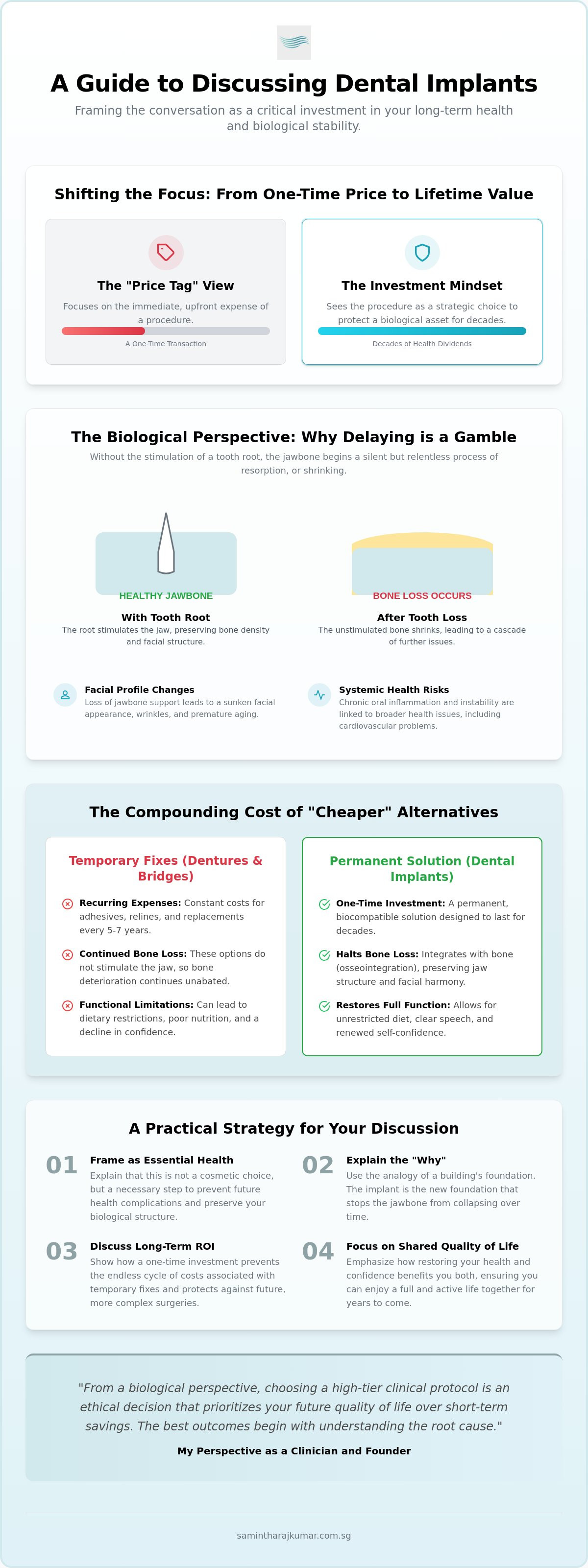
Practical Strategies for the Discussion
In my clinical experience, the success of a patient's journey often begins in the living room, long before they step into my theatre. Talking to your partner about the cost of implants is most effective when approached with a strategy of transparency and shared goals. I recommend choosing a neutral time and space for this dialogue. Avoid bringing it up during high-stress moments or immediately after a long workday. Instead, frame the conversation around your long-term health vision. By focusing on functional outcomes, such as your desire to eat nutritious foods without pain or to speak with clarity during social gatherings, you shift the focus from a financial burden to a pursuit of wellness.
I find that bringing clinical data to the table helps remove the emotional weight of the "sticker shock." Share brochures, clinical studies, or specialist articles that explain the technical necessity of the procedure. This establishes credibility and shows that your decision is based on medical requirements rather than a whim. If the conversation feels stalled, I often suggest inviting your partner to your next appointment. Hearing a specialist’s diagnosis directly can help a loved one understand the complexity of the surgery and the precision required for a successful outcome.
Framing the ROI: Quality of Life vs. Monthly Expenses
It is helpful to compare the financial commitment of dental restoration to other significant life investments. Most families wouldn't hesitate to spend a similar amount on a reliable car or a home renovation, yet a vehicle rarely lasts more than a decade. A well-maintained dental implant is designed to have a 20 to 30 year lifespan. When you amortise the cost over two or three decades, the daily investment in your health is remarkably modest. Beyond the numbers, consider the psychological ROI. The return of self-esteem and the ability to engage in social life without hiding your smile is a dividend that is difficult to quantify but impossible to ignore.
Involving the Specialist in the Financial Dialogue
A formal clinical consultation serves as an educational bridge for both you and your partner. It allows us to clarify why certain surgical fees are necessary, such as the use of advanced AI-assisted diagnostics or premium biocompatible materials. I encourage couples to use resources like my teeth in a day procedure explained guide to visualise the sophisticated steps involved in total rehabilitation. Preparing a list of questions together before the visit ensures that both of your concerns are addressed. This collaborative approach transforms the process from a solo struggle into a shared family mission. To begin this collaborative journey, you may wish to schedule a preliminary consultation to review your unique clinical needs.
My Perspective: Why I Believe Quality Care is Non-Negotiable
In my clinical experience, I've had the privilege of witnessing thousands of patients reclaim their lives through comprehensive oral restoration. As a clinician and founder, I don't view a dental implant as a mere medical device. It is a transformative intervention that restores a person's identity and systemic health. I have seen patients who previously wouldn't smile in family photographs or speak at social gatherings find their voice and confidence again. This profound personal impact is the driving force behind Nuffield Dental. We are committed to building an institution of excellence where clinical mastery and global standards are the only benchmarks.
I often encounter the pressure to provide lower-cost, compromise-heavy alternatives. However, I believe I have an ethical responsibility to recommend the best clinical solution over the cheapest one. Choosing a sub-optimal path often leads to biological failure, and the physical and financial cost of a failed procedure is far higher than the initial investment in a premium solution. Your health is the most significant asset your family owns. It deserves the same level of uncompromising quality and meticulous care that you would expect for any other major medical procedure. Talking to your partner about the cost of implants is, at its heart, a discussion about protecting that asset for the long term.
The Philosophy of Total Rehabilitation
My treatment philosophy centers on the root cause rather than just the visible symptoms. We don't simply replace teeth; we rehabilitate the entire oral ecosystem. By integrating advanced AI-assisted diagnostics, we can plan surgeries with a level of precision that ensures the longevity of the investment. This visionary approach is what I believe the future of healthcare in Southeast Asia should look like. We are not just following protocols; we are innovating to ensure that every patient benefits from the cutting edge of science and functional excellence.
A Message to Partners and Spouses
If you are the partner or spouse reading this, I ask you to view this decision as a gift of longevity. Supporting your loved one in this journey is an act of profound foresight. By addressing these structural and biological needs now, you are preventing the need for more traumatic and costly emergency surgeries in the future. It is about ensuring your partner can live a life free from pain and dietary restrictions. The best outcomes begin with understanding the root cause. Choosing quality care today is the most effective way to secure a healthy, vibrant future for your family.
Securing Your Future Health Together
In my clinical experience, the most successful restorative journeys are those built on a foundation of mutual understanding and shared health goals. We have explored how dental implants are far more than a cosmetic fix; they're a vital biological investment that protects your jawbone and maintains your facial structure. By addressing these needs early, you avoid the physical and financial burden of complex secondary procedures later in life. Talking to your partner about the cost of implants is the first step toward this shared security, ensuring you both prioritise long-term well-being over immediate, temporary solutions.
As the founder of Nuffield Dental and a British-trained surgeon specialising in Zygomatic and All-on-4 protocols, I'm committed to providing the highest tier of specialised expertise. I believe that every patient deserves a solution that's built to last a lifetime. My goal is to move you from a state of uncertainty to one of clinical confidence and functional excellence. The right diagnosis changes everything. Schedule a clinical consultation with Dr Samintharaj Kumar. I look forward to helping you and your family navigate this path toward total oral rehabilitation and a more vibrant, healthy future.
Frequently Asked Questions
How do I justify the cost of dental implants if we have other financial priorities?
Justifying the investment involves shifting the focus from an immediate expense to a long-term health asset. In my clinical experience, dental implants are the only restorative option that preserves your natural jawbone and prevents facial collapse. When talking to your partner about the cost of implants, compare the procedure to other essential life investments. Unlike a vehicle that depreciates, a well-placed implant provides functional excellence and systemic health benefits for decades, making it a cornerstone of your long-term health security.
Is it better to wait until we have more savings or to act now?
Acting now is almost always more cost-effective than waiting. From a biological perspective, bone loss begins the moment a tooth is missing. If you delay, the jawbone may shrink so significantly that you require additional, complex procedures like bone grafting or sinus lifts before an implant can be placed. Early intervention allows us to utilise your existing bone structure, simplifying the surgical process and ensuring a more predictable, stable outcome for your total oral rehabilitation.
Will my partner be able to attend the consultation with me?
I actively encourage partners and spouses to attend the clinical consultation. This shared experience ensures that both parties hear the specialist’s diagnosis and the rationale behind the recommended treatment plan directly. It provides a neutral space to ask technical questions and understand the precision involved in protocols like All-on-4. Having your partner present fosters emotional alignment and financial transparency, which are essential components for a stress-free recovery and successful long-term results.
How long do dental implants actually last if done by a specialist?
When placed by a specialist using premium materials, dental implants are designed to last 20 to 30 years, and often a lifetime. Their longevity depends on the precision of the initial surgery and your commitment to oral hygiene. As a clinician and founder, I prioritise high-tier protocols that ensure maximum stability. This long-term durability is what distinguishes a specialist-led restoration from temporary fixes, providing a permanent solution that stands the test of time and daily function.
Are there more affordable alternatives that offer the same health benefits?
There are no alternatives that provide the same biological benefits as dental implants. While dentures or bridges may fill the gap, they don't provide the necessary stimulation to the jawbone to prevent resorption. Over time, these temporary fixes often lead to further tooth loss and the need for frequent replacements. Implants are the only solution that integrates with your anatomy, offering a permanent, structural foundation that protects your remaining healthy teeth and systemic wellness.
Can we use insurance or Medisave for dental implant procedures in 2026?
In 2026, many insurance plans classify implants as a major procedure, typically covering about 50% of the cost after your deductible is met. In Singapore, Medisave can be utilised for the surgical components of the implant procedure, providing a practical way to manage the investment. It's important to check your specific policy for waiting periods or "missing tooth" clauses. Our clinical team can help you navigate these administrative details to ensure you maximise your available benefits.
What if my partner thinks it is just for "vanity" or aesthetics?
It's vital to explain that this is a structural necessity, not a vanity project. Missing teeth lead to a "collapsed bite" and significant bone loss, which can impair your ability to eat a nutritious diet and speak clearly. When talking to your partner about the cost of implants, focus on these functional consequences. Explain that implants act as internal scaffolding for the face, preserving your natural appearance while ensuring you can maintain your systemic health through proper nutrition.
How do I explain the difference between a general dentist and a specialist surgeon?
A specialist surgeon has undergone years of additional, rigorous training beyond general dentistry to master complex rehabilitative procedures. While a general dentist handles routine care, a specialist possesses the expertise required for advanced cases involving Zygomatic implants or full-arch restorations. This specialised knowledge ensures a higher success rate, especially when dealing with limited bone density or complex anatomy. Choosing a specialist is about prioritising surgical precision and the long-term predictability of your clinical outcome.


Comments