
Temporary Tooth Replacement Options: A Clinical Comparison

The temporary tooth replacement option that looks most natural isn’t always the one that best supports your comfort or treatment plan. If a missing tooth is affecting your confidence, it’s understandable to want a way to fill the gap while you consider what comes next. The right choice depends on more than appearance. The tooth site, the reason for the tooth loss and the plan for definitive treatment all matter.
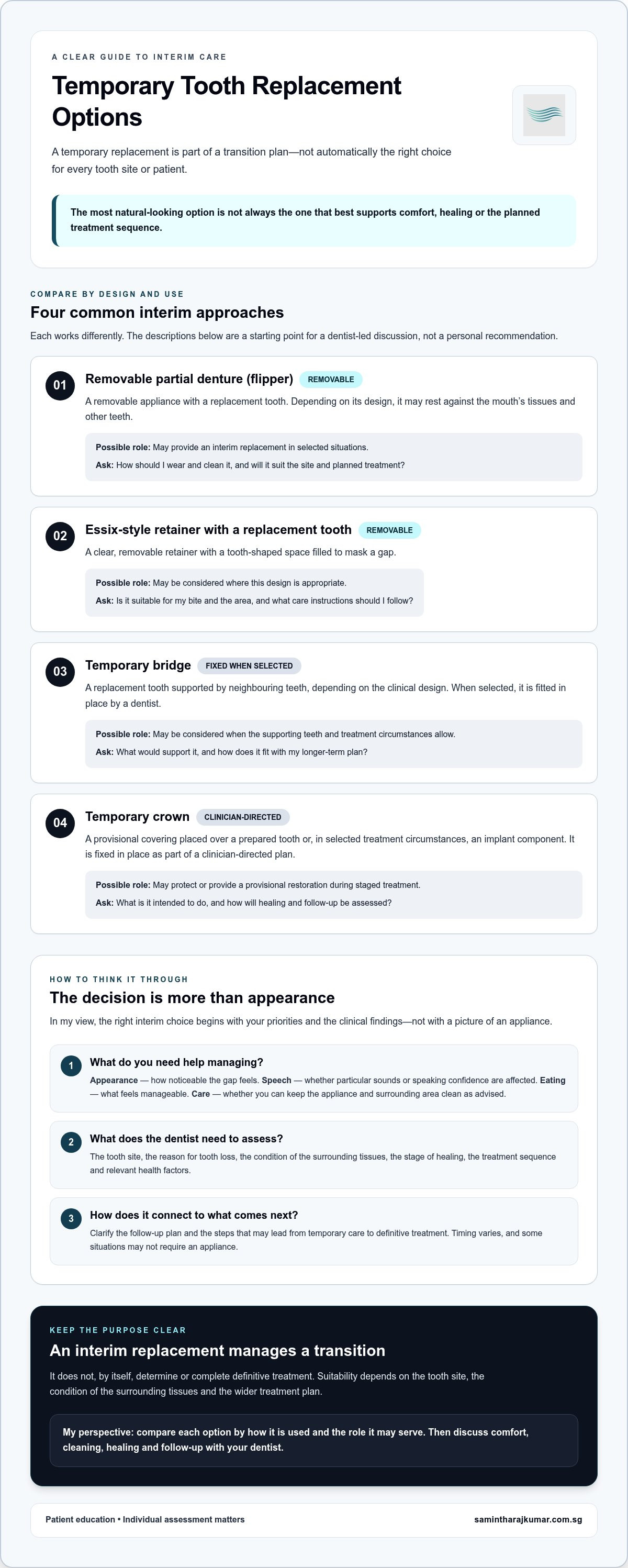
Temporary tooth replacement options include removable appliances, such as a flipper or an Essix-style retainer with a replacement tooth, as well as provisional crowns and bridges. Each works differently, and none is suitable for every patient. Fit, eating and speaking comfort, cleaning, healing and the teeth or tissues involved all need consideration.
This article compares these common approaches, explains what they may help with and outlines what a dentist should assess before making a recommendation. It also explains how a temporary appliance differs from definitive treatment, so you can discuss an individual plan for the transition with greater confidence.
Table of Contents
Temporary tooth replacement options: why an interim solution may matter
Comparing temporary tooth replacement options by design and use
Are temporary tooth replacement options safe, or can they affect healing?
How to choose temporary tooth replacement options for your situation
From temporary tooth replacement to a considered long-term plan
Temporary tooth replacement options: why an interim solution may matter
Losing or having a tooth removed can leave more than a visible gap. You may feel self-conscious when you smile, wonder whether others will notice, or find that speaking or eating feels different. It’s natural to look for a way to feel more comfortable while the next steps are being considered.
A temporary tooth replacement is an interim measure that may help address a short-term need. It isn’t automatically a definitive restoration, and an appliance that looks suitable in a picture may not be appropriate for your mouth. Appearance, comfort, function, healing and the intended treatment sequence can all influence the recommendation.
A temporary replacement may help manage a transition; it doesn’t, by itself, determine or complete the definitive treatment plan.
When might a temporary tooth replacement be considered?
An interim option may be discussed while you wait for a fuller assessment, while the site heals, or while a planned definitive restoration is being arranged. For example, a removable partial denture, sometimes called a flipper, may be considered in some circumstances. The Removable partial denture overview explains this general appliance category, but it can’t establish what is right for an individual patient.
The reason for the gap, the condition of the site and the wider treatment plan all matter. Timing varies, too. A dentist should first assess the area and understand the clinical findings before selecting an appliance.
What should an interim replacement help you manage?
Start with what matters most in daily life. An interim replacement may be considered to address concerns such as:
Appearance: how noticeable the gap feels to you.
Speech: whether the change affects particular sounds or your confidence speaking.
Eating: what feels comfortable and manageable while the site is assessed or treated.
Care: whether you can keep the appliance and surrounding area clean as advised.
These are discussion points, not promised benefits. Comfort and ease of cleaning matter because an appliance needs to work with your daily routine as well as the clinical plan. The condition of the tissues and stage of healing should also inform the decision. Some situations may not require an appliance at all. A dentist can weigh your priorities against the examination findings, then discuss whether an interim measure is appropriate and how it fits into the next stage of care.
Comparing temporary tooth replacement options by design and use
The main difference between temporary tooth replacement options is how each is supported and used. Some are removable, while others are connected to existing teeth or form part of a treatment plan. The comparison below is a starting point for discussion, not a recommendation for your individual case.
Removable partial denture or flipperDesign: A removable appliance with a replacement tooth, generally supported by parts that rest against the mouth’s tissues and, depending on its design, other teeth.Use: Removable.Possible role: May provide an interim replacement in selected situations.Ask your dentist: How should I wear and clean it, and will it suit the site and planned treatment?
Essix-style retainer with a replacement toothDesign: A clear, removable retainer with a tooth-shaped space filled to mask a gap.Use: Removable.Possible role: May be considered where this design is appropriate.Ask your dentist: Is it suitable for my bite and the area, and what care instructions should I follow?
Temporary bridgeDesign: A replacement tooth supported by neighbouring teeth, depending on the clinical design.Use: Fixed in place when selected and fitted by a dentist.Possible role: May be considered when the supporting teeth and treatment circumstances allow.Ask your dentist: What would support it, and how does it fit with my longer-term plan?
Temporary crownDesign: A provisional covering placed over a prepared tooth or, in selected treatment circumstances, an implant component.Use: Fixed in place as part of a clinician-directed plan.Possible role: May protect or provide a provisional restoration during staged treatment.Ask your dentist: What is it intended to do, and how will healing and follow-up be assessed?
Suitability depends on the tooth site, the condition of the surrounding tissues and the treatment plan. A temporary crown is not the same as a definitive implant crown. The provisional restoration serves a short-term role, while the final restoration is planned for longer-term use. The same distinction applies to temporary bridges and definitive restorations. A fixed option, immediate placement or loading is not appropriate for every patient.
The useful comparison is not simply removable versus fixed. Consider how the design fits the site, the stage of care and your ability to maintain it. Confirm wear and cleaning instructions with your dentist, since they depend on the appliance and your clinical circumstances.
Are temporary tooth replacement options safe, or can they affect healing?
A temporary appliance shouldn’t be chosen by appearance alone. A product description or photograph can show what an item looks like, but it can’t tell you whether it fits your mouth, suits the treatment site or works with your care plan. These questions need individual assessment, not a one-size-fits-all answer.
Temporary tooth replacement options may be considered in different circumstances, but no category is automatically safe or suitable for everyone. Fit, the condition of the tissues, the planned treatment and individual health factors can all affect the recommendation. This is particularly relevant when the tooth has recently been removed or treatment is still underway.
What can influence comfort and healing?
A dentist can assess whether an appliance places pressure on sensitive areas, rubs against the tissues or sits securely. They can also advise how to keep it clean in a way that suits the appliance and treatment site. Advice may differ after an extraction, during healing or before restorative treatment, so instructions for one patient may not apply to another.
Don’t rely on general online claims to decide how long to wear an appliance or when healing is complete. Those details require clinically informed guidance based on your examination and treatment plan. Follow your dentist’s instructions, and ask if anything is unclear.
When should you contact your dentist about an appliance?
Contact your dentist for advice if an appliance causes persistent discomfort, rubbing, sores, looseness or a change around the treatment site. Don’t try to adjust a dental appliance yourself or assume that ongoing irritation is simply part of getting used to it. A dentist can assess the fit and determine what, if anything, needs to change.
If you’re concerned about symptoms or they are worsening, seek timely professional assessment in line with your clinician’s advice. A general article can’t diagnose the cause of pain or changes in the mouth. The same symptom may have different explanations depending on the site, the appliance and the stage of care.
The safest next step is an assessment of the appliance and treatment site, rather than a judgement based on appearance or a retail claim. Temporary care is part of a wider clinical plan: comfort matters, but so does preserving appropriate options for treatment that may follow. If an appliance doesn’t feel right, discuss it with your dentist before continuing to rely on it.
How to choose temporary tooth replacement options for your situation
A useful discussion starts with your clinical findings and treatment goals, then considers which interim approach, if any, fits them. Work through these steps with your dentist rather than choosing an appliance based on appearance or convenience alone.
Clarify the goal. Decide what you hope to manage in the short term, such as the visibility of a gap, speech, eating or another concern. Be clear about what matters most to you.
Assess the site. Ask your dentist to examine the area and consider its condition, relevant health factors and any treatment already planned. These findings help determine which categories may be appropriate.
Compare possible categories. Discuss whether a removable or fixed option could suit the clinical situation. Ask why a particular approach is being considered and what alternatives may be relevant.
Review daily care. Understand how the appliance may affect cleaning, eating and speaking, and what instructions apply to its specific design.
Confirm follow-up. Ask when the appliance or site should be reviewed, what changes to report, and how the interim choice relates to definitive treatment.
This framework can help you bring focused questions to an assessment. If you would like to discuss your treatment goals and clinical findings, you can explore a specialist perspective on dental restoration.
Questions to discuss during a dental assessment
Ask which temporary categories may suit your findings and why. You can also ask how each could affect cleaning, eating, speaking and the planned treatment sequence. Before you leave, clarify what changes or symptoms should prompt a review and whom to contact if the appliance feels uncomfortable or unstable.
How to compare options beyond appearance
Compare whether an option is removable, how it should be maintained, whether it feels comfortable and how it fits the treatment plan. A discreet design may matter to you, but convenience and aesthetics don’t replace clinical assessment. When choosing a dental clinic, consider whether the clinician explains the reasoning behind a recommendation, the alternatives and how temporary care connects with your longer-term plan.
A useful temporary choice is one that connects thoughtfully to the next stage of care. Your priorities should be heard, and the clinical reasoning should be clear.
From temporary tooth replacement to a considered long-term plan
An interim appliance is one stage of care, not a diagnosis or a complete treatment plan. The appropriate next step depends on the reason for the missing tooth, the condition of your mouth and your goals. Temporary tooth replacement options should be considered in relation to what comes next, rather than as a decision based on the gap alone.
During a consultation, Dr Samintharaj Kumar may consider the oral examination, your treatment goals and relevant diagnostic information. You can discuss what the findings mean, which approaches may be appropriate and what remains uncertain. A dental implant may be one possible pathway, but it isn’t right for everyone. Other options may be considered according to your individual assessment.
What to expect when discussing a longer-term restoration
A thoughtful conversation should connect the clinical findings with your priorities, such as appearance, comfort and function. Ask how the interim appliance fits into the proposed sequence of care, what the next decision points are, and whether further assessment is needed before a definitive restoration can be planned.
If implant treatment is being considered, planning should reflect your clinical circumstances and the stages involved. An interim solution does not establish that an implant is suitable or determine when a definitive restoration should be placed. Dr Kumar can explain the options relevant to your assessment and discuss their potential benefits, limitations and uncertainties.
My clinical perspective on the interim stage
The temporary stage is most useful when it supports a clear, considered plan. The aim isn’t simply to fill a space. It is to understand what the mouth needs now, preserve appropriate choices for later and make decisions with the patient, not for them.
Precision begins with diagnosis. A careful assessment helps shape decisions about both temporary and definitive care, while an honest discussion builds trust. No appliance or treatment can promise a particular outcome, but sound planning gives the conversation a clearer foundation.
If you’re considering a longer-term restoration, an individual assessment can help clarify which approaches may suit your circumstances, including whether implant rehabilitation is worth exploring. Explore a specialist perspective on dental restoration.
Choose an interim step with the long term in mind
The right interim choice isn’t simply the one that looks best. Temporary tooth replacement options differ in design and use, and their suitability depends on the tooth site, healing and the treatment plan. Appearance, comfort, eating, speech and cleaning are all useful points to discuss with your dentist.
A temporary appliance is not the same as a definitive restoration. The next step should follow a diagnosis and a clear conversation about your goals, findings and possible approaches. An implant may be one pathway, but it isn’t appropriate for everyone.
Dr Samintharaj Kumar specialises in complex dental implantology and oral surgery, with a practice that includes ceramic dental implants and full mouth rehabilitation. Temporary decisions can be considered in the context of the wider plan, where precision and long-term function matter alongside immediate comfort. The right diagnosis helps guide both.
If you’re considering your next steps, book a consultation to discuss your dental restoration options. An individual assessment can help clarify which approaches may suit your circumstances.
Frequently Asked Questions
What is the best temporary tooth replacement option?
The best option is the one a dentist considers suitable for your tooth site, oral health and treatment plan. Temporary tooth replacement options include removable appliances and, in selected circumstances, fixed provisional restorations. Your priorities, such as appearance, speech, eating and ease of cleaning, can help guide the discussion, but they don’t establish clinical suitability. Ask why a particular option is being considered and how it fits with definitive care.
Can I replace a missing tooth while waiting for a dental implant?
Possibly, but a dentist should assess the site and planned implant treatment before advising whether an interim replacement is appropriate. A removable appliance or another provisional approach may be discussed in some cases; it isn’t suitable for everyone. The choice should account for the condition of the area and the treatment sequence. An interim replacement doesn’t confirm that implant treatment is suitable or determine when a definitive implant restoration can be placed.
How long can you wear a temporary tooth replacement?
There isn’t one wear period that applies to every temporary replacement. The appropriate duration depends on the appliance, the reason it was provided, the condition of the site and the next treatment steps. Follow your dentist’s instructions rather than relying on a general timeline or advice intended for another appliance. Ask when your temporary restoration should be reviewed and what to do if it becomes uncomfortable or unstable.
Is a flipper tooth suitable for everyone?
No. A flipper is a type of removable partial denture, but whether it is suitable depends on an individual assessment. A dentist may consider the tooth site, surrounding tissues, the fit of the appliance and how it relates to planned treatment. Its removable design may appeal to some patients, but appearance alone isn’t enough to judge suitability. Ask how it should be cared for and whether it could interfere with your treatment plan.
Can I eat normally with a temporary tooth replacement?
Don’t assume you’ll be able to eat normally straight away. Comfort and function can vary with the appliance, its fit and the condition of the treatment site. Your dentist can explain whether you need to adapt what or how you eat and give guidance specific to your situation. If eating causes pain or the appliance moves, contact your dentist for advice rather than trying to adjust it yourself.
What happens if a temporary tooth replacement feels loose or uncomfortable?
Contact your dentist if the appliance feels persistently uncomfortable, rubs, causes sores or seems loose. A dental professional can assess its fit and the treatment site, then advise whether it needs attention. Don’t try to reshape or repair it yourself, and don’t assume ongoing irritation is normal. If symptoms are worsening or you’re concerned, seek timely professional advice according to the instructions you were given.
Can a temporary crown or bridge be used after tooth extraction?
Sometimes a temporary restoration may be part of care after an extraction, but the appropriate design depends on the site and treatment plan. A crown generally covers a prepared tooth or, in selected circumstances, an implant component; it isn’t simply placed on a tooth that has been removed. A temporary bridge may also be considered in suitable cases. Your dentist can explain what can support a provisional restoration and when it may be used.

Comments