
TMJ Specialist in Singapore: A Surgeon’s Perspective on Total Jaw Rehabilitation (2026)
- Dr Samintharaj Kumar

- 5 hours ago
- 12 min read
Why does your jaw pain persist despite the night guards, the massages, and the endless cycles of painkillers? If you're like many of my patients, you've likely spent months or even years searching for a tmj specialist singapore only to find temporary relief that never quite reaches the source of the problem. It's exhausting to live with chronic headaches or the constant clicking of a joint that simply won't cooperate. I understand the frustration of feeling that your functional harmony is slipping away while the true root cause remains a mystery.
I believe that resolving complex jaw issues requires more than a standard dental checkup; it demands a surgeon’s diagnostic precision and a holistic, biological perspective. In this article, I'll share my clinical approach to total jaw rehabilitation, moving beyond temporary fixes to achieve lasting structural balance. We'll examine the science of why these issues persist, the transformative role of AI-assisted diagnostics, and what you can expect from a comprehensive plan designed to restore your facial symmetry and pain-free function for the long term. The path to recovery begins with a shift in perspective from mere management to complete restoration.
Table of Contents
Understanding TMJ Disorders: Why Your Jaw Pain Persists
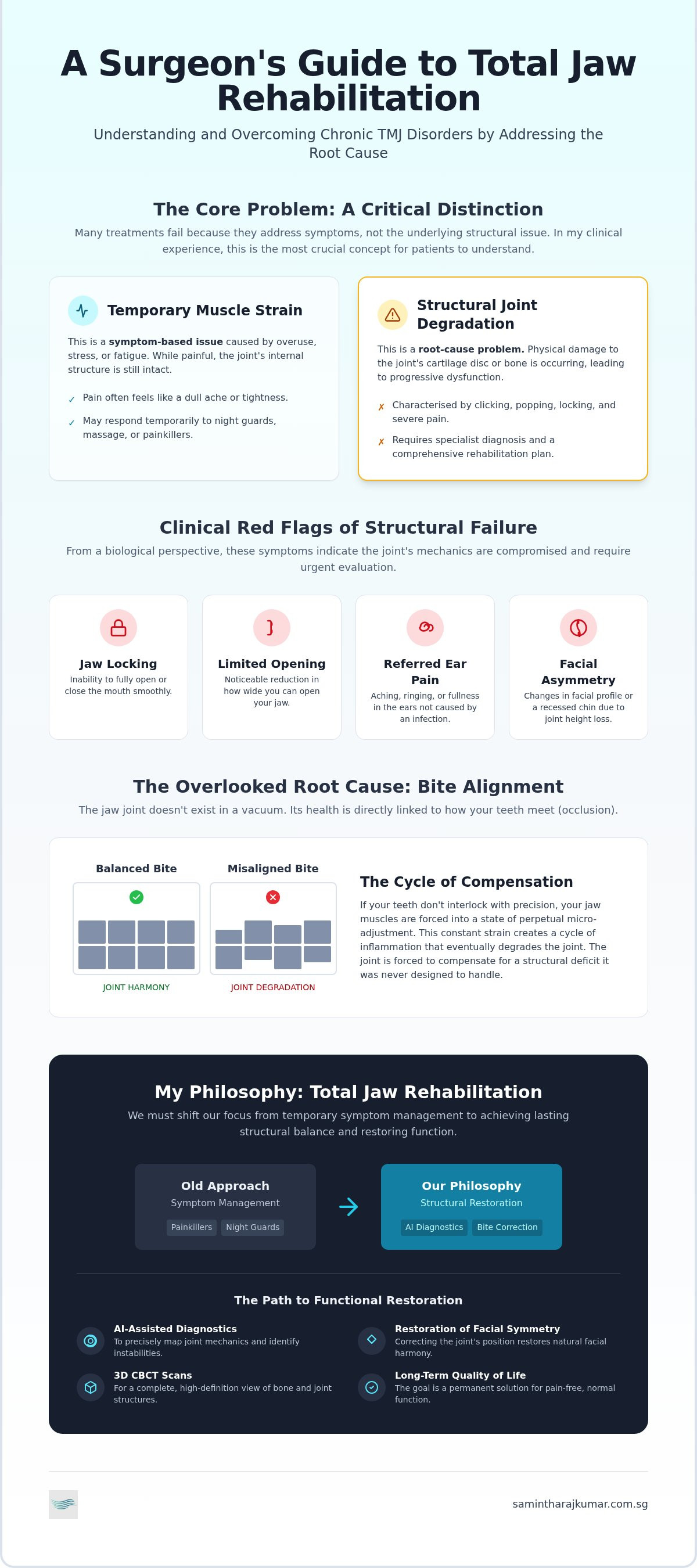
The temporomandibular joint is one of the most sophisticated mechanisms in the human body. It functions as a bi-arthrodial system, meaning it must perform both hinge and sliding movements simultaneously to allow for seamless chewing, speaking, and yawning. Many patients who consult me as a tmj specialist singapore have spent years managing what they believe is simple muscle tension. While the muscles of mastication are often involved, the underlying issue is frequently a structural failure within the joint itself. Distinguishing between temporary soft tissue strain and progressive structural joint degradation is the first step toward a definitive solution.
To better understand this concept, watch this helpful video:
In my clinical experience, a "wait and see" approach is often the most detrimental path a patient can take. When the internal mechanics of the jaw are compromised, the joint doesn't simply heal on its own; instead, it often undergoes further erosion. This chronic friction can lead to the thinning of the protective cartilage and, eventually, bone-on-bone contact. This is why I advocate for Total Jaw Rehabilitation. It's a comprehensive philosophy that looks beyond the symptoms to restore the biological and mechanical integrity of the entire system. For those looking for a comprehensive overview of TMJ dysfunction, it's clear that the condition is rarely isolated to just one factor.
The Anatomy of a TMJ Disorder
The health of your jaw depends on the articular disc, a firm yet flexible cushion that prevents the mandible from grinding against the skull. When this disc becomes displaced, you'll often hear a click or pop. If you struggle with bruxism, the constant pressure of teeth grinding accelerates this wear, significantly shortening the joint's longevity. From a biological perspective, TMD is a multi-factorial structural imbalance.
When Jaw Clicking Becomes a Clinical Concern
Clicking is often the first sign that the system is failing, but it's the appearance of red flags like jaw locking, limited opening, or referred ear pain that signals a clinical emergency. Leaving these structural issues untreated doesn't just result in pain; it can alter your profile. I frequently explain to my patients how dental structure affects face shape, as the loss of joint height can lead to a recessed chin or facial asymmetry. True restoration requires a plan that addresses both the internal health of the joint and its impact on your overall facial harmony.
The Biological Perspective: Why Root Cause Analysis Matters
From a biological perspective, the jaw joint does not exist in a vacuum. It is the cornerstone of a complex network involving teeth, muscles, nerves, and even your posture. When I consult with patients as a tmj specialist singapore, I often find they have been treated for "muscle pain" without anyone investigating why those muscles are straining in the first place. My clinical philosophy is rooted in the belief that we cannot achieve a permanent cure without a meticulous root cause analysis. Symptom management is a temporary bridge; total rehabilitation is the destination.
In my clinical experience, the relationship between bite alignment, or occlusion, and joint stress is the most frequently overlooked factor in chronic jaw disorders. If your teeth don't interlock with precision, your jaw muscles are forced into a state of perpetual micro-adjustment. This constant activity creates a cycle of inflammation that eventually degrades the joint. Whether the cause is a naturally misaligned bite, missing teeth, or old, poorly fitted dental restorations, the result is the same: the joint is forced to compensate for a structural deficit it was never designed to handle.
Bite Alignment and Joint Harmony
A collapsed bite occurs when the vertical dimension of your teeth is lost, often due to wear or tooth loss. This collapse forces the condyle, the rounded end of the jawbone, to sit too far back or too high in its socket. This misalignment is a physical stressor that no amount of pain medication can resolve. Restoring this lost height is essential for joint stability. I frequently emphasise the importance of preventing facial collapse with dental implants, as these provide the necessary mechanical support to keep the jaw in its optimal physiological position. When the foundation is solid, the joint can finally rest.
The Role of Biological Dentistry in TMJ Care
As a clinician and founder, I advocate for a biological approach that considers how every material we place in the mouth affects the body's systemic health. We know from foundational TMD research from the NIDCR that chronic inflammation is a key driver of joint pain. If a patient is reacting to non-biocompatible metals or restorative materials, that systemic inflammation can exacerbate their TMJ symptoms. By choosing ceramic implants and biocompatible prosthetics, we reduce the total inflammatory load on the body. This holistic view ensures that our rehabilitative efforts are supported by the body’s own healing mechanisms rather than hindered by them. Understanding the root cause is the only way to ensure the best outcomes begin with a clear diagnosis.
The path to functional harmony is often simpler than it seems once we address these biological fundamentals. If you are struggling with persistent discomfort, exploring a comprehensive evaluation can provide the clarity you need to move forward.
Choosing a TMJ Specialist in Singapore: Navigating Your Care
When you are living with chronic jaw pain, the path to recovery can feel like a maze of conflicting advice. In my clinical experience, patients often arrive at my clinic after a long journey of trial and error with various practitioners. It is vital to understand the hierarchy of care. While a general dentist is excellent for maintenance and simple appliances, a complex structural issue often requires a tmj specialist singapore with advanced surgical training. As a clinician and founder of Nuffield Dental, I have built our practice on international protocols that prioritise a surgeon’s diagnostic precision for cases where traditional conservative treatments have failed.
A board-certified oral and maxillofacial surgeon brings a unique depth of knowledge to the table. We are trained to operate not just on the teeth, but on the entire facial skeleton and its associated soft tissues. This level of expertise is crucial because many jaw issues are linked to specific classifications of TMD that involve internal derangement of the joint. When you are seeking a TMJ specialist in Singapore, look for credentials that reflect an institutional heritage of excellence and a commitment to global medical standards. The right background ensures that your treatment is grounded in science rather than guesswork.
The Role of an Oral and Maxillofacial Surgeon
For many, the word "surgeon" implies a final resort, but in the context of jaw rehabilitation, a surgeon’s perspective is often the most conservative path because it leads to an accurate diagnosis faster. We possess the surgical expertise required for advanced interventions such as joint lavage, where the joint is flushed to remove inflammatory markers, or complex disc repositioning. Understanding the kind of doctor that treats TMJ is essential, especially for cases involving trauma or severe joint degeneration. A surgeon is best equipped to determine if your issue is a simple muscular strain or a structural failure that requires mechanical correction.
What to Expect During a Specialist Consultation
A consultation with a tmj specialist singapore should feel like a steady, logical progression toward clarity. We begin with a detailed clinical history, but we quickly move into a comprehensive physical examination of your joint range, muscle triggers, and bite alignment. My patient-centred philosophy is designed to reduce surgical anxiety by breaking down complex processes into manageable explanations. We don't just look for where it hurts; we look for why the system is failing. I believe that the right diagnosis is the foundation of a successful outcome, allowing us to replace uncertainty with a clear, long-term plan for functional restoration. The best outcomes begin with understanding the root cause.
Advanced Diagnostics and the Path to Functional Restoration
In my clinical experience, the most sophisticated treatment plan is only as effective as the diagnostic data supporting it. As a tmj specialist singapore, I've observed how traditional methods often miss the subtle structural shifts that precede chronic pain. By 2026, we've moved beyond simple palpation and 2D imaging. We now integrate AI-assisted diagnostics to provide a level of precision that was previously unattainable. This technology allows us to overlay various data points, creating a comprehensive digital twin of your jaw function to predict how different treatments will affect your long-term stability.
The journey from pain to functional harmony follows a logical, sequential path. It begins with diagnostic insight, moves through stabilising the joint, and concludes with a tailored treatment plan that addresses your specific biological needs. We don't guess; we measure. Digital bite mapping is a key part of this process, as it identifies microscopic occlusal interferences that the human eye simply cannot see. This data ensures that every adjustment we make is purposeful and precise.
Precision Imaging: Seeing the Invisible
Standard 2D X-rays are often insufficient for a definitive TMJ diagnosis because they provide a flattened view of a three-dimensional problem. They cannot capture the soft tissue of the articular disc or the complex volume of the joint space. To solve this, I utilise 3D Cone Beam Computed Tomography (CBCT) alongside MRI to gain a 360-degree view of the joint and disc. These images allow us to see exactly how the condyle interacts with the skull during movement. AI-driven diagnostic software significantly reduces human error by highlighting microscopic patterns of early bone erosion that are vital for early intervention.
Non-Surgical vs. Surgical Pathways
Once we have a clear map of the problem, we determine the most appropriate pathway for your rehabilitation. For many patients, the journey begins with conservative, non-surgical options. Precision-crafted occlusal splints are designed using our digital scans to offload the joint and allow the muscles to enter a state of rest. We may also employ therapeutic injections for muscle-related TMJ disorders to break the cycle of spasms and pain. These steps are often enough to restore function in less complex cases.
However, when the diagnostic data reveals significant internal derangement or disc displacement that cannot be resolved through splint therapy, minimally invasive surgical techniques become the logical choice. Procedures such as joint lavage or arthroscopy allow us to clear inflammatory markers and reposition the disc with minimal downtime. My goal is always to choose the path that offers the most predictable, long-term restoration of your quality of life. If you're seeking clarity on your condition, you can consult with our specialist team to begin a comprehensive diagnostic evaluation.
My Perspective: The Future of Total Jaw Rehabilitation
As a clinician and founder, I have spent much of my career observing the evolution of maxillofacial care from simple symptom management to the sophisticated, biological rehabilitation protocols we employ today. My journey as a surgeon has always been driven by a singular pursuit: precision. At Nuffield Dental, we've moved beyond the era of temporary fixes. We don't just treat joints; we rebuild the functional foundation of a person's life. In my clinical experience, the most successful outcomes are those where we treat the jaw not as an isolated mechanical part, but as a vital component of a patient’s systemic health and emotional well-being.
The commitment I hold toward innovation in Singapore’s healthcare ecosystem is deeply personal. I've seen how chronic pain can diminish a person's spirit, and I've seen the transformative power of a successful intervention. Restoring a patient’s ability to eat, speak, and smile without the shadow of pain is a privilege that keeps me focused on the future of our field. We are building a legacy of excellence that prioritises long-term results over immediate, superficial gains.
A Vision for Patient-Centred Innovation
I believe the future of specialist care lies in the seamless integration of functional jaw repair and facial aesthetic rejuvenation. When I lead my surgical team, I emphasise that technical excellence must be balanced with a warm, human approach. It isn't enough to possess the best AI diagnostics or surgical tools; we must also provide a sense of security and trust. Nuffield Dental is setting national standards by ensuring our clinics operate with the highest tier of international medical protocols. We aim to be the destination for complex cases that others cannot resolve, providing a clear path forward for those who have lost hope in traditional dental treatments.
The Long-Term Impact on Quality of Life
The most rewarding aspect of being a tmj specialist singapore is witnessing the profound emotional renewal that follows a successful structural restoration. When the physical burden of a misaligned jaw is lifted, the change in a patient's quality of life is immediate and visible. I often encourage my patients to view their rehabilitation not as a series of appointments, but as a vital investment in their long-term health. Structural stability in the jaw preserves your facial harmony and prevents the accelerated wear that leads to more complex issues later in life.
Functional harmony is within reach, provided we approach the problem with the right diagnostic framework. If you've been living with the frustration of temporary fixes, I invite you to seek a definitive diagnosis that addresses the structural reality of your condition. After all, the best outcomes begin with understanding the root cause. You can consult with our specialist team to begin your journey toward lasting restoration.
Restoring Your Path to Functional Harmony
Achieving a life free from chronic jaw pain requires a shift from temporary fixes to a comprehensive, biological understanding of the joint. In my clinical experience, the most successful journeys toward recovery are those rooted in a surgeon's diagnostic precision and the integration of advanced technology. We've explored how a tmj specialist singapore with oral and maxillofacial expertise can identify structural failures that general maintenance might overlook. By leveraging advanced AI-assisted diagnostic protocols, we can now map the path to restoration with unprecedented accuracy.
As a specialist oral and maxillofacial surgeon and the founder of Nuffield Dental Holdings, I'm committed to setting international standards for jaw health in Singapore. I believe that every patient deserves a clear, long-term plan that prioritises their quality of life and functional excellence. The best outcomes begin with understanding the root cause. Explore a specialist approach to jaw rehabilitation. Your journey toward a pain-free smile is a partnership built on trust and clinical mastery. It's time to replace frustration with the confidence of being in expert hands.
Frequently Asked Questions
What is the difference between TMD and TMJ?
TMJ refers to the temporomandibular joint itself, which is the physical hinge connecting your jaw to your skull. TMD, or temporomandibular disorder, is the clinical term for the actual dysfunction or pain affecting that joint and its associated muscles. In my clinical experience, patients often use the terms interchangeably, but my focus as a surgeon is to identify the specific subtype of TMD you're experiencing to create a tailored rehabilitation plan.
How do I know if I need to see a TMJ specialist in Singapore?
You should consider consulting a tmj specialist singapore if you experience persistent jaw clicking accompanied by pain, limited mouth opening, or chronic facial headaches that don't respond to standard care. While general dentists can manage minor muscle tension, structural issues like joint locking or significant bite misalignment require the diagnostic precision of an oral and maxillofacial surgeon. If temporary fixes like basic night guards haven't provided relief, it's time for a comprehensive surgical and biological evaluation.
Can TMJ disorders be cured without surgery?
Yes, many TMD cases are successfully resolved using non-surgical pathways such as precision-crafted occlusal splints, physical therapy, and therapeutic injections. From a biological perspective, my goal is always to restore function using the most conservative means possible. Surgery is typically only recommended when diagnostic imaging reveals significant internal derangement or structural joint degradation that cannot be corrected through conservative rehabilitation methods.
Will my jaw pain go away on its own?
While minor muscle strain caused by temporary stress might occasionally subside with rest, structural jaw pain rarely disappears without professional intervention. Ignoring the early red flags of TMD often leads to progressive joint erosion and compensatory muscle strain. In my experience, early diagnosis is the most effective way to prevent long-term complications like bone-on-bone friction or permanent disc displacement. The best outcomes begin with understanding the root cause early.
What are the risks of leaving a TMJ disorder untreated?
Untreated TMD can lead to irreversible joint damage, including the thinning of the protective articular disc and the development of osteoarthritis. Beyond the physical pain, chronic joint degradation can cause a collapsed bite, which eventually impacts your facial symmetry and overall dental health. Leaving these structural issues unaddressed often results in more complex and invasive procedures being required later to restore basic functional harmony and prevent further facial collapse.
How long does the rehabilitation process typically take?
The duration of rehabilitation depends entirely on the complexity of the underlying structural issue. Minor muscular TMD may see significant improvement within six to twelve weeks of precision splint therapy. However, complex cases involving total jaw rehabilitation or minimally invasive surgical intervention may require several months to achieve full stability. We monitor your progress through sequential clinical exams to ensure the joint is healing and the bite is perfectly balanced throughout the process.
Does insurance cover TMJ specialist treatments in Singapore?
Coverage for TMD treatment in Singapore varies significantly depending on your specific insurance policy and whether the procedure is classified as medical or dental. Surgical interventions performed by an oral and maxillofacial surgeon are often covered under medical plans, whereas conservative splint therapy may fall under dental benefits. I recommend checking with your provider to see if they recognise TMD as a medical condition; my team can provide the necessary clinical documentation to support your claim.
Can stress really cause my jaw to lock?
Stress is a significant contributing factor because it often leads to bruxism, or teeth grinding, which places immense pressure on the joint. This constant load can cause the articular disc to slip out of place, leading to a locked jaw. While stress triggers the behaviour, the lock itself is a physical, mechanical failure within the joint system. Addressing the biological stress on the joint is just as important as managing the psychological triggers to prevent recurrence.


Comments