
AI voice care and the last human touchpoint

This week, a national health service began trialling an AI voice agent to run follow-up telephone appointments for patients managing a chronic bone condition. A voice-AI company unveiled a new generation model built for autonomous clinical conversations. A health regulator granted a first-of-its-kind clearance to software that analyses video from an otoscope to detect signs of eardrum bulging, effectively creating a new regulatory category. And in Europe, dental AI software received certification under the region's medical device regulations.
Four announcements in one week, and together they mark a quiet turning of the page.
For most of the past decade, the question we asked of artificial intelligence in medicine and dentistry was whether it read images accurately. Could it spot the lesion on the radiograph, the lesion the tired eye might miss? That question has been settled well enough that regulators now certify the software and clinicians increasingly trust it in the workflow.
I have used diagnostic support in my own practice for years, and I have never regarded it as anything other than an aid to my judgement, never a replacement for it.
The new frontier is different. AI is no longer only reading. It is speaking. It is calling patients, asking how they are recovering, recording their answers, deciding whether the answers warrant escalation.
The efficiency argument is real, and I welcome it. Follow-up calls are the kind of essential, repetitive work that fills a team's day and does not always get done as thoroughly as we would like. If a well-governed system can complete every one of those calls, on time, every time, that is a genuine improvement in patient care, not merely a saving in staffing.
But the important question is no longer accuracy. Accuracy is becoming a solved problem, certified category by category. The important question is the last human touchpoint. Which conversations still belong to a person? Where does the clinician stay in the loop, not as a supervisor reviewing a transcript at the end of the week, but as the voice a patient recognises? And what do patients quietly lose when a familiar voice becomes merely a familiar-sounding voice?
My position on this has not changed, and I doubt it will. AI should augment clinical judgement, never replace it. Reading images is one thing; holding a conversation with someone who is worried about their recovery is another.
A follow-up call carries reassurance as much as information. When a patient picks up the phone the day after surgery, they are partly answering questions and partly listening for the tone of the person asking them. Am I normal? Is this what healing sounds like? A system can collect the answers. I am not convinced it can yet carry the reassurance, and I am certain we should not pretend otherwise.
My own operating principle is simple: every AI interaction must have a named clinician behind it, visible to the patient, reachable in one step. If a voice agent completes a follow-up and flags anything at all, the next voice the patient hears must be a human one, from the same team that treated them.
Efficiency lives in the routine conversation; the moment of concern returns to a person. That is the touchpoint line, and I would rather we draw it deliberately than let it be drawn for us by whichever tool arrives first.

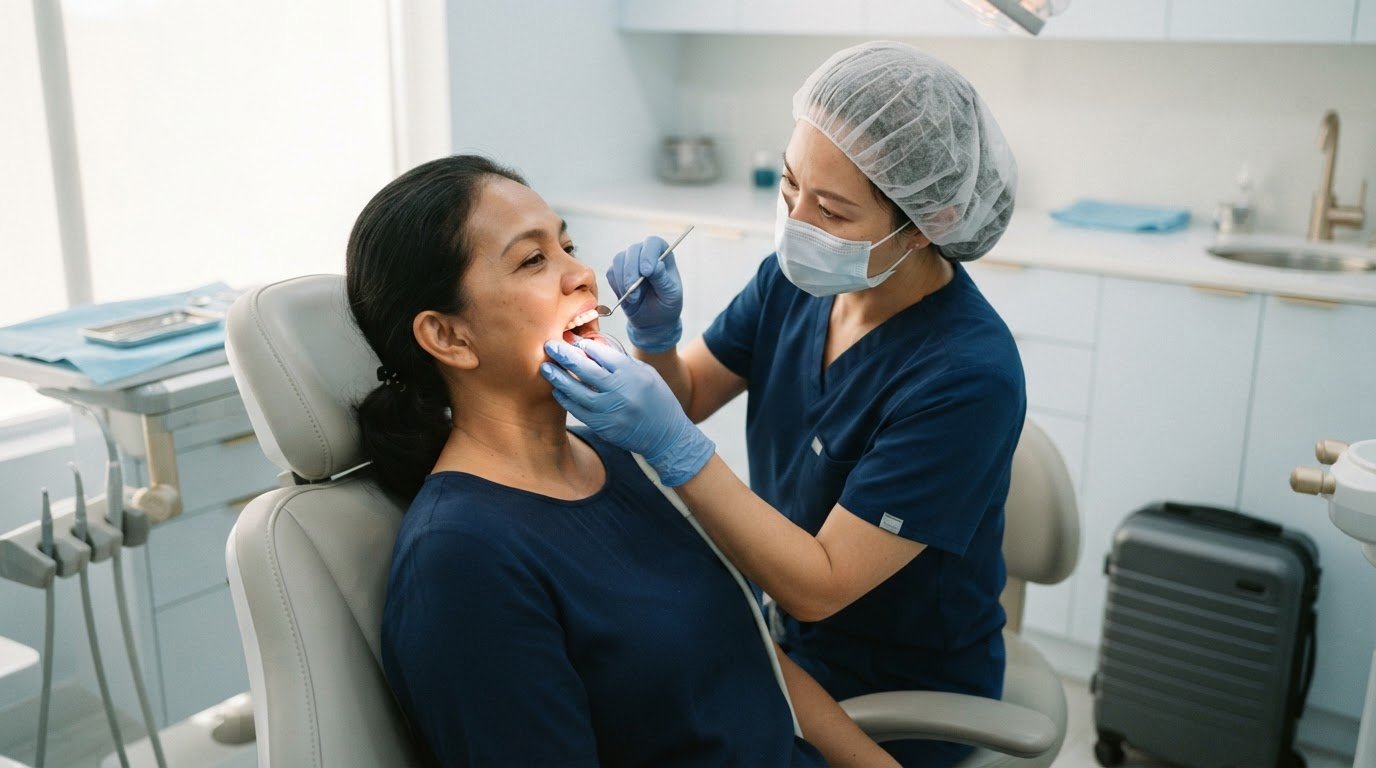
The real-world reflection I keep returning to is from my own chairs. The conversations patients value most are rarely the ones with the most information in them. They are the short ones. The call to check that the bleeding stopped. The voice at the desk that already knows their name and their child's name. The dentist who remembers which side they sleep on.
None of that is data in the strict sense, and none of it is transferable to a model, however large. When we automate the routine well, we buy back time for exactly these moments. When we automate the personal, we spend something we did not price.
The broader implication reaches beyond dentistry. Health systems everywhere are under strain, workforces are stretched, and the case for AI that can hold a conversation is only going to grow. The risk is not that the technology will be too capable. It is that adoption will happen conversation by conversation, department by department, without anyone ever deciding where the line sits.
One day the profession looks up and the last human touchpoint has been traded away by a thousand small efficiencies. The regulators are certifying capability. Nobody is certifying that the relationship survived it.
For patients, I would say this: ask who is behind the voice. It is a reasonable question, and a good practice will answer it without hesitation.
For colleagues, I would say the opposite of resistance. Build with these tools, pilot them, measure them. But do the governance work in public: name the conversations that stay human, and hold that line with the same seriousness we hold sterilisation or consent.
I remain an optimist about all of this. The week's announcements tell me the technology is maturing faster than many expected, and the dental software now certified in Europe will make earlier detection and better planning available to more practices and more patients.
DISCLAIMER: This article is for general information and education. It does not constitute medical or dental advice, diagnosis or treatment, and it is not a substitute for a consultation with a qualified dental practitioner. Any treatment decision should be made together with your dentist, based on your individual circumstances. Outcomes vary from person to person.
AUTHOR LINE: Samintharaj Kumar is a dental surgeon with special interests in dental implantology and ceramic implantology, practising at Nuffield Dental Jewel, Singapore.

Comments