
Benefits of Botox for Teeth Grinding: A Surgeon’s Perspective on Neuromuscular Rehabilitation
- Dr Samintharaj Kumar

- Aug 19
- 12 min read
What if the most effective way to protect your smile isn't found in a traditional mouthguard, but in recalibrating the very muscles that power your jaw? In my clinical experience, many patients arrive at my practice exhausted by persistent morning headaches and the constant anxiety of potentially cracking their teeth. You likely understand the frustration of waking up with facial tension that never seems to dissipate, regardless of how much you try to relax. When considering this treatment, it's natural to have questions about botox for jaw clenching side effects and how the procedure fits into a broader rehabilitative framework.
My goal is to show you how Botulinum Toxin serves as a precise clinical tool to eliminate jaw tension and restore the natural symmetry of your face. By reading further, you'll discover a surgeon’s perspective on how we move beyond temporary fixes to achieve genuine neuromuscular rehabilitation. I will outline the biological reasons why these injections work, what you can realistically expect during the process, and how we prioritise your comfort to ensure a transformative impact on your quality of life.
Table of Contents
Beyond the Surface: Understanding the Biological Toll of Bruxism
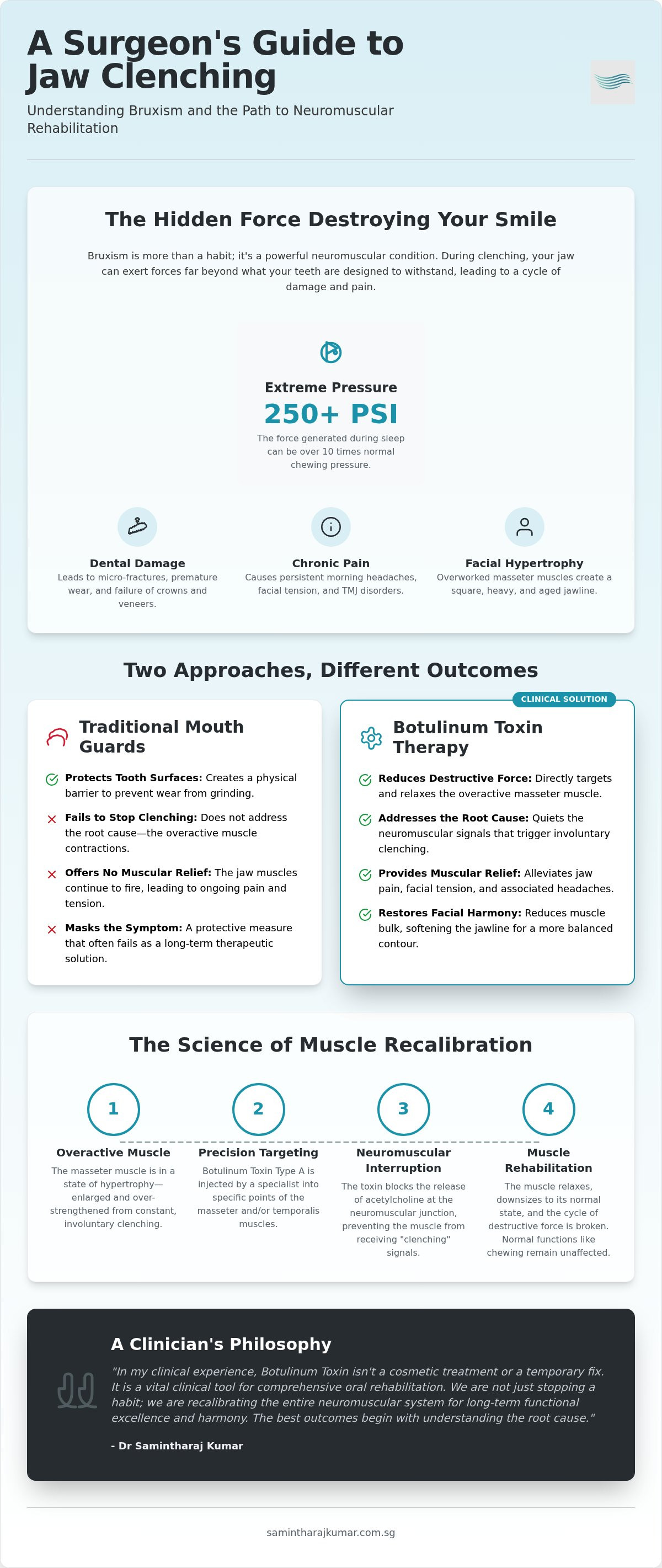
In my clinical experience, bruxism is far more than a simple habit or a stress-induced annoyance. It is a complex neuromuscular condition that demands a specialist’s attention. While many perceive teeth grinding as a nocturnal quirk, the reality is that the masseter and temporalis muscles can exert forces that significantly exceed normal chewing pressure. These muscles are remarkably powerful; during a clenching episode, they can generate hundreds of pounds of force per square inch, far beyond what your dental anatomy was designed to withstand. This constant mechanical stress places an immense burden on your entire oral-facial structure.
From a biological perspective, untreated bruxism causes a destructive cycle of muscular hypertrophy and dental attrition. When these muscles are constantly overworked, they grow larger and stronger, which in turn increases the force of the clenching. This leads to micro-fractures in enamel and the premature failure of expensive dental work, including crowns and veneers. As a clinician and founder, I often see patients who have invested heavily in their smiles only to find their restorations compromised by the sheer mechanical power of their own jaw muscles. This is why a discussion regarding botox for jaw clenching side effects is essential, as it allows us to explore how we safely and effectively mitigate these destructive forces.
The Clinical Consequences of Untreated Clenching
The progression from simple tooth wear to chronic pain is often a steady, logical decline. Initially, you might notice flattened biting surfaces or sensitivity, but without intervention, this frequently evolves into a need for TMJ pain management. The excessive force doesn't just stop at the teeth; it contributes to the degradation of the alveolar bone over time, potentially compromising the stability of your natural teeth or future implants. I define bruxism as a cycle that compromises both dental health and facial harmony, eventually leading to a square, heavy jawline that many patients find distressing.
Why a Proper Diagnosis Changes Everything
A specialist consultation is non-negotiable because bruxism rarely exists in a vacuum. It's my responsibility to rule out underlying issues like obstructive sleep apnea, which can actually trigger clenching as the body struggles to keep the airway open. As an oral surgeon, I look for structural triggers that general practitioners might overlook. For instance, there is a distinct link between jaw tension and the potential need for wisdom tooth surgery, where impacted teeth may be contributing to a patient's overall discomfort and muscular strain. When we evaluate the suitability of treatment and discuss botox for jaw clenching side effects, we do so within this comprehensive diagnostic framework. The best outcomes begin with understanding the root cause.
The Science of Botulinum Toxin in Jaw Muscle Recalibration
Botulinum Toxin Type A works by precisely blocking the neurotransmitters that signal overactive muscle contraction. Specifically, it inhibits the release of acetylcholine at the neuromuscular junction, effectively "quieting" the biological noise that leads to involuntary clenching. As a clinician and founder, I view this as a way to allow the muscle to downsize to a healthy state rather than simply immobilising it. The primary target is the masseter muscle, the large, powerful muscle responsible for chewing. By reducing its bulk and destructive clenching power, we provide the jaw a much-needed reprieve. The goal is always therapeutic relaxation, ensuring you can still eat and speak with total normalcy.
Targeting the Masseter and Temporalis Muscles
Achieving this balance requires significant clinical precision. We must inject the masseter at specific depths and locations to avoid affecting the muscles used for smiling. In my clinical experience, patients are often concerned about botox for jaw clenching side effects, such as an asymmetrical smile; however, a deep understanding of facial anatomy allows us to mitigate these risks entirely. I often treat the temporalis muscle simultaneously to prevent compensatory tension. This ensures the temples don't take over the clenching work once the masseter relaxes. You will typically notice the onset of action within 3 to 5 days, with the full therapeutic effect peaking at approximately two weeks.
Botox as a Tool for Neuromuscular Rehabilitation
It's vital to contrast these therapeutic applications with standard cosmetic treatments. While Botox is famous for smoothing fine lines, its use in complex jaw dysfunction is a matter of neuromuscular rehabilitation. From a biological perspective, the dosage required for bruxism is significantly higher than for treating forehead wrinkles due to the sheer strength and volume of the masseter muscle. By reducing this chronic tension, we don't just protect teeth; we often alleviate debilitating migraines and persistent tension headaches that have plagued patients for years. This restorative approach is central to how we provide facial aesthetic rejuvenation at my practice, focusing on functional excellence as the foundation for beauty. Understanding the root cause of your pain is the first step toward a lasting solution.
Myth-Busting: Why Mouth Guards Often Fail Where Botox Succeeds
In my practice, I often consult with patients who have spent years cycling through various night guards without finding genuine relief. While these appliances serve a necessary role in certain clinical scenarios, they primarily act as a physical barrier to protect the enamel from wear. They do nothing to address the underlying muscular clenching. It's a reactive solution rather than a proactive intervention. As a clinician and founder, I've observed that relying solely on a guard is like wearing a helmet while repeatedly hitting a wall; the helmet protects your head, but it doesn't stop the impact from happening.
Botox addresses the root cause-the overactive muscle-rather than just managing the symptoms. By recalibrating the masseter and temporalis muscles, we reduce the involuntary drive to clench. This shift from passive protection to active intervention is what allows for true neuromuscular rehabilitation. Many patients find that once the muscular tension is managed at the source, the need for bulky, uncomfortable intra-oral appliances diminishes or disappears entirely.
The Limitations of Traditional Intra-Oral Appliances
Some patients actually clench harder when they have a soft mouth guard in place. The resilient material can provide a "chewy" surface that inadvertently stimulates further muscular activity, worsening the very tension we aim to resolve. Beyond this, hygiene and maintenance challenges often lead to poor long-term compliance. A significant limitation is that a guard cannot prevent the facial widening associated with masseter hypertrophy. It protects the teeth, but it doesn't stop the jawline from becoming square and heavy due to muscle overgrowth. When we discuss botox for jaw clenching side effects, we often focus on how this treatment actually preserves the natural, refined proportions of the face while protecting the dentition.
Botox vs. Mouth Guards: A Functional Comparison
I encourage patients to view this through a specific mental framework: guards provide passive protection, while Botox is an active intervention. This distinction is particularly vital for those with complex restorations, such as all-on-4 dental implants. In these cases, reducing the sheer mechanical force of the jaw is essential to protect the structural integrity of the bridge and the underlying bone. For busy professionals, Botox is often the more lifestyle-friendly choice. It removes the nightly burden of wearing a guard and provides a consistent, 24-hour reduction in tension. Understanding botox for jaw clenching side effects and its long-term benefits helps patients transition from merely managing damage to actively restoring their health. The right diagnosis changes everything.
Managing the Process: Safety, Side Effects, and Preserving Facial Structure
In my clinical experience, the aesthetic impact of untreated bruxism is often what finally prompts a consultation. Hypertrophied masseters can create a heavy, square jawline that significantly alters the natural proportions of your face. By precisely reducing this muscle bulk, we can restore a more youthful, heart-shaped or oval facial contour. However, the benefits extend beyond mere aesthetics. Protecting the vertical dimension of your bite is crucial for preventing facial collapse. When teeth are ground down, the lower third of the face shortens, leading to premature ageing and sagging skin. Botox helps arrest this attrition and preserves your structural integrity.
Understanding Potential Side Effects
Patients frequently ask about botox for jaw clenching side effects during our initial assessment. Most common reactions are mild and transient, such as temporary tenderness or minor bruising at the injection site. In rare instances, patients might experience a slight change in smile symmetry or temporary muscle weakness if the toxin spreads beyond the target area. This is precisely why choosing a specialist surgeon is vital; our deep familiarity with craniofacial anatomy minimises the risk of complications. Managing botox for jaw clenching side effects is ultimately a matter of clinical precision and thorough patient education. I always emphasise the importance of post-treatment care, such as avoiding strenuous exercise for 24 hours, to ensure the toxin remains exactly where it was placed.
Safeguarding Your Dental Investment
As a clinician and founder, I view Botox as an essential protective measure for complex restorative work. I frequently recommend it for patients receiving ceramic dental implants. While these implants are incredibly durable, the bone-to-implant interface must be shielded from excessive mechanical stress during the healing phase. Similarly, muscle relaxation plays a pivotal role in the success of teeth in a day. By reducing the clenching force, we significantly extend the lifespan of these complex dental restorations and ensure the long-term stability of your new smile. If you are concerned about the impact of tension on your dental health, understanding the root cause is the first step toward preservation.
My Perspective: A Holistic Approach to Total Jaw Rehabilitation
I believe that true healing begins with understanding the neuromuscular system as a whole. While I have detailed the mechanical benefits of Botulinum Toxin in previous sections, it's vital to recognise that Botox is only one component of a broader, more comprehensive programme. In my clinical experience, the most successful outcomes often involve a sophisticated combination of specialist-led injections, targeted physiotherapy, and structural correction of the bite. As a clinician and founder, I prioritise treatments that offer both immediate relief from debilitating tension and long-term stability for your oral health. The goal of my practice is to restore not just a smile, but the functional harmony of the entire face. We are not simply treating a symptom; we are rebuilding the foundation of your facial health.
What to Expect During a Specialist Consultation
My approach to treatment is defined by a level of meticulous preparation that reflects our global standards. Before any injection takes place, we engage in a detailed process of mapping the jaw muscles to identify specific trigger points and areas of maximum hypertrophy. This precision is what allows us to manage botox for jaw clenching side effects with such a high degree of predictability. I am a firm proponent of micro-dosing; by using the exact amount of toxin required and no more, we maintain a completely natural facial expression while still achieving profound muscle relaxation. This ensures you look like yourself, only more rested. Following the initial procedure, I implement a structured follow-up schedule to ensure the results remain optimal and consistent. By closely observing botox for jaw clenching side effects during these visits, we can tailor future dosages to your body’s unique biological response.
The Long-Term Impact on Quality of Life
From a biological perspective, the impact of chronic clenching extends far beyond the teeth. It affects your mood, your energy levels, and your overall sense of well-being. I often reflect on the transformative power of a patient waking up for the first time in years without a dull, thumping headache. This emotional renewal is a cornerstone of my philosophy as a healer and an innovator. When you are no longer distracted by persistent facial pain, your quality of sleep improves, and your facial appearance regains its natural, relaxed symmetry. It is a profound personal impact that justifies the meticulous care we take at every stage of the patient journey. Ultimately, the best outcomes begin with understanding the root cause. My commitment is to guide you through that journey toward total rehabilitation and a life defined by comfort rather than tension.
Restoring Harmony and Protecting Your Dental Legacy
True oral health is a balance of structural integrity and muscular calm. As we have explored, moving beyond the limitations of passive mouth guards allows us to address the biological root of bruxism. By utilising Botulinum Toxin to recalibrate overactive muscles, we don't just stop the pain; we protect your investment in complex dental work and restore the natural, youthful proportions of your face. In my clinical experience, patients who prioritise this founder-led specialist care find that managing botox for jaw clenching side effects is a straightforward process when guided by international clinical protocols.
I am committed to a comprehensive approach to functional aesthetics that prioritises your long-term well-being. Waking up without tension and knowing your smile is structurally secure is a transformative experience that every patient deserves. The best outcomes begin with understanding the root cause. Explore our approach to total jaw rehabilitation. Your journey toward a life defined by comfort and functional excellence starts with a single, precise diagnosis.
Frequently Asked Questions
How long do the benefits of Botox for teeth grinding last?
The therapeutic effects of Botulinum Toxin for bruxism typically last between three and six months. In my clinical experience, the exact duration depends on your individual muscle mass and the severity of your clenching habit. As the muscle gradually regains its strength, you may notice the return of tension. I recommend scheduled maintenance sessions to ensure the masseter remains in a relaxed, rehabilitated state, preventing the return of destructive forces to your dentition.
Will Botox for bruxism change the way my face looks?
Yes, treatment often results in a subtle, aesthetically pleasing slimming of the lower face. When we treat hypertrophied masseter muscles, they naturally reduce in bulk over several weeks. This restoration can transform a heavy, square jawline into a more refined, heart-shaped or oval contour. From a biological perspective, this isn't just cosmetic; it's a sign that the muscle is downsizing from an overactive state to a healthier, more balanced volume.
Is the procedure painful, and is there any downtime?
Most patients find the procedure remarkably comfortable, often describing the sensation as a minor pinch. We use extremely fine needles and precise anatomical mapping to ensure the experience is as seamless as possible. There is virtually no downtime. You can return to your professional or social schedule immediately after leaving the practice. I simply advise avoiding strenuous exercise or lying flat for approximately 24 hours to ensure the toxin remains localised.
Can Botox for jaw clenching help with my chronic migraines?
Yes, many of my patients report a significant reduction in the frequency and intensity of chronic migraines. By alleviating the constant tension in the masseter and temporalis muscles, we remove a major trigger for tension-type headaches. As a clinician and founder, I've seen how this neuromuscular recalibration provides a level of relief that traditional medications often fail to achieve, leading to a profound improvement in daily quality of life and emotional well-being.
Are there any side effects I should be aware of?
Common botox for jaw clenching side effects are typically mild and temporary, such as slight bruising or tenderness at the injection site. In rare cases, a patient might experience a temporary change in their smile symmetry if the toxin migrates. However, by choosing a specialist surgeon who understands complex craniofacial anatomy, these risks are significantly minimised. We prioritise safety and precision to ensure your results are both functionally effective and aesthetically pleasing.
How many units of Botox are typically needed for teeth grinding?
The dosage is highly individualised, but we typically utilise between 20 and 50 units per side for the masseter muscles. Because these muscles are significantly stronger than those in the upper face, they require a higher concentration to achieve effective relaxation. During your consultation, I meticulously assess your muscle volume and clenching force to determine the precise dosage required to protect your dental integrity while maintaining a completely natural facial expression.
Is Botox a permanent cure for bruxism?
Botox is not a permanent cure, but rather a powerful tool for long-term management and rehabilitation. While the effects are temporary, consistent treatment can "train" the muscles to remain in a more relaxed state over time. In my practice, I view it as a component of a holistic strategy. We aim to break the destructive cycle of clenching, allowing your neuromuscular system to find a new, healthier equilibrium that supports your long-term health.
Can I still chew properly after having Botox in my jaw muscles?
You will certainly be able to chew normally. The goal of the treatment is to reduce the excessive, involuntary clenching force, not to paralyse the muscles used for eating. In my clinical experience, patients don't report difficulty with daily meals; they simply notice that their jaw feels lighter and less fatigued. We target the deep fibres of the masseter to ensure your functional ability remains entirely intact while the destructive power is mitigated.


Comments