
Occlusal Disease Symptoms: A Surgeon’s Guide to Structural Harmony
- Dr Samintharaj Kumar

- 1 minute ago
- 11 min read
What if the chronic morning migraines and facial tension you've been enduring aren't just signs of stress, but symptoms of a structural imbalance hidden within your bite? It's exhausting to invest in dental work only to have it fail repeatedly, or to be told your smile looks perfect when every chew feels like a mechanical struggle. Many patients overlook early occlusal disease symptoms, dismissing worn edges or a clicking jaw as minor inconveniences rather than warning signs of a failing system. I understand the deep frustration that comes when your teeth look straight but feel fundamentally wrong.
In this guide, you'll learn to identify these subtle indicators and understand the advanced clinical protocols, including T-Scan digital force mapping, that I use to restore functional harmony. We'll explore the root causes of your discomfort and the path toward a comprehensive, specialist-led rehabilitation. My goal is to provide you with the clarity needed to prevent long-term damage and the confidence that comes from a meticulously planned restoration designed for your lasting well-being and structural health.
Table of Contents
Beyond the Basics: Identifying the Silent Symptoms of Occlusal Disease
The Physics of Malocclusion: Why Symptoms Manifest in the Jaw and Joint
Diagnostic Precision: Measuring Bite Alignment with Digital Sensors
The Domino Effect: How Untreated Symptoms Lead to Structural Failure
My Perspective: Why Total Rehabilitation Begins with Occlusal Stability
Beyond the Basics: Identifying the Silent Symptoms of Occlusal Disease
When we discuss dental health, the conversation often focuses on cavities or gum disease. However, occlusal disease is a destructive misalignment between the upper and lower dental arches that can be just as damaging. It isn't merely about how your teeth look in a mirror; it's about the mechanical harmony of the entire masticatory system. I've encountered many patients with aesthetically straight teeth who were surprised to discover their bite was fundamentally unstable.
I often describe this condition as the "silent killer" of dental restorations. You might invest in high-quality crowns or dental implants, but if the underlying bite is disharmonious, those restorations are likely to fail prematurely. In my clinical experience, patients often mistake these occlusal disease symptoms for natural ageing. They assume that worn-down teeth or a tired jaw are simply inevitable consequences of getting older, but these are actually signs of a system struggling to compensate for structural imbalance.
Visual and Physical Warning Signs
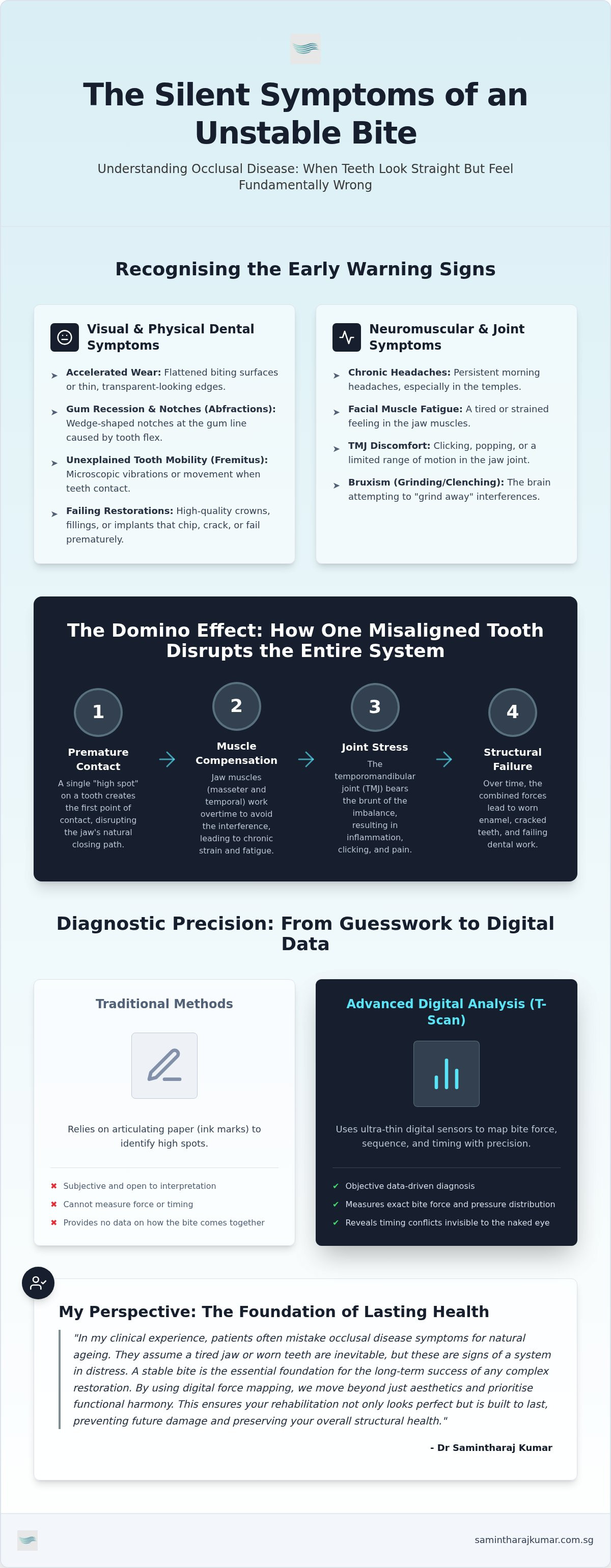
I encourage you to look closely at your enamel for signs of distress. Accelerated wear, such as flattened biting surfaces or edges that appear transparent and thin, indicates that your teeth are colliding rather than gliding. You might also notice gum recession or small, wedge-shaped notches at the gum line known as abfractions. These aren't typically caused by aggressive brushing; they're the result of the tooth flexing under improper pressure. This process, often referred to as occlusal trauma, can eventually lead to unexplained tooth mobility. I also look for fremitus, which are microscopic vibrations felt when your teeth make contact. If a tooth moves even slightly when you bite down, the structural integrity is being compromised.
Neuromuscular and Joint Indicators
Symptoms of occlusal disease aren't always confined to the teeth themselves. Chronic morning headaches and persistent facial muscle fatigue are classic indicators that your jaw muscles are working overtime to find a comfortable resting position. You may experience clicking, popping, or a limited range of motion in the temporomandibular joint. I frequently find a direct link between bruxism, or tooth grinding, and underlying occlusal instability. Your brain is essentially trying to "grind away" the interferences that prevent your jaw from closing in a neutral, relaxed state. Identifying these occlusal disease symptoms early allows us to intervene before the damage necessitates more invasive surgical correction, prioritising your long-term comfort and functional excellence.
The Physics of Malocclusion: Why Symptoms Manifest in the Jaw and Joint
The human masticatory system functions as a complex lever, governed by the same laws of physics as any precision-engineered machine. For the system to operate efficiently, occlusal forces must be distributed evenly across all dental surfaces upon closure. However, even a single "high spot," or a premature contact, can disrupt this entire equilibrium. This isn't just a minor dental annoyance; it's a mechanical crisis. Your masseter and temporal muscles, which act as the powerful engines of your jaw, are forced into a state of hyper-vigilance to compensate for this interference.
This constant adjustment places an immense burden on the temporomandibular joint (TMJ). As the fulcrum of the jaw, the TMJ bears the brunt of misaligned contact. This often results in the inflammation, clicking, and joint sounds that are hallmark occlusal disease symptoms. From a biological dentistry perspective, I prioritise respecting your body's natural mechanical limits. We cannot simply look at teeth in isolation. Instead, we must evaluate how the muscles and joints respond to the significant forces generated during every functional movement.
Static vs. Dynamic Interference
Static interference occurs when you simply close your mouth, but dynamic interference is often far more destructive. This happens during lateral or forward movements, such as when you're chewing or speaking. If your teeth must "slide" to find a comfortable fit upon closure, it creates significant tension in the masticatory muscles. Over time, this dynamic friction accelerates the wear of your natural teeth and compromises the structural integrity of the entire arch. If you suspect your bite is out of sync, a comprehensive diagnostic evaluation is the first step toward restoring this vital balance.
The Neuromuscular Reflex
Your brain is remarkably protective. It constantly re-programmes your muscle activity to avoid painful or jarring tooth contacts that could cause immediate trauma. While this reflex is a brilliant survival mechanism, the long-term cost of constant muscle compensation is high. It manifests as the chronic facial pain and fatigue that many patients mistakenly accept as normal. To provide a true diagnosis, I focus on finding your "Centric Relation." This is the physiologically neutral position where your joints and muscles exist in total harmony, free from the "noise" of occlusal disease symptoms. Achieving this state is essential for any successful, long-term rehabilitation plan.
Diagnostic Precision: Measuring Bite Alignment with Digital Sensors
Traditional articulation paper, while a staple for decades, has significant limitations in a modern surgical setting. It effectively marks contact points, but it cannot reveal the order in which those contacts occur or the intensity of the force applied. Relying solely on this "blue paper" test often leaves a practitioner guessing about the true nature of occlusal disease symptoms. To move beyond subjective interpretation, I prioritise real-time data provided by the T-Scan system. This digital occlusal analysis tool allows me to see exactly what is happening as your teeth meet, frame by frame.
By integrating 3D CBCT scans with digital bite mapping, I can visualise the intricate relationship between your bone structure, joint position, and dental contact. This comprehensive view ensures that we aren't just treating the surface, but addressing the underlying mechanical foundation. It allows for a level of precision that is essential when planning complex rehabilitations, ensuring that every adjustment is made with total clinical certainty.
Mapping Force and Timing
The T-Scan sensor is capable of capturing 256 distinct levels of pressure, allowing me to pinpoint destructive "heavy hits" that are invisible to the naked eye. Occlusal timing is the sequence in which teeth make contact during closure. If one side of your mouth strikes even milliseconds before the other, it can trigger a cascade of muscle tension and joint strain. Visualising the centre of force in real-time allows us to refine your bite until it achieves a balanced, healthy state that protects both your natural teeth and your long-term comfort.
AI-Assisted Diagnostics in Oral Surgery
Modern oral surgery now benefits from the integration of AI-assisted diagnostics. By using digital impressions, I create virtual articulators that simulate your jaw's unique movements with incredible accuracy. AI software helps me identify subtle patterns of wear and force distribution that human eyes might overlook. This data-driven approach is particularly vital for identifying occlusal disease symptoms in complex cases, such as full mouth rehabilitations or dental implants. It ensures every intervention is based on objective measurements rather than clinical intuition alone, leading to more predictable and enduring results.
The Domino Effect: How Untreated Symptoms Lead to Structural Failure
Left unchecked, occlusal disease symptoms don't just remain static; they initiate a progressive decline in your oral architecture. When teeth collide at incorrect angles, the resulting micro-trauma travels deep into the alveolar bone. This excessive pressure often accelerates bone resorption, a process where the body begins to break down the very foundation supporting your teeth. It's a systemic failure that can lead to tooth mobility and, eventually, total tooth loss.
The risk extends to your previous investments in dental health. I frequently see patients whose high-end crowns or veneers have fractured prematurely because their bite was never properly calibrated. This structural instability can even lead to a loss of vertical dimension, resulting in a prematurely aged appearance known as facial collapse. Understanding the link between bite health and preventing facial collapse with dental implants is vital. Recognising these occlusal disease symptoms early is the most effective way to protect your smile and ensure structural rejuvenation.
Occlusal Trauma and Dental Implants
Dental implants require even greater diagnostic scrutiny than natural teeth. Unlike natural teeth, which use a flexible periodontal ligament as a shock absorber, implants fuse directly to the jawbone. This means they cannot "give" under heavy pressure; they're essentially hard-wired to your skeleton. Ensuring balanced force distribution on ceramic dental implants is essential to prevent bone loss, or peri-implantitis. Precision bite alignment is the only way to ensure the longevity of your full-mouth reconstruction.
The TMJ Connection
When teeth don't fit together, the jaw joint is forced to compensate for every chew. Over time, this constant strain leads to degenerative changes, like the displacement of the protective TMJ disc. This painful progression often necessitates a transition to TMJ specialist care to manage inflammation and cartilage damage. I always advocate for restoring the mechanical foundation before treating the secondary symptoms. Request a specialist bite assessment today to halt this domino effect before it compromises your long-term structural health.
My Perspective: Why Total Rehabilitation Begins with Occlusal Stability
In my clinical experience, chasing aesthetics without first establishing functional stability is like building a house on sand. I've seen many patients arrive at my practice with beautifully crafted veneers that have shattered or dental implants that are struggling, simply because the underlying bite was never addressed. My philosophy of "Biological Occlusion" is rooted in the belief that we must respect the harmony of the entire system. We aren't just fixing teeth; we're restoring a complex mechanical and biological relationship between the nerves, muscles, and bone to ensure your health lasts a lifetime.
I believe a specialist diagnosis is the most critical step in any patient's journey toward wellness. Identifying occlusal disease symptoms early allows us to create a meticulous roadmap for long-term health rather than just reacting to individual failures as they occur. Innovation and AI play a central role in this process, providing the predictable, data-driven outcomes that my patients expect and deserve. By removing the guesswork from bite alignment, we can achieve a level of precision that protects your investment and your comfort for decades to come.
The Surgeon-Founder Approach
As the founder of this practice, I've prioritised the standardisation of diagnostic protocols to ensure clinical excellence at every level of care. My commitment to continuous education in advanced occlusal science allows me to integrate the highest global standards into our daily surgical and rehabilitative procedures. I treat the mouth as a dynamic ecosystem rather than a collection of isolated parts. This means every restoration, from a single crown to a full mouth rehabilitation, is planned with a deep understanding of how it will interact with the surrounding tissues and the opposing arch under functional loads.
A Vision for Functional Excellence
My vision for your care moves beyond simple pain management toward total structural rejuvenation. The transformative power of a stable, comfortable bite on your daily quality of life cannot be overstated. When your jaw exists in its natural, neutral position, chronic tension dissolves and your smile functions with effortless grace. The best outcomes always begin with a profound understanding of the root cause behind your occlusal disease symptoms. If you're seeking a permanent solution to persistent dental frustrations, I'm here to guide you toward a legacy of health and functional excellence. Understanding your unique structural needs is the first step toward a restorative plan that truly stands the test of time.
Restoring Your Foundation for Lasting Health
Achieving a harmonious bite is about far more than just a straight smile; it's about ensuring the mechanical longevity of your entire oral system. We've explored how seemingly minor occlusal disease symptoms, such as morning headaches or worn enamel, are often the first indicators of a deeper structural failure. By prioritising functional stability through advanced digital diagnostics and biological dentistry, we can halt the destructive domino effect that leads to bone loss and fractured restorations.
As a specialist surgeon focused on complex rehabilitation, I've dedicated my practice to providing the precision required for total jaw health and TMJ management. My founder-led approach combines clinical mastery with state-of-the-art technology to ensure that every restoration is built on a stable, predictable foundation. The best outcomes begin with understanding the root cause. I invite you to discover our approach to structural harmony and take the first step toward a life free from dental tension. Your journey toward functional excellence and emotional renewal starts with a commitment to comprehensive care.
Frequently Asked Questions
What are the most common occlusal disease symptoms?
The most common occlusal disease symptoms include flattened or worn enamel, chronic morning headaches, and recurring fractures in dental restorations. You might also notice gum recession or a clicking sensation in the jaw joint. These signs indicate that your teeth and muscles are struggling to find a stable resting position. Early identification is essential to prevent the progressive destruction of your natural tooth structure and the failure of previous dental work.
Can occlusal disease cause permanent damage to my jaw joint?
Yes, untreated occlusal disease can lead to permanent degenerative changes within the temporomandibular joint. Constant mechanical strain can cause the protective disc to displace or the cartilage to wear down prematurely. This often results in chronic pain and a restricted range of motion. I focus on restoring structural harmony early to avoid the need for more invasive surgical interventions later in the joint's degenerative cycle, protecting your long-term comfort.
Is a digital bite evaluation painful or invasive?
A digital bite evaluation is entirely non-invasive and painless. I use a T-Scan system, which involves you biting onto a thin, flexible sensor that records pressure and timing data in real-time. It's a quick process that provides far more detail than traditional paper tests. Most patients find it comfortable and are fascinated to see the digital map of their own bite forces displayed instantly on the clinical monitor during their consultation.
How does occlusal disease affect dental implants?
Dental implants are particularly sensitive to occlusal forces because they don't have the natural shock-absorbing ligament found in natural teeth. If your bite is misaligned, an implant can experience "heavy hits" that trigger bone resorption or peri-implantitis. I prioritise a comprehensive bite assessment as a prerequisite for any implant procedure. This ensures your investment is protected by a balanced, functional environment that supports the long-term structural success of your restoration.
Can my bite change even if I have already had orthodontic treatment?
Your bite can certainly change over time, even after successful orthodontic treatment. Factors such as the natural ageing process, the loss of a tooth, or persistent bruxism can cause teeth to shift. While orthodontics focuses on the aesthetic alignment of the arches, it doesn't always address the dynamic functional relationship of the bite. I often see patients who require minor occlusal adjustments to maintain the stability and comfort achieved during their earlier treatment.
What is the difference between a general dentist and a specialist for bite issues?
A specialist brings a deeper level of training in complex rehabilitation and neuromuscular function. While a general dentist handles routine care, a specialist utilises advanced diagnostic tools like T-Scan to measure force distribution with surgical precision. My approach integrates biological dentistry and TMJ expertise to treat the mouth as a dynamic ecosystem. This ensures that we address the root cause of structural failure rather than just repairing the visible damage to the teeth.
How long does it take to treat occlusal disease symptoms?
The timeline for treating occlusal disease symptoms depends entirely on the severity of the structural imbalance. Minor interferences can often be resolved in a single appointment through selective reshaping of the enamel. However, more complex cases involving full-mouth rehabilitation or joint stabilisation may require several months of carefully staged care. I focus on a meticulous diagnostic phase first, as this ensures the treatment plan is predictable and provides a lasting, comfortable outcome for the patient.
Will insurance cover the cost of a specialist bite assessment?
Insurance coverage for a specialist bite assessment remains inconsistent. While dental plans often have limitations, medical insurance is sometimes more likely to provide coverage if the condition is linked to a diagnosed temporomandibular disorder. I recommend reviewing your specific policy for exclusions related to TMJ or occlusal therapy. My team can provide the detailed clinical documentation and diagnostic codes required to help you navigate your provider's reimbursement process with clarity and confidence.


Comments