
Biocompatible Dental Implants for Allergies: A Specialist’s Guide to Metal-Free Restoration

What if the very material designed to restore your smile was actually the source of your body's silent distress? While titanium has long been the industry standard, research from the MELISA diagnostics group suggests that up to 15% of the population may experience sensitivities to various metals used in medical devices. You likely believe that a dental implant should be a permanent, worry-free solution, yet the fear of chronic inflammation or implant rejection often creates a barrier to your care. It's a concern I address daily as a clinician and founder at Nuffield Dental.
In this guide, I'll explain how biocompatible dental implants for allergies provide a biologically harmonious solution, written from my perspective as a specialist surgeon. We'll explore the science behind ceramic materials and how they integrate with your immune system without triggering systemic responses. You'll gain clarity on the clinical reality of metal-free restoration versus common marketing claims. My aim is to replace confusion with clinical confidence, ensuring your treatment aligns with your body's natural chemistry for a truly seamless, life-changing result.
Key Takeaways
Understand why traditional titanium may trigger sensitivities in certain individuals and how we define true biocompatibility to ensure a harmonious host response.
Discover why Zirconia has become the gold standard for biocompatible dental implants for allergies, offering a non-metal, bio-inert alternative that resists corrosion.
Explore the "White Advantage" of ceramic restorations, which eliminates greyish shadows at the gum line while promoting systemic health through biological harmony.
Gain insight into my clinical philosophy of Total Rehabilitation, where we integrate oral surgery with immunology to provide a specialised screening process for allergy-prone patients.
Learn how a patient-centred, biological approach to implantology ensures the long-term longevity of your restoration and enhances your overall quality of life.
Table of Contents Understanding Biocompatibility: Why Metal Allergies Matter in Modern Implantology The Biological Shift: Why Ceramic (Zirconia) is the Gold Standard for Sensitive Patients Beyond Allergies: The Systemic and Aesthetic Benefits of Ceramic Implants My Clinical Philosophy: Total Rehabilitation for the Allergy-Prone Patient The Future of Care: Long-Term Quality of Life with Biocompatible Solutions
Understanding Biocompatibility: Why Metal Allergies Matter in Modern Implantology
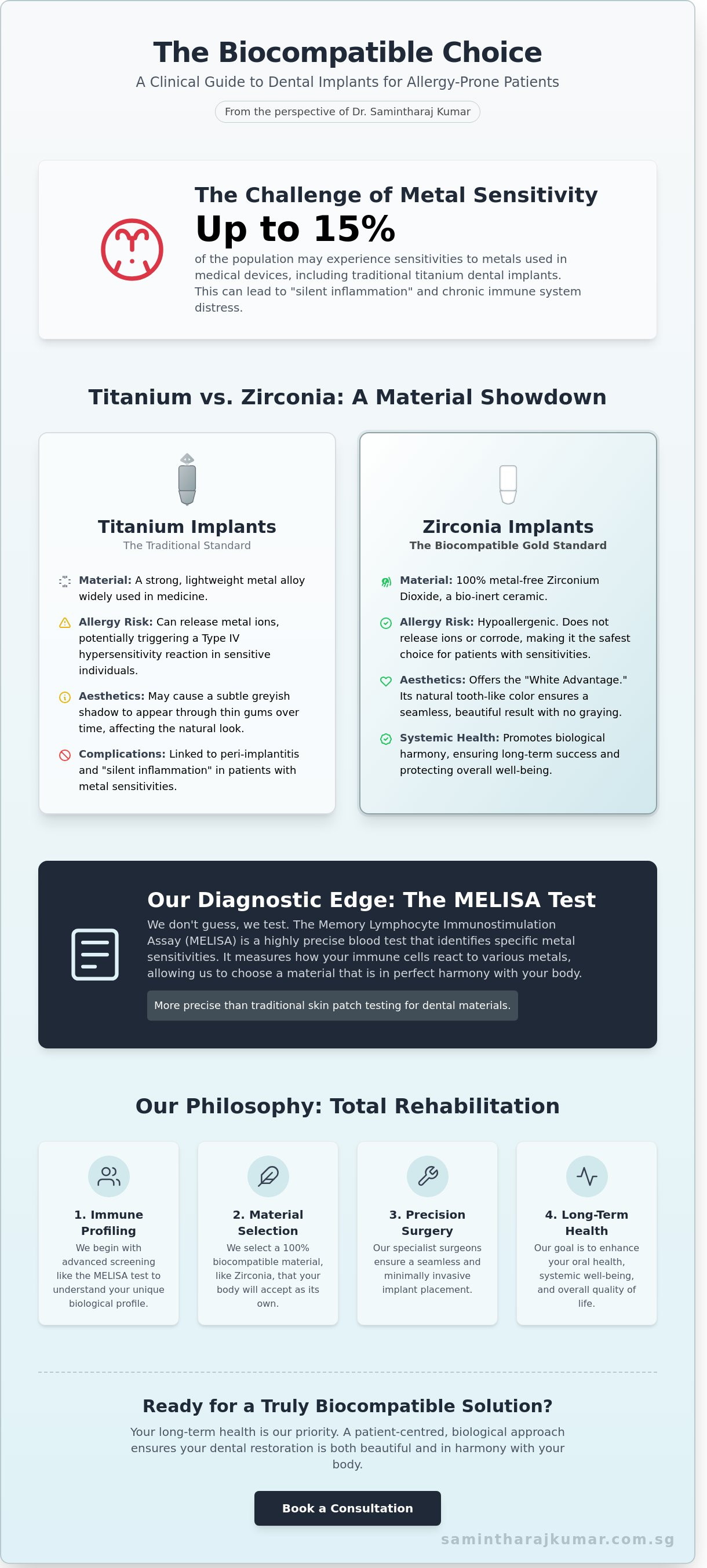
Biocompatibility isn't just a technical term; it's the fundamental ability of a material to perform within your body without triggering an adverse host response. While Modern dental implants have traditionally relied on titanium, we're seeing a significant shift in how we approach the biological interface. Titanium is widely regarded as the gold standard, yet a specific subset of the population experiences sensitivities that can compromise the entire restorative process. From a biological perspective, I often encounter what I call "silent inflammation." This occurs when metal ions are released into the oral cavity, causing the immune system to remain in a state of chronic high alert.
In my clinical experience, the immune system’s response to dental materials is often the most overlooked factor in long-term implant success. Choosing biocompatible dental implants for allergies is no longer a niche preference, but a clinical necessity for patients with hyper-reactive immune systems.
To better understand the nuances of metal sensitivity in dentistry, watch this helpful video:
The Science of Metal Sensitivity and MELISA Testing
At Nuffield Dental, we rely on the Memory Lymphocyte Immunostimulation Assay (MELISA) to identify specific triggers. This blood test is significantly more precise than traditional skin patch testing for dental applications. It measures how your white blood cells react to specific metals, such as nickel, cobalt, and chromium, which are often present in trace amounts in various dental alloys. The biological mechanism is complex. When metal ions migrate into the surrounding soft tissue, they can trigger a Type IV hypersensitivity reaction. This isn't just a local issue; it can lead to systemic immune fatigue that many clinicians fail to connect to the mouth.
Clinical Consequences of Ignoring Biological Compatibility
Ignoring these sensitivities leads to avoidable complications. Symptoms of metal-induced failure aren't always obvious. They often manifest as chronic redness, persistent swelling, or a vague sense of discomfort that traditional X-rays cannot explain. We've identified a clear link between metal sensitivity and peri-implantitis, where the body's inflammatory response accelerates bone loss around the fixture.
As a clinician and founder, I believe a specialist surgeon must prioritise immune profiling before the first incision. Utilising biocompatible dental implants for allergies ensures the body accepts the restoration as part of its own structure rather than an intruder. My Perspective: The right diagnosis changes everything. We aren't just replacing missing teeth; we're protecting your systemic health and ensuring that your transformation is both seamless and sustainable. The best outcomes begin with understanding the root cause of your body's unique requirements.
The Biological Shift: Why Ceramic (Zirconia) is the Gold Standard for Sensitive Patients
In my clinical experience, the transition toward Zirconium Dioxide (Zirconia) represents a fundamental evolution in how we treat patients with systemic sensitivities. For those seeking biocompatible dental implants for allergies, Zirconia is the definitive gold standard because it's a non-metal, ceramic material that's inherently hypoallergenic. Unlike metals that may release ions into the surrounding tissue, Zirconia is bio-inert. It doesn't interact with the body’s chemistry in a way that triggers an immune response, providing a level of security that traditional materials often lack.
From a biological perspective, the distinction between "bio-inert" and "bio-active" is vital. While metals have a bio-active potential for corrosion, Zirconia remains stable. To ensure the highest safety standards, I rely on rigorous biocompatibility testing for dental implants to confirm that every component is suitable for the patient’s unique physiology. In our 2026 protocols, we prioritise 100% metal-free components, ensuring that every element, from the implant body to the prosthetic abutment, is free from metallic triggers.
Zirconia vs. Titanium: A Molecular Comparison
The primary advantage of Zirconia lies in its resistance to electrochemical corrosion, often referred to as galvanism. In a moist environment like the mouth, dissimilar metals can create small electrical currents, which may exacerbate sensitivities. Zirconia doesn't conduct electricity, effectively eliminating this risk. Furthermore, the surface characteristics of ceramic are superior for soft tissue health. Studies have shown that ceramic surfaces discourage bacterial plaque adhesion significantly more than titanium, reducing the risk of peri-implantitis.
We utilise modern Y-TZP (Yttria-stabilised Tetragonal Zirconia Polycrystal), a material engineered for high fracture toughness. This ensures that while the material is metal-free, it doesn't sacrifice the structural integrity required for long-term masticatory function. It’s a seamless blend of strength and biological harmony.
The Role of AI in Biological Diagnostics
As we move into 2026, the integration of AI-assisted diagnostics has transformed how I plan these restorations. We use sophisticated AI algorithms to map bone density with high precision, predicting exactly how a patient’s unique bone structure will integrate with the ceramic surface. This data allows us to use 3D digital planning to ensure minimally invasive placement, which is crucial for reducing the systemic stress on a sensitive patient.
"As a clinician and founder, I believe AI is the bridge between advanced materials and predictable biological outcomes." By removing the guesswork from the integration process, we can achieve results that are both aesthetically beautiful and biologically sound. Understanding the root cause of your sensitivity is the first step toward a successful, long-term restoration that respects your body’s natural balance.
Beyond Allergies: The Systemic and Aesthetic Benefits of Ceramic Implants
While many patients initially seek biocompatible dental implants for allergies, the advantages of metal-free restorations extend far beyond simple sensitivity management. In my clinical experience, choosing zirconia is a decision rooted in systemic health and long-term aesthetic stability. From a biological perspective, the body doesn't just tolerate ceramic; it integrates with it in a way that metal cannot replicate. This is why I often recommend these solutions even to patients without known metal sensitivities. The objective is to create an environment where the oral microbiome remains balanced and the immune system stays unburdened.
Recent research into the Biocompatibility of Zirconia Implants confirms that these materials exhibit significantly lower bacterial adhesion than titanium. This is a critical factor in preventing peri-implantitis, a leading cause of implant failure. By choosing a material that naturally repels plaque, we're investing in the longevity of the restoration and the patient's overall wellness. It's a proactive approach to oral health that prioritises the body's natural state.
Gum Health and Soft Tissue Harmony
Zirconia promotes a superior biological width, which is the protective seal between your gum tissue and the tooth structure. Gums don't just sit next to ceramic; they thrive around it. In my practice, I've observed a reduced risk of gum recession compared to traditional metal implants. This is particularly vital for patients with thin biotypes, where the gum tissue is naturally delicate. Because ceramic is non-corrosive, it doesn't trigger the chronic inflammatory response that can sometimes lead to tissue retreat over time. It's about achieving a state of soft tissue harmony that looks and feels natural.
Aesthetic Excellence and Natural Transformation
The White Advantage of ceramic is undeniable. Traditional titanium implants can often leave a greyish shadow at the gum line, especially if the tissue is thin or if recession occurs. Zirconia eliminates this risk entirely. Its light-transmitting properties mimic natural tooth dentin, allowing for a level of translucency that metal-based crowns simply cannot achieve. For smile makeovers in the aesthetic zone, ceramic is essential. It allows us to create a seamless transition between the implant and the surrounding natural teeth, ensuring that the restoration is indistinguishable from the original dentition.
My Perspective: The Founder’s Insight
As a clinician and founder, I view dental implants not just as mechanical replacements, but as biological integrations. My philosophy centres on Total Rehabilitation, where the health of the mouth is inseparable from the health of the body. When we use biocompatible dental implants for allergies, we aren't just avoiding a reaction; we're choosing a premium material that respects the body's complex physiology. I've seen how this choice transforms a patient's confidence. They aren't just getting their smile back; they're gaining peace of mind that their restoration is in total alignment with their systemic health. The best outcomes begin with understanding the root cause.
My Clinical Philosophy: Total Rehabilitation for the Allergy-Prone Patient
I believe that oral health is the gateway to systemic wellness. At Nuffield Dental, my approach to biological dentistry isn't just about replacing teeth; it's about safeguarding the immune system. We look beyond the jawbone to understand how the body interacts with foreign materials. This multidisciplinary view unites oral surgery with immunology to ensure every restoration supports long-term health. It's a philosophy rooted in Dental Implant Singapore: A Specialist’s Perspective on Total Oral Rehabilitation, where we prioritise the biological compatibility of every component we use. As a clinician and founder, I've seen how total rehabilitation transforms lives when we respect the body's natural chemistry.
Pre-Surgical Screening and Immune Profiling
The journey to a metal-free smile begins with rigorous data. I don't believe in guesswork when it comes to your immune response. Our screening process follows three definitive steps:
Step 1: We begin with a comprehensive consultation. I review your full medical history and systemic health markers to identify potential sensitivities.
Step 2: We use objective data. This includes blood tests or MELISA screening to confirm material compatibility before any surgery occurs.
Step 3: Digital 3D scans allow me to assess bone volume and plan the biological architecture with sub-millimetre precision.
The Surgical Protocol for Ceramic Implants
Placing ceramic implants requires a different level of finesse. Since zirconia is a crystalline structure, it demands specific torque settings and handling techniques that differ from traditional titanium. In my clinical experience, the material's inert nature is its greatest strength, but it requires a surgeon who understands its unique physical properties. I utilise Platelet-Rich Fibrin (PRF), derived from your own blood, to accelerate natural healing and tissue regeneration. This biological boost means recovery is often faster. Patients typically report significantly less inflammation compared to traditional metal methods. Using biocompatible dental implants for allergies ensures the body accepts the new root without a chronic inflammatory response.
The results are life-changing. When we remove the burden of metal sensitivity, the body can finally focus on healing rather than fighting a foreign invader. This holistic, metal-free approach provides more than just a smile; it restores the quality of life you deserve. I've found that patients who choose this path experience a profound sense of relief, knowing their dental health is in total alignment with their systemic wellbeing. The best outcomes begin with understanding the root cause.
The Future of Care: Long-Term Quality of Life with Biocompatible Solutions
The field of implantology is undergoing a fundamental shift. We're moving away from a purely mechanical approach toward a biological, patient-centred model. In my clinical experience, patients are increasingly aware of how oral health impacts their entire system. Ceramic implants represent this evolution perfectly. When managed with specialist care, these implants offer longevity comparable to traditional options. Clinical data indicates that zirconia implants maintain high success rates, often exceeding 97% in long-term follow-ups, provided the surgical protocol is precise and the patient's biological profile is respected.
From a biological perspective, the transition to metal-free dentistry is about more than avoiding a reaction. It's about systemic harmony. By removing the risk of galvanic currents and metal ion release, we support the body's natural healing processes. This shift reflects a broader commitment to total rehabilitation, where the goal is a seamless integration of technology and biology. The result is a restoration that feels and functions like a natural part of the anatomy.
Life-Changing Results: Beyond the Surface
A smile isn't just about aesthetics; it's about functional and biological peace. Many patients come to me with a history of sensitivities that have left them hesitant about traditional surgery. For these individuals, biocompatible dental implants for allergies provide more than just a tooth replacement. They offer the profound peace of mind that comes from knowing no foreign metals are residing in their body. This choice eliminates the psychological burden of worrying about long-term toxicity or chronic inflammation.
Achieving these results requires a specialist who understands the nuances of complex oral surgery. The placement of ceramic materials is technique-sensitive. It demands a surgeon who respects the bone's limits and the soft tissue's delicate response. When we get this right, the transformation is total, restoring both the bite and the patient's confidence in their own health.
My Perspective: Why I Chose the Biological Path
As a clinician and founder, I transitioned to offering advanced ceramic options because I saw a clear need for a more ethical, innovative approach. I've always believed that dentistry should not exist in a vacuum, separate from the rest of the medical field. My vision for Nuffield Dental is to remain a leader in this space, setting a benchmark for what modern, responsible healthcare looks like in Singapore and across Southeast Asia.
"The best outcomes begin with understanding the root cause of sensitivity, ensuring the treatment respects the body’s natural limits."
This philosophy guides every decision we make. By prioritising biocompatible dental implants for allergies, we're contributing to a larger nation-building effort. We're not just fixing teeth; we're raising the national standard of healthcare. We're ensuring that our patients have access to global protocols that prioritise longevity and systemic well-being. The future of care is one where every patient feels heard, safe, and empowered by the technology we use to heal them. The right diagnosis changes everything.
Restoring Health Through Biological Harmony
In my clinical experience, the shift toward metal-free restoration isn't just a trend; it's a necessary evolution for patient safety. As a specialist in complex dental implantology and oral surgery, I've seen how ceramic zirconia solutions eliminate the systemic risks associated with metal sensitivities. By choosing biocompatible dental implants for allergies, we prioritise the body's natural immune response. This ensures a seamless integration that titanium often cannot guarantee for sensitive individuals.
As the founder of Nuffield Dental Holdings, my philosophy centres on total rehabilitation. We utilise pioneer AI-assisted diagnostic protocols to map every detail of your oral anatomy before the procedure begins. This precision ensures that your journey toward a metal-free smile is predictable and transformative. The future of dental care lies in this intersection of advanced material science and biological respect, where the goal is always a lasting improvement in your quality of life.
The right diagnosis changes everything. Explore the future of biological dental care with Dr Samintharaj Kumar.
Your health deserves a solution that works in harmony with your body, and I look forward to helping you achieve that balance.
Frequently Asked Questions
Can I be allergic to titanium dental implants?
Yes, it's possible to be allergic to titanium. While it's considered highly biocompatible, clinical studies indicate that about 0.6% of the population experiences a hypersensitivity reaction to the metal. In my clinical experience, these reactions can compromise the osseointegration process, which is why I prioritise identifying these sensitivities before we begin any surgical work.
What are the symptoms of a metal allergy from a dental implant?
Symptoms typically include localised swelling, redness, or chronic inflammation around the implant site that doesn't resolve with standard hygiene. I've also observed patients presenting with systemic reactions like skin rashes, eczema, or even chronic fatigue syndrome. These signs suggest the body is struggling to accept the foreign metal, making a precise diagnosis essential for your long-term health.
Are ceramic (zirconia) implants as strong as titanium ones?
Modern zirconia implants are exceptionally robust. They possess a flexural strength exceeding 1,200 MPa, which allows them to withstand the significant biting forces of the human jaw without risk of fracture. As a clinician and founder, I've seen these ceramic restorations provide the same structural reliability as titanium while offering superior aesthetic benefits, particularly for patients with thin gum tissue.
How do I know if I need a biocompatible dental implant?
You might require biocompatible dental implants for allergies if you've ever reacted to metal jewellery, watches, or clothing fasteners. From a biological perspective, I advocate for pre-surgical screening via MELISA or Clifford Materials Reactivity Testing for any patient with a history of autoimmune disease. Identifying these sensitivities early ensures your restoration supports your systemic health rather than challenging it.
What is the success rate of ceramic dental implants compared to metal?
The success rate for ceramic implants is now remarkably high. Recent clinical reviews show a success rate of approximately 97% over a five-year period, which aligns closely with the 95 to 98% success rate traditionally associated with titanium. This data confirms that choosing a metal-free path doesn't mean sacrificing the predictability or the clinical excellence of your dental rehabilitation.
Is the procedure for ceramic implants different from traditional ones?
The surgical foundation is similar, but the technical execution requires a specialist's touch. Ceramic implants are often one-piece structures, meaning the implant and the abutment are fused. This requires me to be incredibly precise with the initial placement and angulation. We follow strict international protocols to ensure the ceramic material integrates perfectly with your bone, creating a stable foundation.
Will my insurance cover biocompatible dental implants for allergies?
Coverage depends entirely on your specific policy and provider. In my experience, some private insurers may cover the cost if we provide documented medical proof of a metal allergy from an immunologist. While I can't speak for every insurer, the trend is moving toward recognising biocompatible materials as a medical necessity for sensitive patients rather than a purely elective choice.
How long do zirconia dental implants last?
Zirconia implants are engineered to last a lifetime. Because zirconia is a bio-inert material, it doesn't corrode or trigger the inflammatory responses that can sometimes lead to bone loss around metal implants. Clinical observations suggest that with meticulous oral hygiene and regular professional maintenance, these implants can remain functional and beautiful for 20 years or more.

Comments