
Bone Grafting for Dental Implants: A Surgeon’s Perspective on Building a Biological Foundation
- Dr Samintharaj Kumar

- 7 hours ago
- 12 min read
Most people view a dental implant as a standalone fix for a missing tooth, but the reality is that an implant is only as permanent as the bone that supports it. From a biological perspective, bone grafting for dental implants is not merely an additional step; it's the fundamental investment in the structural harmony of your face. I understand that the prospect of an invasive procedure often brings a sense of anxiety, particularly when considering extended healing timelines or the variety of materials involved. It is a common concern that I address daily in my clinical experience.
In this article, I'll explain why establishing this biological foundation is essential for a stable, lifelong result and how it prevents the gradual collapse of facial volume. You'll gain clarity on the different grafting materials available and what to expect during the restorative journey. We're looking beyond the immediate surgery toward a future of functional excellence and a rejuvenated, youthful structure. By the end, you'll see how modern diagnostics allow us to plan these procedures with uncompromising precision and why this cornerstone is the key to total oral rehabilitation.
Table of Contents
Understanding Bone Resorption: Why a Strong Foundation is Essential for Dental Implants
The Biological Science of Bone Regeneration: Materials and Techniques
My Perspective: Biological Grafting and the Role of Ceramic Implants
The Patient Journey: What to Expect During and After Grafting Surgery
Structural Rejuvenation: The Long-term Impact of a Graft-Supported Smile
Understanding Bone Resorption: Why a Strong Foundation is Essential for Dental Implants
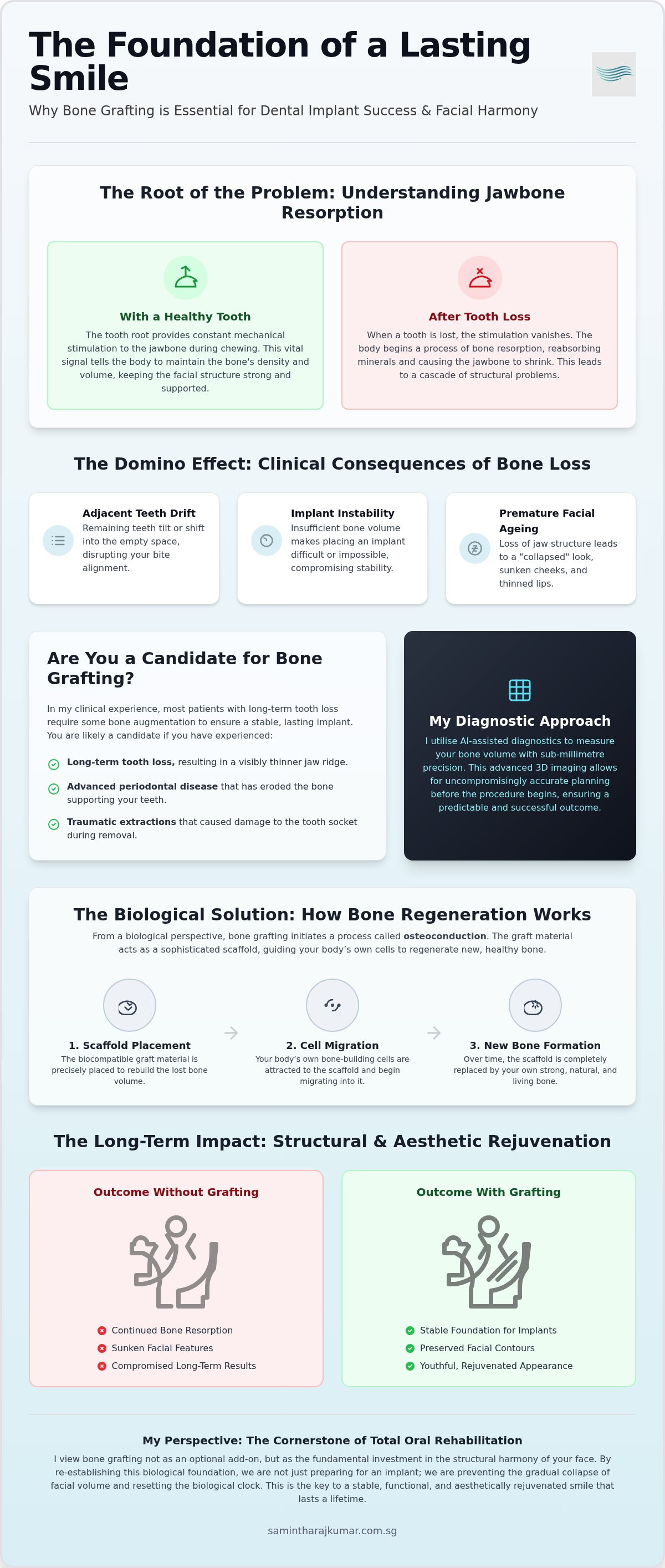
In my clinical experience, the jawbone is one of the most dynamic tissues in the human body. It requires constant mechanical stimulation, provided by the roots of your teeth during daily activities like chewing, to maintain its density and volume. When a tooth is lost, this vital signal vanishes. Without it, the body begins a natural process known as bone resorption, where it reabsorbs the jawbone minerals to use elsewhere. From a biological perspective, this isn't just a dental issue; it's a structural one that affects the entire architecture of your face.
Many patients initially turn to traditional dentures, but these often fail to address the root cause of the problem. Because dentures sit on top of the gum tissue rather than integrating with the bone, they don't provide the necessary stimulation to stop resorption. Over time, the jawbone continues to shrink, leading to a "collapsed" facial appearance where the chin and nose appear closer together. I view Bone grafting for dental implants as the only definitive way to reset this biological clock. It provides the necessary volume to support an implant, which then mimics the function of a natural root to keep the bone healthy and active.
The Clinical Consequences of Bone Loss
Significant bone loss does more than just make implant placement difficult; it compromises the stability of your remaining teeth. When the bone ridge thins, adjacent teeth may begin to tilt or drift into the empty space, shifting your entire bite alignment. This can lead to further tooth loss or chronic discomfort. When I discuss "structural rejuvenation" with my patients, I am referring to the preventative measures we take to stop this cycle of premature ageing. By restoring the bone's natural height and width, we maintain the contours of the face and prevent the sunken look that often follows tooth loss.
Am I a Candidate for Bone Grafting?
Most patients who have been missing teeth for more than a year will require some degree of augmentation. You are likely a candidate if you have experienced:
Long-term tooth loss that has led to a visible thinning of the ridge.
Advanced periodontal disease that has eroded the supporting bone.
Traumatic extractions where the socket was damaged during the tooth removal.
At Nuffield Dental, I utilise AI-assisted diagnostics to measure your bone volume with sub-millimetre precision. This technology allows me to plan bone grafting for dental implants with incredible accuracy before we even begin the procedure. It's also important to address the misconception that conditions like osteoporosis automatically disqualify you from treatment. While systemic bone density is a factor, it doesn't necessarily prevent a successful graft. With careful clinical management and the right materials, we can still build a stable foundation for your smile.
The Biological Science of Bone Regeneration: Materials and Techniques
From a biological perspective, bone is not a static material but a living, breathing tissue capable of remarkable self-renewal. When I perform bone grafting for dental implants, I am essentially initiating a process called osteoconduction. This is where the grafting material serves as a sophisticated physical scaffold, allowing your body’s own bone-building cells to migrate into the site and replace the graft with natural, healthy bone over time. A clinical overview of bone grafts in dentistry confirms that the success of this integration depends heavily on the quality of the material and the surgical environment we create.
In my clinical experience, the goal is always "Total Rehabilitation." This means I don't just look at the gap in your smile; I look at the long-term health of your entire oral ecosystem. To enhance this process, I often incorporate bio-active growth factors. These proteins, often derived from the patient's own blood, act as a biological signal to accelerate healing and improve the density of the newly formed bone. It's a meticulous approach that ensures the foundation we build today will support your smile for decades.
Choosing the Right Grafting Material
Selecting the appropriate material is a decision I make based on your specific bone architecture and lifestyle preferences. I typically categorise these into four primary groups:
Autografts: Using your own bone, usually from another area of the jaw. This remains a highly effective method because it contains your own living cells.
Allografts: Processed human donor bone that provides an excellent scaffold without the need for a second surgical site.
Xenografts: Bovine-derived minerals that are exceptionally stable. I often recommend these when we need to maintain the volume of the ridge over a long period.
Synthetic Alloplasts: These are mineral-based, biocompatible alternatives. They are a visionary choice for patients who prefer a completely metal-free or non-biological source.
Advanced Surgical Techniques
The timing and technique of the graft are just as important as the material itself. Socket preservation is a clinical priority in my practice; by grafting immediately after an extraction, we can stop bone loss before it starts. If the bone has already receded, we perform ridge augmentation to restore the necessary width and height for a natural-looking result. It's important to distinguish these procedures from sinus lift surgery for dental implants, which is a specialised technique used specifically for the upper jaw when the sinus floor is too close to the implant site.
Every patient's anatomy is unique, and understanding the root cause of your bone deficiency allows us to choose the most effective path forward for your restoration.
My Perspective: Biological Grafting and the Role of Ceramic Implants
In my clinical experience, the mouth is not a collection of isolated parts; it is an integrated biological system. As a clinician and founder, my philosophy centres on the belief that any restorative work must harmonise with the body’s natural physiology. When we discuss bone grafting for dental implants, we are talking about more than just a mechanical fix. We are creating a living foundation that must be accepted by your immune system. I uphold rigorous biocompatibility standards in my practice, ensuring that the materials we select promote healing rather than chronic inflammation. While many resources explain what to expect during a dental bone graft, my focus remains on the long-term biological integration of these materials for total oral rehabilitation.
From a biological perspective, looking beyond the surgical site to systemic health is essential. If the body is not in a state to regenerate bone, even the most precise surgery may face challenges. This is why I often pair bone grafting with a focus on nutrition and advanced diagnostics. We aren't just placing a tooth; we are restoring a lifestyle. The best outcomes begin with understanding the root cause of bone loss and addressing it through a comprehensive, patient-centred lens.
The Synergy of Bone and Ceramic
I often recommend pairing bone grafting for dental implants with ceramic (zirconia) implants for patients seeking a completely metal-free solution. Ceramic implants are bio-inert, meaning they do not corrode or trigger the same soft-tissue responses that titanium sometimes can. However, because ceramic does not have the same flexibility as metal, it requires a high-quality, dense bone foundation for optimal osseointegration. By combining a robust graft with a ceramic post, we achieve what I call "Functional Aesthetics." The white colour of the ceramic post ensures that no dark shadows appear at the gum line, even if the tissue is thin, providing a result that is both structurally sound and naturally beautiful.
Innovation in Diagnostics and Planning
A visionary approach to surgery requires planning for the final smile from day one. I utilise high-resolution 3D CBCT scanning to virtually plan the graft and implant placement before the patient even enters the theatre. This allows me to see the exact contours of the jaw and predict how the bone will respond to the graft. This level of precision is particularly vital for complex rehabilitations, such as the teeth in a day procedure explained in my other clinical guides. By using AI-assisted diagnostics, we remove the guesswork, ensuring that the biological foundation we build is perfectly aligned with the final aesthetic goal. The right diagnosis changes everything.
The Patient Journey: What to Expect During and After Grafting Surgery
Understanding the timeline of restoration is essential for peace of mind. As a clinician and founder, I ensure every patient knows that while biology takes time, the process is managed with meticulous care. In my clinical experience, the journey is a logical progression of five key stages, each designed to ensure the long-term success of your total oral rehabilitation.
Step 1: Structural Analysis. We begin with a comprehensive consultation using AI-assisted diagnostics to map your jaw with sub-millimetre precision.
Step 2: The Procedure. The graft is placed with surgical precision. My focus is on minimising tissue trauma to facilitate faster healing.
Step 3: Soft Tissue Integration. Over the first 14 days, the gums close and heal. This is the initial protective phase.
Step 4: Bone Maturation. Over three to six months, the graft material is replaced by your natural bone. This is where the biological foundation is truly built.
Step 5: Final Restoration. Once maturation is complete, we place the dental implant into a rock-solid foundation.
Managing Comfort and Anxiety
I am acutely aware that the prospect of surgery can be intimidating. However, most of my patients report that the discomfort is significantly less than that of a simple extraction. We achieve this through advanced surgical techniques and the use of sedation dentistry. This ensures a quietly premium and stress-free experience, allowing you to remain relaxed throughout the procedure. I take personal accountability for your well-being, and I remain closely involved in every step of your post-operative journey to ensure your recovery is as smooth as possible.
Long-term Healing and Osseointegration
From a biological perspective, we cannot rush the body’s natural healing rhythm. The three to six month waiting period is a clinical necessity for osseointegration, the process where bone grows around the restorative site. If we were to skip bone grafting for dental implants when it is indicated, the risks would be substantial. Without adequate bone volume, implants are prone to failure, and the patient may suffer from the aesthetic and functional consequences of bone loss. I often discuss the importance of preventing facial collapse with dental implants with my patients, as a well-supported ridge is the only way to maintain a youthful facial structure.
Success is measured through radiographic density and the health of the surrounding tissues. The best outcomes always begin with a comprehensive assessment of your unique biological needs.
Structural Rejuvenation: The Long-term Impact of a Graft-Supported Smile
In my clinical experience, the most profound transformations occur when we look beyond the immediate surgical site and consider the architecture of the entire face. Restoring the jawbone to its natural height and width is not merely a technical requirement for implant stability; it is an act of structural rejuvenation. When we lose bone, we lose the internal support that holds our facial features in place. By performing bone grafting for dental implants, I am able to rebuild that lost volume, providing a firm scaffold that supports the lips and cheeks from within. This effectively reverses the sunken appearance often associated with "dental ageing," allowing my patients to retain their natural facial identity as they grow older.
From a biological perspective, the psychological impact of this restoration is significant. There is a deep sense of security that comes from knowing your dental work isn't a temporary mask, but is built upon a permanent, living foundation. It's the difference between a quick fix and a lifelong legacy of health. I believe that true clinical mastery lies in this intersection of biology and aesthetics, where we restore not just a smile, but a person’s confidence in their own reflection.
Beyond the Teeth: Facial Harmony
The relationship between jaw structure and facial harmony is the essence of what I call "Functional Aesthetics." A well-grafted ridge allows for the most natural-looking results, ensuring that the final crown emerges from the gum line exactly like a natural tooth. In the context of cosmetic dentistry singapore, I always emphasise that the most beautiful ceramic restorations are those supported by healthy bone volume. This visionary approach to surgery ensures that we aren't just treating a gap; we are preserving the harmony of your facial proportions for the long term.
Investing in Total Rehabilitation
As a clinician and founder, I view the decision to undergo bone grafting as a strategic investment in your future well-being. While it requires patience during the maturation phase, it's an investment that prevents the need for complex corrective surgeries later in life. The quality of life benefits are immense. When your implants are anchored into a rock-solid, grafted foundation, you gain absolute confidence in chewing, speaking, and smiling. You aren't constantly worrying about the stability of your teeth; you're simply living your life. My final principle remains the same: the best outcomes begin with understanding the root cause. By addressing bone loss at its biological source, we ensure a result that is as enduring as it is beautiful. The right diagnosis changes everything.
Building Your Biological Legacy
Building a foundation for a lifelong smile requires a shift in perspective, moving from a simple mechanical replacement to a vision of total oral rehabilitation. In my clinical experience, the success of any restorative journey depends entirely on the integrity of the underlying anatomy. We've explored how bone grafting for dental implants serves as the essential biological cornerstone for this process, preventing the natural progression of bone resorption and preserving the youthful contours of your face.
As a clinician and founder, I remain committed to upholding global standards of care through the use of ceramic implant protocols and precision AI diagnostics. By choosing to invest in this biological foundation, you aren't just replacing missing teeth; you're securing your facial identity and long-term functional excellence. The journey toward a renewed smile is a partnership between surgical mastery and the body's remarkable ability to regenerate living tissue. I believe that every patient deserves a result that is as structurally sound as it is aesthetically harmonious.
I look forward to helping you restore not just your smile, but your confidence in a healthy, vibrant future.
Common Questions Regarding Bone Grafting
Is bone grafting for dental implants painful?
The procedure is typically not painful because we perform it under local anaesthesia or advanced sedation dentistry. In my clinical experience, most patients report that the sensation is significantly less intense than a routine tooth extraction. While you may feel some pressure during the surgery, the primary focus is on your comfort. After the numbing wears off, any minor tenderness is easily managed with standard post-operative care and medication.
How long does it take for a dental bone graft to heal before I get my implant?
The maturation phase usually requires between three and six months. From a biological perspective, we cannot rush the process of osteoconduction, where your body’s own cells gradually replace the graft with living bone. The exact timeline depends on the volume of the graft and your individual healing capacity. I use precision diagnostics to monitor the site and ensure the foundation is rock-solid before we proceed with the final implant placement.
Can my body reject a dental bone graft?
True biological rejection is extremely rare because bone grafts are not living tissue like organ transplants. Instead, the graft acts as a biocompatible scaffold. When a graft fails to integrate, it's usually due to factors like smoking, uncontrolled systemic issues, or a local infection rather than an immune rejection. I uphold rigorous clinical standards and biocompatibility protocols to ensure your body accepts the material and integrates it into your natural jaw structure.
Where does the bone for the graft come from?
Grafting materials are sourced from four primary categories: your own bone, human donor bone, bovine-derived minerals, or synthetic alloplasts. In my practice, I select the material based on your unique anatomy and restorative goals. For instance, I often recommend mineral-based synthetics for patients seeking a metal-free, biological approach. Each material is processed to the highest international safety standards to ensure it's sterile and highly effective for bone regeneration.
Will I need a bone graft if I just had my tooth extracted?
Not every extraction requires a graft, but I often recommend socket preservation to prevent immediate bone resorption. When a tooth is removed, the surrounding bone begins to shrink almost instantly because it's no longer being stimulated. By placing a small amount of grafting material at the time of extraction, we maintain the ridge's width and height. This proactive step often simplifies the future placement of bone grafting for dental implants.
What happens if I choose not to have a bone graft?
Choosing to forgo a necessary graft can lead to the eventual failure of your dental implant. Without adequate bone volume, the implant cannot achieve proper osseointegration, which may lead to instability or infection. Furthermore, the lack of bone support causes the overlying gum tissue to recede, often resulting in a sunken facial appearance. This structural collapse can make future restorative efforts much more complex and significantly more expensive to correct.
Are there any risks associated with dental bone grafting?
Like any surgical intervention, bone grafting carries minor risks such as infection, swelling, or graft instability. However, these complications are rare when the procedure is performed by a specialist using advanced diagnostics and sterile techniques. In my clinical experience, the vast majority of patients enjoy a smooth, predictable recovery. We manage these risks through meticulous planning and by providing you with a comprehensive post-operative programme to support your biological healing.
How much does bone grafting typically cost for a dental implant?
The cost of the procedure is determined by the complexity of the site and the volume of material required. A simple socket preservation performed at the time of extraction is naturally different from a complex ridge augmentation or a sinus lift. Because every patient’s biological foundation is unique, a comprehensive consultation is the only way to provide an accurate assessment. I focus on providing a transparent, value-led diagnosis that prioritises your long-term structural integrity.


Comments