
Causes of Jaw Locking: A Specialist Surgeon’s Perspective on TMJ Health
- Dr Samintharaj Kumar

- Aug 12
- 11 min read
What if that sudden, frightening sensation of your jaw sticking isn't just a random glitch, but a precise mechanical signal from your body that requires a specialist's eye? I've met many patients who describe the immediate anxiety of being unable to eat or speak comfortably, often while enduring a dull ache that spreads toward the ear and neck. It's a deeply personal struggle that impacts every social interaction and basic daily necessity. Understanding the underlying causes of jaw locking is the first step toward reclaiming your confidence and long-term physical comfort.
You're likely searching for answers because you've felt the frustration of a joint that simply won't cooperate. In my clinical experience, these issues are rarely isolated; they're often the result of complex interactions between the joint-disc complex and chronic muscular tension. I'll guide you through the biological reasons behind these disruptions and show how a specialist approach to oral rehabilitation can provide a lasting solution. We'll explore everything from disc displacement to advanced diagnostic protocols, ensuring you have a clear path back to functional excellence.
Table of Contents
Understanding Jaw Locking: More Than Just a Tight Muscle
A jaw that suddenly refuses to move is never just a minor inconvenience. In my clinical experience, patients often confuse simple muscle fatigue with true jaw locking, assuming that a bit of rest will resolve the issue. However, when the simple act of opening your mouth becomes a physical impossibility, we're looking at a significant mechanical or biological failure. Identifying the precise causes of jaw locking is the only way to move beyond temporary relief toward a permanent, functional solution.
Losing the ability to speak or eat without restriction carries a profound emotional weight. It isn't just about the physical pain; it's the sudden loss of autonomy and the anxiety of not knowing if your jaw will ever feel "normal" again. As a clinician and founder, I view this sudden loss of mobility as a critical clinical signal. It's your body's way of demanding immediate specialist attention to prevent acute interference from becoming a chronic, degenerative condition.
Trismus vs. TMJ Locking
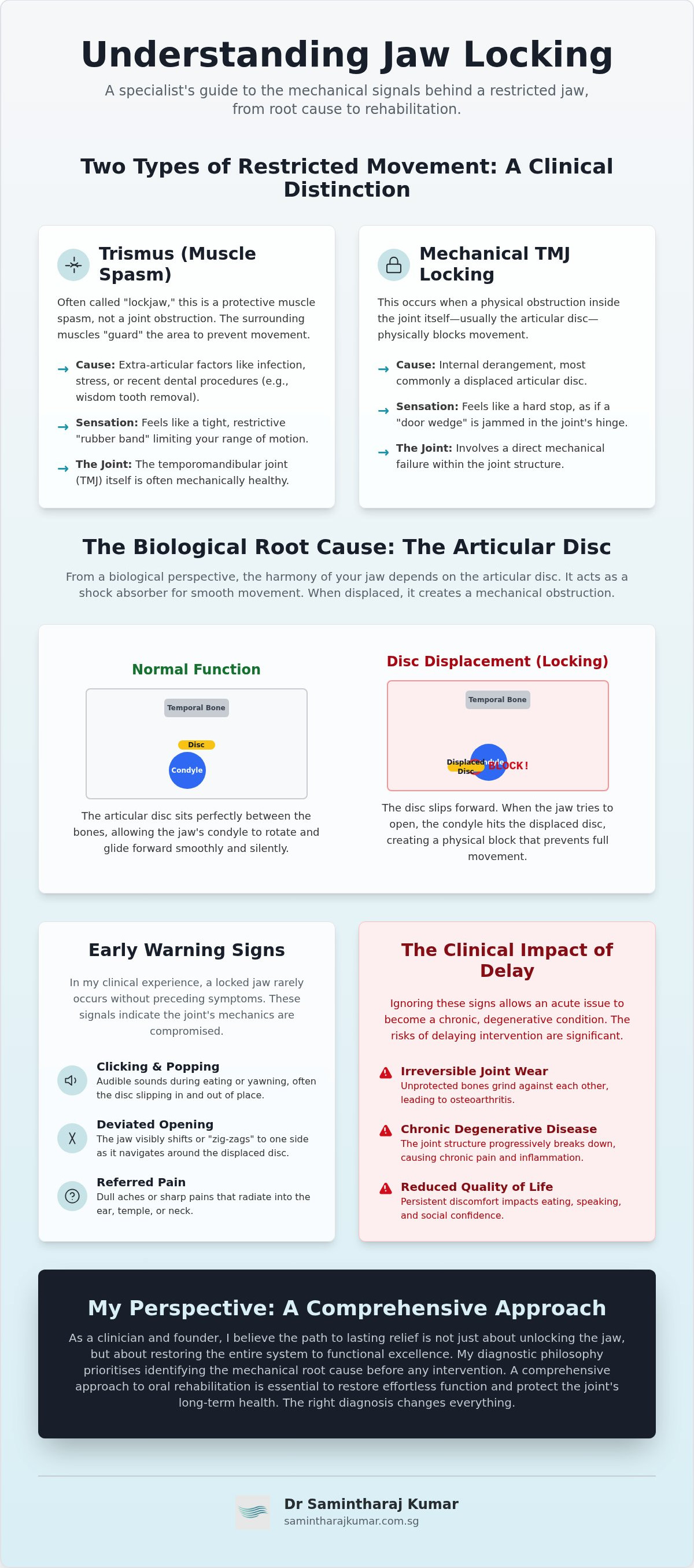
It's vital to distinguish between a protective muscle spasm and a physical obstruction. Trismus, often colloquially called "lockjaw," is frequently a secondary response to external stimuli like a recent wisdom tooth extraction, an infection, or even high levels of acute stress. Trismus is a restricted range of motion caused by extra-articular factors. In these cases, the joint itself might be healthy, but the surrounding muscles have "guarded" to prevent further movement.
Mechanical TMJ locking is different. This occurs when something inside the joint, usually the articular disc, has shifted out of place and is physically blocking the hinge from rotating or sliding. While trismus might feel like a tight rubber band, mechanical locking feels like a door wedge jammed into a hinge. Both require different clinical interventions, which is why a specialist diagnosis is non-negotiable.
Common Symptoms Accompanying the Lock
Jaw locking rarely arrives without warning. You might have noticed years of clicking, popping, or a "grating" sensation during meals. These are early indicators that the internal mechanics are struggling. Other symptoms that help us identify the root causes of jaw locking include:
Deviated Opening: Your jaw shifts or "zig-zags" to one side as you try to open it.
Referred Pain: Sharp or dull aches that radiate into the ear canal or trigger temporal headaches.
Closed Lock: The most common form, where you cannot open your mouth wide enough to eat comfortably.
Open Lock: A rarer, distressing state where the jaw becomes stuck in a wide-open position and cannot be closed.
Understanding these nuances allows us to move from guesswork to a structured plan for oral rehabilitation. The goal is always to restore the effortless, silent function that most people take for granted.
The Biological Mechanism: Why Your Jaw Mechanics Fail
From a biological perspective, the temporomandibular joint (TMJ) is one of the most sophisticated structures in the human body. Unlike a simple hinge, it performs a complex "ginglymoarthrodial" movement, meaning it both rotates and slides. This dual-action capability is what allows for the high-force demands of chewing and the intricate, delicate movements of speech. When this harmony is disrupted, the results are often painful and functionally limiting.
At the centre of this mechanism is the articular disc, a piece of dense fibrocartilage that serves as your jaw's natural shock absorber. It sits between the mandibular condyle and the temporal bone, ensuring smooth, frictionless movement. Internal derangement occurs when this disc becomes displaced. If the disc is "stuck" in front of the joint, it acts as a physical barrier that prevents the jaw from gliding forward. This mechanical obstruction is one of the most frequent causes of jaw locking that I see in my practice.
Chronic bruxism, or teeth grinding, often accelerates this failure. The constant, heavy pressure of grinding stretches the delicate ligaments that hold the disc in place. Over time, these ligaments lose their elasticity, making it easier for the disc to slip out of its optimal position and trigger a locking episode. As a clinician and founder, I've observed that joint stability is deeply intertwined with the overall health of your dentition.
Disc Displacement with and without Reduction
Many patients describe a long history of jaw clicking before a lock occurs. That "click" is the sound of the disc slipping back into its correct position during opening, a process we call reduction. However, when that clicking sound suddenly stops and is replaced by a physical inability to open the mouth, the disc has likely become permanently displaced without reduction. This progression signifies worsening pathology. Often, preventing facial collapse with dental implants is a critical part of the conversation, as maintaining the correct bite height and dental structure provides the necessary support for the joint to function without undue stress.
Inflammatory and Degenerative Causes
Not all locking is purely mechanical; some is driven by biological degradation. Inflammatory conditions like synovitis, which is the inflammation of the joint lining, can cause fluid build-up that restricts movement. Degenerative changes such as osteoarthritis can physically alter the joint surface, making it rough and prone to catching. In biological dentistry, we recognise that systemic health and inflammation levels directly impact jaw function. Addressing these factors is essential for long-term TMJ pain management and restoring your quality of life. The best outcomes begin with understanding the root cause.
The Clinical Impact: Why Ignoring a Locked Jaw Leads to Degeneration
As a clinician and founder, I've seen how delayed treatment leads to irreversible joint wear. While the initial causes of jaw locking may feel like a temporary hurdle, the long-term reality is often far more severe. When the mechanical interference of a displaced disc isn't corrected, the joint is forced to function under abnormal friction. This accelerates the transition from an acute locking episode to chronic degenerative joint disease, where the cartilage and bone begin to break down permanently.
The consequences extend beyond the joint itself. A restricted bite fundamentally alters your nutritional intake and digestive health. Effective mastication is the first step of digestion. When you're forced to avoid certain textures or swallow food that hasn't been properly broken down, it places an undue burden on your gastrointestinal system. We also see a significant secondary impact on dental structures. To compensate for a dysfunctional joint, patients often shift their bite, leading to accelerated tooth wear and fractured restorations that would otherwise have lasted a lifetime.
Structural Changes in the Jawbone
The most concerning structural risk is condylar resorption, a process where the head of the jawbone begins to "shrink" due to sustained, pathological pressure. This isn't just a clinical observation; it's a transformative event for a patient's appearance. A collapsed bite further complicates TMJ recovery by removing the vertical support the joint needs to rest and heal. Untreated mechanical locking can lead to permanent changes in facial symmetry, making later rehabilitation much more complex.
Psychological and Lifestyle Consequences
We cannot ignore the human element of this condition. Chronic jaw pain is a primary driver of sleep disturbances, which in turn affects cognitive function and emotional regulation. There's a specific type of anxiety that accompanies TMJ disorders. The constant fear of the jaw locking in public, perhaps during a meal or an important presentation, frequently leads to social withdrawal. It's a heavy burden to carry alone.
Restoring your function requires more than just managing symptoms. The importance of seeking a tmj specialist singapore for a definitive diagnosis is paramount. Understanding the root cause is the only way to prevent structural degeneration and reclaim the quality of life you deserve. The best outcomes begin with understanding the root cause.
My Perspective: A Comprehensive Approach to TMJ Rehabilitation
As a clinician and founder, my treatment philosophy centres on identifying the structural root cause before prescribing any intervention. When patients present with restricted mobility, they've often been told to "wait and see" or simply "relax" by general practitioners. In my clinical experience, this passive approach is often detrimental to long-term oral health. It allows the underlying causes of jaw locking to worsen, potentially leading to the bone resorption and disc damage we discussed previously. Proactive diagnostics are the hallmark of a specialist approach.
We move beyond the traditional mouthguard by utilising AI-assisted diagnostics to map joint movement and disc position in real-time. This technology allows us to see precisely where the mechanics are failing. It informs the creation of precision-engineered orthotics that do more than protect teeth; they actively decompress the joint and encourage the disc to return to a neutral position. This isn't just about symptom management; it's about re-educating the entire masticatory system for functional excellence.
Diagnostic Excellence
Establishing a definitive roadmap for recovery requires high-resolution visualisation. I utilise 3D CBCT imaging and MRI to see the joint-disc relationship with absolute clarity. This level of detail is essential for a what kind of doctor treats tmj to distinguish between muscular trismus and internal derangement. I always prioritise non-invasive stabilisation as the first line of care. Our goal is to create an environment where the body can heal without immediate surgical interference.
Advanced Clinical Interventions
When conservative measures aren't enough to restore function, we employ advanced, minimally invasive techniques. Arthrocentesis is a primary example. It's a procedure where we "flush" the joint space to remove inflammatory by-products and release the disc from its locked position. We often combine this with biological agents to reduce inflammation and promote tissue healing at a cellular level. This biological approach ensures that we aren't just fixing a hinge, but supporting living tissue.
Surgery is never the first option, but it becomes a necessary path when structural damage prevents a return to a pain-free life. Whether through arthroscopic repair or total joint replacement, the focus remains on restoring effortless function. If you are experiencing persistent mobility issues, exploring specialised TMJ pain management can prevent minor interference from becoming a life-altering condition. The right diagnosis changes everything.
Restoring Function and Quality of Life: Your Path Forward
The ultimate goal of any specialist intervention is total oral rehabilitation and the return of effortless function. It's not enough to simply "unstick" the joint; we must return you to a state where you don't have to think about your jaw at all during the day. In my clinical experience, the most profound transformations occur when a patient moves from a state of constant physical guarding to one of total functional freedom. While we've explored the mechanical and biological causes of jaw locking, the focus must now shift to the structured journey of resolution.
Recovery is a phase of biological adaptation that requires a partnership between the surgeon and the patient. You can expect a gradual restoration of your range of motion, supported by precision diagnostics that ensure we're moving in the right direction. A stable, aligned bite does more than just protect the joint; it provides the structural foundation for facial aesthetics. By maintaining the correct vertical dimension of the face, we ensure that the soft tissues are properly supported, reflecting a sense of health and vitality that goes beyond the mouth. The right diagnosis changes everything for a patient who has lived in the shadow of chronic pain.
The Journey to Rehabilitation
Our rehabilitative process follows a logical, sequential path. We begin with immediate pain relief and joint stabilisation, often using minimally invasive techniques to reduce internal pressure. Once the acute phase is managed, the focus shifts to functional restoration through custom-engineered orthotics and, in some cases, orthodontic or restorative alignment. Patient compliance in physiotherapy and the consistent wear of prescribed orthotics are essential during this time. By addressing the root causes of jaw locking through structural correction, we can effectively prevent future TMJ episodes and ensure the joint operates within its natural, healthy parameters.
A Vision for Pain-Free Living
Reflecting on the transformative power of modern maxillofacial surgery, I see it not as a "last resort," but as a definitive path to renewal for the right candidate. When we restore jaw health, we're also supporting your overall systemic well-being. Better sleep, improved nutritional intake, and the removal of chronic inflammatory triggers all contribute to a higher quality of life. As a clinician and founder, I'm committed to providing care that values legacy and the long-term health of every patient. The best outcomes begin with understanding the root cause.
Reclaiming Your Functional Freedom
In my clinical experience, the moment a patient understands why their body is reacting this way, the path to healing becomes much clearer. We've examined the diverse causes of jaw locking, from internal mechanical derangement to biological degradation, and established that these signals require a specialist's meticulous attention. As a Specialist Oral & Maxillofacial Surgeon and founder of Nuffield Dental, I've built our protocols on a foundation of international clinical expertise to ensure that your recovery is both predictable and profound.
Total oral rehabilitation is within reach when we combine innovative diagnostics with a patient-centred philosophy. It's about moving beyond temporary relief to secure the long-term stability of your joint and your smile. The best outcomes begin with understanding the root cause. Consult with Dr Samintharaj Kumar. Your return to a life of effortless speech and comfort is my ultimate priority, and I'm here to ensure you're in capable, experienced hands.
Frequently Asked Questions
What is the most common cause of a locked jaw?
In my clinical experience, the most common cause is internal derangement of the temporomandibular joint, specifically when the articular disc slips out of place. This mechanical obstruction physically prevents the jaw from moving through its full range of motion. While other factors like muscle spasms contribute, a displaced disc is the primary culprit behind most persistent locking episodes I treat at Nuffield Dental.
Is a locked jaw a medical emergency?
While a locked jaw is rarely a life-threatening emergency, it is a clinical priority that requires prompt specialist attention to prevent long-term joint damage. If the lock is accompanied by difficulty breathing or swelling that suggests an infection, you should seek immediate care. For most, an urgent consultation with an oral surgeon ensures the joint isn't subjected to further mechanical trauma.
Can stress alone cause my jaw to lock?
Stress is a significant contributing factor, but it is rarely the sole cause of a mechanical lock. High stress levels often lead to bruxism, or teeth grinding, which places immense pressure on the joint ligaments. This tension can trigger a lock if the joint is already compromised. Addressing the psychological triggers is important, but we must also treat the structural consequences of that stress.
How do I unlock my jaw at home safely?
You should never attempt to force your jaw open if it becomes stuck, as this can lead to permanent ligament damage or disc tearing. Instead, apply a warm compress to the side of your face to relax the muscles and try to keep your tongue on the roof of your mouth while gently breathing. If it doesn't release within a short period, it's best to seek a professional diagnosis.
Will my jaw lock again after treatment?
The risk of recurrence is significantly reduced when we address the underlying causes of jaw locking through a comprehensive rehabilitation plan. Success depends on correcting the bite and ensuring the joint-disc relationship is stable. While no clinician can provide an absolute guarantee, patients who adhere to their post-treatment orthotic and physiotherapy protocols generally enjoy long-term functional stability and peace of mind.
What is the difference between lockjaw and TMJ?
Lockjaw, or trismus, is a descriptive term for the symptom of being unable to open the mouth, whereas TMJ refers to the joint itself or a disorder within it. Trismus is often caused by external factors like infection or muscle spasms. In contrast, TMJ disorders involve the internal mechanics of the joint, such as disc displacement or degenerative bone changes that physically obstruct movement.
Can wisdom teeth cause jaw locking?
Yes, wisdom teeth are a frequent cause of trismus, particularly when they are impacted or infected. This condition, known as pericoronitis, causes significant inflammation in the surrounding tissues and muscles, leading to a protective spasm that "locks" the jaw. In these cases, removing the wisdom tooth and clearing the infection usually resolves the restricted movement and prevents future episodes from occurring.
How long does it take for a locked jaw to heal?
Healing times vary based on whether the issue is muscular or mechanical, with acute muscle spasms often resolving within a few days of treatment. If the causes of jaw locking involve disc displacement or joint degeneration, the rehabilitation phase may take several months. Our goal is to achieve stable, long-term oral health through a phased approach that prioritises both immediate relief and structural restoration.


Comments