
Combining Aesthetic Treatments with Dental Work: A Surgeon’s Perspective on Total Facial Harmony

What if the secret to a naturally youthful appearance isn't found in a syringe of filler, but in the structural support of your teeth? Many patients come to me feeling frustrated that their non-surgical treatments aren't yielding the results they expected. They often share a common fear of looking overfilled or unnatural, a result that usually stems from a lack of underlying dental support for the facial soft tissues. It's a confusing position to be in, especially when you're unsure whether to consult a dentist or an aesthetician first.
In my clinical experience, the most profound transformations occur when we stop treating the face in isolation. By combining aesthetic treatments with dental work, we can address the root cause of facial aging rather than just masking the symptoms. As a clinician and founder, I believe that integrating advanced dental rehabilitation with facial aesthetics creates the only true foundation for natural, long-lasting rejuvenation. This article will explain the biological link between your teeth and face shape, offering a clear roadmap for total facial harmony through a synchronised, structural-first approach.
Table of Contents
The Biological Foundation: How Dental Structure Supports Facial Aesthetics
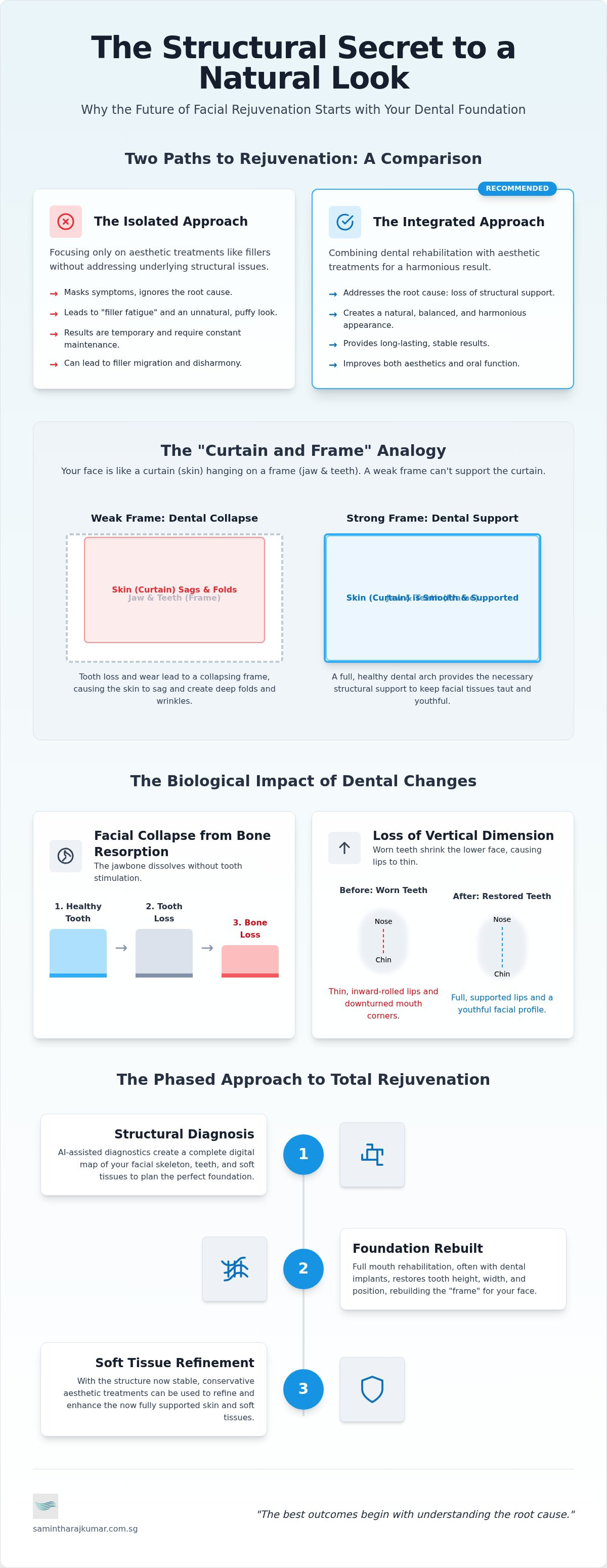
In my clinical experience, the face is a composition of layers where the dental arch serves as the essential scaffolding. Without this internal support, the overlying soft tissues have nothing to rest upon. I often use the "curtain and frame" analogy with my patients: your skin is the curtain, and your jaw and teeth are the frame. If the frame is too small or unstable, the curtain will inevitably sag and fold, regardless of how much you try to "iron" it with topical treatments. This is why combining aesthetic treatments with dental work is the only way to achieve a truly harmonious result.
From a biological perspective, tooth loss leads to alveolar bone resorption. This is a physiological process where the jawbone, no longer stimulated by the roots of the teeth, begins to dissolve. This results in the lower third of the face "collapsing," which deepens nasolabial folds and marionette lines. We can't ignore the structural deficit at its source. Our expertise in Oral and Maxillofacial Surgery allows us to appreciate that facial harmony is deeply rooted in skeletal integrity.
The Science of Facial Collapse and Bone Resorption
The extraction of a tooth initiates a countdown for the surrounding bone. Without the mechanical stress of chewing, the alveolar bone loses density and volume. By preventing facial collapse with dental implants, we provide the necessary stimulation to keep the bone healthy and the jawline sharp. This structural preservation ensures that any subsequent facial aesthetic rejuvenation looks natural rather than forced. It's about maintaining the biological "real estate" that supports your features.
Vertical Dimension: The Secret to Lip Support
Many people don't realise that worn-down teeth are often the culprit behind thin, disappearing lips. As teeth lose height through grinding or erosion, the distance between the nose and chin decreases. This loss of "vertical dimension" causes the lips to roll inward and the corners of the mouth to downturn. Full mouth rehabilitation restores this lost height, providing the internal volume needed to push the lips back into a youthful position. Vertical dimension is the cornerstone of structural rejuvenation.
The Clinical Consequences of Isolated Aesthetic Treatments
As a clinician and founder, I often see patients who have spent years on aesthetics without addressing the root cause: their bite. They come to me feeling that their face looks heavy or puffy despite regular maintenance. This is the clinical reality of isolated aesthetic treatments. When we ignore the underlying scaffolding, we fall into the trap of filler fatigue. This occurs when practitioners over-inject the face to compensate for a lack of skeletal and dental support. Without teeth to provide the necessary outward projection, filler has nowhere to go but to sit on the surface. This often leads to migration or an unnatural, uncanny appearance that lacks the vitality of a truly youthful face.
Research supported by the National Institute of Dental and Craniofacial Research emphasises that the craniofacial complex is a highly integrated system. Treating the skin while neglecting the dental foundation leads to functional and aesthetic disharmony. A collapsed bite doesn't just age the face; it can exacerbate jaw pain and TMJ issues. This makes even the most skilled aesthetic results look strained or uncomfortable because the muscles are constantly fighting a losing battle against a misaligned jaw. Combining aesthetic treatments with dental work allows us to stop chasing symptoms and start building a lasting result.
Why Fillers Alone Aren’t Always the Answer
The fundamental issue is often one of projection. Teeth provide the essential push that keeps the skin of the mid-face and lips taut. When teeth are missing, worn, or tilted inwards, that support vanishes. While injectables can add temporary volume, cosmetic dentistry provides a more permanent lift by restoring the actual dimensions of the mouth. Establishing a stable foundation is non-negotiable before we begin refining the soft tissues. It ensures the skin has a sturdy structure to rest upon, preventing the need for excessive filler in the future.
The Interplay Between TMJ Health and Facial Symmetry
Facial symmetry is often dictated by the health of the temporomandibular joint. If the jaw is misaligned, the muscles of mastication often overcompensate. This leads to masseter muscle hypertrophy, which creates a wider, more masculine jawline that many patients find undesirable. Consulting a TMJ specialist is often the first step in balancing these facial muscles. In my practice, I use Botox not just for wrinkles, but as a therapeutic tool for jaw rehabilitation. This relaxes overactive muscles and slims the lower face, creating a more elegant contour that reflects true facial harmony.
The best outcomes begin with understanding the root cause of facial aging.
Synergistic Protocols: Combining Smile Makeovers with Facial Rejuvenation
In my clinical experience, the most successful outcomes follow a logical hierarchy of care. I always recommend completing major structural dental work before finalising facial fillers or skin tightening procedures. This is because the dental framework determines the final position of your lips and cheeks. If we inject filler before the teeth are correctly positioned, we risk creating a shape that no longer fits once the dental work is complete. Combining aesthetic treatments with dental work requires a disciplined sequence to ensure the soft tissues are refined around a stable, permanent foundation.
I frequently utilise ceramic dental implants for patients seeking a truly holistic result. These biocompatible materials integrate seamlessly with the body, providing a metal-free alternative that mimics the natural light-reflecting properties of real teeth. For patients with significant tooth loss, "Teeth in a Day" protocols offer an immediate "internal facelift." By restoring the dental arch in a single session, we provide an instant boost to facial volume that topical treatments simply cannot replicate.
The Smile Makeover and Dermal Filler Synergy
A smile makeover is about more than just white teeth. We design veneers to support the upper lip by carefully calculating the incisal edge position and the "buccal corridor" (the space between your teeth and the corners of your mouth). When the teeth provide the correct outward push, the need for lip fillers is often significantly reduced. We use the Golden Ratio to ensure that the proportions of the teeth align with the broader facial features. This coordination allows us to reveal a new smile while simultaneously refining the perioral area for a balanced, natural look.
Advanced Implantology as a Structural Lift
For patients with more extensive bone loss, All-on-4 dental implants provide essential mid-face volume. This protocol restores the entire dental arch, which in turn supports the cheeks and smooths out the lower face. In cases of severe maxillary atrophy, Zygomatic implants act as internal cheekbone supports, lifting the mid-face from the skeletal level up. This structural approach often achieves what a surgical facelift cannot: it addresses the loss of hard tissue volume.
My Perspective: The Philosophy of Total Facial Rehabilitation
As a clinician and founder, I've always maintained that a surgeon must be both an architect of the bone and an artist of the skin. True facial harmony isn't achieved by looking at the mouth in isolation. Instead, it requires a vision that encompasses the entire craniofacial structure. In my clinical experience, the most rewarding cases are those where we address the foundational skeletal support before refining the surface aesthetics. By combining aesthetic treatments with dental work, we respect the natural biology of the face while achieving results that are both functional and breathtakingly natural.
At Nuffield Dental, we've pioneered an approach that integrates AI-assisted diagnostics into our planning phase. This technology allows us to simulate facial and dental outcomes simultaneously, providing a level of precision that was previously unattainable. We don't just guess where a lip should sit; we engineer the underlying support to ensure it rests exactly where it should. This meticulous attention to detail is what defines a premium patient experience and ensures a legacy of health and functional excellence.
The Architect and the Artist: A Dual Approach
My background in oral and maxillofacial surgery is fundamental to how I approach facial aesthetics. It provides a deep understanding of how bone, muscle, and skin interact as a single, cohesive unit. When I evaluate a patient, I don't just see a set of teeth; I see the way the jawline defines the neck, how the cheekbones support the eyes, and how the dental arch dictates the mid-face volume. This holistic view is essential for total oral rehabilitation. Meticulous planning ensures that every surgical intervention serves the dual purpose of restoring health and enhancing natural beauty.
Biocompatibility and Long-Term Wellness
From a biological perspective, the materials we place in the body matter just as much as the surgical technique itself. I prioritise ceramic implants for my health-conscious patients because they are completely metal-free and highly biocompatible. There's an undeniable link between oral health, systemic wellness, and aesthetic vitality. A body that is free from chronic inflammation around dental restorations is a body that reflects health through the skin. Biological dentistry is the future of sustainable aesthetics. It prioritises the long-term integrity of the patient over quick, temporary fixes that fail to address the root cause.
Restoring both function and confidence is a transformative experience for the patient and the clinician alike. It's a journey from discomfort and self-consciousness to a state of profound personal renewal. If you're ready to explore how a structural approach can redefine your appearance, discover the Nuffield Dental difference today.
Expectations and Long-Term Impact: Beyond the Surface
In my clinical experience, patients who choose a phased, integrated approach often report a sense of relief once they understand the roadmap ahead. We don't rush the process. Instead, we prioritise biological stability. By combining aesthetic treatments with dental work, we ensure that every change we make is supported by a healthy, functional foundation. This structural integrity is the key to longevity. Standalone aesthetic tweaks often require frequent maintenance because they don't address the underlying volume loss. When the dental arch is correctly restored, it provides a permanent lift to the soft tissues. This often reduces both the frequency and the volume of future facial injections, making your rejuvenation journey more sustainable and natural.
The impact of this total rehabilitation extends far beyond the mirror. I've watched patients regain their social confidence and improve their quality of life after years of hiding their smiles. From a biological perspective, a healthy bite also reduces chronic muscle tension and improves systemic wellness. As a clinician and founder, I find that the most profound transformations are those that restore both the ability to eat comfortably and the desire to smile without hesitation. It's about creating a legacy of health that allows you to age with grace and vitality.
The Patient Journey: What to Expect
The journey begins with a comprehensive consultation where we use advanced 3D imaging and AI-assisted diagnostics to map your facial and dental anatomy. This allows us to plan the final, harmonised look before we even begin treatment. Managing recovery is a coordinated effort. While surgical procedures like dental implants require a healing period, we often integrate non-surgical aesthetic refinements during the final stages of your dental restoration. The timeline for achieving a total transformation varies, but most patients see significant structural improvements within months. We guide you through every step, ensuring comfort and clarity throughout the process.
The Future of Integrated Care
My vision for the future of healthcare is one where dental and facial aesthetic clinics operate as a single, integrated ecosystem. We're moving away from fragmented care toward a model where every practitioner understands the interplay between bone, muscle, and skin. Technology plays a pivotal role in this evolution. AI diagnostics and digital workflows allow us to provide predictable, natural results that were once impossible to guarantee. This precision is the Nuffield Dental hallmark. As we continue to innovate, our focus remains on delivering high-tier clinical excellence that respects the unique biology of every patient. The best outcomes begin with understanding the root cause.
Embracing a Future of Total Facial Harmony
Achieving a naturally youthful appearance is not about chasing individual lines or adding temporary volume. It's about respecting the intricate relationship between your dental structure and your facial features. In my clinical experience, combining aesthetic treatments with dental work is the only sustainable way to restore the scaffolding your face needs to age with grace. By addressing bone resorption and vertical dimension first, we create a stable foundation that enhances the longevity and natural look of every subsequent aesthetic refinement.
As a clinician and founder specialising in complex Zygomatic and All-on-4 protocols, I've designed our clinics to be centres for comprehensive restoration. From a biological perspective, our focus on biocompatible materials and AI-assisted diagnostics ensures that your journey toward total facial rehabilitation is precise, predictable, and deeply personal. We don't just treat symptoms; we build a foundation for long-term health and renewed social confidence.
The right diagnosis changes everything. Explore our approach to total facial rehabilitation with Dr Samintharaj Kumar.
The best outcomes begin with understanding the root cause, and I look forward to helping you rediscover your most harmonious self.
Frequently Asked Questions
Can I get Botox on the same day as my dental cleaning or surgery?
Yes, you can generally receive anti-wrinkle injections on the same day as a routine cleaning. However, I often advise waiting if you've undergone a complex surgical procedure. Extensive oral surgery can cause localised swelling or require you to keep your mouth open for long periods, which may affect the settling of aesthetic injectables. In my clinical experience, scheduling these treatments sequentially ensures the most predictable and comfortable outcome for the patient.
Will dental implants change the way my face looks?
Dental implants significantly impact your facial appearance by halting the process of bone resorption. When you lose a tooth, the jawbone begins to dissolve, which can lead to a sunken, aged look. By placing an implant, we provide the mechanical stimulation necessary to preserve bone volume. This maintains the natural contours of your jawline and prevents the facial collapse that often occurs with long-term tooth loss or ill-fitting dentures.
Which should I do first: veneers or lip fillers?
I always recommend completing your veneers before considering lip fillers. Your teeth dictate the projection and support of your upper lip. By combining aesthetic treatments with dental work in this order, we can design your smile to provide the ideal level of natural lip support. Often, patients find they need far less filler once their dental arch is correctly positioned, as the veneers provide a permanent, structural lift.
How does a "collapsed bite" affect the appearance of wrinkles?
A collapsed bite occurs when teeth are worn down or missing, leading to a loss of vertical dimension in the lower face. From a biological perspective, this causes the skin to bunch and sag because the underlying frame has shrunk. This directly exacerbates the appearance of deep nasolabial folds and marionette lines around the mouth. Restoring this lost height through full mouth rehabilitation effectively irons out these wrinkles from the inside.
Are combined dental and aesthetic treatments safe for older patients?
Combined protocols are not only safe but often essential for older patients seeking comprehensive restoration. As we age, we lose both bone density and soft tissue volume. My approach integrates biocompatible ceramic implants with non-surgical rejuvenation to address both layers of aging. We carefully tailor the pace of treatment to your overall health, ensuring that the process is gentle while delivering a profound impact on your functional well-being and appearance.
How long do the results of a total facial rehabilitation last?
The results of a total facial rehabilitation are designed for long-term excellence. While facial fillers and skin treatments typically require maintenance every 6 to 18 months, the dental foundation we build is meant to last for decades. Ceramic implants and veneers provide a permanent structural lift that doesn't wear off. Because the underlying scaffolding is stable, you'll likely find that your soft tissue treatments remain effective for longer periods between top-ups.
Can dental work reduce the need for a surgical facelift?
In many cases, advanced dental work can delay or even reduce the need for a traditional surgical facelift. A facelift primarily addresses sagging skin, but it cannot restore lost bone or tooth volume. By rebuilding the dental arch, we restore the internal projection that keeps the skin taut. This structural rejuvenation addresses the root cause of mid-face sagging, providing a more natural and functional result than skin-tightening procedures alone can achieve.
What is the role of a dental surgeon in facial rejuvenation?
As a dental surgeon with a background in oral and maxillofacial surgery, my role is to act as the architect of your facial structure. I focus on the hard tissues, the bone and teeth, which serve as the foundation for everything else. By understanding the interplay between the jaw and facial muscles, I can plan treatments that ensure your smile and features work in total harmony. I provide the stable frame for the art of aesthetics.


Comments