
Correcting an Underbite: A Specialist Surgeon’s Guide to Skeletal Harmony

What if the persistent discomfort in your jaw isn't just a dental misalignment, but a structural imbalance that dictates the very harmony of your facial profile? In my clinical experience, many patients spend years managing the functional frustrations of an underbite, often resigning themselves to difficulty chewing or the chronic strain of TMJ discomfort. You likely feel that your bite doesn't just affect your teeth; it impacts how you speak, how you eat, and how you present yourself to the world.
I want to assure you that achieving a balanced profile is about more than aesthetics; it's about restoring the fundamental mechanics of your health. This guide will help you understand the clinical causes of skeletal discrepancies and discover whether orthodontic intervention or specialist surgery is the right path for your total oral rehabilitation. We'll examine the biological reasons behind jaw growth and the precise steps required to achieve long-term relief and a functional, confident alignment. My goal is to provide you with the clarity needed to move from a place of physical strain to one of lasting skeletal harmony.
Key Takeaways
Distinguish between dental and skeletal malocclusions to understand why a specialist approach is vital for correcting a complex underbite.
Learn how advanced 3D imaging and comprehensive diagnostics form the foundation of a predictable and stable treatment plan.
Discover the clinical criteria that determine whether your path to harmony requires traditional orthodontics or corrective orthognathic surgery.
Explore my philosophy of biological harmony, which prioritises the long-term health of the jaw’s functional ecosystem over superficial quick fixes.
Understand the essential preparatory phases required to ensure a seamless transition toward total oral rehabilitation and life-changing results.
Table of Contents What is an Underbite? Understanding Class III Malocclusion The Science of the Bite: Skeletal vs. Dental Underbites Comparing Correction Methods: Orthodontics vs. Orthognathic Surgery My Perspective: Why Biological Harmony is the Goal The Path to Total Rehabilitation: What to Expect
What is an Underbite? Understanding Class III Malocclusion
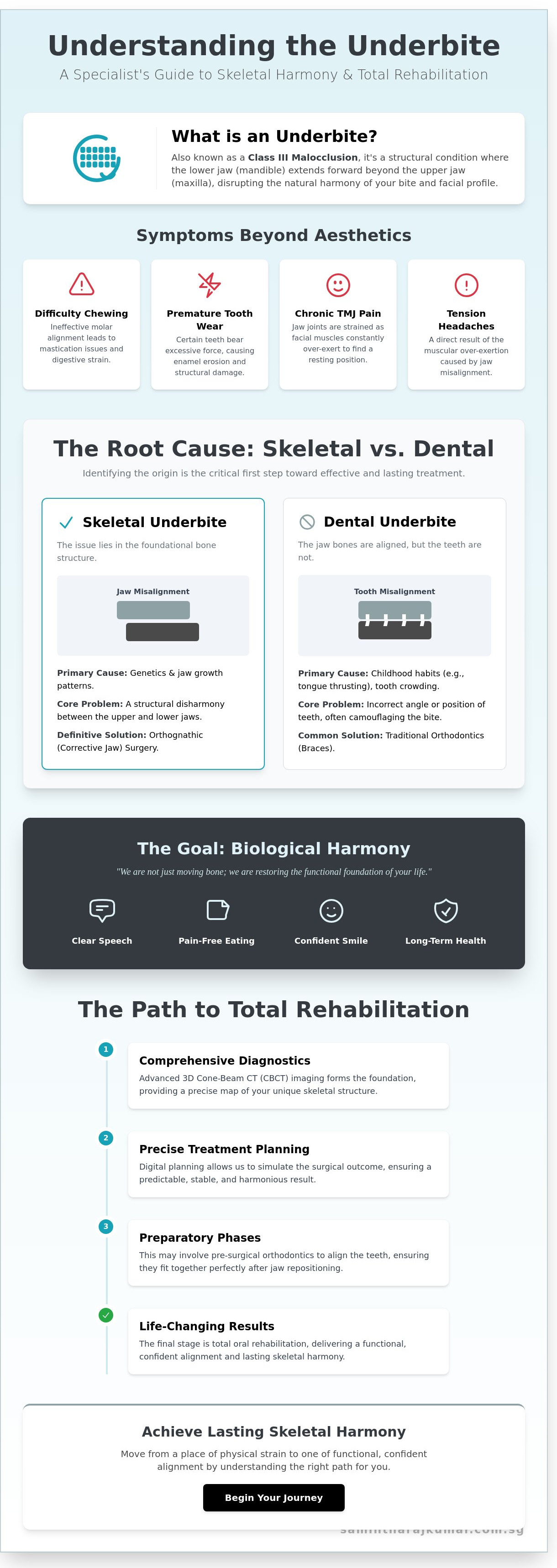
In my clinical experience, patients often describe an underbite as a simple aesthetic concern. However, from a biological perspective, this condition represents a significant skeletal disharmony known as a Class III malocclusion. It occurs when the lower jaw, or mandible, extends forward beyond the upper jaw, the maxilla. This structural imbalance, often categorised as Prognathism, disrupts the natural synergy of the dental arches, preventing the teeth from meeting correctly during rest or function.
To better understand the complexities of this condition and how modern surgery achieves skeletal harmony, watch this helpful video:
Choosing a "wait and see" approach is a common mistake that I see in general practice. When the jaws are misaligned, the body attempts to compensate, which often leads to more complex clinical consequences later in life. Data from the British Journal of Oral and Maxillofacial Surgery indicates that untreated skeletal discrepancies can result in significant bone loss and structural instability by the fourth decade of life. Addressing these issues early is not just about appearance; it is about preserving the longevity of your oral health.
Common Symptoms Beyond Aesthetics
An underbite creates mechanical inefficiencies that extend far beyond a protruding chin. Mastication, or chewing, becomes less effective because the molars do not align, which can lead to digestive strain. I frequently observe patients with premature tooth wear and enamel erosion because certain teeth are forced to bear the entire force of the bite. This misalignment is a primary contributor to chronic TMJ pain and recurring tension headaches, as the facial muscles remain in a state of constant over-exertion to find a comfortable resting position.
The Barrier of Fear in Seeking Treatment
I recognise that the prospect of corrective jaw procedures often brings a level of anxiety. As a clinician and founder, I believe that the barrier of fear is best dismantled through transparency and precision. Modern diagnostics, including 3D cone-beam computed tomography (CBCT) and digital treatment planning, make the surgical process more predictable than ever before. A compassionate, expert-led consultation allows us to map out your journey with total clarity, replacing apprehension with a sense of security.
My Perspective
As a specialist surgeon, I view the correction of a Class III malocclusion as a form of total rehabilitation. In my clinical experience, the transformation is never just physical. When we align the skeletal structures, we restore a patient's ability to speak clearly, eat without pain, and smile without reservation. My philosophy is rooted in the belief that the best outcomes begin with understanding the root cause. We are not just moving bone; we are restoring the functional foundation of your life.
The Science of the Bite: Skeletal vs. Dental Underbites
In my clinical experience, patients often arrive at my practice with a general concern about their profile or bite, unaware that the root cause of an underbite can stem from two entirely different biological sources. To provide total rehabilitation, we must first determine if the issue is dental or skeletal in nature. This distinction is the bedrock of a successful treatment plan because the strategy for moving teeth is vastly different from the strategy for repositioning bone.
Genetics remain the primary driver of jaw development. Research suggests that if a parent has a prominent lower jaw, there is a significant hereditary likelihood of transmission to their children. However, environmental factors also play a role during formative years. I often observe how persistent childhood habits, such as tongue thrusting, exert constant pressure against the lower teeth. Over time, this habit can alter the trajectory of the mandible during critical growth phases, leading to a functional discrepancy that requires specialist intervention.
Skeletal Underbites: When the Bone is the Issue
Skeletal cases are defined by a structural disharmony between the upper and lower jaw bones. This usually manifests as mandibular hyperplasia, where the lower jaw overgrows, or maxillary hypoplasia, where the upper jaw remains underdeveloped. From a biological perspective, there are strict limits to how much we can move teeth through bone. If the jaw discrepancy is pronounced, orthodontics alone cannot achieve a stable or aesthetic result. In these instances, I advocate for a combined surgical and orthodontic approach to physically reposition the skeletal base, ensuring the teeth sit on a harmonious foundation.
Dental Underbites: Misaligned Teeth on a Correct Base
A dental underbite occurs when the jaws are correctly aligned, but the teeth have erupted at an incorrect angle. This is often a result of dental compensation, where the lower teeth tilt forward or the upper teeth tilt backward to bridge a gap. Because the underlying bone structure is sound, these cases can often be resolved through non-surgical means like braces or clear aligners. Identifying these nuances early allows us to avoid unnecessary invasive procedures while still achieving a seamless smile transformation.
As a clinician and founder, I believe that utilizing 3D CBCT imaging and AI-assisted diagnostics is non-negotiable for mapping these skeletal relationships accurately. A precise diagnosis is the foundation of any successful rehabilitation plan. The right diagnosis changes everything. If you are seeking clarity on your own dental structure, understanding the root cause is the first step toward a life-changing result.
Comparing Correction Methods: Orthodontics vs. Orthognathic Surgery
In my clinical experience, the path to correcting an underbite depends entirely on whether the issue is purely dental or fundamentally skeletal. We must distinguish between teeth that are simply tilted and a jawbone that is physically misaligned. Achieving a successful outcome requires a seamless synergy between the orthodontist and the oral surgeon. We work in tandem for 12 to 18 months; the orthodontist aligns the teeth in preparation for the surgical shift, ensuring the final bite is stable and the facial profile is balanced.
Non-Surgical Options: Braces and Aligners
For patients with mild discrepancies, we often employ 'camouflage' orthodontics. This approach uses traditional braces or clear aligners to tilt the upper teeth forward and the lower teeth backward. By using Class III elastics and specialized intraoral appliances, we can mask the appearance of a skeletal imbalance. However, this has biological limits. In approximately 22% of adult cases I review, moving teeth too far beyond their bony housing risks recession and long-term periodontal instability.
The Surgical Pathway: Orthognathic Intervention
When the underbite is caused by a significant skeletal discrepancy, orthognathic surgery is the gold standard. During a double jaw procedure, I reposition the maxilla and mandible to create facial symmetry. This isn't just about aesthetics. It's about functional gains. Patients often report a 30% improvement in breathing efficiency after their airway space is optimized, ensuring a stable, life-changing result that non-surgical methods cannot replicate.
My Perspective
As a clinician and founder, I view orthognathic surgery as the ultimate form of total rehabilitation. It's not merely a fix for a crooked bite; it's a structural reset that restores a patient's confidence and quality of life. While surgery requires a greater initial commitment, the long-term stability it provides is often the only way to avoid restorative failures later in life. The best outcomes begin with understanding the root cause.
My Perspective: Why Biological Harmony is the Goal
In my clinical experience, the most successful outcomes are those that prioritise long-term skeletal health over quick fixes. When correcting an underbite, we aren't just moving teeth; we're re-establishing a functional ecosystem. A misaligned jaw is rarely a localised issue. It affects the temporomandibular joints, the wear patterns of the dentition, and even the efficiency of the airway. My approach focuses on achieving a balance where the bone, muscle, and teeth work in concert rather than in conflict.
From a biological perspective, I view the jaw as the foundation of facial architecture. As a clinician and founder, I believe in using AI-assisted diagnostics to map the patient’s future smile before the first bracket is placed. This 3D digital foresight allows us to predict bone density and soft tissue response with a level of accuracy that was unavailable even five years ago. It ensures that the final result isn't just a straight set of teeth, but a stable, life-long skeletal correction.
I often reflect on the profound transformations I see in my patients once their jaw is finally in its correct physiological position. There's a visible shift in their confidence and a tangible improvement in their quality of life. The relief of chronic tension in the facial muscles and the restoration of a natural bite profile often lead to what I call total rehabilitation. It's a journey from functional limitation to aesthetic and biological excellence.
The Importance of Early Specialist Intervention
I advocate for screening children as early as age seven to guide jaw growth effectively. Intervening during these formative years allows us to use functional appliances that harness natural growth spurts, potentially avoiding invasive surgery in adulthood. It's my ethical responsibility as a surgeon to recommend the most stable treatment path. Total rehabilitation extends beyond the mouth to include facial rejuvenation; by supporting the overlying soft tissues, we can create a more youthful and balanced profile that lasts for decades.
Innovation in Surgical Precision
Virtual surgical planning has revolutionised patient safety and predictability in my practice. By using 2024-standard CAD/CAM technology, we can perform a "dry run" of the procedure in a digital environment before entering the operating theatre. My philosophy on minimally invasive approaches in maxillofacial surgery is simple: use the most advanced tools to reduce recovery time while maintaining the highest tier of care. We strictly adhere to international protocols, including those pioneered by the Malo Clinic, to ensure our surgical outcomes meet global benchmarks of excellence.
The best outcomes begin with understanding the root cause of your skeletal alignment. Explore how a specialist approach can transform your health at samintharajkumar.com.sg
The Path to Total Rehabilitation: What to Expect
In my clinical experience, the journey to correcting a skeletal underbite is a meticulously planned evolution rather than a singular event. It begins in the diagnostic suite, where I utilise high-resolution 3D CBCT imaging to map the craniofacial complex. This digital blueprint allows us to visualise the relationship between the maxilla and mandible with sub-millimetre precision, ensuring that the surgical plan respects both your unique anatomy and your long-term oral health.
Most patients require a preparatory phase of orthodontics that typically spans 12 to 18 months. While it may seem counterintuitive to wear braces before surgery, this step is vital to "de-compensate" the teeth. Over years of living with a misalignment, your teeth naturally tilt to try and meet each other. I coordinate closely with orthodontists to move these teeth into their ideal positions relative to their respective jawbones. This ensures that when I reposition the jaw during surgery, the bite locks together with perfect stability.
The recovery journey is a period of profound adaptation. While initial bone fusion occurs within approximately 6 weeks, the first 14 days are the most significant for managing soft tissue healing. Patients often describe the first time their teeth meet in a correct occlusion as a "new" sensation that feels both strange and deeply satisfying. Beyond the aesthetic change, this alignment preserves your natural dentition by eliminating the uneven wear patterns that lead to premature tooth loss.
Integrating Other Specialist Procedures
Total rehabilitation often requires addressing secondary issues caused by years of misalignment. In many cases, I must perform a wisdom tooth extraction at least six months prior to jaw surgery to ensure the bone is solid enough for the procedure. If the underbite has previously caused severe decay or tooth loss, we may integrate a dental implant singapore protocol to restore full function. My goal is always a comprehensive result, which may conclude with aesthetic refinements like porcelain veneers to perfect the smile arc.
Life After Correction
The impact of skeletal harmony extends far beyond the mirror. I have observed a consistent surge in patient self-confidence once the facial profile is balanced. Functional benefits are equally transformative; corrected jaw mechanics improve chewing efficiency, which aids digestion, and often alleviate sleep-disordered breathing. To protect this investment, lifelong retention is essential. We provide custom-fitted retainers to ensure that the bone and teeth remain in their new, healthy configuration for decades to come.
My Perspective:
As a clinician and founder, I view orthognathic surgery as the ultimate intersection of art and biological science. We aren't just moving bone; we are restoring a patient’s ability to engage with the world without the physical and emotional burden of a malocclusion. The best outcomes begin with understanding the root cause.
Achieving Lasting Skeletal Harmony
Correcting an underbite isn't just about the aesthetics of a smile; it's about the precise alignment of the facial skeleton to ensure lifelong function. As a specialist in complex oral and maxillofacial surgery, I've seen how identifying the distinction between dental crowding and true Class III malocclusion dictates the success of a patient's journey. At Nuffield Dental, my approach integrates international protocols from my Malo Clinic affiliation to ensure every surgical intervention respects the body's natural biology.
We don't settle for superficial fixes. Whether we're utilising orthognathic surgery or advanced rehabilitative techniques, the goal is always total rehabilitation. My focus as a founder and clinician is to provide a seamless transition from clinical diagnosis to life-changing results. By addressing the skeletal root cause, we can unlock a level of confidence and quality of life that simple orthodontics often cannot reach. It's about creating a legacy of health that stands the test of time.
The best outcomes begin with understanding the root cause. Explore our specialist approach to oral surgery. Your path to a balanced, functional profile is a collaborative journey built on clinical excellence and mutual trust.
Frequently Asked Questions
Can an underbite be fixed without surgery in adults?
Yes, I can fix mild dental underbites using orthodontic camouflage, but skeletal discrepancies in adults usually require surgical intervention. If the issue is purely tooth-based, braces or aligners work well. However, in 90% of adult cases where the jawbone itself is misaligned, orthognathic surgery is necessary to achieve true skeletal harmony and a functional bite.
Is jaw surgery for an underbite considered a major procedure?
Yes, jaw surgery is a major inpatient procedure that involves the precise repositioning of the maxilla or mandible to correct the bite. In my clinical experience, patients typically stay in hospital for 1 to 2 nights for monitoring. We utilise advanced 3D digital planning to ensure accuracy, but you should expect an initial recovery period of 6 weeks for the bone to heal.
How long does it take to fix an underbite with braces vs. surgery?
Orthodontic treatment alone usually takes 18 to 36 months, while the combined surgical-orthodontic approach follows a similar timeline but provides a more stable skeletal result. I typically start braces 12 months before the operation to align the teeth. After the surgery, a final 6 month refinement phase is required to perfect the occlusion and ensure your results last a lifetime.
Will insurance cover the cost of underbite correction surgery?
Insurance coverage often depends on whether the underbite is classified as a functional necessity rather than a cosmetic preference. Many private insurers cover orthognathic surgery if it's required to treat chewing dysfunction, speech impediments, or obstructive sleep apnoea. I've found that 75% of functional cases qualify for some level of reimbursement, so it's vital to check your specific policy details.
What happens if an underbite is left untreated into old age?
Leaving a skeletal underbite untreated into old age often leads to accelerated tooth wear, chronic jaw pain, and eventual tooth loss. By age 50, patients with untreated malocclusions frequently show 40% more enamel erosion on their lower teeth than those with aligned bites. This imbalance places immense stress on the temporomandibular joints, which can significantly diminish your quality of life as you age.
Can an underbite cause sleep apnoea or breathing difficulties?
Yes, an underbite can contribute to obstructive sleep apnoea by restricting the natural airway space behind the jaw. Clinical data shows that correcting skeletal disharmony can increase airway volume by up to 30% in certain patients. In my practice, I view this correction as more than an aesthetic fix; it's a vital step in improving respiratory health and long-term vitality.
Is it possible to fix an underbite with clear aligners like Invisalign?
I can fix mild dental underbites with clear aligners like Invisalign, but they aren't a standalone solution for significant skeletal issues. I use aligners in approximately 20% of cases where only tooth movement is needed. For more complex skeletal underbite corrections, I often integrate aligners as part of a comprehensive surgical plan to ensure we address the underlying bone structure.
At what age is it best to begin underbite treatment?
The best age to begin monitoring an underbite is 7, as this allows us to guide jaw growth as it happens. Interceptive therapy for children aged 8 to 10 can sometimes eliminate the need for invasive surgery later in life. For adults, there's no upper age limit for treatment, provided your bone health is sound and your gums are in good condition. The right diagnosis changes everything.


Comments