
Essential Questions to Ask Before Full Mouth Rehabilitation: A Specialist’s Guide
- Dr Samintharaj Kumar

- Jul 4
- 11 min read
What if the longevity of your dental restoration has less to do with the materials chosen and everything to do with the diagnostic philosophy of your surgeon? I understand that the prospect of rebuilding your entire smile is as much an emotional journey as it is a clinical one. It is entirely natural to feel a sense of trepidation regarding surgical outcomes or how different implant protocols might impact your long term biological health.
In my clinical experience as a surgeon and founder, I have found that clarity is the best antidote to anxiety. My goal is to equip you with the strategic questions to ask before full mouth rehabilitation so you can evaluate a specialist’s mastery with confidence. By the end of this guide, you will understand how to probe beyond the surface of a smile makeover. We will look at the critical intersection of AI-assisted diagnostics, the choice between titanium and ceramic implants, and how to ensure your functional reality matches your aesthetic aspirations. This is about more than just teeth; it is about restoring your quality of life through meticulous, evidence-based care.
Table of Contents
Preparing for Full Mouth Rehabilitation: Why Your Questions Matter
Evaluating the Diagnostic Phase: Questions on AI and Biological Planning
Understanding Materials and Surgical Protocols: Ceramic Implants vs Traditional Options
Managing Expectations: Questions on Recovery, Longevity, and 'Teeth in a Day'
My Perspective: Choosing a Visionary Partner for Your Functional Transformation
Preparing for Full Mouth Rehabilitation: Why Your Questions Matter
Full mouth rehabilitation isn't just a dental appointment. It's a complex architectural project for the human face. In my clinical experience, the results that truly transform lives are those where the patient is fully engaged in the process. You need to know the "why" behind every clinical decision I make. I encourage you to prepare a specific list of questions to ask before full mouth rehabilitation. A specialist should view your curiosity as a sign of commitment to your long-term health rather than a challenge to their authority.
This process, often referred to as full mouth reconstruction or full mouth rehabilitation, is not a singular event but a meticulously planned sequence of complex interventions. The goal of this guide is to move your focus beyond surface-level aesthetics. While a beautiful smile is a primary outcome, the structural and biological restoration of your oral ecosystem is what ensures that beauty lasts for decades.
To better understand how we assess the underlying foundations of your smile and the mechanics of your bite, watch this helpful video:
Defining the Scope of Total Oral Rehabilitation
Many patients initially confuse a cosmetic smile makeover with functional rehabilitation. A cosmetic approach might focus on the visible surface of the teeth. Functional restoration goes much deeper. We must look at bone density, soft tissue health, and the mechanics of your jaw joints. If we don't address the foundation, the most beautiful ceramic implants can still fail. I often find that the best results require a multi-disciplinary approach. As a clinician and founder, I coordinate different layers of expertise to ensure every biological factor is addressed before we even begin the surgical phase.
The Psychology of the Consultation
The first time we sit down together is the most important part of the journey. This initial dialogue sets the tone for the entire surgical experience. You're looking for clinical authority, but you also need compassionate reassurance. Is the surgeon listening to your functional goals? Or are they simply pushing a specific implant protocol? I believe in a patient-centered philosophy where we prioritise your comfort and long-term well-being. If a practitioner seems rushed or dismissive of your concerns, it's a red flag. You deserve a visionary partner who values the transformative power of modern medicine as much as you do. The right diagnosis changes everything, and that begins with a surgeon who values your input.
Evaluating the Diagnostic Phase: Questions on AI and Biological Planning
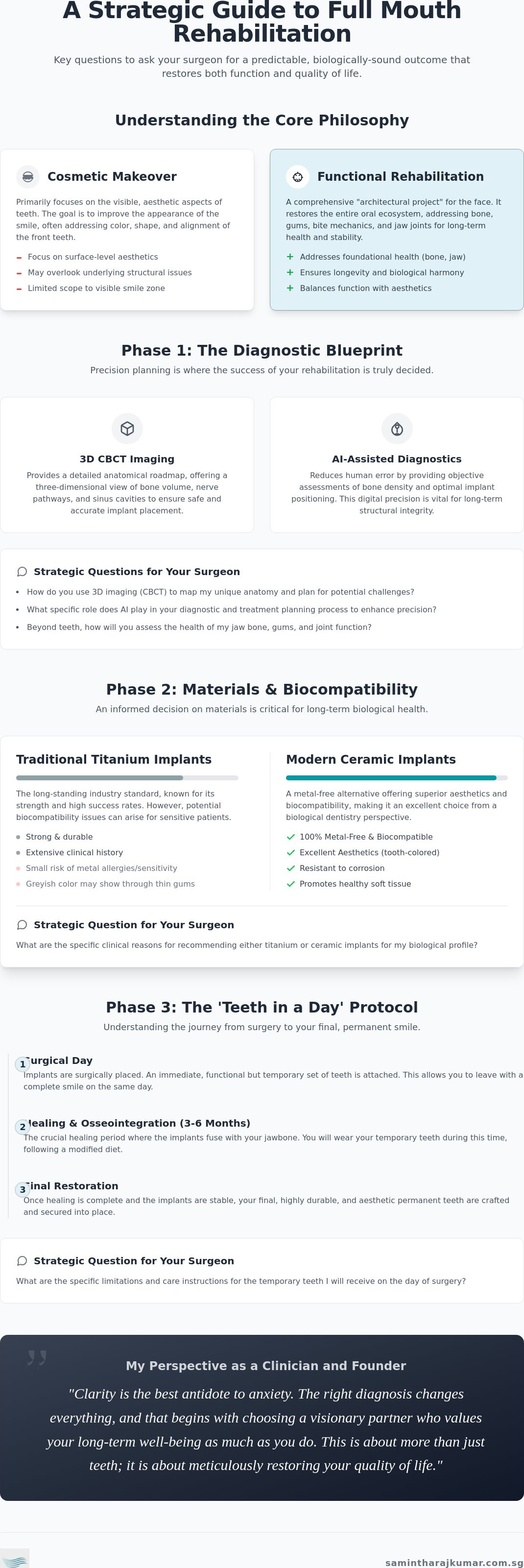
As a clinician and founder, I believe the diagnostic phase is where the success of your rehabilitation is truly decided. It's the period where we move from a general vision to a precise, anatomical roadmap. When you're considering your questions to ask before full mouth rehabilitation, you must look closely at the technology a surgeon employs. I often explain to my patients that CBCT scans are essential because they provide the anatomical roadmap for safe implant placement by offering a three-dimensional view of bone volume, nerve pathways, and sinus cavities. Without this level of detail, we're essentially working in the dark.
The Role of AI in Modern Implantology
In my clinical experience, the integration of Artificial Intelligence has been a paradigm shift. AI-assisted diagnostics allow us to reduce human error by providing objective assessments of bone density and optimal implant positioning. This precision is vital for preventing facial collapse with dental implants, as it ensures the structural integrity of your jaw is maintained. Digital smile design also allows you to see a preview of your structural rejuvenation before we begin. This ensures your aesthetic expectations align perfectly with the functional reality we can achieve.
Biological Considerations in Treatment Planning
From a biological perspective, we cannot treat the mouth in isolation. I always screen for pre-existing conditions like bruxism or sleep apnoea, as these factors significantly influence how we manage your bite alignment and protect your TMJ. You should feel comfortable presenting a list of questions to ask your dentist regarding how they manage the transition from failing teeth to a new prosthesis. This transition is not just mechanical; it's biological. We must consider how your systemic health, such as inflammatory markers or nutritional status, will impact the healing of your bone and soft tissue.
We must also discuss how the final bite alignment will prevent future pain. A common mistake in complex cases is focusing solely on the teeth while ignoring the jaw joints. I use digital previews to show you exactly how we'll rebuild the architecture of your face. If you value a diagnostic approach that prioritises long-term stability, I invite you to learn more about our comprehensive diagnostic protocols. The right diagnosis changes everything because it allows us to plan for a lifetime of health rather than just a temporary fix.
Understanding Materials and Surgical Protocols: Ceramic Implants vs Traditional Options
Once we have established a diagnostic roadmap, the conversation must shift to the physical components of your restoration. The choice of materials and surgical protocols is not merely a technical preference; it is a clinical decision that affects your systemic health and the longevity of the restoration. In my clinical experience, the most critical questions to ask before full mouth rehabilitation involve how a surgeon selects materials to match your unique biological profile. We are no longer in an era where one material fits all patients.
Titanium remains the gold standard for many, with long-term success rates between 95 and 98 percent over 20 years. However, from a biological perspective, I recognise that a small percentage of the population—approximately 0.6 percent—presents with titanium sensitivities. As a clinician and founder, I prioritise offering a range of solutions that respect your body's immune response while ensuring structural integrity.
The Case for Ceramic Dental Implants
For patients seeking a metal-free alternative or those with thin gingival biotypes, ceramic dental implants made from zirconia offer distinct advantages. Zirconia is highly biocompatible and tends to attract less bacterial biofilm than traditional metal. This material interacts beautifully with gum tissue, often resulting in a more natural, pink aesthetic around the implant site. When evaluating a specialist, ask if they are specifically trained in ceramic systems. The surgical nuances of zirconia differ from titanium; it requires a meticulous understanding of bone heating and primary stability to achieve survival rates which, in recent studies, range between 92 and 97 percent at the five-year mark.
Advanced Surgical Techniques for Complex Cases
In cases of severe bone resorption, traditional implant placement may not be possible without extensive grafting. This is where advanced protocols like Zygomatic or Pterygoid implants become essential. These specialised implants anchor into the cheekbone or the stable bone at the back of the jaw, bypassing the need for months of bone augmentation. I often utilise these techniques within the all on 4 dental implants protocol to provide a fixed, non-removable bridge.
Fixed vs. Removable: We must decide if a fixed prosthesis or a removable overdenture better suits your lifestyle and manual dexterity.
Immediate Loading: Inquire about success rates for "Teeth in a Day." While transformative, this protocol requires high primary stability and precise surgical execution.
Structural Integrity: Every material choice must support the long-term architecture of your face and prevent further bone loss.
The best outcomes begin with understanding the root cause of tooth loss and selecting a protocol that addresses it comprehensively. Whether we choose titanium for its proven legacy or zirconia for its biological harmony, the goal remains the same: a restoration that feels and functions like a natural part of you.
Managing Expectations: Questions on Recovery, Longevity, and 'Teeth in a Day'
In my clinical experience, the most profound transformations occur when the clinical plan is matched by realistic patient expectations. Understanding the post-operative journey is just as critical as the surgery itself. When you're preparing your questions to ask before full mouth rehabilitation, you must look beyond the day of the procedure. You need to know how we'll support your healing and protect your investment over the coming decades. Recovery isn't just about the absence of pain; it's about the active restoration of function.
The first 24 hours after surgery are focused on stability and comfort. I typically advise patients to expect some degree of swelling, which we manage through precise surgical techniques and tailored medication protocols. During this window, you'll be adjusting to the presence of your provisional teeth. It's a period of significant emotional renewal, but it requires a disciplined approach to aftercare to ensure the underlying biological processes remain on track.
The Reality of Immediate Loading
It's vital to understand that "immediate loading" doesn't mean the process is finished in 24 hours. You should ask your surgeon to have the teeth in a day procedure explained in detail. Usually, this involves a multi-stage approach where a provisional bridge is fixed to the implants on the day of surgery. This temporary restoration allows you to smile and speak with confidence while the bone heals. However, you'll need to follow strict dietary restrictions—typically a soft-food diet—to avoid placing excessive force on the implants during the critical early weeks of osseointegration.
Long-term Success and Maintenance
As a clinician and founder, I view full mouth rehabilitation as a lifelong partnership. Your long-term success depends heavily on a structured maintenance programme. This includes regular clinical reviews and professional cleanings with a dental hygienist who specialises in implant care. We must also address lifestyle factors; for instance, smoking significantly increases the risk of implant failure by compromising blood flow to the healing tissues. You should also inquire about your surgeon's revision policy. While titanium implants have a 10-year success rate of approximately 95.7 percent, we must have a plan in place if an implant fails to integrate.
The final permanent bridge is typically fitted after 3-6 months of healing to ensure the implants have fully integrated with the jawbone and the gum architecture has matured. This phased approach ensures that the final result is not only beautiful but structurally sound for the long term. If you're ready to discuss a bespoke recovery plan for your smile, I encourage you to consult our specialist team to begin your journey with clarity and confidence.
My Perspective: Choosing a Visionary Partner for Your Functional Transformation
In my clinical experience as the founder of Nuffield Dental, I have seen how a shared vision of health transforms the surgical journey. I, Dr Samintharaj Kumar, believe that full mouth rehabilitation is not merely a technical task; it is an act of restoring the fundamental architecture of the face. The questions to ask before full mouth rehabilitation should lead you to a partner who understands that every clinical choice impacts your long-term biological harmony. The right diagnosis changes everything, and that begins with a clinician who values the root cause over the immediate symptom.
The Surgeon-Patient Partnership
I genuinely value patients who arrive with challenging, technical inquiries. It demonstrates a commitment to the long-term success of the treatment that mirrors my own. At Nuffield Dental, we have built a roadmap for transformation that draws upon global standards and a rich institutional heritage. We don't just follow protocols; we help define them. By building a legacy of care, we ensure your restoration is sustainable, looking at how your new smile will function decades into the future.
The Future of Restorative Care
From a biological perspective, the future of restorative care lies in the marriage of AI-driven precision and biocompatible materials. As a clinician and founder, my vision for Nuffield Dental is rooted in ethical scale and innovation. We are moving toward a standard of care where AI reduces human error and ceramic systems provide metal-free stability. This transformative power of a restored smile directly impacts your overall quality of life, and I, Dr Samintharaj Kumar, am committed to leading that evolution through a patient-centered philosophy of excellence.
Securing a Legacy of Oral Health and Facial Architecture
Rebuilding your smile is a significant commitment that merges surgical engineering with a deep respect for your body's natural biology. We've explored the importance of advanced diagnostics and the strategic choice between traditional and ceramic materials. By identifying the right questions to ask before full mouth rehabilitation, you've empowered yourself to choose a partner who values long-term stability over short-term fixes.
As the founder of Nuffield Dental with over a decade of clinical excellence, I've dedicated my career to mastering complex oral surgery and Zygomatic implants. My practice is rooted in international protocols and a patient-centered philosophy that prioritises your comfort and safety. I believe that a visionary approach to dentistry can restore not just your teeth, but your confidence and overall well-being. The right diagnosis changes everything, and it starts with a clinician who listens to your goals.
The best outcomes begin with understanding the root cause. Explore our clinical approach to total rehabilitation.
I look forward to helping you achieve a transformation that's as functional as it is beautiful.
Frequently Asked Questions
Is full mouth rehabilitation a painful process?
In my clinical experience, patients are often surprised by how manageable the recovery process is. We utilise advanced local anaesthesia and sedation options to ensure you feel no discomfort during the procedure itself. Post-operative swelling is a natural part of the healing response, but we manage this with precise medication protocols. My priority as a clinician is always your comfort and long-term biological well-being.
How long does a typical full mouth reconstruction take from start to finish?
A comprehensive restoration typically spans three to six months. This timeline allows for the critical biological phase of osseointegration, where the implants fuse securely with your jawbone. While you may receive provisional teeth much sooner, the final architectural masterpiece is fitted only after the foundation is perfectly stable and the soft tissues have matured to ensure a lasting result.
Can I really get new teeth in a single day?
Yes, for suitable candidates, we can provide a fixed provisional bridge on the same day as your surgery. This "Teeth in a Day" protocol allows you to leave the clinic with a functional, aesthetic smile immediately. However, it's important to remember these are temporary teeth designed for the healing phase. Your final, permanent restoration is crafted once your biological integration is complete.
What is the difference between an oral surgeon and a general dentist for this procedure?
A specialist or oral surgeon has extensive postgraduate training in complex bone grafting, implantology, and advanced surgical protocols. While a general dentist handles routine care, a specialist is equipped to manage high-stakes cases involving Zygomatic implants or severe bone loss. As a clinician and founder, I believe this level of specialised expertise is vital for navigating complex facial architecture.
How much does full mouth rehabilitation cost on average?
The cost of rehabilitation is highly bespoke, reflecting the complexity of your case and the materials chosen. Factors such as the need for Zygomatic implants, the choice between titanium or ceramic, and the diagnostic technology involved all play a role. I recommend a detailed consultation to understand the structural requirements necessary for your specific needs, as the right diagnosis changes everything.
What are the risks associated with full mouth dental implants?
Like any surgical intervention, risks include infection or a failure of the implant to osseointegrate with the bone. In my experience, these risks are significantly mitigated by rigorous diagnostic planning and the use of AI-assisted diagnostics. We also carefully screen for lifestyle factors like smoking, which can impact blood flow and the body's natural ability to heal after surgery.
Will my new teeth look natural or obviously artificial?
Your new teeth are designed to look and feel completely natural. We use digital smile design to ensure the proportions match your unique facial structure and lip line. Whether we choose ceramic dental implants for their superior gum-line aesthetics or high-grade titanium, the goal is a result that reflects your personality and restores the youthful architecture of your face.
How do I know if I have enough bone for dental implants?
We determine bone volume using high-resolution CBCT scans, which provide a three-dimensional map of your jaw. This is one of the most important questions to ask before full mouth rehabilitation during your initial consultation. If bone loss is significant, we can often utilise Zygomatic or Pterygoid implants to anchor the restoration into denser bone structures, bypassing the need for extensive grafting.

Comments