
Feeling Self-Conscious About Missing Teeth: A Surgeon’s Perspective on Reclaiming Your Confidence
- Dr Samintharaj Kumar

- Jul 5
- 11 min read
Imagine the simple joy of a shared joke, yet instead of laughing freely, your hand instinctively moves to cover your mouth. In my clinical experience, this reflexive gesture is the most poignant sign of someone feeling self-conscious about missing teeth. It represents a quiet form of social withdrawal that affects millions of adults globally, yet the emotional toll remains deeply personal. Whether you are hiding your smile in photographs or finding yourself avoiding certain foods, the impact on your daily confidence and functional well-being is significant.
I agree that the burden of an incomplete smile is as much about your internal identity as it is about your external appearance. From a biological perspective, tooth loss is never a static event; it initiates a process of bone resorption that can lead to facial collapse and a prematurely aged profile. My promise is to help you understand the clinical and psychological journey of restoration. We will explore the transformative potential of permanent, biocompatible solutions like ceramic implants and All-on-4 protocols, showing you why modern rehabilitation is a vital investment in your long-term health and self-assurance.
Table of Contents
The Hidden Weight: Understanding Why We Feel Self-Conscious About Missing Teeth
In my clinical experience, the most profound impact of tooth loss isn't found in a radiograph, but in the subtle ways a person changes their behaviour. I've seen patients who were once vibrant and expressive become masters of "social hiding." They tilt their heads, look away when speaking, or develop a tight-lipped smile that never reaches their eyes. This constant vigilance stems from feeling self-conscious about missing teeth, a burden that quietly erodes one's sense of presence in the world. It's a weight that many carry for years before seeking help.
This isn't merely a matter of vanity. Our teeth are central to our identity and how we project ourselves. When a tooth is lost, it can inadvertently signal premature ageing to others, as the lower third of the face loses its structural support. For many, this physical change triggers a cycle of dental anxiety. The fear of being judged or the dread of complex procedures often leads to delayed treatment, which only serves to exacerbate the initial insecurity. Breaking this cycle requires a blend of clinical excellence and genuine empathy.
To better understand how these feelings manifest and why you shouldn't let them hold you back, watch this helpful video:
The Emotional Cadence of Tooth Loss
The journey from losing a single tooth to chronic social withdrawal follows a predictable, yet painful, emotional cadence. It often begins with a functional limitation, such as avoiding certain foods in a restaurant to prevent embarrassment. Over time, these small compromises accumulate. The Biological Reality of Tooth Loss involves more than just a gap; it affects speech clarity and nutritional intake, which further damages self-worth. In the eyes of a patient, it's never just a tooth. It's the loss of the ability to engage with life without hesitation or hidden shame.
My Perspective: The Human Element of Oral Surgery
From a biological perspective, my role is to restore anatomy and function. However, as a clinician and founder, I've learned that my real work is restoring dignity. In my consultations, I often observe the precise moment a patient stops covering their mouth when they laugh. It's a breakthrough that transcends surgery. I believe every patient deserves a solution that honours their unique biology while providing a permanent, stable foundation. Modern rehabilitation isn't just about filling spaces; it's about reclaiming the person behind the smile and ensuring they feel seen, heard, and understood.
The Biological Reality: Why Missing Teeth Change Your Face Shape
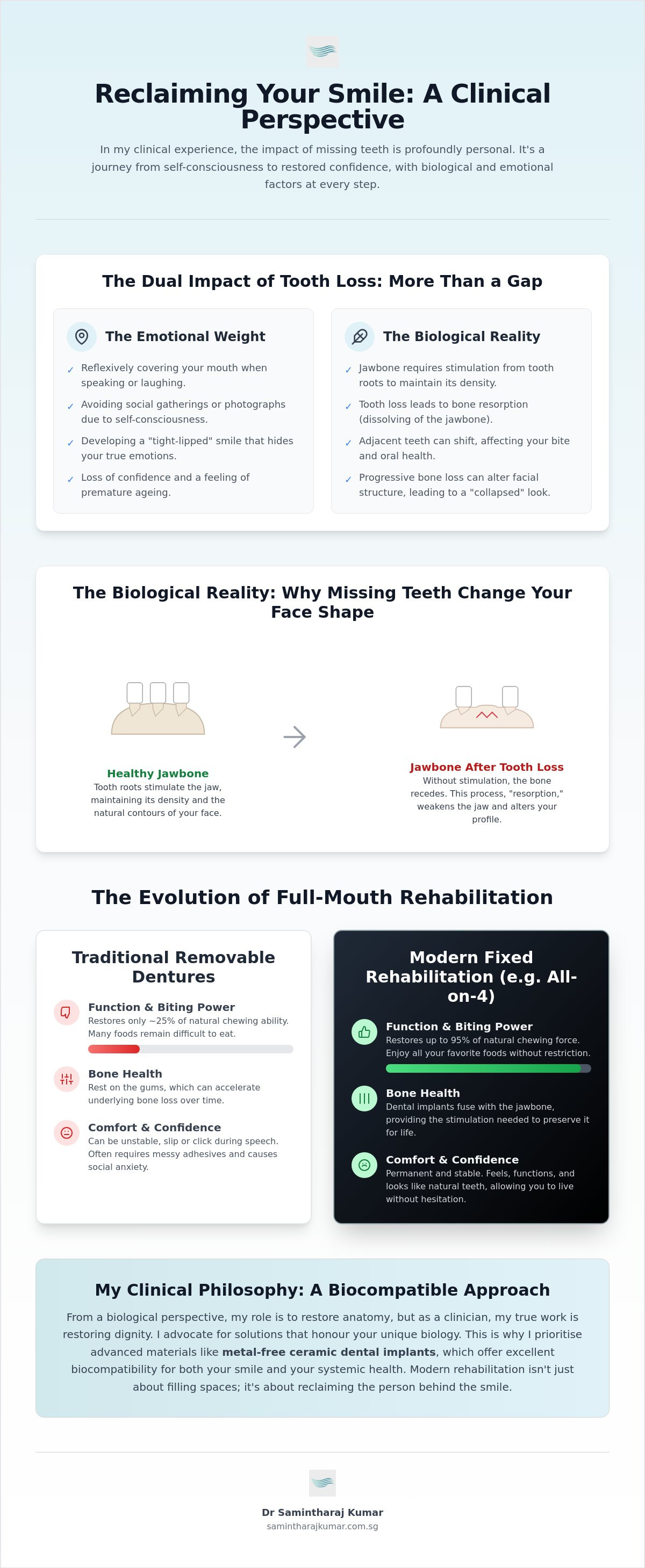
From a biological perspective, the jawbone is a "use it or lose it" tissue. It requires the constant mechanical stimulation of biting and chewing, transmitted through the tooth roots, to maintain its density and volume. When a tooth is lost, this vital stimulation ceases. Bone resorption is the body’s natural response to the absence of dental stress on the alveolar bone. Over time, the bone that once supported your teeth begins to dissolve, leading to a significant loss of facial height and width. I often tell my patients that feeling self-conscious about missing teeth is not just a reaction to a gap in their smile, but a response to the quiet, structural erosion of their facial foundation.
The clinical consequences of this loss extend beyond aesthetics. As the bone retreats, adjacent teeth begin to shift and tilt into the empty space, creating hard-to-clean areas that increase the risk of periodontal disease. This movement further destabilises the bite, often leading to TMJ issues or further tooth loss. Research by the American Psychiatric Association highlights the link between dental and mental health, noting that these physical changes can create a profound sense of psychological distress. It's a cycle where biological decline and emotional insecurity reinforce one another.
Facial Collapse and Structural Rejuvenation
When multiple teeth are missing, particularly in the posterior regions, the lower third of the face begins to shorten. This is often referred to as a "collapsed bite." Without the vertical support of the teeth and bone, the distance between the nose and chin decreases. This causes the lips to appear thinner and the chin to rotate forward and upward, creating a prematurely aged appearance. In my clinical experience, preventing facial collapse with dental implants is the only way to provide the internal scaffolding necessary to support the soft tissues of the cheeks and lips, effectively rejuvenating the face from within.
The Science of the Alveolar Bone
The rate of bone loss is most aggressive in the first year following an extraction. While traditional dentures may restore some surface-level appearance, they do not provide the internal stimulation the jawbone needs. In fact, the pressure from a removable denture can sometimes accelerate bone resorption by compressing the remaining tissue. As a clinician and founder, I advocate for root-mimicking solutions. Dental implants are unique because they undergo osseointegration, fusing with the bone to act as artificial roots. This process halts bone loss and preserves the integrity of your facial structure. The best outcomes begin with understanding the root cause, which is why reclaiming your facial structure through specialist care remains the gold standard for long-term health.
Beyond Dentures: The Evolution of Full Mouth Rehabilitation
In my clinical experience, many patients arrive at my practice having already tried traditional removable dentures. While these are often viewed as a standard replacement, they rarely solve the deep-seated issue of feeling self-conscious about missing teeth. Traditional dentures can slip, click, or require messy adhesives, which often replaces one form of anxiety with another. From a biological perspective, they also fail to preserve the jawbone. As a clinician and founder, I prioritise long-term structural integrity over these temporary cosmetic fixes. True rehabilitation requires a foundation that mimics the natural dentition.
The evolution of full mouth rehabilitation has moved toward fixed, implant-supported solutions that restore not just the look, but the force and feel of natural teeth. A peer-reviewed study in the Gerodontology Journal highlights the profound impact of tooth loss on quality of life, confirming that well-being is tied directly to oral function. This is why I advocate for advanced protocols that offer stability and permanence. These solutions are designed to integrate with your biology, ensuring that your new smile is a lasting part of your identity.
The All-on-4 Protocol: A New Standard
One of the most transformative advancements in my field is the All-on-4 protocol. By strategically placing four implants in a single arch, we can support a full set of fixed teeth. This technique often allows for immediate loading, meaning patients can walk out with a functional smile the same day. The psychological relief of all on 4 dental implants is immense. It marks the turning point where a patient stops worrying about their teeth and starts living again. It is a highly efficient way to restore a total jaw with minimal surgical intervention.
Zygomatic Implants for Severe Bone Loss
For cases where the jawbone has significantly resorbed, traditional implants may not be viable. In these complex scenarios, I utilise Zygomatic Dental Implants. These are anchored in the cheekbones, or zygoma, which provide a dense and stable foundation even when the maxillary bone is insufficient. This advanced surgical approach removes the barrier for patients who were previously told they were not candidates for implants. It is a vital option for those who have spent years feeling self-conscious about missing teeth and were told their bone loss was too severe for treatment. Reclaiming your confidence is possible, regardless of the complexity of your case. The right diagnosis changes everything.
My Clinical Philosophy: Ceramic Implants and Biocompatible Restoration
As a clinician and founder, I believe that true rehabilitation must align with the body’s natural systems. For many of my patients, feeling self-conscious about missing teeth is often compounded by a secondary fear: that the replacement will look artificial or cause a biological reaction. This is why my clinical philosophy centres on biocompatibility. Ceramic implants, specifically those made from high-tier Zirconia, represent a significant leap forward in restorative science. Ceramic implants are 100% metal-free and offer superior gingival integration compared to traditional alloys, ensuring that the interface between the implant and your soft tissue remains healthy and vibrant.
From a biological perspective, the mouth is not an isolated system. It is the gateway to your entire body. Using inert, non-corrosive materials like Zirconia reduces the risk of chronic inflammation or metal sensitivities that can arise with traditional titanium. Ceramic materials also mimic the natural light-reflecting properties of real teeth, providing a translucency that titanium simply cannot replicate. This ensures that even under bright light, your smile looks entirely natural. This level of detail is essential for anyone who has spent years feeling self-conscious about missing teeth and finally wants a solution that feels indistinguishable from nature.
The Aesthetic Advantage of Zirconia
One of the most common complaints I hear from patients with older dental work is the appearance of a "grey line" at the gumline. This occurs when the metal substructure of an implant or crown becomes visible as the gum tissue recedes or thins. By utilising ceramic dental implants, we eliminate this aesthetic hurdle entirely. Because the material is white and opaque, it remains invisible even in patients with thin gum biotypes. I select these materials because they promote both holistic wellness and aesthetic excellence, allowing you to reclaim your confidence without compromise.
Biological Dentistry and Total Health
The link between oral health and systemic inflammation is well-documented in modern medicine. A specialist surgeon must view the mouth as an integrated part of the whole body, not just a collection of teeth. Choosing biocompatible restorations means prioritising your long-term systemic health. The peace of mind that comes from knowing your dental foundation is made of inert, body-friendly material is invaluable. If you are ready to explore how metal-free solutions can transform your smile, I invite you to learn more about our approach to biocompatible dental implants.
Reclaiming Your Confidence: The Patient Journey and Next Steps
In my clinical experience, the most challenging part of the restorative journey is often the first step through the clinic doors. Many patients who spend years feeling self-conscious about missing teeth develop a deep-seated hesitation to seek help, fearing judgment or complex, painful procedures. My goal during the initial consultation is to replace that anxiety with a bespoke clinical roadmap. We move away from the uncertainty of "what if" and toward a structured plan that addresses your unique anatomy, biological needs, and aesthetic goals. This isn't just a dental appointment; it's the start of reclaiming your identity.
The reality of modern oral surgery is far removed from the outdated perceptions of the past. We prioritise your comfort through advanced sedation techniques and minimally invasive protocols, ensuring a serene experience from start to finish. For many, the most life-changing aspect is the speed of transformation. Through the teeth in a day procedure explained in our clinical protocols, patients can often receive a functional, fixed set of teeth in a single session. This immediate result provides an instant psychological boost, ending the cycle of "smile hiding" almost overnight.
What to Expect During Your Recovery
Recovery is a phased process that requires both clinical precision and patient patience. During the initial transition, you may wear a high-quality temporary prosthetic while your implants undergo osseointegration. This biological healing phase is crucial for long-term success. In our specialist environment, we provide comprehensive support systems to monitor your progress, including:
Regular follow-up assessments to ensure soft tissue health and proper bite alignment.
Personalised hygiene protocols designed to protect your new investment.
Direct access to your clinical team to address any concerns during the integration period.
My Perspective: The Future of Your Smile
As a clinician and founder, I am deeply optimistic about the future of restorative dentistry. We are entering an era where AI-assisted diagnostics and precision implantology allow us to plan surgeries with sub-millimetre accuracy before we even begin. This level of innovation ensures that for anyone feeling self-conscious about missing teeth, the solutions are more predictable, aesthetic, and durable than ever before. Seeing a patient’s posture change and their voice become more confident after rehabilitation is why I dedicated my life to this field. The best outcomes begin with understanding the root cause, and the right diagnosis changes everything.
Your Path Toward Total Smile Restoration
Restoring a smile is a journey that involves both the precision of surgery and the preservation of biology. We have explored how the structural changes in your jawbone can lead to feeling self-conscious about missing teeth, and why traditional solutions often fall short of addressing these root causes. As a clinician and founder, my commitment at Nuffield Dental is to provide clinical excellence that prioritises your long-term systemic health. By utilising advanced All-on-4 and Zygomatic protocols, we can overcome even the most complex cases of bone loss.
From a biological perspective, the move toward biocompatible ceramic implantology ensures your restoration is as healthy as it is beautiful. My perspective is that no one should have to compromise on their dignity or their ability to engage with the world. Whether through immediate rehabilitation or bespoke surgical roadmaps, the future of your oral health is bright. The best outcomes begin with understanding the root cause. Explore how total rehabilitation can restore your confidence.
Frequently Asked Questions
Is it normal to feel depressed or anxious because of missing teeth?
It is entirely normal to experience emotional distress. In my clinical experience, the psychological weight of an incomplete smile often leads to a cycle of social withdrawal and a loss of identity. Many patients report a significant decline in their self-worth, which is why our approach to rehabilitation focuses on emotional renewal alongside technical excellence.
How much bone loss occurs after losing a tooth?
Bone loss is most aggressive during the first twelve months after a tooth is removed. Without the mechanical stimulation of a tooth root, the jawbone can lose a significant portion of its volume in just one year. This process of resorption continues indefinitely, eventually leading to the facial collapse and structural changes discussed earlier in this article.
Can I get dental implants if I have been missing teeth for many years?
Yes, you can still be a candidate for dental implants even after decades of tooth loss. While long-term resorption might make traditional implants more complex, advanced techniques such as Zygomatic dental implants allow us to anchor restorations in the cheekbones. We can almost always find a bespoke clinical roadmap to restoration, regardless of how much time has passed.
What is the difference between titanium and ceramic dental implants?
Titanium is the traditional metal standard, whereas ceramic implants are 100% metal-free and made from Zirconia. From a biological perspective, ceramic is often preferred for its superior biocompatibility and its ability to mimic the natural translucency of teeth. This is a vital consideration for anyone feeling self-conscious about missing teeth who desires the most aesthetic, life-like result possible.
Will my new teeth look and feel like natural ones?
Modern prosthetics are designed to mimic the light-reflecting properties and texture of natural enamel. We use high-tier materials and precise diagnostics to ensure your new teeth provide a secure, comfortable fit. Most patients find that once the healing process is complete, their restorations feel like a natural, integrated part of their body.
Is the surgery for full mouth rehabilitation painful?
Surgery is managed with advanced sedation and minimally invasive protocols to prioritise your comfort. Most patients describe the experience as a series of pressure sensations rather than acute pain. My clinical goal is to ensure a steady, calm rhythm during the procedure, allowing you to feel secure and at ease throughout the journey.
How long does the entire process take to get permanent replacement teeth?
The timeline varies based on your specific clinical needs. Protocols like "Teeth in a Day" allow for immediate loading, where you walk out with a functional smile in a single session. Other cases may require several months to allow for osseointegration, ensuring the implants are fully fused with the bone before the final, permanent crown is placed.
What happens if I don’t replace my missing teeth?
Leaving gaps in your smile can lead to shifting teeth, a "collapsed bite," and an increased risk of periodontal disease in your remaining teeth. Over time, the lack of stimulation causes the jawbone to shrink, which can prematurely age your facial profile. Addressing the root cause early is essential for maintaining both your oral health and your long-term quality of life.


Comments