
Gum Recession Treatment Options: A Specialist Surgeon’s Perspective on Tissue Restoration
- Dr Samintharaj Kumar

- 2 minutes ago
- 15 min read
Your gum line is not simply a cosmetic frame for your teeth. It is a living biological boundary that, when it begins to recede, signals something far more consequential than an aesthetic concern. In my clinical experience, patients who arrive seeking gum recession treatment options are almost always managing two burdens simultaneously: the sharp, involuntary flinch of sensitivity when a cold drink touches an exposed root, and a quiet anxiety about what their smile has begun to communicate about their health. Both concerns are entirely valid, and both deserve a precise, specialist-led answer.
You already sense that receding gums are a problem worth addressing. What you may not yet know is that the underlying biology driving that recession, whether it stems from mechanical trauma, periodontal disease, or structural bone loss, determines which treatment pathway will actually deliver lasting results. A surface-level fix applied to a deeper structural issue simply will not hold.
In this article, I'll walk you through the clinical science behind gum recession, the full spectrum of modern surgical and non-surgical options available today, and the philosophy I apply when designing a restoration strategy that prioritises long-term stability alongside a balanced, youthful smile.
Table of Contents
Understanding Gum Recession: A Specialist's Perspective on Biological Tissue Loss
The Clinical Consequences: Why Treating Receding Gums Matters
Modern Gum Recession Treatment Options: Comparing Clinical Pathways
My Perspective: The Philosophy of Precision in Gum Restoration
The Patient Journey: Restoring Functional Aesthetics and Stability
Understanding Gum Recession: A Specialist's Perspective on Biological Tissue Loss
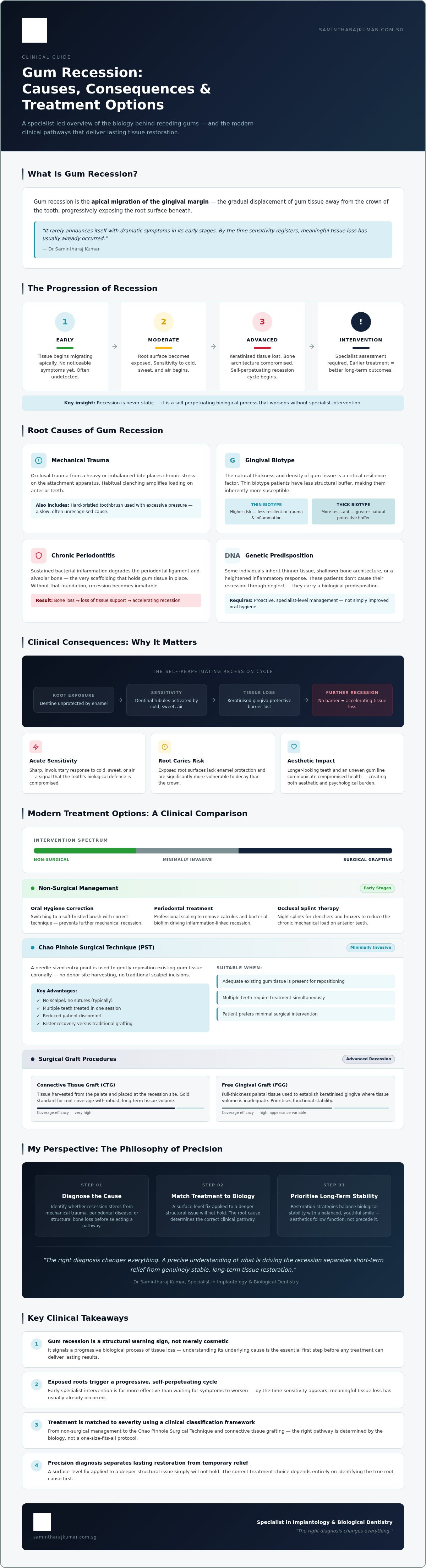
Gum recession is defined clinically as the apical migration of the gingival margin — the gradual displacement of gum tissue away from the crown of the tooth, progressively exposing the root surface beneath. That definition, precise as it is, doesn't fully capture what I observe in practice. What I see is a structural warning sign: the visible endpoint of a biological process that has often been active, silently, for months or even years before the patient notices anything at all.
This is what makes recession particularly insidious. It rarely announces itself with dramatic symptoms in its early stages. By the time sensitivity registers or a patient catches a glimpse of a longer-looking tooth in the mirror, meaningful tissue loss has usually already occurred. That delay is exactly why early specialist assessment matters so profoundly when evaluating gum recession treatment options. Waiting for the problem to become undeniable is, clinically speaking, waiting too long.
The Biomechanics of Gingival Recession
One of the most underappreciated drivers of recession is mechanical force. Occlusal trauma — the sustained, misdirected pressure created by a heavy or imbalanced bite — places chronic stress on the attachment apparatus surrounding the tooth. Over time, this stress displaces the delicate connective tissue that anchors the gum to the root surface. I also see this pattern in patients who grip or clench habitually, where the cumulative loading on anterior teeth gradually overwhelms the tissue's capacity to maintain its position.
A patient's gingival biotype — the natural thickness and density of their gum tissue — is a critical determinant of how resilient that tissue will be under mechanical load. Patients with a thin biotype have less structural buffer against both trauma and inflammation, making them inherently more susceptible to recession even when their oral hygiene is exemplary.
Biological and Environmental Contributors
Chronic periodontitis operates through a different mechanism, but the endpoint is equally damaging. Sustained bacterial inflammation degrades the periodontal ligament and the underlying alveolar bone, eroding the very scaffolding that holds gum tissue in place. Without that foundation, recession is an inevitable consequence rather than a coincidental one.
Aggressive brushing is another factor I address in almost every consultation. The abrasive mechanical action of a hard-bristled brush, applied with excessive pressure, physically wears away the gingival margin over time. It's a slow process, which is precisely why patients rarely connect the habit to the outcome.
Genetics also plays a meaningful role. Some individuals simply inherit thinner tissue, shallower bone architecture, or a heightened inflammatory response. These patients don't cause their recession through neglect — they carry a biological predisposition that requires proactive, specialist-level management to address effectively.
The Clinical Consequences: Why Treating Receding Gums Matters
Recession is never a static condition. Once the gingival margin begins its apical migration, it sets off a chain of biological consequences that compound over time. Understanding those consequences is what transforms gum recession from a cosmetic inconvenience into a clinical priority, and it's why the timing of intervention matters as much as the choice of gum recession treatment options itself.
When root surfaces become exposed, the underlying dentine is no longer protected by enamel. Dentine contains microscopic tubules that connect directly to the nerve of the tooth, and when thermal or osmotic stimuli reach those tubules, the result is acute dentine hypersensitivity. Patients describe it as a sharp, involuntary response to cold liquids, sweet foods, or even a breath of cool air. It's not merely uncomfortable; it's a signal that the tooth's biological defence has been compromised.
The tissue loss itself creates a self-perpetuating problem. Keratinised gingiva, the firm, attached tissue that forms a protective seal around the tooth, acts as a mechanical barrier against further recession. Once that barrier thins or disappears, the remaining tissue is far more vulnerable to bacterial infiltration, frictional trauma, and inflammatory breakdown. Each millimetre lost makes the next millimetre easier to lose.
Exposed cementum, the softer mineralised layer covering the root, is also significantly more susceptible to carious attack than enamel. Root caries can progress rapidly and, in advanced cases, undermine the structural integrity of the tooth itself. I've seen patients who delayed treatment for what they considered a minor aesthetic issue arrive with root decay that substantially complicated their rehabilitation pathway.
There's a broader clinical dimension here, too. The health of the gingival architecture is foundational to the success of any cosmetic dentistry undertaken in the same zone. Veneers, crowns, and smile makeovers placed over compromised tissue simply won't deliver stable, lasting outcomes. Gum health isn't a preliminary consideration; it's the prerequisite.
Structural Instability and Bone Loss
Gum recession and alveolar bone resorption are frequently concurrent processes rather than sequential ones. As the soft tissue retreats, the bone beneath often follows. This has direct implications for adjacent teeth, which can experience increased mobility as their shared bony support diminishes. For patients who may require dental implants in the future, active recession represents a meaningful complication; implant stability depends on adequate bone volume and a healthy band of attached tissue, both of which recession erodes.
The Psychological and Aesthetic Impact
An uneven gum line disrupts the visual rhythm of a smile in ways that patients feel intuitively, even when they can't articulate precisely why their smile looks different. The appearance of elongated teeth, the loss of symmetry, and the emergence of the so-called "black triangle" phenomenon, where dark interdental spaces open up as tissue recedes, all affect how a patient presents and how they feel in social and professional settings. Genuine rehabilitation must address both soft and hard tissue harmony. A restored gum line isn't just a clinical correction; it's the structural canvas on which a balanced, confident smile is rebuilt.
If you're noticing any of these signs, a specialist assessment is the most direct route to understanding what's actually driving the change and what can realistically be done about it.
Modern Gum Recession Treatment Options: Comparing Clinical Pathways
Not every case of recession calls for the same response. The clinical framework I use to guide treatment decisions is built around the Miller Classification system, which grades recession from Class I through Class IV based on the extent of tissue loss, the condition of the interdental bone, and the realistic potential for root coverage. That classification directly determines whether a patient is a candidate for complete root coverage, partial coverage, or stabilisation management. Matching the intervention to the classification isn't a preference; it's a prerequisite for predictable outcomes.
The broader evolution of gum recession treatment options over the past two decades has moved decisively toward biological precision and minimal invasiveness. Where surgery once meant significant soft tissue harvesting and extended recovery, today's techniques prioritise working with the body's existing architecture rather than replacing it wholesale.
Non-Surgical Management and Prevention
For early-stage recession, particularly where active periodontal disease is a contributing factor, the immediate clinical priority is stabilisation. Specialist scaling and root planing removes the bacterial biofilm and calculus deposits that sustain chronic inflammation, creating conditions in which the remaining tissue can stabilise rather than continue retreating. This isn't a cure for recession that has already occurred, but it's the essential foundation before any restorative work begins.
Where recession is shallow and the primary concern is aesthetic, composite bonding or gingival veneers can mask exposed root surfaces effectively. These are not tissue restoration solutions; they're cosmetic management tools, and I'm transparent with patients about that distinction. Alongside this, I implement what I consider a biological oral hygiene protocol: transitioning patients to ultra-soft brushes, correcting technique, and in some cases recommending specific biocompatible rinses that support rather than disrupt the gingival microenvironment. Halting progression is itself a meaningful clinical win.
Traditional Gingival Grafting Techniques
Connective Tissue Grafts and Free Gingival Grafts remain the evidence-backed gold standard for moderate to advanced recession, particularly in Class I and Class II cases. Both involve harvesting donor tissue from the patient's palate and securing it at the recipient site to restore tissue volume and keratinised gingiva. The long-term predictability of these techniques is well-established, and in the right clinical scenario, I still recommend them without hesitation.
The honest clinical reality, however, is that two-site surgery carries genuine recovery demands. Patients manage discomfort at both the palatal harvest site and the treated gum area simultaneously, and full healing typically requires several weeks. For patients with multiple recession sites, the palate's donor capacity also has limits.
The Chao Pinhole® Surgical Technique
The Chao Pinhole Surgical Technique represents a genuinely different philosophy. Rather than harvesting and transplanting tissue, this approach works through a small entry point to loosen and reposition the patient's own existing gingival tissue coronally over the exposed root surface. No scalpel incisions. No sutures. No palatal donor site.
As a trained specialist in this technique, what I find most clinically compelling is the combination of immediate aesthetic change and significantly reduced post-operative discomfort. Patients typically return to normal activity within days rather than weeks. Multiple recession sites can be addressed in a single session, which is a meaningful advantage for patients with generalised recession patterns. The results, when patient selection is appropriate, are both stable and visually natural because we're working with the patient's own biological tissue rather than introducing a graft.
The right technique is always determined by the individual presentation. What matters most is that the choice is made by a specialist who understands the full range of options, not by the limits of what a single clinic happens to offer.
My Perspective: The Philosophy of Precision in Gum Restoration
In my clinical experience, the most consequential decision in any gum restoration case isn't which technique to use. It's whether I've correctly identified what's actually driving the recession in the first place. A technically flawless procedure applied to the wrong diagnosis will fail. That principle shapes every consultation I conduct and every treatment plan I design.
I also approach the mouth as an integrated biological system, not a collection of isolated teeth with independent problems. Gum tissue doesn't exist in isolation from bite mechanics, bone architecture, jaw alignment, or systemic health. When I evaluate a patient presenting with recession, I'm simultaneously assessing the entire structural environment in which that tissue is expected to survive long-term. That systems-level thinking is what separates a durable outcome from a temporary one.
One of the tools I find genuinely transformative in this process is AI-assisted diagnostics. Using technology to map tissue thickness across the gingival architecture before surgery allows me to plan with a precision that simply wasn't available a decade ago. Rather than estimating biotype visually or through tactile probing alone, I can quantify the tissue profile at each site and model the likely response to repositioning or augmentation. The result is a surgical plan that's calibrated to the patient's actual biology, not a generalised protocol.
Why the Right Diagnosis Changes Everything
One distinction I consider non-negotiable before selecting from any range of gum recession treatment options is whether the recession is active or stable. Active recession, where tissue is still migrating apically, demands a different clinical response than stable tissue loss where the process has plateaued. Intervening surgically on active recession without first addressing the underlying driver is one of the most common reasons for post-treatment relapse.
Bite alignment is a particularly underappreciated factor in this equation. Where occlusal forces remain misdirected after soft tissue restoration, the restored tissue faces the same mechanical pressures that contributed to the original recession. I routinely assess and, where necessary, address bite equilibration as part of the rehabilitation plan. It's not an optional add-on; it's how we protect the investment of surgery. As a clinician, I consider it my responsibility to choose the most conservative path that can still deliver genuine, lasting stability.
Customising the Rehabilitation Plan
No two patients arrive with the same recession pattern, lifestyle, or aesthetic vision. A musician with fine motor sensitivity in their hands has different recovery priorities than a corporate professional managing a demanding travel schedule. I factor those realities into the surgical approach, the staging of treatment, and the recovery protocol I recommend.
Where recession is accompanied by significant bone volume loss, the rehabilitation plan must extend beyond soft tissue. In those cases, I integrate considerations around bone augmentation, and where posterior bone deficiency is also present, procedures such as sinus lift surgery become part of a unified treatment strategy rather than a separate conversation. Tissue and bone must be restored in concert if the outcome is to hold.
Looking further ahead, the frontier I find most compelling is regenerative dentistry and tissue engineering. The prospect of stimulating the body's own cellular machinery to rebuild lost gingival and periodontal structures, rather than transplanting or repositioning existing tissue, represents a genuine paradigm shift. We're not there yet in routine clinical practice, but the trajectory is clear and the science is advancing rapidly.
The right diagnosis truly does change everything. If you'd like to understand what's driving your recession and what a precision-led restoration plan might look like for your specific presentation, a specialist consultation is the most direct place to start.
The Patient Journey: Restoring Functional Aesthetics and Stability
Understanding your gum recession treatment options is one thing. Knowing what the actual experience of treatment looks and feels like, from the first consultation through to long-term recovery, is what allows patients to move forward with genuine confidence rather than guarded hesitation. In my practice, I've found that clarity at every stage of the journey is as therapeutically valuable as the surgery itself.
The Consultation and Digital Mapping
The specialist consultation begins not with a treatment recommendation, but with a comprehensive diagnostic picture. I use 3D imaging and high-resolution digital photography to map the gingival architecture with precision, capturing tissue thickness, the position of the gum margin relative to the cemento-enamel junction, and the underlying bone profile at each site. This digital baseline serves two purposes simultaneously: it informs the surgical plan with quantifiable data rather than estimation, and it gives the patient a clear, visual understanding of what's actually happening in their mouth.
That second point matters more than most clinicians acknowledge. Patients who can see their own tissue map, and who understand what the measurements mean, engage with their treatment differently. Anxiety doesn't disappear, but it transforms into something more manageable: informed participation. I walk through every finding transparently, explaining not just what I see but why it matters and what the realistic range of outcomes looks like. This consultation also establishes the monitoring baseline we'll return to at every review appointment, allowing us to track tissue stability with objective precision over time.
Long-Term Outcomes and Quality of Life
The post-operative phase varies by technique. Patients who undergo the Chao Pinhole Surgical Technique typically report a meaningfully faster return to normal activity than those recovering from traditional grafting, where two surgical sites require simultaneous healing. Regardless of approach, I provide a structured recovery protocol covering dietary modifications, oral hygiene adaptations, and clear guidance on what to expect day by day.
The longer-term picture is where the real clinical reward becomes apparent. Patients describe a transition that goes beyond the physical: the involuntary flinch at a cold drink disappears, the self-conscious awareness of an uneven smile recedes, and a quiet confidence returns to everyday interactions. Restored keratinised tissue protects the entire dental arch, reducing susceptibility to root caries, bacterial infiltration, and further recession. For patients with future rehabilitative needs, whether implants or cosmetic work, healthy gum architecture is the foundation that makes those outcomes durable.
Ongoing maintenance within a specialist-led environment is non-negotiable. Periodic reviews allow early identification of any tissue changes before they become clinically significant, and the digital baseline captured at the initial consultation makes those comparisons precise. The best outcomes in gum restoration don't end at the final suture or the last pinhole closure. They're sustained through a long-term partnership between patient and specialist, built on the same diagnostic rigour that guided the treatment from the beginning.
Precision-Led Gum Restoration: Your Next Step Towards Lasting Stability
Gum recession is never simply a cosmetic concern, and it rarely resolves on its own. What this article has established is that the right diagnosis genuinely changes everything. Understanding the biological drivers behind tissue loss, recognising the progressive clinical consequences of leaving it unaddressed, and selecting from the full spectrum of gum recession treatment options with specialist precision are what separate temporary relief from genuinely durable restoration.
The techniques available today, including the minimally invasive Chao Pinhole Surgical Technique, make it possible to address recession with far less disruption than patients typically expect. But technique alone is never the whole answer. It's the systems-level thinking, the precise diagnosis, and the commitment to treating the underlying cause rather than the surface symptom that determines whether results hold long-term.
As founder of Nuffield Dental and a specialist in complex oral rehabilitation, I approach every case with that philosophy at the centre. If you're ready to understand what's actually driving your recession and what a precision-led restoration plan could look like for you, discover our specialist approach to gum restoration at samintharajkumar.com.sg. The right starting point is always an honest, expert-led conversation.
Frequently Asked Questions About Gum Recession Treatment Options
Can receding gums grow back naturally without professional treatment?
No. Once gum tissue has receded, it cannot regenerate on its own. Unlike some other soft tissues in the body, gingival tissue doesn't have the biological capacity for spontaneous regrowth once the margin has migrated apically. What you can do without professional intervention is slow further progression by addressing mechanical contributors like brushing technique, but the tissue that's already lost requires clinical restoration to recover.
This is precisely why early specialist assessment matters. Waiting for the problem to stabilise on its own is, in most cases, allowing it to worsen quietly. The sooner the underlying cause is identified and addressed, the more tissue there is left to work with.
Is gum recession surgery painful, and what is the typical recovery time?
Discomfort levels and recovery timelines vary meaningfully depending on the technique used. Traditional connective tissue grafting involves two surgical sites, the palate and the treated gum area, which typically means several weeks of recovery with managed discomfort at both locations. Most patients describe the palatal harvest site as the more uncomfortable of the two.
The Chao Pinhole Surgical Technique involves no scalpel incisions and no palatal donor site, which translates directly into a significantly faster recovery. Most patients return to normal daily activity within days rather than weeks. In both cases, I provide a structured recovery protocol so patients know exactly what to expect at each stage.
How do I know if I am a candidate for the Chao Pinhole® Surgical Technique?
Candidacy for the Chao Pinhole Surgical Technique depends on several clinical factors: the degree of recession, the amount of existing keratinised tissue available to reposition, and whether the recession is stable rather than actively progressing. It tends to be particularly well-suited to patients with multiple recession sites across the arch, where traditional grafting would require repeated harvesting from a palate with limited donor capacity.
It's not the right approach for every presentation. Where recession is accompanied by significant bone loss or very minimal residual tissue, a different pathway may deliver more predictable results. A specialist assessment with digital tissue mapping is the only reliable way to determine which approach is genuinely appropriate for your specific anatomy.
What happens if I choose to leave my receding gums untreated?
Leaving recession untreated sets off a progressive cycle that becomes increasingly difficult to reverse. Exposed root surfaces are vulnerable to root caries, which can advance rapidly and compromise the structural integrity of the tooth itself. The loss of keratinised gingiva removes the protective barrier that resists bacterial infiltration and further tissue breakdown, meaning each millimetre lost makes the next easier to lose.
Beyond the tooth-level consequences, untreated recession frequently involves concurrent bone resorption, which affects adjacent teeth and complicates any future rehabilitative work, including implants or cosmetic procedures. What begins as a manageable clinical problem becomes a significantly more complex one the longer intervention is delayed.
Will my dental insurance cover the cost of gum recession treatment?
Coverage varies considerably depending on your insurance provider, your specific policy, and how the treatment is classified. Procedures deemed medically necessary, such as grafting to address active periodontal disease or to prevent further structural deterioration, are more likely to attract partial coverage than treatments classified as primarily cosmetic. It's worth requesting a pre-authorisation assessment from your insurer before committing to a treatment plan.
I'd recommend checking directly with your provider about the specific procedure codes involved, as classification can differ between insurers. My clinical team can provide the relevant documentation to support that conversation on your behalf.
How can I prevent my gums from receding further after treatment?
Long-term stability after any gum recession treatment depends on addressing the original drivers of recession, not just restoring the tissue. If aggressive brushing contributed to the problem, transitioning to an ultra-soft brush with a modified technique is non-negotiable. If bite mechanics played a role, occlusal equilibration must be part of the rehabilitation plan, otherwise restored tissue faces the same mechanical pressures that caused the original damage.
Ongoing specialist maintenance reviews are equally important. They allow early detection of any tissue changes before they become clinically significant, and they ensure that the biological environment supporting your restored gum line remains stable over the long term. Prevention after treatment isn't passive; it requires an active, structured approach.
Are the results of gum grafting or pinhole surgery permanent?
Both techniques can deliver highly stable, long-lasting results when patient selection is appropriate and the underlying cause of recession has been properly addressed. The restored tissue becomes integrated into the existing gingival architecture over time, and well-executed root coverage can remain stable for many years with proper maintenance.
That said, "permanent" requires qualification. If the original drivers of recession, whether occlusal trauma, periodontal disease, or brushing habits, aren't resolved, the restored tissue remains vulnerable to the same forces that caused the initial loss. Durability is a shared outcome between the surgical result and the patient's ongoing commitment to specialist-led maintenance and the behavioural changes that protect it.
Can gum recession be a sign of a more serious underlying health issue?
Yes, and this is a dimension I take seriously in every consultation. Recession can be an early indicator of uncontrolled periodontal disease, which itself has documented associations with systemic conditions including cardiovascular disease and metabolic disorders. In some patients, recession patterns that don't align with mechanical causes prompt a closer look at systemic inflammatory status or medication effects, particularly for drugs known to affect gingival tissue.
This is one reason why a specialist assessment goes well beyond measuring tissue loss. Understanding the full biological context of a patient's recession, including relevant medical history and systemic factors, is part of arriving at a diagnosis that's genuinely accurate rather than superficially convenient. The mouth doesn't exist in isolation from the rest of the body, and neither does the treatment plan.


Comments