
What is Included in a Smile Makeover? A Specialist’s Perspective on Functional Aesthetics (2026)
- Dr Samintharaj Kumar

- 1 day ago
- 11 min read
A smile makeover is far more than a simple aesthetic enhancement; it's a precise architectural restoration of your facial harmony. In my clinical experience, many patients approach me with a valid concern that modern dentistry produces results that look artificial or 'too perfect' to be real. You might feel a sense of hesitation, wondering if the process is overly invasive or if you'll lose the unique character of your natural expression. Understanding exactly what is included in a smile makeover is the first step toward replacing that anxiety with a sense of clinical security.
I believe that true excellence in dentistry lies at the intersection of biological health and visionary design. My philosophy centres on creating a foundation that supports long-term well-being while achieving a look that's 'perfectly imperfect' and tailored to your specific facial features. In this article, I'll guide you through the sophisticated components of a total transformation, from AI-assisted diagnostics to the latest 2026 protocols in digital smile design. We'll explore how we integrate structural elements like ceramic implants with subtle facial rejuvenation to ensure your new smile feels like a natural extension of yourself.
Table of Contents
Beyond Aesthetics: What Truly Defines a Smile Makeover?
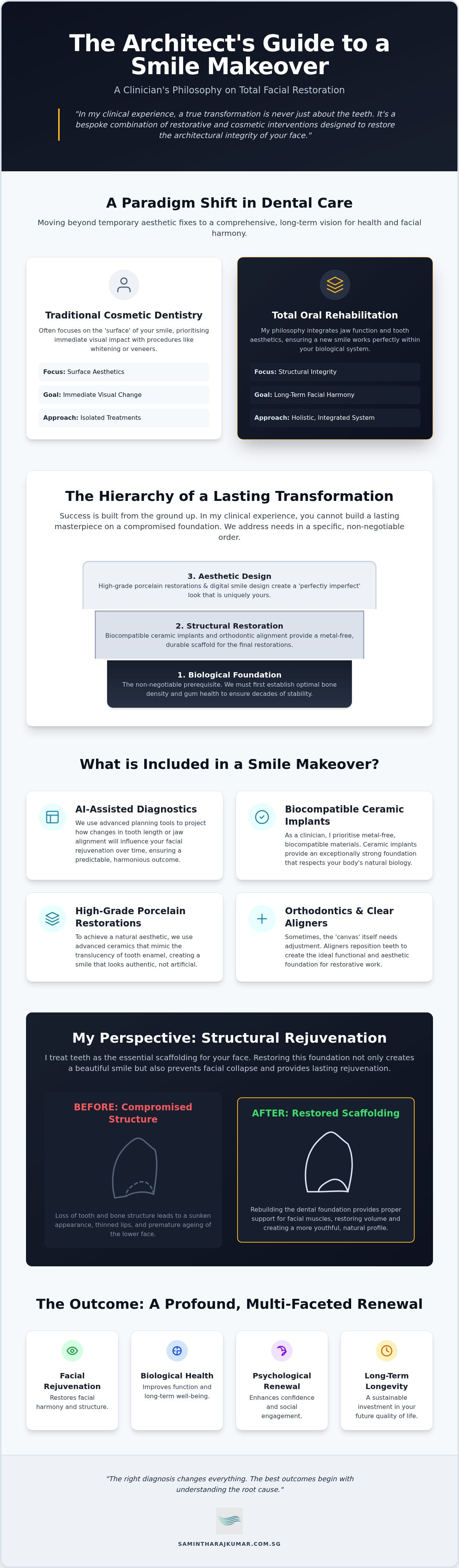
In my clinical experience, patients often view a smile makeover as a curated list of aesthetic upgrades. While cosmetic dentistry procedures like whitening or veneers are certainly part of the equation, a true transformation is never just about the teeth. It's a bespoke combination of restorative and cosmetic interventions designed to restore the architectural integrity of your face. When people ask me what is included in a smile makeover, I explain that we're moving beyond 'smile maintenance', which involves the routine cleaning and filling of cavities, towards 'smile design'. This is a visionary process that harmonises your dental structure with your unique facial features.
To better understand this concept, watch this helpful video:
As a clinician and founder, I see myself as both an architect and a healer. We aren't simply fixing what's broken; we're reimagining what's possible for your quality of life. This involves using advanced diagnostics and AI-assisted planning to project how changes in tooth length or jaw alignment will influence your facial rejuvenation over time. The ultimate goal is to achieve a precise balance between biology, function, and aesthetics.
The Difference Between Cosmetic Dentistry and Total Rehabilitation
Traditional cosmetic dentistry often focuses on the 'surface' of your smile, prioritising immediate visual impact. While this has its place, my focus as a specialist is on total rehabilitation. Structural integrity is the non-negotiable prerequisite for any aesthetic improvement. You cannot build a lasting masterpiece on a compromised foundation. I define Total Oral Rehabilitation as the seamless integration of jaw function and tooth aesthetics. This ensures that your new smile doesn't just look magnificent but works perfectly within your biological system, supporting your facial muscles and speech.
Why a Holistic Approach Matters for Longevity
From a biological perspective, we must consider how the gums, bone, and teeth interact as a single, living ecosystem. A smile makeover must be sustainable for decades, not just a few years. This longevity depends on using biocompatible materials that the body accepts as its own. In my practice at Nuffield Dental, we prioritise advanced ceramics and biological protocols because they mimic natural enamel and respect the surrounding soft tissue. When we discuss what is included in a smile makeover, we address the underlying bone density and gingival health. If these foundations are neglected, even the most beautiful porcelain work will eventually fail. True excellence requires a meticulous eye for the micro-aesthetics of the tooth and a macro-view of your long-term well-being.
The Clinical Components: Essential Procedures for a Transformation
In my clinical experience, the most successful transformations are built on a hierarchy of needs. We always begin with the foundation. When patients enquire about what is included in a smile makeover, they often expect a simple list of aesthetic fixes. However, a specialist's repertoire includes a sophisticated array of surgical and restorative tools designed for longevity. I rely heavily on ceramic dental implants. These provide a metal-free, biocompatible foundation that respects your body's biology while offering exceptional strength.
Integrating these structural elements with the various components of a smile makeover requires a meticulous eye for detail. For instance, I utilise high-grade porcelain restorations because they mimic the natural translucency of tooth enamel. Sometimes, the 'canvas' itself needs adjustment. This is where orthodontics or clear aligners play a vital role. They reposition teeth to ensure that subsequent restorative work is functionally sound and aesthetically balanced.
Restorative Foundations: Dental Implants and Crowns
For patients facing significant tooth loss, I often implement the All-on-4 dental implants protocol. This allows for total oral rehabilitation, often within a single day. In more complex cases where severe bone resorption has occurred, Zygomatic implants offer a life-changing solution by utilising the cheekbone for support. Dental crowns then act as the final protective layer. They shield weakened teeth while perfecting the overall smile arc and bite alignment.
Surface Refinements: Porcelain Veneers and Teeth Whitening
Once the foundation is secure, we address the micro-aesthetics. Porcelain veneers are an art form. I focus on shade, shape, and texture to ensure they blend seamlessly with your facial profile. Professional whitening serves as the finishing touch, unifying the colour across the entire arch for a bright, healthy appearance. For minor imperfections, composite bonding provides a minimally invasive way to repair small chips or gaps without removing significant tooth structure. Understanding these options is key, as the best outcomes begin with understanding the root cause of your dental concerns.
My Perspective: Integrating Dental Structure with Facial Rejuvenation
In my clinical experience, the most profound transformations occur when we stop viewing the mouth in isolation. As a clinician and founder, my philosophy centres on 'Structural Rejuvenation'. I view the teeth and jaw not merely as tools for mastication, but as the essential scaffolding of the entire face. When considering what is included in a smile makeover, we must look beyond the enamel to the underlying support systems that define your profile. A restored smile can take years off a patient's appearance naturally, providing a lift that no topical treatment can replicate.
A primary outcome of this integrated approach is preventing facial collapse with dental implants. When teeth are missing or severely worn, the jawbone begins to resorb, and the distance between the nose and chin decreases. This loss of vertical dimension leads to the 'collapsed' look often associated with ageing. By strategically placing implants and restorations, we provide the necessary tension to the facial muscles. This redefines the jawline and restores the youthful volume of the lips and cheeks.
How Jaw Alignment and Tooth Support Influence Face Shape
From a biological perspective, the maxilla, or upper jaw, provides the critical support for your mid-face and upper lip. If the teeth are angled incorrectly or have lost their volume, the lips can appear thin or sunken. In my practice, I use complex dental reconstruction to restore this lost dimension. We don't just replace teeth; we recalibrate the bite to ensure the jaw sits in a position that maximises both comfort and facial aesthetics. This precision ensures that your smile supports your face as much as it enhances your expression.
The Role of Soft Tissue: Gum Contouring and Facial Aesthetics
The frame of your smile is just as important as the teeth themselves. I often perform gum contouring for a balanced smile to correct what is commonly known as a 'gummy' smile. Using advanced laser technology, I can reshape the gum line with extreme precision and minimal invasiveness. This creates a harmonious proportion between the teeth and the soft tissue. To achieve a truly comprehensive result, we may also integrate non-surgical facial aesthetics. This ensures the skin and musculature complement the new dental architecture. The right diagnosis changes everything, ensuring that every element of your face works in concert.
The Clinical Journey: What to Expect During Your Treatment
In my clinical experience, the most successful outcomes are born from a deep understanding of a patient's lifestyle and long-term aspirations. As a clinician and founder, I believe the journey toward a new smile is as significant as the final result. When patients ask me what is included in a smile makeover, they are often surprised by the depth of the initial 'discovery' phase. This is where we move beyond clinical charts to understand how you use your smile in your daily life. This phase ensures that the final design doesn't just look magnificent but feels entirely authentic to your personality.
Modern treatment planning in 2026 is a fusion of human artistry and AI-assisted diagnostics. We use 3D imaging to map every millimetre of your oral anatomy, allowing us to identify potential biological challenges before they arise. This level of precision is now supported by the latest global standards, ensuring that every piece of technology we use, from intraoral scanners to CAD/CAM systems, meets rigorous international quality protocols. By managing complex sequencing through a specialist team, we replace the typical anxiety of dental surgery with a sense of clinical security and predictable excellence.
Comprehensive Assessment and Digital Smile Design
The process begins with creating a 'digital twin' of your mouth using high-definition intraoral scanners. This eliminates the need for uncomfortable traditional moulds and provides a perfect baseline for our work. Through Digital Smile Design (DSD), I can provide a virtual preview of your final result before we even begin. This is a collaborative phase where you are an active participant. We adjust the proportions, shade, and alignment together, ensuring the outcome reflects your personal vision of health and beauty.
Sequencing Your Procedures for Optimal Healing
From a biological perspective, the order of treatment is critical for longevity. We must ensure the foundation is healthy before placing final restorations; for example, gum treatments or bone grafting must always precede the placement of veneers. For those seeking a more rapid transformation, the teeth in a day procedure explained in my previous clinical guides offers a pathway to immediate functional renewal. We follow strict recovery management protocols to prioritise your comfort, ensuring that each stage of the sequence supports the next for a seamless transition to your new smile. If you are ready to explore these possibilities, I invite you to consult with our specialist team at Nuffield Dental to begin your personalised assessment.
Investing in Your Future: Quality of Life and Maintenance
In my clinical experience, the final appointment of a restorative journey is not the end; it is the beginning of a new chapter in your personal health. As a clinician and founder, I have seen how a total smile transformation acts as a catalyst for profound psychological and functional renewal. While we have discussed the clinical procedures, it is equally important to understand that what is included in a smile makeover also encompasses the long-term maintenance protocols that safeguard your health. This is an investment in your future self, where the best outcomes begin with understanding the root cause of previous dental failures to ensure they never return.
From a biological perspective, the functional benefits of a reconstructed smile extend far beyond the dental chair. Properly aligned and stable teeth allow for significantly better digestion through efficient mastication. They also facilitate clearer speech and, perhaps most importantly, reduce the strain on the temporomandibular joint (TMJ). By restoring the correct vertical dimension of your bite, we often see a reduction in chronic headaches and neck tension. This is the essence of functional aesthetics: a smile that performs as beautifully as it looks.
The Functional Benefits of a Corrected Bite
A healthy bite is the primary defence against the premature wear and tear of your natural dentition. When teeth are properly aligned, the forces of chewing are distributed evenly across the jaw. This prevents the fractures and enamel erosion that commonly occur when the bite is 'off'. I have observed that patients with a corrected bite experience a significant decrease in chronic jaw pain and muscle fatigue. Furthermore, a well-aligned, restored smile is inherently easier to maintain, as there are fewer hard-to-reach areas where plaque can accumulate and cause inflammation.
Protecting Your Investment Through Specialist Aftercare
As a clinician and founder, I view our relationship with patients as a lifelong partnership for health. Protecting your investment requires a commitment to specialist aftercare. This includes annual clinical checkups and professional hygiene maintenance specifically tailored for ceramic implants and porcelain veneers. For many, I recommend a custom-fitted night guard to protect the new restorations from the forces of bruxism, or teeth grinding, during sleep. This proactive approach ensures the longevity of your results, allowing your smile to remain a source of confidence for decades. The transformative power of a healthy smile lies in its ability to restore your spirit, and the best outcomes begin with understanding the root cause of your dental health journey.
Embracing the Future of Your Functional Aesthetic
A smile makeover is a profound commitment to your long-term health and self-assurance. As a specialist in complex oral and maxillofacial surgery, I have dedicated my career to refining the protocols that define total oral rehabilitation. We've explored how what is included in a smile makeover extends far beyond surface-level aesthetics. It is a meticulous integration of biological health, structural scaffolding, and facial harmony. From the use of Zygomatic and Pterygoid systems to address severe bone loss to the precision of AI-assisted design, every element serves a singular purpose: your renewal.
As the founder of Nuffield Dental Holdings, my vision has always been to bridge the gap between advanced clinical science and compassionate care. True transformation occurs when we stop treating symptoms and start addressing the architectural foundations of the face. Your journey doesn't end with a beautiful set of teeth; it begins with a functional, sustainable system that supports your lifestyle for decades. The best outcomes begin with understanding the root cause. Explore our approach to total rehabilitation. I look forward to helping you rediscover the power of a healthy, confident smile.
Frequently Asked Questions
How long does a complete smile makeover usually take from start to finish?
The timeline for a transformation varies significantly based on the specific clinical needs of each patient. For minor aesthetic refinements such as porcelain veneers, the process might be completed in two to four weeks. If your treatment plan requires total oral rehabilitation with dental implants, the biological healing phase may extend the journey to six months or more to ensure structural stability.
Is a smile makeover painful, and what sedation options are available?
Modern clinical protocols prioritise your comfort, ensuring that procedures are virtually painless. In my practice, we offer a range of sedation options including local anaesthesia, intravenous (IV) sedation, and general anaesthesia for more complex oral surgeries. These methods allow you to remain relaxed and secure, replacing anxiety with a sense of being in capable, experienced hands.
Can dental implants be integrated into a smile makeover if I have missing teeth?
Dental implants are frequently a foundational element of what is included in a smile makeover, especially when we are addressing tooth loss or structural decay. From a biological perspective, implants like ceramic or Zygomatic options don't just replace teeth; they preserve bone structure and support facial volume. They are essential for achieving both functional excellence and a natural aesthetic harmony.
What is the difference between a cosmetic smile makeover and full mouth reconstruction?
A cosmetic makeover focuses primarily on the visible 'smile zone' and surface aesthetics, whereas a full mouth reconstruction addresses the underlying structural integrity and bite function. As a clinician and founder, I believe the best outcomes occur when these two disciplines overlap. A specialist approach ensures that your aesthetic result is built upon a sound, functionally sound foundation.
How much does a smile makeover cost, and what factors influence the price?
The investment required for a transformation depends on the specific procedures and materials selected for your bespoke plan. Factors such as the number of teeth being restored, the choice between porcelain or composite, and the necessity of surgical foundations like bone grafting or sinus lifts influence the final cost. I always recommend a detailed diagnostic assessment to understand the unique scope of your needs.
How long will the results of my smile makeover last with proper care?
With meticulous specialist aftercare, the results of your transformation can last for many years. Porcelain veneers and crowns typically have a lifespan of ten to fifteen years, while dental implants are designed to be a lifelong solution. Your commitment to oral hygiene and regular clinical reviews at Nuffield Dental is vital for protecting this long-term investment in your well-being.
Can I see a preview of my new smile before the actual procedures begin?
You can absolutely preview your results before any clinical work begins through our Digital Smile Design protocols. By creating a 'digital twin' of your mouth using 3D intraoral scanners, we can project exactly what is included in a smile makeover for your specific case. This collaborative phase allows you to visualise the shape, shade, and alignment of your new smile.
Will my new smile look natural, or will it be obvious I've had work done?
My philosophy focuses on creating a 'perfectly imperfect' result that mimics the natural translucency and micro-aesthetics of real tooth enamel. We avoid the artificial, uniform look by carefully selecting shades and textures that complement your age, skin tone, and facial features. The goal is a smile that looks like a healthier, rejuvenated version of your natural self rather than a clinical intervention.


Comments