
How Dental Structure Affects Face Shape: A Surgeon’s Perspective on Structural Rejuvenation
- Dr Samintharaj Kumar

- Jul 8
- 12 min read
You cannot build a beautiful home on a crumbling foundation, and the same principle applies to the human face. In my clinical experience, many patients spend years seeking dermal fillers to address sagging skin without ever realising how dental structure affects face shape from the inside out. When the underlying scaffold of the teeth and jawbone begins to diminish, the soft tissues of the face inevitably lose their support. This often leads to a prematurely aged appearance that topical treatments simply cannot fix.
If you've noticed sunken cheeks or discomfort while chewing, you're likely feeling the physical and emotional effects of structural bone loss. I understand how disheartening it is when traditional aesthetic procedures fail to deliver the vibrant, natural look you expect. From a biological perspective, true rejuvenation requires more than just surface-level changes. In this article, I'll explain the vital link between your jawbone health and facial volume. We'll discuss how modern solutions like dental implants can prevent facial collapse, providing a permanent, holistic foundation for both your oral function and your natural aesthetics.
Table of Contents
The Dental Scaffold: How Teeth Support Your Facial Architecture
The Biological Reality of Bone Resorption and Facial Collapse
Vertical Dimension of Occlusion: Why Your Bite Dictates Your Profile
Beyond Surface Aesthetics: Structural Rejuvenation vs. Soft Tissue Fillers
My Perspective: Restoring the Foundation for Lasting Vitality
The Dental Scaffold: How Teeth Support Your Facial Architecture
In my clinical experience, patients often view their teeth as isolated tools for chewing or simple components of a smile. As a surgeon and founder, I perceive them differently. I see the teeth and the alveolar bone that houses them as a sophisticated architectural framework. This dental scaffold provides the critical volume that allows your lips and cheeks to maintain their natural projection. Understanding how dental structure affects face shape is essential for anyone considering long-term rejuvenation. When this internal support is robust, the face appears vibrant and supported; when it falters, the entire aesthetic begins to shift.
To better understand how the underlying bone and tooth position influence your appearance, watch this helpful video:
The Role of the Maxilla and Mandible
The skeletal foundation of the lower two-thirds of your face is defined by the maxilla and the mandible. The maxilla, or upper jaw, acts as a crucial platform for the mid-face. It supports the base of the nose and provides the projection needed for full, healthy-looking cheeks. Meanwhile, the mandible defines the strength of your jawline and the prominence of your chin. A harmonious relationship between these bones is essential for a balanced facial structure. If the teeth are misaligned or the jaws are not properly positioned, the profile can appear recessed or disproportionately elongated. In my work, I focus on restoring this balance to ensure every patient achieves a profile that feels both functional and aesthetically pleasing.
Soft Tissue vs. Hard Tissue Support
Many individuals seek help for sagging skin or deep folds around the mouth, assuming the issue lies solely within the skin itself. From a biological perspective, these concerns are often secondary to hard tissue deficiencies. Your facial muscles and skin are effectively draped over the underlying bone and teeth. If that frame becomes smaller due to tooth loss or bone thinning, a draping effect occurs. The soft tissue loses its tension and begins to sag, creating a hollowed or prematurely aged appearance. I've found that addressing the foundation first often resolves many of these surface-level aesthetic concerns. By restoring the hard tissue support, we can naturally lift the face without the need for excessive artificial volume.
The Biological Reality of Bone Resorption and Facial Collapse
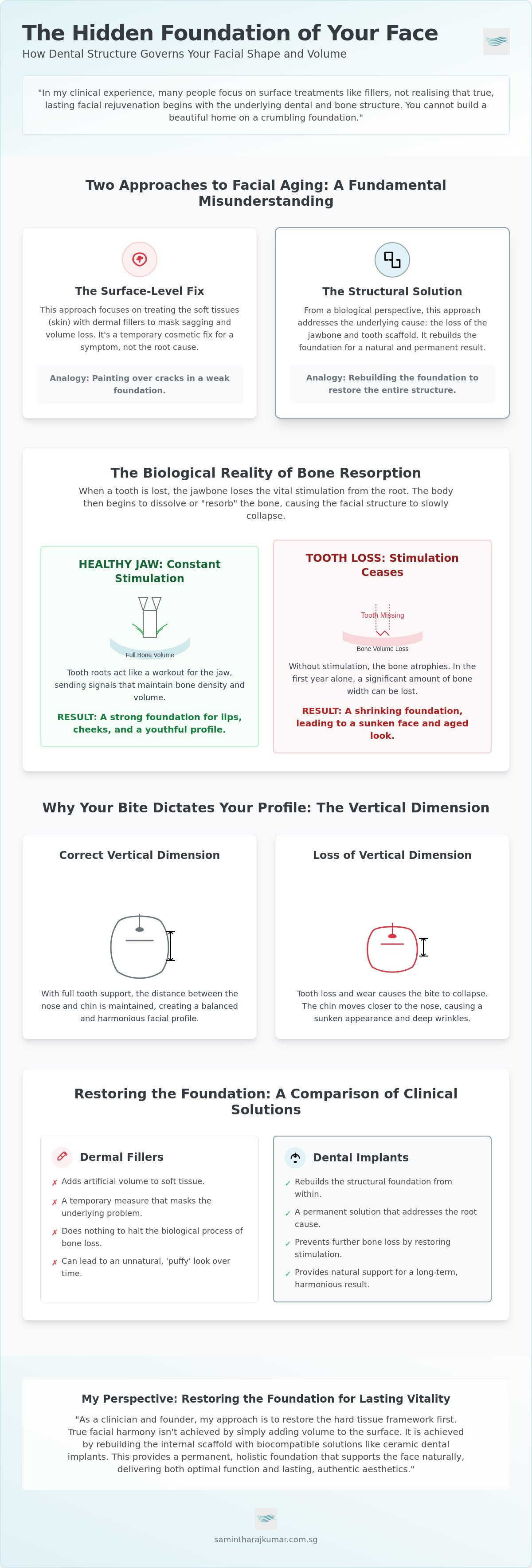
Bone is often perceived as a static, stone-like material, but in reality, it is a dynamic and living tissue. From a biological perspective, the jawbone depends on the constant physical stimulation of tooth roots to maintain its density and volume. When a tooth is lost, that vital stimulation ceases, and the body begins to reclaim the minerals from the surrounding bone. As a clinician and founder, I have observed that this process, known as bone resorption, is the primary driver behind how dental structure affects face shape over time. Without the internal support of the alveolar bone, the lower third of the face begins a slow but steady process of collapse.
This deterioration does not happen overnight, but its cumulative effect is profound. Within the first year of tooth loss, a significant percentage of bone width can be lost, followed by a gradual reduction in height. This loss of structural integrity is what eventually leads to the "sunken" or "hollow" appearance that many patients mistake for simple skin ageing. While dermal fillers may temporarily mask the surface shadows, they cannot halt the underlying biological retreat of the jawbone.
The Mechanism of Bone Loss
The body is remarkably efficient; it rarely maintains tissue that no longer serves a functional purpose. When tooth roots are absent, the alveolar process, the part of the jawbone that supports teeth, begins to atrophy. Bone resorption is the physiological process where the jawbone shrinks due to lack of stimulation from tooth roots. This occurs in two dimensions. Horizontal bone loss causes the jaw ridge to narrow, while vertical bone loss reduces the actual height of the jaw. In my clinical experience, the combination of both leads to a narrowed, weakened foundation that fails to support the facial muscles effectively. Understanding the root cause of this bone loss is the first step toward meaningful restoration.
Consequences for Facial Aesthetics
The aesthetic impact of bone resorption is often most visible in the profile. As the jawbone loses height, the distance between the nose and the chin shortens, causing the lower face to "scrunch" together. This often results in the "witch’s chin" effect, where the chin appears to rotate forward and upward as the jaw collapses. This structural shift also places undue stress on the mentalis muscle, leading to a puckered or strained appearance of the chin skin. Furthermore, the loss of bone volume allows the cheeks to fall inward and the nasolabial folds, or smile lines, to deepen significantly. These are not merely skin-deep wrinkles; they are the visible markers of a failing internal scaffold. I believe that addressing these changes requires a surgical perspective that prioritises the restoration of bone volume to provide a lasting, natural lift to the entire facial structure.
Vertical Dimension of Occlusion: Why Your Bite Dictates Your Profile
If bone volume represents the depth of your facial foundation, then the Vertical Dimension of Occlusion (VDO) represents its height. As a clinician and founder, I often meet patients who believe they are simply experiencing the inevitable progression of age. They notice their lips appear thinner or their chin seems more prominent and aggressive. In my clinical experience, the root cause is frequently not skin elasticity, but a lost bite height. When teeth are worn down through years of attrition or grinding, the entire lower third of the face begins to compress. This physical shortening is a primary example of how dental structure affects face shape, leading to a "collapsed" look that topical treatments cannot reach.
VDO is the specific distance between two points on the face, usually the tip of the nose and the base of the chin, when the teeth are fully in contact. It acts as a vertical pillar for your facial architecture. When this pillar is shortened, the soft tissues of the lower face have nowhere to go but outwards and downwards. This results in a facial profile that looks prematurely aged, often accompanied by deep folds at the corners of the mouth. Restoring this dimension is about more than just teeth; it's about returning the face to its intended biological proportions.
Identifying a Collapsed Bite
A collapsed bite often presents with symptoms that go beyond aesthetics. Beyond the visible wear on the enamel, you might experience persistent jaw joint (TMJ) discomfort or unexplained tension in the facial muscles. This happens because your muscles are forced to over-contract to bring the teeth together. During a consultation, we use precise diagnostics to measure the ideal vertical height for your unique facial structure. By restoring this height, we allow the facial muscles to rest at a natural, tension-free length. This often provides an immediate "lift" to the facial features, reducing the drooping effect caused by the shortened bite.
Structural Consequences of Malocclusion
Malocclusion, or jaw misalignment, significantly alters the way the lips and chin are perceived. For instance, an overbite can make the lower jaw appear recessed, while an underbite can create a heavy, protruding chin. These imbalances don't just affect your smile; they change how the skin and muscles settle over the jawline, often contributing to the early development of jowls. Correcting the bite through structural rejuvenation is often the first step in a comprehensive aesthetic plan. By realigning the jaw and restoring lost tooth height, we provide the necessary support for the lips and jawline to appear sharp and well-defined. The best outcomes begin with understanding the root cause of these structural shifts.
Beyond Surface Aesthetics: Structural Rejuvenation vs. Soft Tissue Fillers
In my clinical experience, the surge in popularity of dermal fillers has led to a common misunderstanding of facial ageing. Many patients attempt to address sagging skin or deep folds by adding volume to the soft tissues, yet they often overlook the fact that the skin is merely a reflection of what lies beneath. When we ignore how dental structure affects face shape, we risk chasing symptoms rather than solving the problem. If the underlying bone and teeth have diminished, adding filler is like trying to tighten a tent over a collapsing pole. The fabric may look fuller, but the structure remains unstable.
This approach frequently results in the "over-filled" look, often referred to in clinical circles as "pillow face." This occurs when too much soft tissue volume is added to a failing scaffold, leading to an unnatural puffiness that distorts the patient’s features rather than rejuvenating them. From a biological perspective, true vitality comes from a balanced foundation. I believe that preventing facial collapse with dental implants offers a far more natural and permanent result. By restoring the hard tissue, we provide the necessary tension for the skin to sit correctly, achieving a lift that looks authentic and lasts for years.
The Limitations of Non-Surgical Aesthetics
Non-surgical treatments like fillers and toxins certainly have their place in a refined aesthetic plan, but they are often used to camouflage issues that require a more fundamental intervention. As a clinician and founder, I advocate for a foundation-first philosophy. We must first ensure the dental scaffold is intact before fine-tuning the surface. This holistic approach avoids the trap of temporary masks and focuses on long-term well-being. When we prioritise the architecture of the mouth and jaw, the need for external injectables often decreases significantly, as the face regains its natural support system.
The Surgeon’s Advantage in Facial Harmony
My background in oral and maxillofacial surgery allows me to view facial aesthetics through a unique lens. I don't just see the surface; I see the complex interplay of facial planes, muscle attachments, and bone density. This specialised perspective is vital for creating true facial harmony. Structural rejuvenation involves restoring the hard tissue foundation to naturally support the soft tissues of the face. By combining surgical precision with an eye for aesthetics, we can achieve a transformation that feels both profound and personal. I invite you to explore a comprehensive approach to facial aesthetic rejuvenation that prioritises your long-term health and appearance. The right diagnosis changes everything.
My Perspective: Restoring the Foundation for Lasting Vitality
As a clinician and founder, my philosophy centres on the belief that oral health is the cornerstone of facial vitality. I don't simply view myself as a surgeon who replaces teeth; I see my role as a restorer of human architecture. In my clinical experience, the most profound transformations occur when we move beyond surface-level aesthetics to address the core foundation. This is where "Teeth in a Day" serves as a truly transformative tool. It allows us to intervene decisively, halting the cycle of bone loss and immediately addressing how dental structure affects face shape.
From a biological perspective, the materials we use are just as important as the surgical technique. I frequently advocate for ceramic dental implants because they offer a biocompatible solution that integrates seamlessly with the body. These metal-free alternatives are exceptional at preserving bone volume, ensuring that the facial scaffold remains stable for decades. For patients facing severe bone loss in the upper jaw, Zygomatic implants provide a unique solution. By anchoring into the cheekbones, they restore mid-face support that would otherwise be lost, effectively lifting the base of the nose and the cheeks from within.
The All-on-4 Protocol and Facial Support
The All-on-4 dental implants protocol is a cornerstone of my rehabilitative approach. It allows us to instantly restore the Vertical Dimension of Occlusion (VDO) that we discussed previously. By re-establishing this lost height, patients often experience an immediate aesthetic improvement. Lip support is regained, and the "compressed" appearance of the lower face vanishes. While the physical change is rapid, I always remind my patients that the transition is a journey. Adjusting to a new dental prosthesis involves a period of neurological and muscular adaptation, but the long-term impact on quality of life is immeasurable.
The Future of Functional Aesthetics
Looking forward, the integration of AI-assisted diagnostics is revolutionising how we plan these complex cases. We can now map facial-dental harmony with a level of precision that was previously impossible. My practice prioritises these innovations to ensure every patient achieves a result that is both functional and beautiful. Key benefits of this specialised approach include:
Precise placement of implants to maximise existing bone density.
Customised prosthetic design that matches the patient's unique facial planes.
Predictable outcomes that prioritise long-term structural stability.
Success in these procedures depends on choosing a specialist who understands the intricate relationship between dental implants and facial anatomy. Total oral rehabilitation is a specialised field that requires a deep understanding of both function and form. My goal is to ensure that every patient leaves my care not just with a functional bite, but with a face that reflects their inner vitality. The best outcomes begin with understanding the root cause.
Embracing a Future of Structural Harmony
True rejuvenation is never a surface-level pursuit. As we have explored, understanding how dental structure affects face shape is the first step toward lasting vitality. By prioritising the internal scaffold of the jaw and teeth, we can address the root cause of facial collapse rather than merely camouflaging its symptoms. Whether through restoring the vertical dimension of your bite or preserving bone volume with ceramic implants, the goal is always to create a foundation that supports your natural features with integrity.
As the founder of Nuffield Dental Holdings and a specialist in Zygomatic and All-on-4 protocols, I am committed to the principles of biological dentistry and functional aesthetics. My clinical focus remains on achieving profound personal impact through meticulous surgical precision and AI-assisted diagnostics. The right diagnosis changes everything. Begin your journey toward structural restoration and rediscover the confidence that comes with a balanced, healthy profile. You deserve a future where your smile and your facial aesthetics are in perfect, enduring harmony.
Frequently Asked Questions
Can missing teeth really make my face look older?
Yes, missing teeth lead to a loss of internal support that directly results in a prematurely aged appearance. When the underlying bone resorbs, the skin loses its tension, leading to deeper nasolabial folds and a hollowed look in the cheeks. This is because the teeth and jawbone no longer provide the necessary scaffold to keep the facial tissues taut.
How do dental implants prevent facial collapse?
Dental implants prevent facial collapse by mimicking the function of natural tooth roots. From a biological perspective, they provide the necessary mechanical stimulation to the jawbone, which signals the body to maintain bone density and volume. By stopping the process of bone resorption, implants ensure the lower face retains its structural height and youthful proportions.
Will getting dentures fix my face shape?
While dentures can offer some initial surface support for the lips, they don't address the root cause of bone resorption. In my clinical experience, traditional dentures may actually accelerate bone loss over time because they sit on top of the gums rather than stimulating the bone. This often leads to the dentures becoming loose as the jaw continues to shrink and the face shape collapses further.
Is it possible to restore facial volume without fillers?
It is absolutely possible to restore facial volume by addressing the hard tissue foundation first. By rebuilding the dental scaffold through structural rejuvenation, we provide a natural lift to the soft tissues. This approach often reduces the need for temporary dermal fillers because the skin is once again supported by a robust internal framework.
How long does it take for face shape to change after tooth loss?
Facial changes begin almost immediately after a tooth is lost. Data suggests that a significant portion of bone width can be lost within the first twelve months, with the most visible aesthetic changes appearing gradually as the vertical height of the jaw decreases. Over several years, this cumulative loss results in the characteristic sunken appearance of facial collapse.
Can a "collapsed bite" be fixed in adults?
A collapsed bite can certainly be corrected in adults through comprehensive restorative protocols. We focus on re-establishing the proper vertical dimension of occlusion, which restores the natural height of the lower face and relieves tension in the jaw muscles. This process not only improves function but also provides an immediate aesthetic lift to the chin and jawline.
What is the difference between a cosmetic dentist and a maxillofacial surgeon for facial aesthetics?
A cosmetic dentist typically focuses on the appearance of the teeth themselves, such as their colour and alignment. As a maxillofacial surgeon, I look at the entire skeletal framework, including how dental structure affects face shape and the complex relationship between bone, muscle, and skin. This allows for a deeper level of structural rejuvenation that goes beyond the surface of the smile.
Does bone grafting help with facial rejuvenation?
Bone grafting is a vital component of structural rejuvenation. It allows us to replace lost volume in the jaw, providing the necessary foundation for dental implants and ensuring the face has the internal architecture required to maintain a youthful, supported appearance. This procedure is often essential for patients who have experienced significant bone loss due to long-term tooth absence.


Comments