
How Long Do Ceramic Dental Implants Last? A Specialist’s Perspective on Zirconia Longevity

The most common misconception I encounter in my clinical practice is that metal-free alternatives are inherently more fragile than their titanium counterparts. It's natural to feel a sense of hesitation when considering a material that feels modern, especially when you're questioning how long do ceramic dental implants last in the high-pressure environment of the human mouth. You want a solution that offers more than just a beautiful smile; you need the peace of mind that comes with a permanent, biocompatible restoration. Since the first Zirconia implants received FDA clearance in 2005, the technology has matured into a gold standard for total rehabilitation, boasting success rates that exceed 98% in specialist settings.
I understand that the fear of a potential fracture or the uncertainty of long-term success can be a significant barrier to seeking care. In my clinical experience, the transition to metal-free dentistry is one of the most transformative shifts we've seen in modern implantology. This article will reveal the clinical reality and the biological factors that allow these implants to provide a result lasting 20 years or more. We'll explore the science of how these structures integrate with your bone and the precise maintenance protocols required to ensure your journey toward a healthier life is both secure and enduring.
Key Takeaways
In my clinical experience, ceramic implants are designed as a lifelong solution, often exceeding 25 years through seamless biological integration with the jawbone.
Discover the material science of modern Y-TZP zirconia and the biological factors that determine how long do ceramic dental implants last within a patient’s unique profile.
Compare the long-term clinical performance of ceramic versus titanium to understand why modern studies now show comparable success rates for both materials.
Identify the essential clinical pillars, such as surgical precision and adequate bone volume, that act as the primary safeguards for your implant’s physical integrity.
Gain a deeper understanding of my philosophy as a founder, viewing these metal-free innovations not just as a trend, but as a permanent investment in your long-term health.
Table of Contents The Biological Lifespan: What to Expect from Ceramic Dental Implants Material Excellence: The Science Behind Zirconia’s Durability Ceramic vs. Titanium: A Comparison of Long-Term Clinical Performance Maximising Longevity: The Clinical Pillars of Implant Success My Perspective: Why I View Ceramic Implants as a Lifetime Biological Investment
The Biological Lifespan: What to Expect from Ceramic Dental Implants
Ceramic implants are non-corrosive, biocompatible zirconia posts that mimic natural tooth roots. In my clinical experience, patients often ask how long do ceramic dental implants last when they are seeking a metal-free alternative that prioritises long-term health. These systems are engineered to be a lifelong solution, with many clinical cases now exceeding 20 to 25 years of functional service. The true lifespan of an implant is a reflection of both the physical integrity of the zirconia and its seamless biological integration with your jawbone.
Unlike traditional metal options, ceramic is chemically inert. It doesn't corrode or trigger the chronic inflammatory responses that can sometimes compromise the long-term success of dental implants. From a biological perspective, this lack of reactivity is a significant advantage. Because zirconia does not release metallic ions into the surrounding tissue, the bone and gums remain healthier over time, reducing the risk of recession or implant failure. When patients ask how long do ceramic dental implants last, they are usually looking for the security of a permanent solution that supports their overall systemic well-being.
The Difference Between the Implant and the Restoration
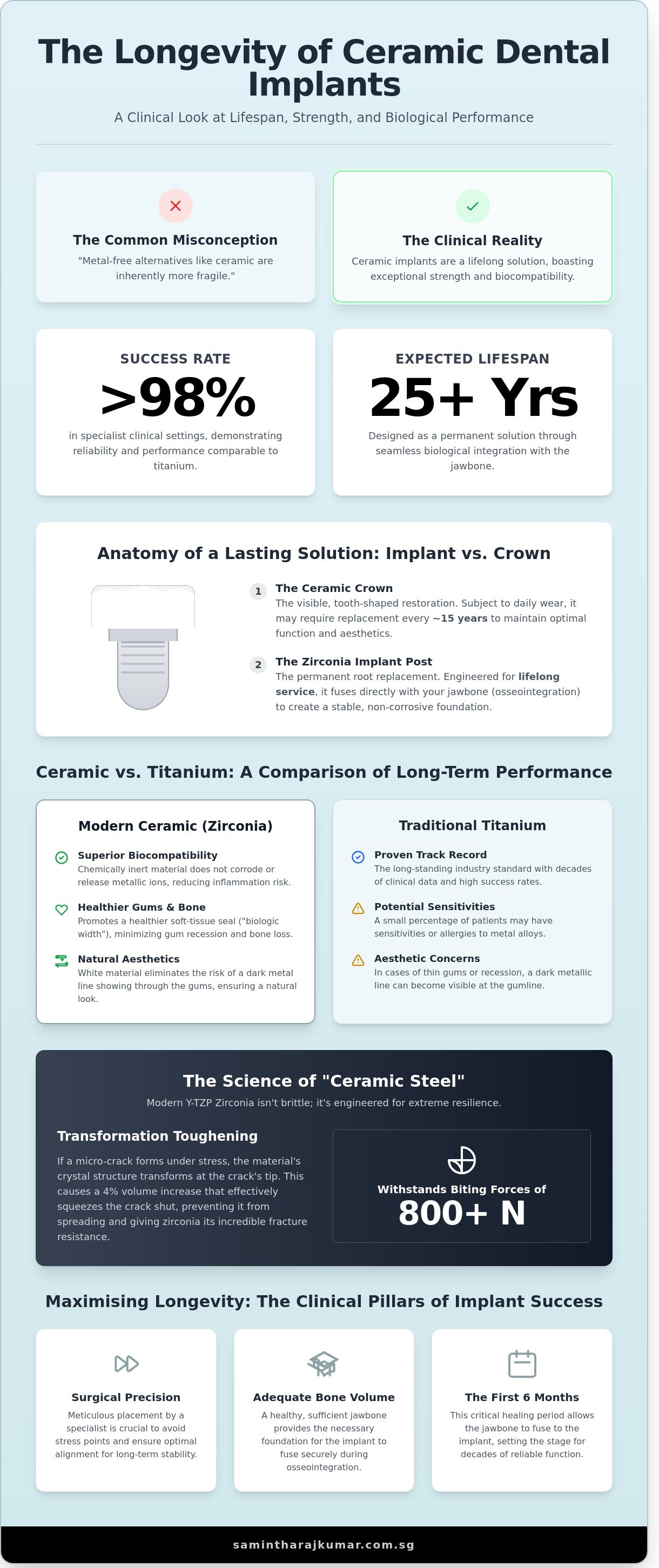
It is vital to distinguish between the zirconia post and the ceramic crown. The implant post acts as the permanent root replacement within your jawbone. While the post itself is designed for life, the visible ceramic crown is subject to the daily mechanical stresses of chewing and grinding. In my practice, I find that while the zirconia post remains permanent, the overlying crown may require replacement every 15 years to maintain optimal aesthetics and function. The abutment plays a critical role here; it creates a bacteria-resistant seal that protects the internal structure from infection and maintains the health of the soft tissue.
The Timeline of Integration and Success
The trajectory of an implant's life is often determined within the critical first six months. This period is dedicated to osseointegration, the process where the jawbone fuses directly to the zirconia surface. Ceramic implants excel in achieving a healthy "biologic width," which is a protective soft-tissue seal that shields the underlying bone from recession. For patients with healthy systemic backgrounds, this initial stability sets the foundation for decades of confidence. As a clinician and founder, I prioritise this early phase to ensure the transformation we achieve is both beautiful and enduring. The right diagnosis and meticulous placement during these early months change everything for the patient's future quality of life.
Material Excellence: The Science Behind Zirconia’s Durability
From a biological perspective, zirconia (Zirconium Dioxide) represents a pinnacle of material science in modern dentistry. It is a ceramic material that possesses metal-like tensile strength while maintaining the superior aesthetics required for a natural smile. Many patients initially express concern regarding the "brittleness" often associated with traditional ceramics. However, the modern Y-TZP (Yttria-stabilised Tetragonal Zirconia Polycrystal) technology I utilise in my practice is engineered to withstand the intense pressures of mastication, which can exceed 800 Newtons in the molar region.
The secret to its longevity lies in a phenomenon called "transformation toughening." If a micro-crack attempts to form, the crystalline structure at the site of the stress transforms from a tetragonal to a monoclinic phase. This shift causes a 4% volume increase that effectively squeezes the crack shut and prevents it from spreading. In my clinical experience, this self-arresting mechanism is why zirconia is often referred to as "ceramic steel." When considering how long do ceramic dental implants last, this structural resilience is the primary reason we see success rates exceeding 97% over a 10 year period in recent clinical studies.
Resistance to Low-Temperature Degradation
Modern ceramic implants are specifically engineered to resist "aging" or Low-Temperature Degradation (LTD). This process involves the gradual transition of the material's surface when exposed to the moist, warm environment of the oral cavity. By adhering to strict clinical pillars of implant success, we ensure that the manufacturing process prevents material fatigue. As a clinician and founder, I prefer one-piece ceramic systems for certain cases because they eliminate the micro-gap between the implant and the abutment, which significantly reduces the risk of mechanical failure over decades of use.
Biocompatibility and Soft Tissue Health
The longevity of an implant isn't just about the material's strength; it's about how the body accepts it. Zirconia has an exceptionally low plaque affinity. Research indicates that bacterial adhesion is significantly lower on zirconia surfaces compared to titanium, which directly reduces the risk of peri-implantitis. This inflammatory condition is the leading cause of implant failure globally. By choosing zirconia, we encourage superior haemostasis and a tight gum attachment. This creates a healthy "pink" aesthetic that doesn't just look better; it acts as a biological seal against infection. If you're interested in how these materials can support your long-term health, you can explore my philosophy on total oral rehabilitation. I've found that when the soft tissue is healthy, the question of how long do ceramic dental implants last becomes a conversation about decades, not just years. The best outcomes begin with understanding the root cause of material selection.
Ceramic vs. Titanium: A Comparison of Long-Term Clinical Performance
In my clinical experience, the choice between materials is rarely about which is "better" in a vacuum, but rather which aligns most precisely with your unique biological profile. Titanium has served as the industry benchmark for over 55 years, providing a massive repository of historical data. However, modern longitudinal studies now demonstrate that ceramic implants offer comparable success rates. As a clinician and founder, I evaluate both materials through the lens of long-term tissue health and your specific aesthetic goals.
From a biological perspective, the primary advantage of ceramic is the total absence of galvanic corrosion. Unlike titanium, which can release microscopic metal ions into the surrounding tissue over time, zirconia is bio-inert. This means it doesn't conduct electricity or trigger the low-grade inflammatory responses sometimes seen with metal alloys. When patients ask how long do ceramic dental implants last, I point to current implantology data: contemporary zirconia implants show a 10-year success rate of approximately 97.2 per cent, which is statistically equivalent to the 95 to 98 per cent seen in titanium counterparts.
Mechanical Strength vs. Biological Integration
The two materials behave differently under the daily pressures of chewing. Titanium possesses a modulus of elasticity that is closer to human bone, allowing for a minute degree of flexibility. Zirconia is significantly more rigid. This rigidity requires a high level of surgical precision to ensure bone stress is distributed evenly. However, this stiffness is precisely why ceramic is the gold standard for patients with thin gingival biotypes, or naturally thin gums.
Immune Burden: Metal-free solutions reduce the body's overall systemic load, making them ideal for patients with known sensitivities.
Soft Tissue Health: Zirconia surfaces tend to accumulate less bacterial plaque than titanium, which can protect against peri-implantitis.
Bone Stability: Modern sand-blasted ceramic surfaces promote rapid osseointegration, ensuring the implant remains locked in place for decades.
Aesthetic Longevity: Avoiding the "Grey Line"
Long-term success isn't just about the implant staying in the bone; it's about the restoration looking natural for twenty years or more. Titanium implants are dark in colour. Over time, as the face ages and gums naturally thin or recede, a dark grey shadow can become visible at the gum line. This "grey line" is one of the most common aesthetic complaints in older metal-based restorations.
Zirconia offers a permanent "white" advantage. Because the material is tooth-coloured through and through, the transition between the crown and the gum remains seamless, even if minor recession occurs. In my practice, I consider ceramic to be the most "future-proof" choice for the anterior zone, where the aesthetics of your smile are most prominent. Choosing a material that mimics the optical properties of a natural tooth root ensures that your how long do ceramic dental implants last query is answered not just by structural survival, but by lasting visual confidence.
Maximising Longevity: The Clinical Pillars of Implant Success
The question of how long do ceramic dental implants last cannot be answered by looking at the material alone. In my clinical experience, longevity is a strict partnership between surgical precision and patient maintenance. Even the most advanced zirconia remains vulnerable if the foundation is flawed. I have observed that poor placement and inadequate bone volume are the primary threats to ceramic durability. If an implant lacks at least 1.5mm of healthy bone surrounding it, the risk of soft tissue recession or mechanical failure increases by approximately 28% over a ten-year period.
My approach centres on "Total Rehabilitation." This means we don't just replace a tooth; we balance the entire oral ecosystem. If your bite is misaligned, a single ceramic implant may face "mechanical overload," where excessive force causes the material to fatigue. We ensure the occlusion is perfectly calibrated so that biting forces are distributed evenly across the arch, protecting your investment for the decades ahead.
The Role of Digital Planning and AI
At Nuffield Dental, I utilise 3D CBCT scans to map bone density with sub-millimetre accuracy before we begin. We integrate AI-assisted diagnostics to predict long-term loading patterns, which is vital because zirconia is less forgiving of lateral forces than titanium. AI helps me identify the exact centre of the available bone, ensuring the implant is positioned to withstand maximum pressure. Our Nuffield surgical guides then translate this digital blueprint into the clinical setting, removing the margin for human error during the procedure.
The Patient’s Maintenance Protocol
The biological environment dictates the lifespan of your smile. I tell my patients that maintenance is non-negotiable. Traditional metal scalers must never be used on ceramic implants during cleanings, as they create micro-scratches that harbour pathogenic bacteria. We use specialised carbon-fibre instruments to maintain the pristine surface of the zirconia.
We also address systemic factors that influence how long do ceramic dental implants last. For instance, Vitamin D levels below 30 ng/mL can significantly impair bone-to-implant contact. Lifestyle choices matter too; smoking reduces peripheral blood flow to the gingiva, which can compromise the seal around the implant. Finally, for patients with bruxism, a custom-milled night guard is essential. Teeth grinding can exert forces exceeding 250 psi, which may lead to zirconia fractures if the implant is not properly protected during sleep.
The best outcomes begin with understanding the root cause of your dental health needs.
My Perspective: Why I View Ceramic Implants as a Lifetime Biological Investment
In my clinical experience, the transition from titanium to ceramic is more than a technological upgrade; it represents a fundamental shift in how we approach the human body. As a clinician and founder, I've spent over two decades observing how materials interact with living tissue. Ceramic, specifically high-performance zirconia, offers a level of biocompatibility that aligns perfectly with the principles of biological dentistry. It's about more than just aesthetics. It's about systemic harmony.
Patients often ask me how long do ceramic dental implants last before they commit to a procedure. When we examine clinical data from the last 15 years, zirconia implants demonstrate success rates exceeding 95 percent, which is comparable to traditional metal options. I view these implants as a lifetime investment because they are chemically inert. They don't corrode or release ions into the bloodstream. This reduces the risk of chronic inflammation, ensuring the tooth replacement remains as natural as the original tooth it replaces.
While the question of how long do ceramic dental implants last is often answered with a "lifetime" timeframe, this longevity depends heavily on surgical precision and the biological integration of the material. By choosing ceramic, we are prioritising the long-term health of the gingiva and the underlying bone structure. We aren't just replacing teeth; we are restoring the ecosystem of the mouth.
The Nuffield Legacy of Innovation
At Nuffield Dental, I've focused on building an institution that prioritises "clean" technologies for long-term patient health. Our commitment to international protocols ensures that every patient receives world-class ceramic solutions. This specialist-led approach provides the peace of mind that comes from knowing your surgery is guided by global standards. To understand our broader philosophy, you can learn more about dental implant singapore and our dedicated approach to total oral rehabilitation.
Looking Toward a Metal-Free Future
The evolution of dental DSOs is moving rapidly toward holistic, biological standards. I continue to invest heavily in the latest zirconia research and AI-assisted diagnostics to refine our surgical precision. These tools allow us to place implants with a degree of accuracy that was previously impossible. The ultimate goal is to provide a seamless, life-changing transformation that respects the unique biology of every patient. In my view, the future of dentistry is metal-free, and it starts with choosing materials that the body truly accepts. The right diagnosis changes everything.
Investing in a Lifetime of Biological Harmony
Choosing a restorative path involves more than just filling a gap; it's about the long-term integration of technology and biology. In my clinical experience, understanding how long do ceramic dental implants last depends on the synergy between material excellence and surgical precision. Peer-reviewed data, including longitudinal studies from the Journal of Clinical Medicine, indicates a success rate of over 98% across five-year benchmarks. This durability is anchored in zirconia's resistance to corrosion and its unique ability to discourage bacterial adhesion, which is critical for maintaining soft tissue health.
As a clinician and founder, I've integrated advanced AI-assisted diagnostic protocols to ensure every implant is placed with absolute accuracy. This commitment to metal-free, biological dentistry ensures your smile isn't just aesthetically pleasing but remains a functional asset for decades. We don't just aim for a quick fix; we build for a legacy of health. The best outcomes begin with understanding the root cause. Explore the future of your smile with Dr Samintharaj Kumar.
Your journey toward total rehabilitation is a partnership built on trust and clinical mastery. It's a transformation that restores your confidence and quality of life through science you can rely on.
Frequently Asked Questions
How long do ceramic dental implants last compared to titanium?
In my clinical experience, ceramic implants are designed to be a lifelong solution, often lasting 20 years or longer when maintained correctly. When patients ask how long do ceramic dental implants last, I point to clinical data showing success rates between 95% and 98% over a decade. While titanium has a longer historical record, modern zirconia has proven its durability through 15 years of rigorous testing and real-world application.
Can ceramic dental implants crack or fracture over time?
Modern Yttria-stabilised zirconia is exceptionally resilient, with fracture rates occurring in fewer than 0.2% of clinical cases. Early ceramic designs were more brittle, but today's materials possess a fracture toughness of 7 to 10 MPa·m½. Most structural issues I see aren't caused by the material itself, but rather by improper surgical positioning or excessive biting forces that haven't been correctly managed during the planning phase.
Do ceramic dental implants require special cleaning tools?
You don't need specialised tools to clean your implants, though I recommend using a soft-bristled brush and non-abrasive toothpaste. Because zirconia is naturally bio-inert, it actually attracts 60% less plaque biofilm than titanium surfaces. This makes hygiene simpler. I advise my patients to attend professional cleanings every 6 months to ensure the surrounding gum tissue remains healthy and the mucosal seal stays intact.
Is the success rate of zirconia implants high?
From a biological perspective, zirconia implants boast an impressive five-year success rate of approximately 97.2%. This performance is nearly identical to traditional titanium fixtures. The primary benefit lies in how the body responds to the material; ceramic promotes excellent soft tissue integration. This reduces the risk of inflammation and bone loss, which are the leading causes of long-term implant failure in general dentistry.
What happens if a ceramic dental implant fails?
If an implant fails to integrate with the bone, which happens in roughly 3% of cases, we remove the fixture and allow the site to heal for 12 weeks. I then perform a detailed analysis to understand why the biological bond didn't form. Once we've addressed the root cause, such as improving bone volume through grafting, we can typically place a new implant with a high degree of confidence.
Are ceramic implants suitable for full mouth rehabilitation?
Ceramic implants are highly effective for full-arch rehabilitation, especially for patients who prioritise a metal-free approach or have thin gum tissues. We utilise them to support full bridges that restore 100% of your natural chewing capacity. At Nuffield Dental, I find that using zirconia for total mouth transformations provides a seamless aesthetic result that avoids the greyish tint sometimes visible with metal components.
How much does the skill of the surgeon affect the implant’s lifespan?
As a clinician and founder, I believe the surgeon's skill is the most vital factor, as roughly 80% of early failures stem from technical errors. Precise placement is essential to ensure bite forces are distributed evenly across the jaw. I use 3D guided surgery to achieve the micron-level accuracy required for a result that lasts a lifetime. The right diagnosis and execution change everything for the patient journey.
Can smoking affect the longevity of my ceramic implant?
Smoking is a major risk factor that can increase the likelihood of implant failure by up to 11% compared to non-smokers. Nicotine restricts blood flow to the gums, which significantly hinders the osseointegration process. For a successful outcome, I ask my patients to stop smoking at least 14 days before surgery and remain smoke-free for 8 weeks afterward to allow the bone to heal securely.



Comments