
How Misaligned Bite Causes Jaw Pain: A Specialist Surgeon’s Perspective
- Dr Samintharaj Kumar

- Aug 28
- 12 min read
Updated: 2 days ago
What if the persistent tension in your temples and the clicking in your jaw aren't merely signs of stress, but symptoms of a fundamental structural conflict? I've met many patients who've spent years managing chronic facial muscle tension without realising that the root cause lies within the complex mechanics of their mouth. Understanding how misaligned bite causes jaw pain is the essential first step toward achieving permanent relief. It's a frustrating cycle that can make even simple actions like chewing or speaking feel like a burden, but it's one that can be broken with the right specialist insight.
I recognise the exhaustion that comes with frequent tension headaches and limited jaw movement. From a biological perspective, when your teeth don't meet correctly, your muscles and joints are forced into a state of constant overcompensation. This article explores the clinical link between bite misalignment and chronic discomfort, offering a preview of how comprehensive oral rehabilitation can restore your function and aesthetics. We'll look at the science of why this happens and how a meticulous, long-term solution can finally return your quality of life to its full potential.
Table of Contents
The silent strain: Defining malocclusion and its link to jaw pain
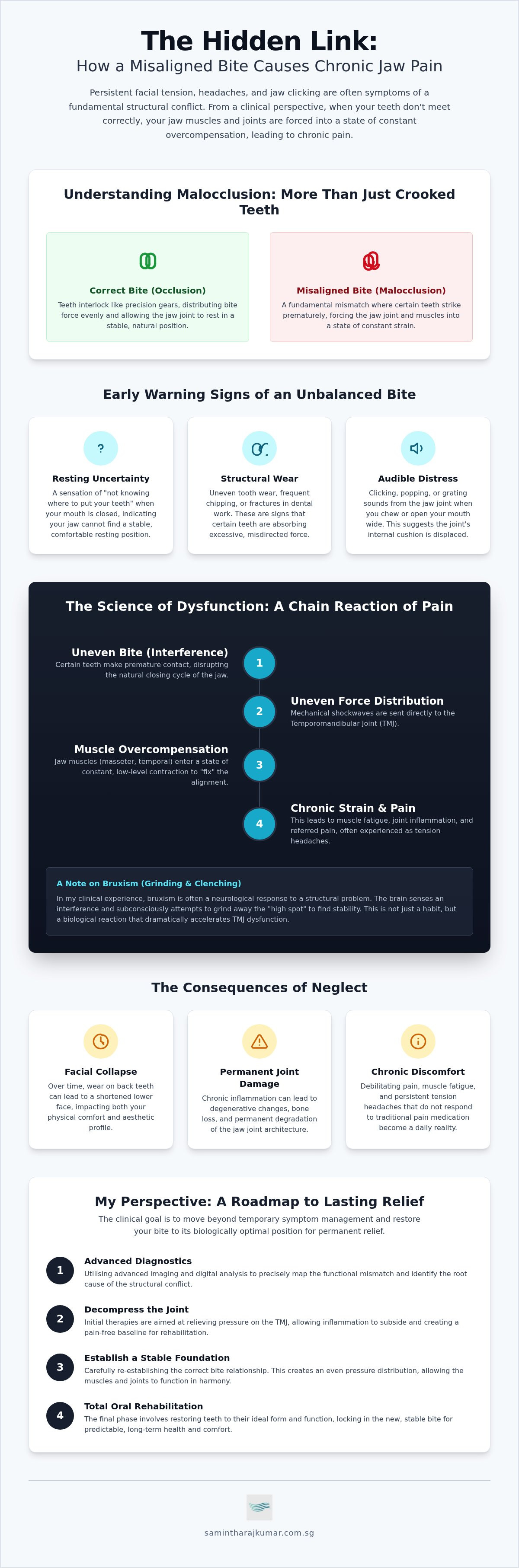
Many people view crooked teeth as a purely aesthetic concern. However, as a clinician, I see it as a functional red flag. A malocclusion is more than just a lack of visual symmetry; it represents a fundamental mismatch between your upper and lower jaw. This structural imbalance is exactly how misaligned bite causes jaw pain. When your teeth don't interlock like a precision-engineered gear system, the surrounding anatomy must absorb the resulting stress.
In my clinical experience, patients often ignore minor misalignments for years. They might notice a slight crowding or a tooth that sits higher than the rest, but they don't seek help until these issues manifest as debilitating pain. Your Temporomandibular Joint (TMJ) acts as a sophisticated sliding hinge. For pain-free movement, this joint must remain in perfect balance. When the bite is uneven, this hinge is forced out of its natural track, leading to chronic fatigue and inflammation within the joint capsule itself.
Common signs of an uneven bite
Identifying the early warning signs of an imbalanced bite can prevent long-term damage. If you're experiencing any of the following, your jaw may be struggling to compensate:
Resting uncertainty: You have a sensation of "not knowing where to put your teeth" when your mouth is closed or at rest.
Structural wear: You notice uneven tooth wear, frequent chipping, or fractures in dental work that should otherwise be durable.
Audible distress: Clicking, popping, or grating sounds occur when you chew or open your mouth wide.
Why your jaw muscles are overcompensating
From a biological perspective, your jaw muscles are incredibly powerful. The masseter and temporal muscles are responsible for maintaining jaw position and facilitating the force needed for chewing. When you have a "bad bite," these muscles are forced into a state of constant, low-level contraction. They are essentially trying to "fix" the alignment every time you swallow or speak.
This persistent strain leads to muscle exhaustion. It's this specific mechanism that explains how misaligned bite causes jaw pain and radiates discomfort into other areas. This muscle fatigue is frequently the hidden driver behind chronic tension headaches that don't respond to traditional over-the-counter medication. By understanding the structural root, we can move toward a solution that offers more than just temporary relief.
The science of dysfunction: How bite force distribution impacts the TMJ
From a biological perspective, the jaw is a complex lever system that requires even pressure distribution across all teeth to function without strain. When teeth are misaligned, we see what clinicians call "interference." This means certain teeth strike before others during the closing cycle. These premature contacts send mechanical shockwaves directly to the Temporomandibular Joint (TMJ). This constant, repetitive stress is a primary reason how misaligned bite causes jaw pain. It's not just a dental issue; it's a structural failure of the entire masticatory system.
Repetitive trauma from an uneven bite doesn't only affect the teeth; it damages the delicate internal joint architecture. The articular disc, which acts as a vital cushion between the jawbone and the skull, can become displaced due to these irregular forces. Over time, chronic inflammation within the joint capsule leads to degenerative changes. In my clinical experience, if these mechanical imbalances are left unaddressed, they can eventually lead to permanent bone loss and joint degradation.
The biomechanics of bruxism and clenching
Many patients are surprised to learn that bruxism is often a neurological response to a structural problem. Your brain is incredibly sensitive to the way your teeth meet. If it senses an interference, it may subconsciously attempt to "grind away" the high spot to find a stable resting position. This often manifests as a nocturnal cycle of clenching and grinding. This isn't merely a habit triggered by stress; it's a biological reaction to structural imbalance. This constant pressure significantly accelerates TMJ dysfunction (TMD), turning a minor misalignment into a chronic pain condition.
The role of dental structure in joint health
The back teeth serve as the essential pillars of your facial structure. When teeth are missing or severely worn, you suffer from a "collapsed bite." This loss of vertical dimension forces the jaw into a more retruded or compressed position, which puts immense pressure on the TMJ. I often discuss how dental structure affects face shape, as a collapsed bite frequently leads to a prematurely aged appearance and sagging facial tissues.
By restoring these structural pillars, we can effectively decompress the joint and alleviate chronic discomfort. Proper oral rehabilitation isn't just about a beautiful smile; it's about returning the jaw to a neutral, biologically optimal position. Understanding these mechanical links is vital because the best outcomes begin with identifying the root cause of the dysfunction rather than just masking the symptoms with temporary fixes.
The consequences of neglect: Facial collapse and chronic discomfort
As a clinician and founder, I've observed that the most profound impacts of malocclusion aren't always immediate. When patients ignore the underlying mechanics of their bite, they aren't just living with discomfort; they're allowing a slow, structural erosion of their facial framework. This neglect often leads to a significant loss of vertical dimension. Essentially, as teeth wear down or shift, the distance between the nose and the chin decreases, causing the lower face to appear shortened and prematurely aged. It's a progressive change that often goes unnoticed until the aesthetic and functional damage is advanced.
The physiological toll extends far beyond the mouth. Chronic jaw pain frequently triggers a cascade of secondary issues that patients don't initially link to their dental health. In my experience, these complications often manifest as:
Persistent earaches or a feeling of "fullness" in the ear canal.
Radiating neck and shoulder tension that resists traditional massage or physiotherapy.
Subtle postural changes as the body attempts to realign the head over a strained jaw.
Facial aesthetics and the collapsed bite
A lack of proper dental support inevitably changes how you look. Without the internal scaffolding provided by a healthy bite, the soft tissues of the face begin to sag. You might notice thinning lips and the deepening of nasolabial folds, creating a perpetually tired or stern expression. This is what we call facial collapse, a result of both tooth wear and the bone resorption that occurs when the jaw isn't stimulated correctly. My approach focuses on structural rejuvenation through dental implants and restorative techniques to rebuild this lost support from the foundation up.
Systemic links: Headaches and neck tension
The jaw doesn't exist in isolation. Referred pain pathways mean that strain in the TMJ often travels directly to the cervical spine. It's very common for my patients to report morning headaches from jaw clenching, which are a hallmark of an imbalanced bite struggling for stability during sleep. Beyond the physical, there's a heavy psychological toll to consider. Living with chronic, undiagnosed craniofacial pain can lead to severe sleep disturbances and dietary restrictions, ultimately diminishing your daily quality of life. Understanding how misaligned bite causes jaw pain is the vital first step in preventing these systemic complications and reclaiming your well-being.
My Perspective: Why total oral rehabilitation is the key to lasting relief
In my clinical experience, treating the symptoms of jaw discomfort with a simple night guard is rarely enough for complex cases. While these appliances can protect the teeth from wear, they often fail to address the underlying structural conflict. My philosophy centres on total rehabilitation, which means restoring the bite to its biologically optimal position. To achieve this, we must look beyond the teeth themselves and evaluate the underlying bone structure and muscle function. The ultimate goal is functional aesthetics—a principle practiced by teams like Smile&Co.—where a smile looks beautiful and works harmoniously with the rest of your body.
The limitation of generalist treatments
Many patients seek my help after years of "managing" their pain through general dental practices. There's a fundamental difference between managing symptoms and resolving a structural cause. A TMJ specialist is often required because persistent jaw pain is rarely just a dental issue. It's a neuromuscular and skeletal challenge. As a clinician and founder, I believe that specialist qualifications in complex implantology and oral surgery are essential for navigating these intricacies. We aren't just moving teeth; we're recalibrating a biological system that has fallen into disarray. This comprehensive approach is what distinguishes a personal professional brand from a generalist institution.
Innovation in diagnostics and biological dentistry
The future of healthcare delivery lies at the intersection of technology and biology. At Nuffield Dental, we utilise AI-assisted diagnostics to map bite forces with extreme precision. This allows us to identify exactly how misaligned bite causes jaw pain by pinpointing the micro-interferences that traditional methods might miss. From a biological perspective, I also advocate for the use of biocompatible materials. Ceramic implants, for instance, are an excellent choice for patients looking to reduce systemic inflammation and achieve a more natural integration with their oral tissues. This combination of science and empathy ensures that the practice remains at the cutting edge while being rooted in personal care.
My vision is to create a clinical environment where innovation serves the patient journey. By combining advanced diagnostics with a deep understanding of human biology, we can move from temporary relief to profound, long-term restoration. If you're ready to address the root cause of your discomfort, I invite you to explore our specialised TMJ pain management protocols. The best outcomes begin with a meticulous diagnosis and a commitment to total oral health.
Roadmap to Recovery: Diagnostics to Restoration
The best outcomes in clinical practice begin with a meticulous understanding of the root cause. When I evaluate a patient, I'm not just looking at their teeth; I'm assessing the entire craniofacial architecture. This is where advanced imaging becomes indispensable. By using 3D CBCT scans and digital bite analysis, such as T-Scan, we can visualise the precise points of interference and force distribution. This data is critical to understanding exactly how misaligned bite causes jaw pain in your specific case. A detailed consultation allows me to map your pain history against these digital findings, ensuring that the treatment plan addresses the biological reality of your condition.
Step 1: Comprehensive clinical assessment
My diagnostic process is thorough because a generalist approach often misses the subtle triggers of TMJ dysfunction. I evaluate the entire facial profile to see how the jaw relates to the rest of the skull. Digital bite analysis allows us to see the timing and force of every tooth contact in real-time. It's not enough to know that the teeth touch; we need to know the order in which they touch. This level of precision helps us identify the "shocks" to the system that lead to chronic muscle fatigue. Understanding your unique pain history is equally vital, as it reveals the lifestyle impacts of your structural imbalance.
Step 2: Customised treatment pathways
Recovery follows a logical, two-phase progression. Phase one is dedicated to decompressing the joint and relaxing the overworked muscles. We often use customised orthotic appliances to "reprogramme" the muscles, allowing us to find the jaw's true, neutral relation. Once stability is achieved, phase two focuses on permanent structural correction. For some, this involves orthodontics or meticulous restorations. For others with a severely collapsed bite, I may recommend All-on-4 dental implants or the teeth in a day procedure. These advanced surgical protocols provide immediate functional support, restoring the vertical dimension that was lost to years of wear and providing a stable foundation for the joint.
Step 3: Long-term quality of life
The final stage of the roadmap is perhaps the most rewarding. It's the moment a patient realises their jaw is finally resting in a neutral position without constant effort. The relief from chronic tension is often profound and immediate. Beyond the cessation of pain, the secondary benefits are life-changing. Patients frequently report improved sleep quality and a more balanced, symmetrical facial profile. Long-term maintenance ensures this new bite remains stable and the TMJ remains healthy for years to come. I view this as a legacy of care; a balanced bite is the essential foundation for lifelong health and aesthetic confidence. The best outcomes begin with understanding the root cause.
Restoring Balance for Long-Term Health
Achieving lasting relief from craniofacial discomfort requires moving beyond temporary fixes to address the biological root of the problem. As a clinician and founder of Nuffield Dental Holdings, I've dedicated my career to complex oral surgery and total rehabilitation. We've explored how a functional mismatch in your bite places an unsustainable burden on the TMJ and your facial muscles. This structural conflict is exactly how misaligned bite causes jaw pain, leading to chronic tension and even the premature ageing of your facial profile.
Restoring your quality of life is a journey from precise diagnostics to meticulous restoration. As an international speaker and mentor in dental innovation, I believe that the future of care lies in combining advanced technology with a patient-centred philosophy. Whether through structural rejuvenation or joint decompression, the goal is a harmonious system that supports your long-term well-being. By aligning the bite, we don't just stop the pain; we restore the foundation of your oral health.
The best outcomes begin with understanding the root cause, and I'm here to guide you toward a future of functional excellence and renewed comfort.
Frequently Asked Questions
Can a misaligned bite cause permanent jaw damage?
Yes, chronic malocclusion leads to repetitive trauma within the temporomandibular joint. Over time, this stress can cause the articular disc to displace and the bone to resorb, leading to irreversible degenerative changes. In my clinical experience, early intervention is vital to preventing this structural erosion. By addressing the mechanical imbalance, we protect the joint's long term integrity and avoid the need for more invasive surgical repairs later in life.
How do I know if my jaw pain is caused by my teeth?
You should look for specific red flags such as "resting uncertainty," where you aren't sure where to comfortably place your teeth. If you notice clicking, popping, or uneven tooth wear, it's a strong indicator of a structural issue. Often, this is how misaligned bite causes jaw pain that radiates into the temples. I use advanced digital diagnostics to confirm if your dental alignment is the primary driver of your discomfort.
Is surgery always necessary to fix a misaligned bite?
Is surgery always necessary to fix a misaligned bite?
Orthodontics can be a vital part of the solution, but it's rarely the entire answer for complex TMJ cases. Straightening teeth improves aesthetics, but it doesn't always address the underlying joint compression. From a biological perspective, we must ensure the new tooth positions harmonise with the jaw's neutral resting state—a standard of care maintained by practices like Mountain West Dental Specialists. In my experience, a multidisciplinary approach involving both alignment and structural restoration typically yields the most reliable and lasting relief.
What is the link between bite alignment and chronic headaches?
The link lies in muscle overcompensation. When your bite is uneven, muscles like the masseter and temporal are forced into constant contraction to find a stable position. This persistent strain leads to tension headaches, often felt most intensely in the mornings. Understanding how misaligned bite causes jaw pain and referred headaches is essential. By correcting the bite, we allow these muscles to finally relax, resolving the structural source of the pain.
How long does it take to see relief after bite correction?
Relief often occurs in phases. Many patients feel a significant reduction in muscle tension within weeks of starting orthotic therapy. However, full structural restoration and joint healing can take several months. The timeline depends on the severity of the initial damage and the complexity of the rehabilitation. I focus on steady, rhythmic progress to ensure the joint adapts comfortably to its new, biologically optimal position without causing further inflammation.
Can missing teeth lead to jaw pain years later?
Absolutely. Missing back teeth cause the remaining teeth to shift and the bite to "collapse" over time. This loss of vertical support forces the jaw into a compressed position, putting immense pressure on the TMJ. You might not feel the impact immediately, but the cumulative stress over several years often results in chronic pain and facial sagging. Restoring these missing pillars is a cornerstone of my approach to total oral rehabilitation.
What kind of specialist should I see for chronic jaw pain?
You should seek a specialist oral surgeon or a clinician with specific expertise in TMJ pain management and total oral rehabilitation. While general dentists provide excellent routine care, complex jaw issues require advanced training in neuromuscular function and skeletal diagnostics. In my clinical experience, a specialist can use tools like CBCT scans and digital bite analysis to identify root causes that are often overlooked in a generalist setting.


Comments