
Preventing Premature Aging from Tooth Loss: A Surgeon’s Perspective on Structural Rejuvenation

Most people view a missing tooth as a simple gap in their smile; however, from a biological perspective, it's actually the start of a structural collapse in the lower third of your face. This architectural shift is why preventing premature aging from tooth loss requires more than just surface-level cosmetic treatments. It's about addressing the bone loss that leads to sagging skin and a diminished jawline.
I understand the frustration of seeing your facial profile change or noticing deep wrinkles appear around your mouth, making you look significantly older than you feel. It's a common concern that affects not just how you eat and speak, but how you carry yourself in the world. You shouldn't have to settle for a reflection that doesn't match your internal vitality.
In my clinical experience as a founder and surgeon, I've seen how advanced dental implantology can halt this process by mimicking the natural stimulation your jawbone needs to stay strong. I'll share how we use sophisticated techniques like ceramic implants and "Teeth in a Day" protocols to provide a permanent solution that restores your facial volume and returns your self-confidence.
Table of Contents
Understanding the Link Between Dental Integrity and Facial Aesthetics
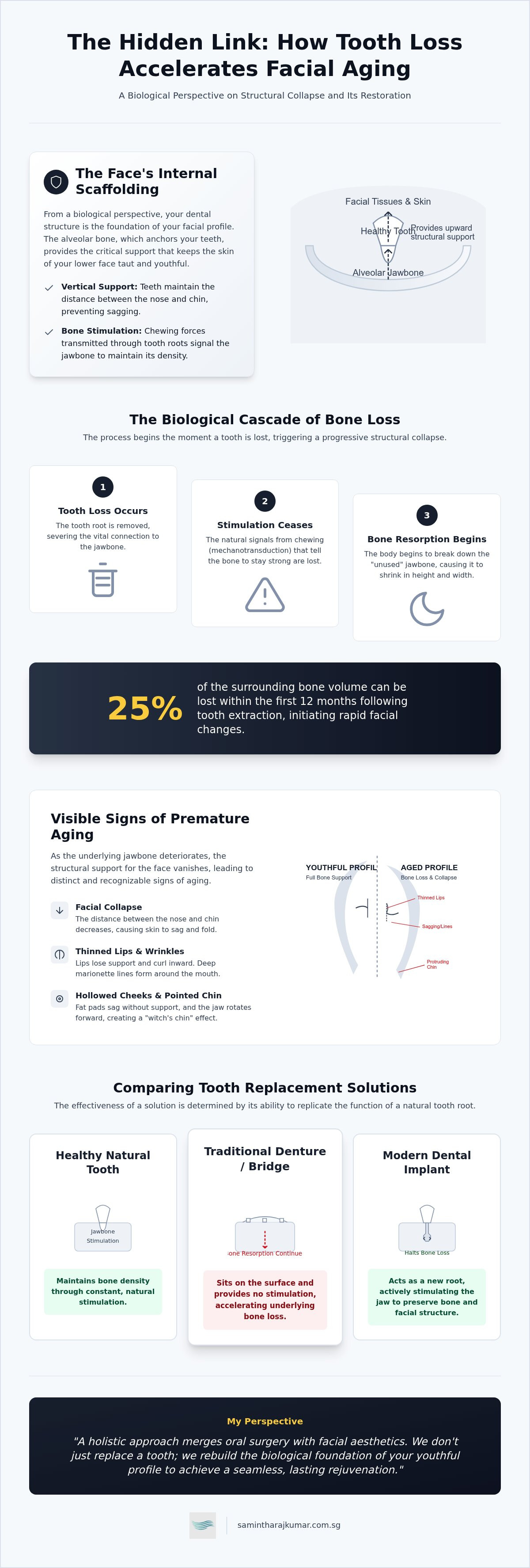
In my clinical experience, patients often view dentistry as separate from facial aesthetics. However, the integrity of your smile is the very foundation of your facial profile. The alveolar bone, which holds your teeth in place, provides the necessary tension to keep your skin taut and youthful. When teeth are lost, the underlying bone begins to deteriorate. This structural degradation leads to "facial collapse," a clinical consequence where the face appears to fold inward and lose its youthful proportions.
The lower third of your face is entirely dependent on your dental height. Without the vertical support provided by your teeth, the distance between your nose and chin decreases. This loss of height causes the skin to sag and fold, creating a prematurely aged appearance. Our dental structure acts as the internal scaffolding for the face.
The Role of Tooth Roots in Bone Stimulation
From a biological perspective, the relationship between your teeth and your jawbone is dynamic. Through a process known as mechanotransduction, the simple act of chewing sends signals through the tooth roots to the surrounding bone. This mechanical stress stimulates the bone to maintain its density and volume. When you lose the root, this vital stimulation ceases almost immediately.
Losing the root is far more significant than losing the crown for the aging process. While a traditional bridge might replace the visible part of the tooth, it does nothing to preserve the bone underneath. This lack of stimulation leads to bone resorption after tooth loss, a silent process that compromises the very foundation of your face. This is why preventing premature aging from tooth loss requires a solution that addresses the root, not just the surface of the smile.
Visible Signs of Premature Aging from Tooth Loss
The aesthetic consequences of dental bone loss are often unmistakable. As the structural support vanishes, we see the development of deep marionette lines around the mouth and a noticeable thinning of the lips. Without the internal volume provided by the teeth and bone, the lips lose their plumpness and begin to curl inward, which is a hallmark of advanced aging.
We also observe a distinct hollowing of the cheeks. This occurs because the buccal fat pads lose their underlying support, causing them to shift and sag. Over time, this can lead to the "witch’s chin" effect, where the lower jaw appears to protrude forward and upward as the jawbone shrinks. These changes can make a person look decades older than their actual age, impacting both self-confidence and functional excellence.
The Biological Cascade: How Bone Resorption Causes Facial Collapse
From a biological perspective, bone is a "use it or lose it" tissue. Once a tooth is extracted, the alveolar bone that once supported it no longer receives the mechanical load required to signal its continued existence. This triggers a cellular shift where osteoclasts, the cells responsible for breaking down bone, outpace the osteoblasts that build it. In my clinical experience, this isn't a static event but a progressive disease that begins immediately after extraction.
The pace of this deterioration is often startling to patients. Research indicates that approximately 25% of the surrounding bone volume is lost within the first 12 months alone. This rapid resorption marks the beginning of a cascade that fundamentally alters your facial architecture. As the bone dissolves, the vertical dimension of your face decreases, leading to a "collapsed" bite. This loss of height is a primary driver in the aesthetic shift many associate with aging, yet it's a direct clinical consequence of untreated tooth loss.
The Progressive Nature of Jawbone Atrophy
Jawbone atrophy is a multi-dimensional process. The bone thins horizontally and shortens vertically at the same time. The impact differs between the upper and lower jaws. In the maxilla (upper jaw), the bone resorbs upward and inward, causing the upper lip to lose its support. Conversely, the mandible (lower jaw) tends to resorb downward and outward. This divergent pattern creates a profile where the chin appears to protrude while the mid-face sinks, a hallmark of facial collapse.
This structural retreat is why preventing bone loss through early intervention is so critical. When the jawline loses its definition, the overlying soft tissues have no choice but to sag. By addressing the root cause of this atrophy, we can effectively maintain the tension required for a rejuvenated appearance. Ensuring you have a comprehensive plan for preventing premature aging from tooth loss is the most effective way to preserve your natural facial contours.
Why Delaying Treatment Multiplies Clinical Complexity
Waiting to replace missing teeth doesn't just affect your appearance; it complicates the surgical path forward. As a surgeon and founder, I often see patients who have waited years, only to find they no longer have enough bone to support standard implants. This lack of volume necessitates additional procedures to rebuild the foundation before we can even begin the restorative phase. These complexities often involve Sinus Lift Surgery for Dental Implants or extensive bone grafting.
The more bone that is lost, the more we must rely on advanced regenerative techniques. While we have the technology to restore even severe cases of atrophy, the most predictable outcomes occur when we intervene early. Understanding the biological timeline of your jawbone allows for a more proactive approach to your health. If you've noticed changes in your facial structure, the right diagnosis changes everything.
Why Traditional Prosthetics May Not Stop the Biological Clock
While traditional dentures have served as a standard of care for decades, they're fundamentally a surface-level solution to a deep-seated structural problem. From a biological perspective, dentures only replace the visible crowns of the teeth. They fail to address the missing roots, which we've established are essential for bone stimulation. In fact, the pressure exerted by a removable prosthesis on the gingival tissues can actually accelerate the very bone resorption we seek to avoid.
In my clinical experience, I've observed that the constant friction and uneven load of dentures often signal the body to further dissolve the underlying ridge. This is why patients find their dentures becoming "loose" or "sinking" over time. It isn't the prosthetic that is changing; it's the jawbone beneath it that is retreating. This ongoing atrophy is a significant hurdle in preventing premature aging from tooth loss, as it allows the facial structure to continue its inward collapse despite the presence of artificial teeth.
The Myth of the "Sufficient" Denture
The limitations of conventional dentures extend beyond the bone. When a prosthesis shifts during speech or mastication, it often leads to muscle atrophy in the face. Patients subconsciously limit their facial expressions or change how they move their mouth to keep the denture in place. This can result in a static, aged appearance and the development of deep folds around the jawline. There's a profound difference between simply looking like you have teeth and possessing the functional excellence of a natural-feeling bite. A shifting prosthesis carries a psychological burden, dampening the confidence required for vibrant social engagement.
My Perspective: The Limitations of Conventional Removable Options
As a clinician and founder, I frequently consult with patients experiencing what is often termed "denture face." These individuals have often spent years with removable options, only to find their facial profile has significantly flattened. My philosophy at Nuffield Dental prioritises long-term structural integrity over the temporary convenience of a removable plate. Total rehabilitation requires a fixed, root-replacing solution that integrates with the biology of the jaw.
True rejuvenation isn't found in a glass of water overnight. It's found in a permanent foundation that supports the lips and cheeks from within. By moving toward modern implantology, we stop the biological clock and restore the "lift" that only a stable dental structure can provide. The best outcomes begin with understanding the root cause of facial change.
Modern Solutions for Structural Rejuvenation
In my clinical experience, the shift from traditional removable options to fixed implant solutions is the most significant step a patient can take toward preventing premature aging from tooth loss. While dentures merely mask the gap, dental implants are the only clinical intervention that actively halts bone resorption by replacing the root's mechanical function. This structural preservation is the cornerstone of modern facial rejuvenation. It doesn't just fix a smile; it maintains the very architecture of the face.
Many patients are told they aren't candidates for implants due to severe bone loss in the upper jaw. However, as a specialist in complex implantology, I utilise Zygomatic dental implants to bypass this limitation. By anchoring into the stable zygoma, or cheekbone, we can provide a secure foundation even when the maxillary bone has significantly atrophied. This approach ensures that no patient is left without a path to total mouth and face rehabilitation, regardless of how long they've lived with missing teeth.
All-on-4 and Teeth in a Day: Immediate Support
One of the most transformative protocols I offer is the All-on-4 technique. This allows for the Teeth in a Day procedure, where a fixed bridge is attached to four strategically placed implants. From a biological perspective, this immediate loading is vital. It provides instant support to the facial muscles, preventing the further sagging that occurs when the mouth is left without structural height for extended periods.
A fixed bridge does more than just restore chewing function. It meticulously recreates the vertical dimension of the face, which in turn restores lip fullness and smooths out the deep folds around the mouth. This immediate structural support is a powerful tool for patients who fear the "collapsed" look often seen with long-term tooth loss. It's about restoring functional excellence and aesthetic vitality in a single visit.
Ceramic Dental Implants: A Biological Choice
For patients who prioritise a metal-free, holistic approach, I advocate for ceramic dental implants. These are crafted from zirconia, a material renowned for its exceptional biocompatibility. Unlike titanium, ceramic implants allow for a more natural gum tissue attachment, which is essential for maintaining a youthful, healthy-looking smile line. You can learn more about our Ceramic Dental Implants and Biocompatibility Standards to understand why this material choice matters for long-term health.
Healthy soft tissue is the final layer of facial aesthetics. When the gums integrate seamlessly with ceramic, it prevents the greyish tint often seen with metal implants, ensuring the restoration looks as vibrant as natural teeth. This biological harmony is key to a lasting result. If you're ready to explore how these advanced protocols can restore your profile, discover the transformative power of modern dental implants.
My Perspective: A Holistic Approach to Facial Renewal
In my clinical experience, the mouth is not an isolated system; it is the anatomical foundation of the entire face. As a clinician and founder, I have always believed that true rejuvenation must be structural. Many patients come to me having tried superficial treatments like dermal fillers to address sagging skin, yet they find the results fleeting. This is because the underlying support, the jawbone and dental height, is still missing. By focusing on preventing premature aging from tooth loss through surgical intervention, we address the root cause rather than just masking the symptoms.
I often combine oral surgery with facial aesthetic rejuvenation to achieve a total impact. When we restore the dental foundation, we often find that the need for injectable fillers decreases significantly. The skin is naturally pulled tighter over the restored bone and prosthetic structure, smoothing out wrinkles that no amount of topical care could reach. It is about restoring the harmony between the internal scaffolding and the external soft tissue. Restoring a patient’s original facial proportions is one of the most rewarding aspects of my work.
Correcting the Collapsed Bite
A critical part of my philosophy involves measuring the correct vertical dimension of the face. This isn't just about aesthetics; it's a precise clinical calculation. When a bite collapses due to tooth loss, the facial proportions are skewed, making the lower face appear shorter. By surgically restoring this height, we can return the face to its "golden ratio," the mathematical standard of beauty and balance. You can read more about How Dental Structure Affects Face Shape to understand this measurement process in detail.
The Future of Care: AI and Precision Diagnostics
As we look toward the future, the integration of AI-assisted diagnostics has revolutionised how we plan these complex cases. We use precision imaging to ensure every implant is positioned to provide maximum support to the facial envelope. This level of accuracy is what allows us to create a natural, youthful smile that doesn't look "worked on." It looks like the patient's original self, only revitalised. Precision is the difference between a standard result and a transformative one.
Ultimately, preventing premature aging from tooth loss is about more than just looking younger. It's about restoring functional excellence and the profound personal impact of feeling confident in your own skin. The long-term impact on your overall vitality is immeasurable. The best outcomes begin with understanding the root cause. When we build a foundation that lasts a lifetime, we aren't just changing a smile; we're reclaiming a legacy of health and well-being.
Reclaiming Your Structural Vitality
Tooth loss is a biological challenge that requires a sophisticated surgical solution. As we've discussed, the loss of tooth roots triggers a cascade of bone resorption that fundamentally alters your facial profile. By prioritising structural integrity through specialist expertise in Zygomatic and All-on-4 protocols, we can effectively halt this decline. My approach as a clinician and founder is to integrate oral surgery with facial aesthetics to restore your natural proportions and functional excellence.
Preventing premature aging from tooth loss is a journey toward total mouth and face rehabilitation. It's about moving beyond surface-level fixes toward a permanent, root-replacing foundation that supports your lips and cheeks from within. This comprehensive restoration ensures that your external appearance reflects your internal vitality for the long term. We don't just aim to replace teeth; we aim to preserve your architectural legacy.
The best outcomes begin with understanding the root cause. Explore our approach to total rehabilitation. You deserve a smile and a profile that feel as vibrant as you are.
Frequently Asked Questions
How exactly do dental implants prevent my face from sagging?
Dental implants prevent sagging by halting the process of bone resorption through mechanical stimulation. When I place an implant, it acts as a prosthetic root that signals the jawbone to maintain its density. This preserved bone volume provides the necessary tension for your facial skin, keeping the lower third of your face lifted. It is the most effective method for preventing premature aging from tooth loss by maintaining your face's internal architecture.
Can I still get dental implants if I already have significant bone loss?
You can still achieve total rehabilitation even with significant bone loss. As a specialist in complex cases, I utilise Zygomatic dental implants that anchor into the cheekbone rather than the jaw. This advanced protocol bypasses the need for extensive bone grafting in the upper jaw. My goal is to ensure that every patient has a path toward structural rejuvenation, regardless of the current state of their alveolar bone volume or history of tooth loss.
Will dental implants get rid of the wrinkles around my mouth?
Dental implants address the structural cause of deep wrinkles around the mouth by restoring your facial height. When you lose teeth, the distance between your nose and chin decreases, causing the skin to bunch and fold. By correcting this "collapsed bite" with a fixed bridge, I can naturally smooth out marionette lines and restore lip fullness. While they aren't a topical fix, they provide the essential "lift" required for profound structural rejuvenation.
How long after losing a tooth should I wait before getting an implant to avoid aging?
I recommend seeking treatment as soon as possible after a tooth is lost. Research indicates that approximately 25% of the surrounding bone volume is lost within the first 12 months alone. This rapid decline makes early intervention vital for preventing premature aging from tooth loss. The sooner we place an implant, the more of your natural facial architecture we can preserve, simplifying the overall surgical journey and ensuring a more predictable aesthetic result.
Are ceramic implants better than titanium for preventing facial aging?
Both materials effectively prevent bone loss, but I often recommend ceramic implants for their superior biocompatibility. Zirconia is metal-free and encourages a healthier attachment of gum tissue, which is essential for a youthful smile line. Ceramic avoids the greyish tint that titanium can sometimes cause through thin gums. From a biological perspective, this seamless integration between the implant and soft tissue creates a more vibrant and naturally rejuvenated appearance that stands the test of time.
Is the All-on-4 procedure suitable for someone worried about facial collapse?
The All-on-4 protocol is an excellent solution for patients concerned about facial collapse. This procedure provides immediate structural support by anchoring a full arch of teeth onto four strategically placed implants. In my clinical experience, the "Teeth in a Day" approach is transformative because it instantly restores the vertical dimension of the face. This immediate loading helps maintain facial muscle tone and prevents the sunken-in look associated with long-term tooth loss and subsequent bone deterioration.
What is the difference between facial collapse and normal aging?
Normal aging is a gradual process involving loss of skin elasticity and shifting fat pads. Facial collapse, however, is a rapid skeletal change caused by the resorption of the jawbone. It is a direct clinical consequence of missing teeth rather than just the passage of time. While everyone ages, facial collapse causes a much more severe and premature folding of the face that can only be corrected through structural dental surgery and root-level replacement.
Can dental implants restore the original shape of my jawline?
Dental implants can significantly restore the definition of your jawline by recovering lost bone volume and dental height. When the jawbone thins and shortens, the jawline loses its sharp edge and the skin begins to jowl. By providing a stable, root-replacing foundation, I can restore the tension required to tighten the skin along the mandible. This structural renewal helps return your face to its original proportions and a more youthful, defined profile that feels authentic.

Comments