
How to Clean All-on-4 Dental Implants (2026)
- Dr Samintharaj Kumar

- 1 day ago
- 12 min read
The long-term success of your full-arch restoration isn't solely determined in the operating theatre. It's actually decided every morning and evening at your bathroom sink. I understand that many patients feel a sense of trepidation when they first transition to a fixed bridge. You might worry about the complexity of reaching the narrow space between the prosthesis and your gums, or perhaps you're confused by the conflicting advice on which tools are truly safe. Learning how to clean all on 4 dental implants correctly is the single most important step you can take to protect your investment and prevent the onset of peri-implantitis.
In my clinical experience, a meticulous daily routine is what separates a decade of comfort from an early implant failure. This guide provides a clear, surgeon-approved protocol designed to maintain the biological health of your bone-implant interface. I'll walk you through the essential tools, from specialised water flossers to non-abrasive agents, ensuring you have the confidence to manage your oral health with precision. By mastering these habits, you don't just preserve a smile; you ensure the lifelong functional excellence of your restoration.
Table of Contents
The Biological Science of All-on-4 Maintenance
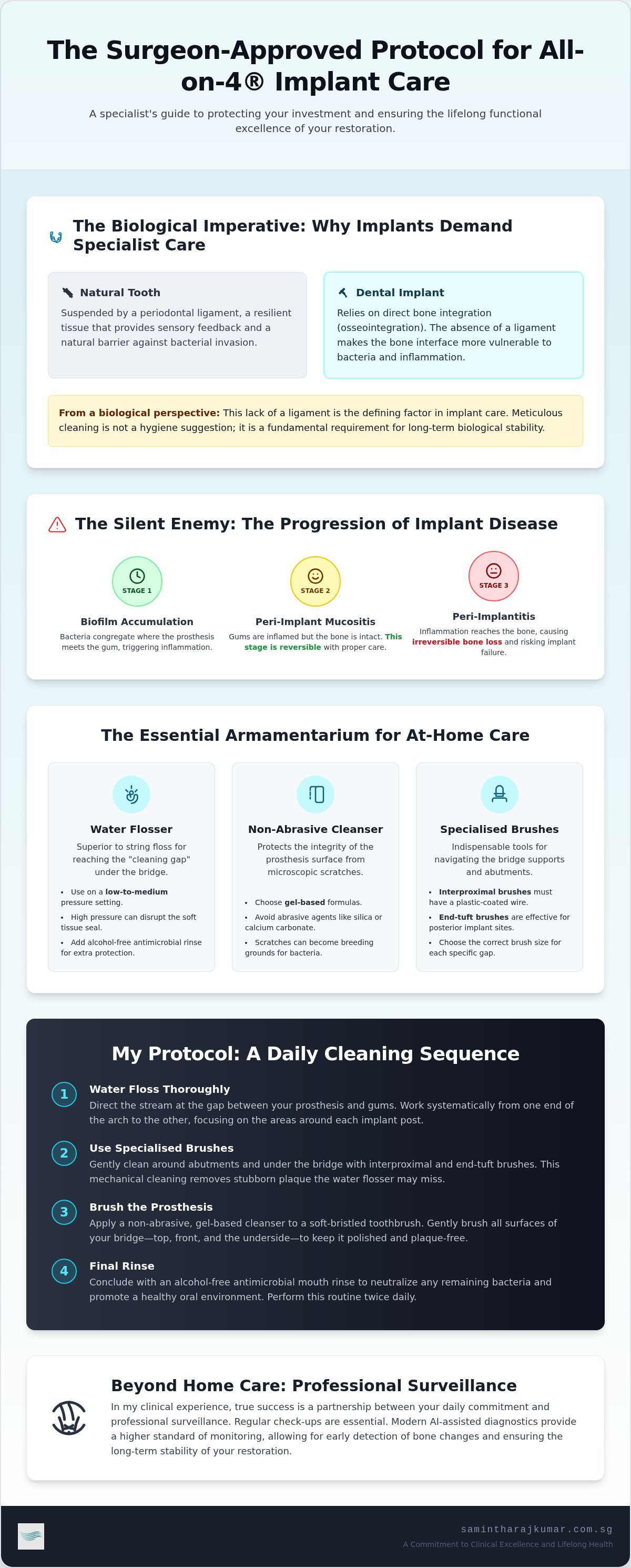
From a biological perspective, we must recognise that dental implants are not simply replacement teeth; they are sophisticated medical devices integrated into your living tissue. Unlike natural teeth, which are suspended by a periodontal ligament, implants rely on a direct biological process called osseointegration. This lack of a ligament is a defining factor in how we approach care. The ligament serves as a sensory organ and a resilient barrier against bacterial invasion. Without it, the interface between your implant and the surrounding bone is more vulnerable to external stressors. This is why mastering how to clean all on 4 dental implants is a fundamental requirement for biological stability, rather than a mere hygiene suggestion.
Biofilm accumulation is the silent enemy of total oral rehabilitation. When bacteria congregate at the junction where the prosthesis meets the gingiva, they trigger a rapid inflammatory response. In my clinical experience, undetected inflammation is the primary driver of late-stage implant failure. If left undisturbed, these bacteria produce toxins that can bypass the mucosal seal. This seal is the soft tissue's attempt to "cuff" around the implant post. Once breached, the inflammatory cascade reaches the underlying bone, leading to the science of peri-implantitis, where the body begins to reject the very bone supporting your new smile.
Why the Prosthesis-Tissue Interface Matters
The unique design of All-on-4 dental implants involves a bridge that sits securely above the gum line. This creates a small but critical "cleaning gap." While this space allows for a natural appearance and functional freedom, it also acts as a sanctuary for food debris. If food becomes entrapped, it causes chronic tissue irritation. As a clinician and founder, I've observed that persistent irritation often precedes bone resorption. Protecting the mucosal seal through meticulous home care is the only way to ensure the titanium or ceramic posts remain shielded from the oral environment.
Clinical Consequences of Neglect
Neglect follows a predictable and often silent path. It begins with peri-implant mucositis, a reversible state where the gums are inflamed but the bone remains intact. However, if this is not addressed, it quickly progresses to peri-implantitis. This stage involves irreversible bone loss, which can compromise the stability of the entire arch. Beyond the mouth, we must consider the systemic link between oral inflammation and overall health. The "Teeth in a Day" protocol offers an immediate transformation, but it doesn't exempt you from long-term biological care. True success is a partnership between surgical excellence and your daily commitment to maintenance.
Essential Tools for All-on-4 Hygiene
Selecting the right armamentarium is a critical decision in your post-surgical journey. Many patients assume that a standard toothbrush is sufficient, but the complex architecture of full-arch restorations requires a more specialised approach. From a biological perspective, we must protect the integrity of the prosthesis surface. I always advise patients to avoid abrasive toothpastes. These products often contain silica or calcium carbonate which can create microscopic scratches on the acrylic or porcelain. Over time, these scratches become breeding grounds for bacteria. Instead, choose non-abrasive, gel-based cleansers that are biocompatible and non-corrosive to the underlying titanium or ceramic components.
The Role of the Water Flosser
In my clinical experience, hydro-magnetic irrigation is significantly superior to traditional string floss for All-on-4 systems. A water flosser can reach the deep recesses of the cleaning gap where mechanical flossing often fails to provide adequate coverage. I recommend using a low-to-medium pressure setting. High pressure can inadvertently disrupt the delicate soft tissue attachment at the mucosal seal, potentially inviting bacterial ingress. For an added layer of protection, you can incorporate an alcohol-free antimicrobial rinse into the reservoir. This helps neutralise biofilm in areas your brush simply cannot reach.
Specialised Brushes and Floss
Navigating the bridge supports requires tools that respect the hardware. Interproximal or interdental brushes are indispensable, provided you choose the correct size for each specific gap. It's vital that these brushes have a plastic-coated wire core to avoid scratching the metal abutments. For the posterior implant sites, an end-tuft brush is particularly effective at reaching the back of the bridge where a standard head is too bulky. When it comes to floss, I prefer Superfloss or thick, tufted varieties designed for bridges. These allow you to thread the material under the prosthesis and sweep away debris without snagging on the components.
Understanding the potential benefits and risks associated with different cleaning methods is part of being an informed patient. While the technical aspects of maintenance may seem daunting, they are the foundation of your long-term functional freedom. If you're unsure which tools best suit your specific bridge material, a specialist clinical assessment can provide the clarity you need. Mastering how to clean all on 4 dental implants is not just about hygiene; it's about safeguarding the legacy of your smile and ensuring the longevity of your investment.
My Protocol for Daily At-Home Cleaning
Consistency is the foundation of total rehabilitation. In my clinical experience, the most successful patients are those who view their hygiene routine as a non-negotiable ritual. While full-arch restoration has become an integral treatment modality in dentistry, its lifelong success relies on your ability to disrupt biofilm daily. If bacteria are allowed to sit undisturbed, they mineralise into calculus, which is impossible to remove with a toothbrush alone. When I explain how to clean all on 4 dental implants to my patients, I focus heavily on the "transition zone." This is the critical interface where the prosthetic bridge meets your natural gingiva, and it's where most biological complications begin.
The Morning and Evening Routine
A structured sequence ensures that no surface of the prosthesis or the underlying tissue is overlooked. I recommend a three-step process twice daily. First, begin with initial irrigation using a water flosser. This step is vital for removing loose debris and food particles from under the bridge before you begin brushing. Second, perform meticulous brushing with a soft-bristled brush. Hold the brush at a 45-degree angle toward the gum line, using gentle circular motions to sweep away plaque. Finally, use your specialised interdental tools to clean around each of the four implant posts. This ensures the "chimneys" of the implants remain free from bacterial colonies.
Post-Meal Maintenance
Your care shouldn't stop at the bathroom sink. I advocate for rinsing with water or a pH-balancing mouthwash after every meal. This simple habit helps neutralise acids and flushes out debris before it can settle. If you feel a stubborn food particle trapped under the bridge, don't be tempted to use metal picks or sharp objects. These can permanently damage the mucosal seal or scratch the bridge material. Instead, use a high-volume rinse or a portable water flosser. Maintaining the functional aesthetics of your smile makeover requires a proactive approach to stain prevention. By rinsing away dark pigments from coffee or tea immediately, you preserve the pristine finish of your restoration for years to come.
From a biological perspective, these daily habits are what protect the bone-implant interface from the inflammatory cascade. It's about more than just a clean mouth; it's about protecting the structural integrity of your jaw. When you commit to this protocol, you aren't just cleaning teeth. You're actively participating in the preservation of your oral health and your quality of life. The best outcomes always begin with a deep understanding of the daily care required to maintain excellence.
Professional Surveillance and Advanced Diagnostics
While your daily hygiene routine is the bedrock of maintenance, professional surveillance is the necessary safeguard for your biological investment. It's about more than just a standard scaling. In my clinical experience, professional cleanings for All-on-4 require specialised equipment, such as carbon-fibre or plastic-coated ultrasonic tips. These tools ensure we remove calcified deposits without scratching the titanium surface of the implants. Beyond cleaning, these visits allow us to assess your "bite" or occlusion. Even minor shifts in how your teeth meet can create uneven pressure, potentially stressing the implant-to-bone interface over time.
The Specialist Check-Up Protocol
A specialist-led review is far more comprehensive than a general dental check-up. Depending on your clinical needs, I may recommend an annual removal of the bridge. This allows for deep decontamination of the abutments and the underside of the prosthesis that you cannot reach at home. During this process, we perform torque testing of the prosthetic screws. It's a vital step to ensure the bridge remains securely anchored. We also conduct meticulous soft tissue health assessments, mapping pocket depths around each implant to catch the earliest signs of inflammation before they progress to bone loss.
Monitoring with AI and Digital Imaging
As a clinician and founder, I advocate for the use of AI-assisted diagnostics to detect bone changes far earlier than traditional radiography allows. We utilise digital scans to compare your bone levels year-over-year with sub-millimetre precision. This data-driven approach is a cornerstone of the teeth in a day procedure explained long-term care plan. AI helps us identify early markers of peri-implantitis long before physical symptoms appear, allowing for minimally invasive interventions. Understanding how to clean all on 4 dental implants professionally is just as critical as the diligence you show in your own bathroom every morning.
The long-term success of your restoration depends on this dual approach of expert monitoring and personal diligence. If you haven't had your implants professionally reviewed recently, I encourage you to schedule a specialist implant maintenance consultation. The best outcomes begin with a proactive commitment to biological health and a deep understanding of the root cause of any potential issues.
Long-Term Success: My Clinical Perspective on Quality of Life
The true value of an All-on-4 restoration lies in the profound restoration of confidence and functional freedom it provides. As a clinician and founder, I've witnessed patients undergo a complete emotional renewal once they regain the ability to eat, speak, and smile without hesitation. However, total rehabilitation is a journey, not a destination. It requires a resilient partnership between the surgical team and the patient. Maintaining your implants is essentially an act of self-care that preserves your facial harmony and prevents structural collapse. In my view, the most successful patients are those who view their hygiene routine as an essential part of their overall wellness rather than a mere chore.
My Perspective: The Philosophy of Preservation
In my clinical experience, the best outcomes begin with understanding the root cause of oral health challenges. My philosophy is rooted in the belief that we aren't just replacing teeth; we are restoring a biological system. When you master how to clean all on 4 dental implants, you are engaging in a daily ritual that safeguards your biological integrity. I've reflected often on the transformative power of a healthy, functioning smile. It ripples through a patient's social and professional life, renewing their sense of self. This level of excellence requires a shared commitment to quality from both the clinical team and the person behind the smile.
Protecting Your Investment in the Future
Diligence in your daily routine is the most effective way to prevent the need for costly and complex revision surgeries in the future. Beyond the health of the gingiva, dental implants play a critical role in preventing facial collapse with dental implants. By preserving the bone density of your jaw, you maintain the structural rejuvenation that defines a healthy, youthful appearance. From a biological perspective, every minute spent on maintenance is an investment in your longevity. Understanding how to clean all on 4 dental implants correctly ensures that the legacy of your smile remains a source of pride for decades to come.
The transition to a full-arch restoration is a significant milestone in your healthcare journey. It represents a move toward a future defined by functional excellence and aesthetic harmony. I believe that the best outcomes begin with understanding the root cause and maintaining a proactive stance on health. As you move forward, remember that your daily habits are the foundation upon which your long-term success is built. The right diagnosis changes everything, but the right maintenance ensures that change lasts a lifetime.
Securing the Future of Your Restoration
Total oral rehabilitation is one of the most transformative procedures in modern dentistry. However, the true legacy of your new smile is built on the daily commitment you make at home. By mastering how to clean all on 4 dental implants, you aren't just maintaining a prosthesis; you're actively protecting the biological interface between your implants and your bone. In my clinical experience, the most successful outcomes are achieved through a combination of meticulous patient hygiene and advanced, specialist-led monitoring.
As a clinician and founder, I'm proud to integrate advanced AI-assisted diagnostic tools within my practice to ensure your bone health is monitored with sub-millimetre precision. This proactive surveillance, combined with our specialist surgical expertise in full-arch protocols, provides a level of security that generalist practices often cannot match. Protecting your investment in your health is a lifelong journey, and we're here to guide you through every stage of that process. The right diagnosis changes everything. Explore our approach to total oral rehabilitation. Your journey toward lasting functional excellence begins with a foundation of trust and understanding.
Frequently Asked Questions
Can I use a regular electric toothbrush on All-on-4 implants?
Yes, you can use an electric toothbrush, provided it has a soft-bristled head and you use it on a gentle setting. In my clinical experience, the mechanical vibration is excellent for disrupting biofilm that settles along the bridge. However, you must avoid applying aggressive pressure. Focus your technique on the transition zone where the prosthesis meets the gums to ensure you are protecting the delicate mucosal seal while maintaining hygiene.
How often should I see my specialist for professional cleaning?
I recommend a professional specialist review every six months as a standard protocol for most patients. For those with specific risk factors or acrylic restorations, a three or four-month interval may be more appropriate to prevent calculus buildup. These visits are essential because they allow us to use specialised instruments and AI diagnostic tools to monitor your bone stability and the long-term integrity of your full-arch restoration.
Is it normal for food to get stuck under my All-on-4 bridge?
It is entirely normal for small food particles to settle in the cleaning gap between your bridge and the natural gum line. This space is a necessary design feature that allows you to access the area for hygiene purposes. Using a water flosser after meals is the most effective way to flush these particles out. If you experience persistent entrapment of large pieces, it may indicate a change in tissue contours that requires a clinical assessment.
Can I use mouthwash with my dental implants?
You can certainly use mouthwash, but it's vital to choose an alcohol-free formula to avoid drying out your oral tissues. Alcohol can cause chronic irritation to the sensitive areas surrounding your implant posts. I often suggest pH-balancing or antimicrobial rinses to help neutralise bacteria in hard-to-reach recesses. Incorporating a high-quality rinse into your daily routine for how to clean all on 4 dental implants adds a necessary layer of biological protection.
What happens if I stop cleaning my dental implants?
If you stop cleaning your implants, the accumulation of biofilm will lead to peri-implant mucositis and eventually peri-implantitis. Because implants lack a periodontal ligament to act as a natural barrier, infection can reach the underlying bone very quickly. This progression causes irreversible bone loss and can lead to the total failure of the restoration. Neglecting hygiene is the primary driver of late-stage complications in an otherwise successful surgical outcome.
Will a water flosser damage the seal around my implants?
A water flosser will not damage the mucosal seal if you use it on a low-to-medium pressure setting. It is actually the most effective tool for maintaining the health of that attachment. I advise my patients to avoid the highest pressure settings, which could potentially force water into the space around the implant post. When used correctly, hydro-magnetic irrigation is a gentle and superior method for preserving your oral health and functional excellence.
Do I need to clean my implants if they don’t feel dirty?
Yes, you must clean them twice daily regardless of how they feel. Biofilm is microscopic and often invisible to the naked eye, meaning it can accumulate and trigger an inflammatory response before you notice any physical sensation. Consistency is the foundation of biological preservation. My protocol for how to clean all on 4 dental implants is designed to disrupt bacteria before they have the opportunity to mineralise into hard calculus, which is much harder to remove.
Are there specific foods I should avoid to keep my implants clean?
While All-on-4 provides significant functional freedom, I suggest being cautious with extremely sticky foods or very hard items like unpopped popcorn kernels. Sticky foods can be difficult to remove from the narrow space under the bridge, while hard items can put unnecessary stress on the prosthetic screws. Always rinse your mouth with water after consuming highly pigmented foods or drinks to maintain the aesthetic brilliance and stain-free finish of your smile makeover.


Comments