
Questions to Ask Your Dental Implant Surgeon in Singapore: A Specialist’s Guide (2026)
- Dr Samintharaj Kumar

- 12 hours ago
- 12 min read
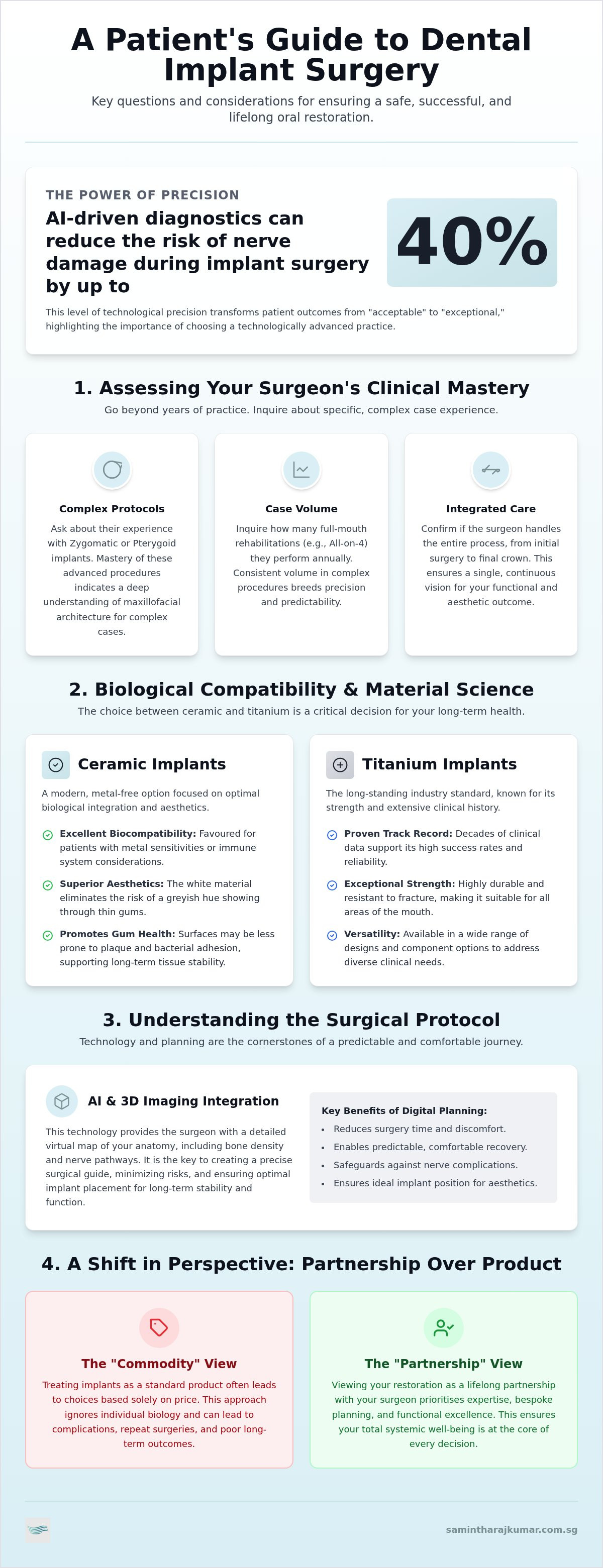
Did you know that AI-driven diagnostics in 2026 can reduce the risk of nerve damage during implant surgery by 40% compared to traditional manual planning? As a clinician and founder, I've seen how this level of precision transforms patient outcomes from "acceptable" to "exceptional." However, accessing this standard of care requires more than a simple search. It demands that you know the specific questions to ask your dental implant surgeon in Singapore before you ever step into the operating theatre.
I recognise the deep-seated anxiety many patients feel regarding surgical failure or the long-term biological impact of different implant materials. It's perfectly natural to feel overwhelmed by the choice between titanium and ceramic options, or to worry about complications in complex full-mouth cases. My goal is to replace that uncertainty with clinical clarity. By understanding the precise technical and ethical markers of expert care, you can move forward with a sense of profound security. We will look at how to evaluate success rates, the significance of HSA-regulated protocols, and exactly what to expect as your body heals and restores its natural function.
Table of Contents
Why the Right Questions Safeguard Your Oral Rehabilitation Journey
Credentials and Expertise: Assessing Your Surgeon’s Clinical Mastery
Biological Compatibility and Material Science: Asking About Ceramic vs. Titanium
The Surgical Protocol: Understanding Timeline, Technology, and Recovery
My Perspective: Choosing a Partner for Your Long-Term Functional Restoration
Why the Right Questions Safeguard Your Oral Rehabilitation Journey
In my clinical experience, a well-informed patient is the foundation of a successful surgical outcome. When you enter my practice, I don't see a "case"; I see a person seeking to restore their quality of life through precise medical intervention. Understanding the specific questions to ask your dental implant surgeon in Singapore is the first step toward that restoration. It's about moving beyond the surface and examining the clinical philosophy that will guide your care.
Dental implants are often marketed as a standard product, but they are actually a complex biological intervention requiring bespoke planning. Treating them as a commodity ignores the unique nuances of your jawbone, your immune system, and your soft tissue. Choosing a practitioner based solely on price rather than surgical expertise often leads to clinical consequences that are difficult to reverse. I've seen many patients require secondary corrective surgeries because the initial placement didn't account for long-term bone stability or facial harmony.
To better understand why this initial dialogue is so critical to your success, watch this helpful video regarding the essential inquiries you should make:
The Stakes of Complex Implantology
There is a vast difference between replacing a single tooth and performing a full-mouth rehabilitation. The latter requires a deep understanding of occlusion, skeletal support, and how structural restoration impacts your entire facial profile. For instance, preventing facial collapse with dental implants is only possible when the surgeon considers the long-term aesthetic health of the patient. For those seeking a comprehensive overview of dental implants, it's clear that the intersection of engineering and biology is where true success lies. I believe transparency during the consultation prevents complications later.
Shifting from Passive Patient to Informed Partner
I prioritise patient education as a core pillar of Nuffield Dental's mission. You shouldn't be a passive recipient of care. Instead, use your consultation to gauge a surgeon’s commitment to biological principles and international protocols. It's vital to know the questions to ask your dental implant surgeon in Singapore regarding their personal involvement in the entire treatment arc. As a clinician and founder, I ensure that our protocols reflect a dedication to functional excellence rather than just transactional efficiency. Your journey is a partnership, and that partnership begins with a transparent, expert-led conversation.
Credentials and Expertise: Assessing Your Surgeon’s Clinical Mastery
Clinical mastery isn't just about the number of years in practice; it's about the depth of surgical exposure to complex anatomical challenges. When considering the questions to ask your dental implant surgeon in Singapore, you should start by inquiring about their experience with Zygomatic or Pterygoid implants. These procedures require a higher tier of expertise than standard alveolar placements because they involve anchoring into the cheekbone or the skull base. In my clinical experience, a surgeon who understands these advanced protocols possesses a more comprehensive grasp of maxillofacial architecture and can handle cases where others might see no solution.
You should also ask how many all on 4 dental implants procedures they have performed in the last year. Consistency in high-volume, complex cases breeds precision. It's equally important to know if the surgeon handles the entire process, from the initial incision to the final restorative crown, or if the care is fragmented across different clinics. As a clinician and founder, I advocate for a unified treatment arc because it ensures biological and aesthetic continuity, preventing the communication gaps that can occur when surgeons and restorative dentists work in isolation.
Specialist vs. Generalist: Understanding the Distinction
While many dentists offer "implants," there is a profound distinction between a general practitioner and a dedicated implant surgeon with postgraduate training in oral and maxillofacial surgery. Complex bone grafting requires a specialist’s surgical precision to ensure the site is viable for long-term loading. While every procedure carries inherent risks of dental implant surgery, a specialist is uniquely trained to mitigate these through advanced diagnostics and meticulous technique. Ask about their affiliations with international medical networks, as this often indicates a commitment to global standards of excellence and continuous innovation.
Success Rates and Case Portfolios
Don't hesitate to ask for a portfolio of "before and after" cases that specifically mirror your dental condition. This visual evidence provides transparency and builds trust. I define clinical success beyond the initial healing phase; it involves the long-term stability of the implant and the health of the surrounding tissue. Inquire about their protocol for managing complications, such as failure to osseointegrate. A surgeon’s accountability shouldn't end once the surgery is complete. It's the long-term follow-up and the ability to manage rare biological hurdles that truly distinguishes a mentor-led practice. Understanding the depth of a practitioner's expertise is the first step toward a successful restoration. If you are ready to discuss your specific needs, exploring a consultation with a specialist can provide the clarity you require.
Biological Compatibility and Material Science: Asking About Ceramic vs. Titanium
In my practice, I have seen a significant shift towards patients seeking metal-free alternatives. This isn't just a trend; it's a profound evolution in how we view the relationship between dental materials and systemic health. From a biological perspective, the oral cavity is the gateway to the rest of your body. Therefore, the questions to ask your dental implant surgeon in Singapore must include a deep dive into material science. You should ask: "What material is best for my specific immune system and gum health?" This question shifts the focus from simple mechanical repair to holistic biological integration.
As a clinician and founder, I believe the choice of material is a pivotal decision in your treatment arc. We must consider how the body interacts with foreign objects over decades, not just months. While official FDA guidance on dental implants provides a foundational framework for safety, your unique biology requires a more nuanced approach. I often recommend specific biocompatibility testing for patients with a history of allergies or autoimmune concerns to ensure the chosen material supports their long-term health.
The Rise of Zirconia in Modern Implantology
Zirconia has emerged as a transformative material in modern implantology. It is a non-corrosive, hypoallergenic ceramic that offers exceptional biocompatibility. In my clinical experience, ceramic dental implants provide a superior aesthetic result, particularly for patients with thin gum biotypes. Unlike metal, zirconia is tooth-coloured. This prevents the dark, greyish line that can sometimes appear at the gum margin with titanium. When discussing this option, ask about the origin and brand of the ceramic components. I only use high-tier, internationally recognised ceramic systems to ensure the material's structural integrity matches its aesthetic appeal.
Titanium Standards and Potential Sensitivities
Titanium remains a robust choice for structural stability, especially in complex full-arch rehabilitations like Zygomatic protocols. It has a long-standing history of success. However, we must be diligent about the grade of titanium used. Lower-grade alloys may increase the risk of metal ions leaching into the surrounding tissues, which can trigger inflammatory responses in sensitive individuals. I balance mechanical strength with biological safety by screening patients for potential metal sensitivities before surgery. The right material choice ensures your restoration is both functional and biologically harmonious, laying the groundwork for a lifetime of functional excellence.
The Surgical Protocol: Understanding Timeline, Technology, and Recovery
The surgical phase is the bridge between clinical planning and functional restoration. While the choice of material is vital, the method of delivery determines the longevity of the result. When considering the questions to ask your dental implant surgeon in Singapore, you should focus on how they leverage modern technology to ensure a minimally invasive experience. In my clinical experience, the integration of AI-assisted diagnostics has been a game-changer. By using AI to analyse CBCT scans, we can reduce the risk of nerve damage by 40% compared to traditional manual planning. This level of precision is what allows us to move from generic surgery to bespoke medical care.
You must also inquire about the specific recovery timeline. Many patients worry that surgery will sideline them for weeks, but with advanced protocols, most return to normal social activities within three to five days. Managing pain and swelling during the first 72 hours is a priority in my practice. We use targeted medication protocols and precise surgical techniques to limit tissue trauma, ensuring your comfort is maintained throughout the healing journey. Understanding the step-by-step process helps replace anxiety with confidence.
Advanced Diagnostics and AI Integration
I invest heavily in AI-assisted diagnostics because it removes the guesswork from complex implantology. You should ask your surgeon whether they use 3D-printed surgical guides or if they rely on free-hand placement. As a clinician and founder, I advocate for guided surgery in almost every case to ensure the implant is positioned exactly where the bone is strongest. Digital impressions have also replaced traditional putty, allowing us to create a perfectly aligned bite with a level of accuracy that was previously impossible. This technology ensures that your new teeth feel as natural as they look.
Immediate Load vs. Traditional Healing
A common point of confusion is whether a patient is a candidate for the teeth in a day procedure explained protocol. From a biological perspective, "immediate loading" involves placing a functional prosthesis on the same day as the surgery. This is often possible when the primary stability of the implant is high. In certain cases, I believe this protocol can actually stimulate better bone healing by providing controlled functional stress. However, it requires a meticulous assessment of your jawbone density. Ask about the transition from the temporary prosthesis to the final set to ensure you have clear expectations for the entire treatment arc. If you are ready to see if these advanced technologies are right for you, consult with our surgical team at Nuffield Dental.
My Perspective: Choosing a Partner for Your Long-Term Functional Restoration
As a clinician and founder, I view dental implants as a lifelong investment in your systemic health. In my clinical experience, the most successful outcomes occur when the patient feels they have gained a partner, not just a practitioner. The relationship with your surgeon shouldn't end once the final crown is fitted. True excellence in implantology requires a commitment to long-term maintenance and the biological monitoring of the integration site. This is why the questions to ask your dental implant surgeon in Singapore should always touch upon their post-operative philosophy and their vision for your functional longevity.
My approach is rooted in what I call "Total Rehabilitation." This means looking beyond the immediate gap in your smile to the entire facial structure. We must consider how bone volume affects cheek support and how the alignment of your implants influences your jaw joint health. Choosing a clinic with a stable, long-term leadership pipeline in Singapore is essential. It ensures that the professional who planned your surgery is the same institution that will support you ten or twenty years down the line. We aren't just placing screws; we are restoring a legacy of health.
The Future of Care at Nuffield Dental
I am deeply focused on scaling ethical dental care across Southeast Asia without compromising on specialist quality. My vision for Nuffield Dental involves integrating holistic wellness with advanced oral surgery. From a biological perspective, I believe the best outcomes begin with understanding the root cause of tooth loss, whether it's periodontal disease, trauma, or systemic inflammation. By addressing these underlying factors, we ensure the environment for your ceramic or titanium implants remains stable. We are building an ecosystem where innovation and empathy coexist, allowing us to deliver global standards of care in a deeply personal environment.
Final Considerations for the Patient
When you are evaluating your options, pay close attention to potential red flags. A surgeon who dismisses your concerns about material biocompatibility or who cannot provide a clear, tech-enabled recovery plan may not be the right fit for complex rehabilitation. I always encourage patients to seek a second opinion in complex cases. A second perspective often provides the clinical clarity needed to make a decision with absolute confidence. For those seeking high-quality care in other regions, you can check out Dental Scotland for an example of multi-location clinical excellence. Your health is too important for compromise. The right diagnosis changes everything, and the best outcomes begin with understanding the root cause.
Restoring Your Confidence through Clinical Excellence
Navigating oral rehabilitation is a significant life decision that requires more than just technical skill; it requires a partnership built on trust and biological understanding. As a clinician and founder, I've dedicated my career at Nuffield Dental to integrating specialist expertise with compassionate care. Whether we're discussing Zygomatic protocols for complex bone loss or the aesthetic advantages of ceramic implants, the goal remains the same: a functional restoration that harmonises with your natural biology.
Choosing the right path starts with the right dialogue. By using the specific questions to ask your dental implant surgeon in Singapore outlined in this guide, you ensure that your treatment is guided by AI-assisted precision and international safety standards. I believe that every patient deserves a bespoke plan that prioritises long-term well-being over immediate convenience. The best outcomes begin with understanding the root cause; consult with Dr Samintharaj Kumar today. Your journey toward a renewed smile and improved quality of life is a transformative process, and I look forward to helping you navigate it with confidence.
Frequently Asked Questions
Is dental implant surgery painful under a specialist's care?
Under a specialist's care, the procedure is designed to be as comfortable as possible. In my clinical experience, we use local anaesthesia or intravenous sedation to ensure you feel no pain during the surgery. Post-operative discomfort is usually comparable to a simple extraction and can be managed effectively with targeted medication protocols. Most patients find that they can resume their normal routine within a few days with minimal disruption.
Can I get dental implants if I have significant bone loss in my jaw?
Significant bone loss does not disqualify you from oral rehabilitation. As a specialist, I use advanced techniques such as bone grafting or Zygomatic dental implants to anchor fixtures into denser bone structures like the cheekbone. These protocols allow us to provide stable, long-term solutions for patients who were previously told they were not candidates for traditional implants. We use AI-assisted diagnostics to map your existing bone with absolute precision.
How long do ceramic dental implants last compared to titanium?
Both materials are designed for long-term functional excellence and can last a lifetime with proper care. From a biological perspective, ceramic (zirconia) implants are highly resistant to corrosion and attract less plaque than titanium, which can support healthier gum tissue. While titanium has a longer clinical track record, modern zirconia implants show comparable survival rates of over 95% when placed by an experienced surgeon using international protocols.
What happens if my body rejects the dental implant?
True "rejection" is rare because implants are made of biocompatible materials that the body typically accepts. However, if an implant fails to osseointegrate, which means it doesn't fuse with the bone, it is typically removed to allow the site to heal. In my practice, we investigate the root cause, such as infection or insufficient bone density, before attempting a replacement to ensure a successful second outcome for your restoration.
How much does a specialist dental implant surgeon cost in Singapore?
The cost of surgery in Singapore varies based on the complexity of your case and the materials selected. While I don't provide specific pricing here, it's important to know that Singaporeans can often use their Medisave account to offset the surgical portion of the fixture placement. You should discuss the total investment, including preparatory steps like bone grafting and the final crown, during your initial consultation to ensure full transparency.
Can I fly or travel immediately after my dental implant procedure?
I generally advise patients to wait at least 24 to 72 hours before flying after a standard implant procedure. For more complex surgeries, such as Zygomatic or All-on-4 protocols, a longer recovery window may be necessary to monitor for any initial swelling. Air pressure changes in a cabin can sometimes cause discomfort or minor bleeding at the surgical site if the area hasn't had sufficient time to begin the stabilising process.
What is the success rate of Zygomatic implants for full-mouth rehabilitation?
Zygomatic implants have a remarkably high success rate, often exceeding 95% in specialist settings as of 2026. As a clinician and founder, I've seen these implants provide life-changing stability for patients with severe bone loss who cannot support traditional fixtures—a standard of care also championed by international experts like Implantološki centar Smile. Their success depends heavily on the surgeon's precise anatomical knowledge and the use of AI-driven planning to ensure exact placement within the zygomatic bone structure.
How do I maintain my dental implants to ensure they last a lifetime?
Maintaining your implants requires the same diligence as natural teeth, involving regular brushing and professional hygiene appointments. These are the essential questions to ask your dental implant surgeon in Singapore during your follow-up visits to ensure you're using the correct cleaning tools. Preventing peri-implantitis through excellent oral hygiene is the most effective way to protect your investment and ensure your implants remain a permanent part of your smile.


Comments