
How to Fix a Collapsed Bite: A Surgeon’s Guide to Restoring Vertical Dimension
- Dr Samintharaj Kumar

- Jun 10
- 12 min read
Have you ever looked in the mirror and felt that your face looks shorter or older than your years, despite your best efforts at skincare? In my clinical experience, patients often come to me asking how to fix a collapsed bite because they've noticed their chin appearing closer to their nose or a persistent, nagging tightness in their jaw. It's a distressing realization to find that your dental health is actively changing your facial structure.
I understand the frustration of living with worn-down teeth that make chewing a challenge and lead to chronic TMJ tension. You deserve a solution that prioritizes both your long-term well-being and technical excellence. In this guide, I'll share the clinical pathways to restoring your facial volume and dental function through advanced bite reconstruction. We'll examine the biological reasons behind this loss of vertical dimension and the sophisticated surgical protocols I use to rebuild a durable, functional smile that truly lasts.
Key Takeaways
Understand the "sinking face" phenomenon and how the loss of vertical dimension impacts your facial aesthetics and structural harmony.
Explore the biological root causes, such as chronic bruxism and missing teeth, to learn how to fix a collapsed bite from the foundation up.
Identify the critical link between bite misalignment and debilitating symptoms like TMJ discomfort and persistent tension-type headaches.
Discover the role of AI-assisted diagnostics and digital wax-ups in achieving a precise, meticulous recalibration of your dental function.
Learn why restoring your bite is a comprehensive journey toward structural rejuvenation and a profound improvement in your daily quality of life.
Table of Contents
Understanding Bite Collapse and the Sinking Face Phenomenon
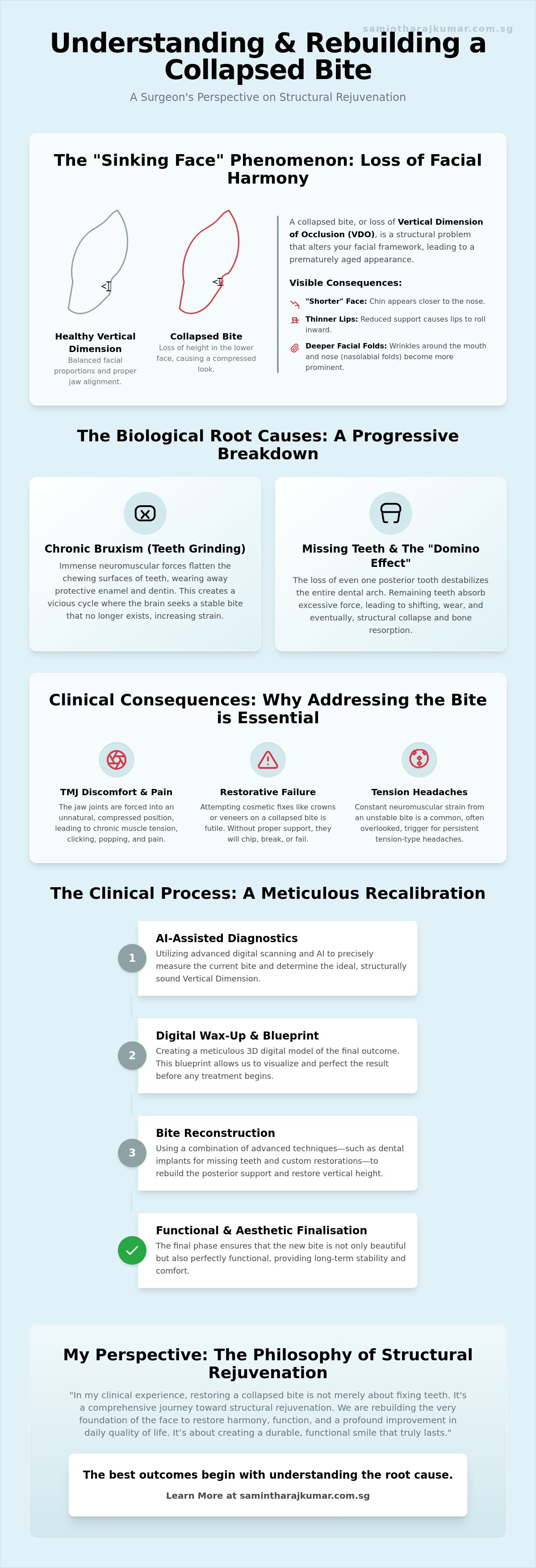
In my clinical experience, we refer to a collapsed bite as a significant loss of the Vertical Dimension of Occlusion (VDO). This isn't merely a dental issue; it's a fundamental shift in the architectural framework of your face. When the height of your bite decreases, the lower third of your face begins to look compressed, leading to what I often call the "sinking face" phenomenon. It's a biological reality that when the vertical support of the teeth is lost, the soft tissues of the face have no choice but to follow, resulting in a heavy, prematurely aged appearance that topical treatments simply cannot resolve.
Patients often mistake this structural collapse for simple skin ageing. They might seek dermal fillers or facelifts, yet the root cause remains unaddressed. If you're wondering how to fix a collapsed bite, you must understand that the solution lies in restoring the foundation of the jaw, not just the surface. Attempting to "just fix the front teeth" without recalibrating the entire bite often leads to restorative failure. Without addressing the posterior support, new restorations will likely chip or fail because they are bearing loads they weren't designed to handle. The mechanics must be sound before the aesthetics can be beautiful.
To better understand this concept, watch this helpful video:
The Anatomy of a Collapsed Bite
The relationship between your maxilla and mandible dictates your facial height. Think of your posterior teeth as the structural pillars of your face. When these pillars are compromised through wear or tooth loss, the lower face collapses. This leads to visible symptoms: lips that appear thinner, deeper nasolabial folds, and a chin that seems to protrude forward. In my practice, I look beyond the enamel to see how these skeletal changes affect your overall profile and muscle function.
Why Vertical Dimension Matters
Vertical dimension is essentially the distance between two fixed points on the face when the teeth are in full contact. When this distance shrinks, the temporomandibular joints (TMJ) are forced into an unnatural position, which often results in chronic discomfort. I frequently discuss how dental structure affects face shape with my patients because the impact on long-term skeletal health is profound. Restoring this dimension is the first step in a comprehensive journey toward structural rejuvenation and functional excellence.
The Biological Root Causes: Why Bites Collapse
Understanding the "why" is the first step in determining how to fix a collapsed bite. In my clinical experience, this structural breakdown is rarely the result of a single, isolated event. It is more often a progressive biological erosion. From a biological perspective, our teeth are designed to exist in a state of dynamic equilibrium. When this balance is disrupted, the entire system begins to fail. This failure can manifest as rapid mechanical trauma or a slow, insidious wear that gradually robs the face of its height.
Bruxism and Neuromuscular Strain
Chronic bruxism, or teeth grinding, is perhaps the most common architect of collapse. The sheer force of the jaw muscles can exert hundreds of pounds of pressure, flattening the occlusal surfaces of the teeth over time. As the protective enamel and dentine wear away, the vertical dimension begins to shrink. This creates a vicious cycle where the brain constantly tries to "find" a stable bite that no longer exists, leading to further neuromuscular strain. I often discuss the benefits of Botox for teeth grinding with my patients. It serves as a sophisticated tool to deprogram these overactive muscles, providing the necessary relief to prevent further structural loss during the reconstruction phase.
Missing Teeth and Bone Resorption
The loss of even a single posterior tooth can trigger what I call the "Domino Effect." Without the support of back teeth, the remaining dentition is forced to absorb excessive loads. This leads to what clinicians describe as Posterior Bite Collapse: Guidelines for Treatment. When back teeth are missing, the jawbone begins to resorb, and the mandible over-closes to seek contact. This over-closure is a primary driver of the "sinking" appearance discussed in the previous section. Replacing these missing units is not just a cosmetic choice; it is a clinical necessity to halt skeletal collapse and protect the integrity of the jawbone.
Periodontal disease further complicates this process. As the supporting bone and ligaments weaken, teeth begin to migrate out of their optimal positions. This drifting creates "pathological migration," where the bite literally shifts and opens up gaps, further destabilising the foundation. Determining how to fix a collapsed bite requires a deep dive into these biological triggers to ensure the solution is as durable as it is aesthetic. I believe that comprehensive diagnostic oversight is the only way to identify these root causes before they cause irreversible damage to the facial architecture.
Clinical Consequences: Why Addressing the Bite is Essential
In my clinical experience, ignoring a collapsed bite is akin to overlooking a failing foundation in a skyscraper. The structural integrity of the entire system is at risk. Beyond the visible changes to your profile, the biological consequences of vertical loss extend into your systemic health and daily comfort. Many patients arrive at my clinic exhausted by persistent tension-type headaches. These are rarely simple migraines; they are often the result of chronic muscular fatigue as the masticatory muscles struggle to find a stable resting position in a system that has lost its height.
The impact on nutrition is equally significant. When your teeth are worn or missing, your chewing efficiency drops. This often forces a shift toward softer, more processed foods, which can have long-term implications for your digestive health. There is also a profound psychological toll. Watching your facial appearance change and feeling your confidence ebb away because of a "sunken" look is a heavy burden to carry. Understanding how to fix a collapsed bite is about more than just a smile; it is about restoring your quality of life and your sense of self.
TMJ and Neuromuscular Dysfunction
When a bite collapses, the mandible is frequently forced into an unnatural posterior position. This displacement puts immense pressure on the temporomandibular joints, leading to what we call TMD. From a biological perspective, my objective is to return the jaw to "centric relation." This is the most stable, anatomically correct position for the jaw joint, independent of tooth contact. If we leave a collapsed bite untreated, the risk of permanent joint disc displacement increases. This can lead to painful clicking, locking, and irreversible joint degeneration that becomes much harder to manage later in life.
The Aesthetic-Functional Link
There is an inseparable bond between how a bite functions and how the face looks. I often see patients who have attempted to address sagging skin or deep folds with dermal fillers, only to find the results underwhelming. In these cases, restoring facial volume with dental reconstruction is far more effective. By rebuilding the internal dental scaffold, we provide the necessary support for the lips and cheeks. Proper tooth length is the secret to a youthful profile. When we restore the vertical dimension, we aren't just masking the signs of ageing; we are correcting the skeletal deficit that caused them. This structural approach ensures that the rejuvenation is both natural and durable. The best outcomes begin with understanding the root cause.
The Clinical Process: How I Fix a Collapsed Bite
Determining how to fix a collapsed bite requires a logical, sequential approach that prioritises structural stability before aesthetic finishing. In my clinical experience, rushing to place final crowns without a verified foundation is a recipe for long-term failure. As a clinician and founder, I've developed a meticulous five-step protocol to ensure every reconstruction is as durable as it is life-changing. We begin with a comprehensive digital diagnostic phase, using AI-assisted occlusal analysis to remove the guesswork from complex jaw relationships. This allows us to move into the "Wax-Up" phase, where we determine your ideal vertical dimension and create a blueprint for your new smile.
Once the blueprint is set, we focus on stabilising the foundation. This involves treating any underlying periodontal disease or decay to ensure the supporting structures are healthy. The actual rehabilitation then takes place, utilising a combination of high-tier crowns, bridges, or ceramic implants to restore the lost height. Finally, we implement long-term maintenance protocols, often including protective occlusal splints, to safeguard your investment against the forces of bruxism. This rhythmic progression ensures that the emotional barriers often associated with complex surgery are replaced by a sense of being in capable, experienced hands.
Precision Diagnostics and Measurement
Precision is the hallmark of my practice. We utilise 3D CBCT scans to evaluate the health of your jaw joints and the density of your bone with absolute clarity. This data is essential for understanding how dentists measure bite alignment with digital accuracy. Before any permanent changes are made, we often transition patients through a "trial smile" or provisional phase. This allows you to live with your new bite height, ensuring the muscular and joint response is positive before we proceed to the final porcelain or ceramic restorations.
Advanced Implantology for Complex Collapse
While some practitioners promote non-invasive overlays, these are often insufficient for patients with missing teeth or severe skeletal bone loss. When crowns alone cannot provide the necessary support, I turn to advanced implantology. For total arch rehabilitation, our All-on-4 protocols can restore a functional set of teeth in a single day. In cases of extreme bone resorption in the upper jaw, I utilise Zygomatic dental implants. These specialised implants anchor into the cheekbone, providing a secure foundation where traditional implants might fail. This tier of care ensures that even the most complex cases of collapse can be successfully managed. If you are ready to explore your options, the right diagnosis changes everything.
From a biological perspective, we are rebuilding more than just a bite; we are restoring the internal scaffold of your face. By integrating international protocols and global standards, we ensure that your treatment is at the cutting edge of modern medicine. This meticulous attention to detail is what distinguishes a generalist approach from a specialist reconstruction. Every step is designed to restore your facial harmony and eliminate the chronic discomfort of a collapsed system.
My Perspective: The Philosophy of Structural Rejuvenation
In my clinical experience, a bite is much more than a point of contact between upper and lower teeth; it is the fundamental foundation of facial harmony. When patients ask me how to fix a collapsed bite, they are often seeking more than just dental repair. They are looking to reclaim a version of themselves that has been eroded by time and mechanical wear. As a clinician and founder, I view every reconstruction as a legacy project. My goal is never a temporary fix. I aim for a profound restoration that respects the delicate balance of the human face and the long-term health of the individual.
From a biological perspective, we are not just fixing teeth; we are restoring a complex musculoskeletal system. This is why I prioritise the use of ceramic implants and other biocompatible materials in my practice. These choices aren't merely about aesthetics. They are about long-term systemic health and the body’s seamless acceptance of the restorative work. A stable bite has a transformative power that extends far beyond the dental chair. It restores the simple joys of eating without pain and the quiet confidence of a facial profile that finally feels "right" again. The impact on a patient’s quality of life is why I remain so dedicated to this specialised field.
A Holistic Approach to Oral Surgery
Success in complex bite reconstruction requires integrating facial aesthetics with surgical precision for a result that feels entirely natural. I believe a visionary treatment plan must look 20 years ahead, anticipating how the jaw and soft tissues will age alongside the restorations. This level of foresight ensures that the vertical dimension we restore today remains functional and beautiful for decades. I often tell my team that the right diagnosis changes everything for the patient. Without a deep, diagnostic understanding of the skeletal and muscular drivers behind the collapse, any clinical intervention is merely addressing symptoms rather than the cause.
The Future of Full Mouth Rehabilitation
The landscape of healthcare is shifting, and I am deeply optimistic about where we are headed. AI-assisted diagnostics and digital workflows are making the process of how to fix a collapsed bite more predictable and precise than ever before. My commitment to global standards and international clinical protocols ensures that our patients receive the same tier of care found in the world's leading medical networks. I see myself as both a healer and an educator, helping patients navigate these complex choices with clarity and security. The journey to comprehensive restoration is a partnership built on trust. The best outcomes begin with understanding the root cause.
Restoring Your Foundation for a Future of Health
As a clinician and founder with over a decade of surgical expertise, I've seen firsthand how the restoration of vertical dimension can be truly life-altering. We've examined the biological triggers of structural loss and the meticulous clinical pathways available to reverse it. Understanding how to fix a collapsed bite is the first step toward resolving chronic jaw tension and reclaiming the natural volume of your face. It's a journey that moves beyond surface-level aesthetics to address the very core of your oral health.
At Nuffield Dental, I specialise in advanced Zygomatic and All-on-4 implant protocols, always adhering to international clinical standards and the principles of biological dentistry. My philosophy is rooted in the belief that we're restoring a vital system rather than just repairing individual teeth. This comprehensive approach ensures that your results are as durable as they are life-changing. By prioritising biocompatible materials and digital precision, we create a legacy of health that lasts for decades.
The right diagnosis changes everything. Discover how we can restore your structural health. The best outcomes begin with understanding the root cause. I look forward to helping you move toward a life defined by functional excellence and renewed confidence.
Frequently Asked Questions
Can a collapsed bite be fixed without surgery?
A collapsed bite can often be corrected without invasive surgery if your existing teeth are structurally sound. In these instances, I use high-tier porcelain crowns or overlays to rebuild the lost vertical dimension and restore the bite's height. However, if teeth are missing or the jawbone has resorbed significantly, surgical protocols like dental implants become a clinical necessity to provide the required structural support.
How long does it take to fix a collapsed bite?
The timeline for how to fix a collapsed bite depends entirely on the complexity of your specific case. A purely restorative approach using crowns may take four to six weeks from the initial diagnostic phase to final fitting. If your treatment plan includes surgical elements like All on 4 dental implants, the process can span several months to allow for proper biological healing and the integration of the implants with your jawbone.
Will fixing my bite make me look younger?
Restoring your bite can significantly rejuvenate your facial appearance by correcting the "sinking" effect caused by tooth wear. When we increase the height of your teeth, we provide a stable internal scaffold for your lips and cheeks. This naturally smooths out deep nasolabial folds and restores the youthful proportions of the lower third of your face, often achieving results that soft tissue fillers cannot match.
What happens if I don’t fix a collapsed bite?
Leaving a collapsed bite untreated leads to a progressive decline in both oral function and daily comfort. The excessive forces on your remaining teeth will cause them to fracture or wear down further, while the lack of support can trigger chronic TMJ pain and tension headaches. Over time, the skeletal changes become more difficult to reverse as the jawbone continues to resorb and the facial muscles adapt to the misalignment.
Is full mouth reconstruction painful?
Full mouth reconstruction is designed with your comfort as a primary priority throughout the clinical journey. In my clinical experience, patients are often surprised by how manageable the process is when using advanced anaesthesia and AI-assisted diagnostics. While you may experience some mild soreness during the healing phase, we use meticulous surgical techniques to minimise downtime and ensure a smooth, predictable recovery.
How do I know if my bite has actually collapsed?
You can identify a potential collapse by observing specific visual changes and physical symptoms. Common signs include teeth that appear noticeably shorter or flat, a chin that seems to protrude forward, and the development of deep creases at the corners of the mouth. If you also suffer from persistent jaw fatigue or find it increasingly difficult to chew tough foods, your bite has likely lost its essential vertical dimension.
Can dental implants fix a sinking face?
Dental implants are an exceptional tool for addressing a sinking face caused by missing teeth and bone loss. By replacing both the root and the crown, implants provide the structural integrity needed to maintain the jawbone and support the facial muscles. Protocols such as Zygomatic dental implants are particularly effective for patients with severe bone loss who require a more robust foundation to restore their facial features.
What is the cost of restoring a collapsed bite in 2026?
The investment required for bite restoration is determined by the specific clinical pathways chosen for your unique biological needs. Factors such as the number of teeth involved, the choice between crowns or implants, and the necessity of bone grafting all influence the final scope of the reconstruction. I always recommend a comprehensive diagnostic consultation to establish a clear, transparent treatment plan tailored to your long-term health and lifestyle goals.


Comments