
Jaw Pain When Chewing: A Specialist Surgeon’s Perspective on Structural Rehabilitation (2026)
- Dr Samintharaj Kumar

- 11 minutes ago
- 13 min read
That sharp, grinding ache you feel every time you bite into something isn't just an inconvenience. It's a signal. Jaw pain when chewing is one of the most consistent indicators I see in clinical practice that something structural is under stress, and in my experience, it rarely resolves on its own without understanding precisely why it began.
You already know this isn't normal. You've adjusted what you eat, perhaps avoided meals you once enjoyed, and you've likely woken with a dull facial tension or a headache that takes the morning to shake. That quiet fear of your jaw locking mid-meal is real, and it deserves a real clinical answer, not a temporary fix.
What this article offers is exactly that: a surgeon's perspective on the structural root causes of masticatory pain, why those causes matter beyond the discomfort itself, and what a genuine restorative pathway looks like when function, aesthetics, and long-term joint health are addressed together. From diagnosis through to rehabilitation, I want to walk you through what's actually happening inside your jaw, and what comprehensive, specialist-led care can do to change it.
Table of Contents
Understanding Jaw Pain When Chewing: More Than a Temporary Discomfort
Jaw pain when chewing is, at its most precise clinical definition, a symptom of underlying mechanical disharmony within the temporomandibular system. It tells you that the delicate interplay between bone, cartilage, disc, and muscle has been disrupted, and that the forces generated during mastication are no longer being distributed as they should be.
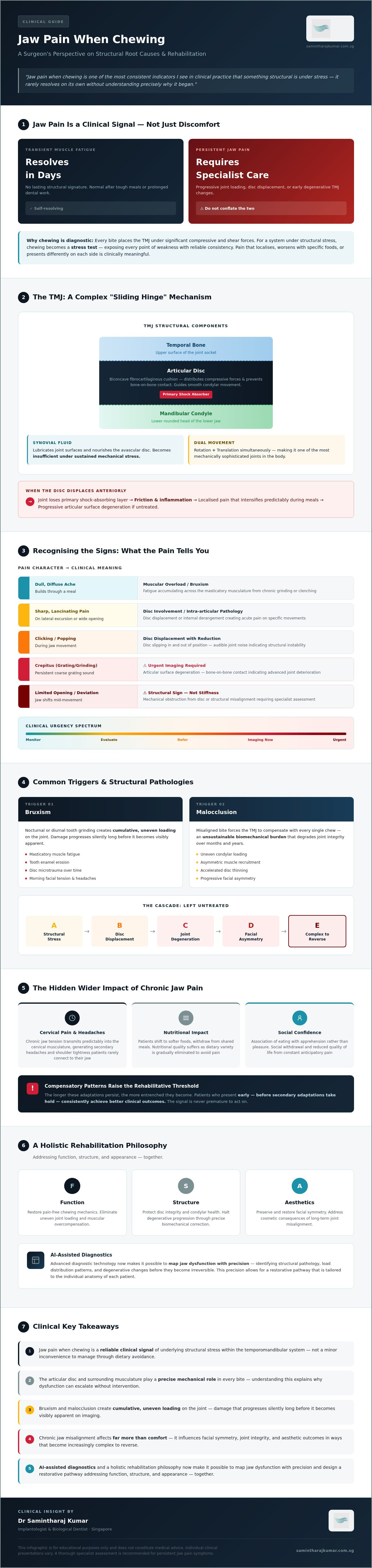
What makes chewing such a revealing diagnostic event is its mechanical demand. Every bite places the temporomandibular joint under significant compressive and shear forces. For a system functioning in balance, this is effortless. For a system under structural stress, chewing becomes a stress test, one that exposes every point of weakness with reliable consistency. This is precisely why the pain tends to localise, worsen with specific foods, or present differently on each side of the jaw.
There is also a critical clinical distinction I want to draw early. Transient muscle fatigue, the kind that follows an unusually tough meal or prolonged dental work, resolves within days and leaves no lasting structural signature. What I see in patients who present with persistent discomfort is something categorically different: progressive joint loading, disc displacement, or early degenerative changes consistent with temporomandibular joint dysfunction. Conflating the two leads to delayed diagnosis and, in my experience, avoidable complexity further down the line.
Identifying the Early Signs of Masticatory Distress
The character of the pain matters enormously. A dull, diffuse ache that builds through a meal often points toward muscular overload or bruxism-related fatigue. Sharp, lancinating pain on a specific movement, particularly lateral excursion or wide opening, is more suggestive of disc involvement or intra-articular pathology. Clicking and popping sounds indicate disc displacement with reduction; a grating, grinding quality known as crepitus signals articular surface degeneration and warrants urgent imaging. Limited opening or a jaw that deviates mid-movement is not stiffness. It's a structural sign.
The Emotional and Physical Toll of Chronic Pain
What often goes underdiscussed is the cumulative personal cost. Patients quietly shift to softer foods, withdraw from shared meals, and begin to associate eating with apprehension rather than pleasure. Nutritional quality suffers. Social confidence erodes. Chronic jaw tension also transmits predictably into the cervical musculature, generating secondary headaches and shoulder tightness that patients rarely connect to their jaw at all. And the longer these compensatory patterns persist, the more entrenched they become, raising the rehabilitative threshold considerably.
In my clinical experience, the patients who present early, before secondary adaptations have taken hold, consistently achieve better outcomes. The signal is never premature to act on.
The Biological Mechanics: Why Your Jaw Hurts During Function
To understand why jaw pain when chewing persists, you first need to understand what's actually moving inside your joint every time you bite. The temporomandibular joint is not a simple hinge. It's a bilateral synovial structure that performs a combined rotation and translation, what clinicians describe as a "sliding hinge" mechanism. This dual movement allows the jaw to open wide, shift laterally, and protract forward, all within fractions of a second. That mechanical sophistication is precisely what makes it so vulnerable when structural balance is lost.
The Role of the Temporomandibular Joint (TMJ)
Sitting between the mandibular condyle and the temporal bone is the articular disc, a biconcave fibrocartilaginous structure that acts as a dynamic cushion. Its job is to distribute compressive forces, prevent bone-on-bone contact, and guide smooth condylar movement. When this disc displaces anteriorly or becomes thinned through chronic overloading, the joint loses its primary shock-absorbing layer. Synovial fluid, which normally lubricates the joint surfaces and nourishes the avascular disc tissue, becomes insufficient under sustained mechanical stress. The result is friction, inflammation, and the kind of localised pain that intensifies predictably during meals.
The masseter and temporalis muscles compound this picture considerably. These are among the most powerful muscles in the body relative to their size, capable of generating bite forces that place the joint under substantial compressive load. When they function in balance, this force is distributed evenly. When bruxism, postural asymmetry, or malocclusion skews that distribution, specific regions of the joint absorb disproportionate stress over time. The damage is cumulative and largely silent until it isn't.
Biological Triggers of Joint Inflammation
From a biological perspective, the body's response to mechanical overloading in the jaw follows a predictable inflammatory cascade. Cytokine activity increases within the synovial membrane, cartilage matrix begins to degrade, and subchondral bone remodelling accelerates in ways that alter condylar morphology. What's less commonly discussed, and what I consider a significant gap in mainstream clinical guidance on temporomandibular disorders, is the role of the oral microbiome in amplifying this process. Dysbiosis, an imbalance in oral bacterial populations driven by periodontal disease or chronic inflammation, can elevate systemic inflammatory markers that directly impair joint tissue integrity.
This is why my restorative philosophy doesn't begin and end at the joint itself. Biocompatibility matters at every level of intervention. When I select materials for any restorative work, ceramic implants included, the priority is always tissue compatibility and long-term biological neutrality. Metal-based restorations can introduce low-grade galvanic currents and corrosion by-products that sensitise already-inflamed tissue. The choice of material is not an aesthetic preference; it's a clinical one with real consequences for joint health and healing trajectory.
Uneven bite force distribution also places extraordinary demands on natural teeth and implants alike. A joint under structural stress transfers compensatory loading to adjacent dental structures, accelerating wear, fracture risk, and implant failure at the bone interface. Addressing the joint without addressing the occlusal load that created the problem is, in my view, an incomplete solution. Understanding the full structural picture is where genuinely lasting rehabilitation begins.
Common Triggers and Underlying Structural Pathologies
Jaw pain when chewing doesn't emerge from nowhere. In the vast majority of cases I see clinically, there is a specific, identifiable structural trigger, and frequently more than one operating simultaneously. Understanding these triggers isn't academic; it's the foundation of any restorative plan that actually holds over time. The TMJ disorder symptoms and causes documented by leading medical institutions confirm what I observe daily in practice: this is a multifactorial condition, and treating only one contributing factor rarely resolves the whole picture.
Bruxism and the Impact of Stress
Bruxism is, in my experience, the most underdiagnosed contributor to masticatory pain. Most patients don't know they grind their teeth because it happens at night, silently, while they sleep. The signs, however, are visible to a trained eye: flattened cusp tips, enamel wear on the lingual surfaces, scalloped lateral tongue margins from pressure, and a masseter muscle that's visibly hypertrophied on palpation.
What makes bruxism particularly damaging is its persistence. Eight hours of low-grade clenching generates cumulative compressive forces that the joint was never designed to sustain at rest. Over weeks and months, this fatigues the masticatory musculature, sensitises the joint capsule, and accelerates disc thinning in ways that mirror the degenerative changes seen in far older patients. Stress management strategies and a well-fitted occlusal splint can interrupt this cycle in the short term, but they are protective measures, not structural corrections. They buy time. They don't resolve the underlying mechanical imbalance.
Structural Instability and Missing Teeth
The relationship between dental architecture and joint health is one that general dentistry doesn't always communicate clearly enough. When posterior teeth, particularly molars, are lost and not replaced, the vertical dimension of the bite begins to collapse. The mandible rotates upward and backward, compressing the condyle against the posterior wall of the glenoid fossa. This is what clinicians refer to as a "collapsed bite," and it places the TMJ under a type of sustained, misdirected loading that is both painful and progressively destructive.
Missing teeth also trigger a cascade of secondary changes: adjacent teeth tilt into the gap, opposing teeth over-erupt, and the entire occlusal plane shifts. Each of these changes alters how forces are distributed across the joint during function. The result, experienced as jaw pain when chewing, is actually the end product of a structural deterioration that began the moment that tooth was lost. This is why preventing facial collapse with dental implants isn't simply an aesthetic consideration; it's a joint-preservation strategy.
Impacted wisdom teeth add another layer of complexity. Their pressure on adjacent structures can refer pain anteriorly along the inferior alveolar nerve pathway, mimicking joint-origin pain convincingly enough that patients are sometimes managed for TMJ dysfunction for months before the true source is identified. Careful clinical examination and cone beam CT imaging are essential to distinguish between referred dental pain and genuine intra-articular pathology. Getting that distinction right early changes the entire treatment trajectory.
Clinical Consequences: Why Early Specialist Intervention Matters
There is a progression I see with uncomfortable regularity in clinical practice. A patient arrives having managed jaw pain when chewing for months, sometimes years, with ibuprofen and soft food substitutions. By the time they sit in my chair, what began as muscular tension has evolved into measurable disc displacement, altered condylar morphology, or early degenerative joint changes that no longer respond to conservative management alone. The window for straightforward intervention has closed.
This is the clinical reality that generic medical advice consistently fails to communicate. Jaw dysfunction doesn't plateau. It progresses. Muscle fatigue sensitises the joint capsule, which accelerates disc wear, which shifts load onto the articular surfaces, which initiates subchondral bone remodelling. Each stage compounds the next. Treating the symptom at any single stage without addressing the underlying mechanical cause simply allows that progression to continue, quietly, between appointments.
Self-diagnosis and over-the-counter relief carry a specific clinical risk that I want to name directly. Anti-inflammatory medications reduce pain perception without altering the structural forces that caused it. Patients feel better and delay specialist review. In the interim, the joint continues to degrade. When they do present for assessment, the complexity, and the corresponding rehabilitative burden, has increased substantially. The right diagnosis changes everything, and the timing of that diagnosis matters enormously.
Jaw Health and Facial Aesthetics
What most patients don't realise is that chronic jaw misalignment leaves a visible signature on the face over time. As vertical bite dimension collapses and the mandible rotates posteriorly, the lower facial third shortens. Jowling accelerates. The nasolabial folds deepen. Lip support diminishes. These are not simply ageing changes; they are structural consequences of a compromised occlusal foundation. In my experience, patients who address jaw dysfunction comprehensively often describe looking noticeably more rested and youthful as a secondary outcome, because the structural scaffolding of the lower face has been restored. Oral surgery, when applied with an understanding of facial harmony, does more than resolve pain. It restores the architecture that supports appearance.
Preventing Long-Term Joint Degeneration
Osteoarthritis of the temporomandibular joint is not inevitable, but it is a real destination for untreated chronic dysfunction. Early specialist intervention can interrupt the inflammatory and mechanical cascade before irreversible cartilage loss occurs. The alternative, total joint replacement surgery, is a complex, resource-intensive procedure that carries its own rehabilitative demands. No patient should reach that point without having had the opportunity for earlier, less invasive correction.
Seeking a TMJ specialist for a definitive structural assessment is not an overreaction to jaw pain. It is the single most important step toward preserving joint integrity and long-term facial health. A specialist brings diagnostic tools, clinical pattern recognition, and a rehabilitative philosophy that no general practitioner or online symptom checker can replicate.
Your joint health is a long-term asset. Treat it accordingly.
My Perspective: A Holistic Approach to Total Jaw Rehabilitation
In my clinical experience, the single variable that most reliably predicts a patient's outcome isn't the severity of their condition at presentation. It's the precision of their diagnosis. Jaw pain when chewing can originate from a dozen different structural sources, and treating the wrong one, or treating the right one incompletely, simply defers the problem. What changes everything is arriving at a diagnosis that maps the full mechanical picture before a single treatment decision is made.
This is the philosophy that shapes every case I take on at Nuffield Dental. Rehabilitation, in my view, is not a sequence of isolated procedures. It's a coordinated restoration of the entire masticatory system, and it demands that function, structure, and long-term biological health are addressed as a single integrated objective.
Advanced Diagnostics at Nuffield Dental
Accurate treatment begins with accurate information. We use 3D cone beam CT imaging alongside digital bite analysis to map condylar position, joint space dimensions, and occlusal load distribution with a level of precision that conventional radiography simply cannot provide. Sub-millimetre discrepancies in joint alignment, the kind that produce significant functional symptoms but remain invisible on standard X-rays, become clearly legible. AI-assisted diagnostic tools allow us to analyse jaw movement patterns and identify asymmetrical loading before those forces have caused irreversible structural change. The result is a clinical picture that's specific, not assumed, and a treatment plan that's built on evidence rather than estimation.
A comprehensive specialist consultation is where this process begins. There is no substitute for an experienced clinician interpreting that data in the context of your full medical and dental history.
Restoring Function and Quality of Life
Pain relief is a starting point, not a destination. True rehabilitation means restoring the structural foundation that allows a patient to eat without apprehension, speak without discomfort, and move through their day without chronic tension radiating from the jaw into the neck and temples.
For patients with significant occlusal collapse, Teeth in a Day offers a clinically meaningful pathway to re-establishing bite stability within a single surgical appointment. When paired with the biological precision of complex dental implantology, the outcome isn't simply a restored smile. It's a rebuilt occlusal architecture that removes the mechanical stressors responsible for joint deterioration in the first place.
What I find most meaningful in this work is the transformation that follows. Patients who once quietly managed jaw pain when chewing by avoiding entire food groups rediscover meals they'd written off. Confidence returns. The face regains its structural support. This is what modern, biological dentistry, applied with surgical precision and a genuinely holistic philosophy, is capable of delivering. The right diagnosis changes everything. And it's never too early to seek one.
The Right Diagnosis Changes Everything
Jaw pain when chewing is never just a minor inconvenience to manage around. As this article has explored, it's a structural signal, one that reflects real mechanical stress within the temporomandibular system and carries genuine consequences for joint integrity, facial architecture, and long-term quality of life if left unaddressed.
Three things matter most. First, early specialist intervention consistently produces better outcomes than delayed management. Second, accurate diagnosis, not symptom suppression, is where lasting rehabilitation begins. Third, function and aesthetics are inseparable; restoring one without the other is an incomplete solution.
At Nuffield Dental, every case is approached with founder-led clinical oversight, specialist expertise in complex TMJ management, and a biological dentistry philosophy that prioritises long-term structural health over short-term relief. That combination makes a measurable difference to what's achievable.
Your jaw health is worth taking seriously, and the earlier you do, the more options remain available to you. The best outcomes begin with understanding the root cause.Explore our clinical approach to jaw rehabilitation and take the first step toward genuine, lasting change.
Frequently Asked Questions About Jaw Pain When Chewing
Is jaw pain when chewing always a sign of TMJ disorder?
Not always, but it warrants careful clinical evaluation regardless. Jaw pain when chewing can originate from dental pathology such as cracked teeth, periodontal disease, or impacted wisdom teeth, none of which are technically TMJ disorders. That said, persistent masticatory pain that doesn't resolve within a week or two is rarely benign. A specialist can distinguish between dental-origin pain, muscular dysfunction, and genuine intra-articular pathology through clinical examination and targeted imaging.
Can a misaligned bite cause pain in only one side of the jaw?
Yes, and this is actually a clinically meaningful pattern. Malocclusion rarely distributes force symmetrically; instead, it tends to concentrate compressive load on one condyle disproportionately. Patients often describe unilateral aching that worsens on the affected side during meals, with the contralateral side remaining largely comfortable. This asymmetrical loading, if sustained, accelerates degenerative change on the overloaded side while the opposite joint compensates, which can create its own secondary dysfunction over time.
How do I know if my jaw pain requires surgery or conservative treatment?
The decision depends on what's driving the pain structurally. Muscular overload, early disc displacement, and bruxism-related tension typically respond well to conservative management including occlusal splints, physiotherapy, and bite adjustment. Surgery becomes relevant when there is irreversible disc damage, condylar degeneration, significant occlusal collapse from missing teeth, or when conservative measures have failed over a documented period. Only specialist imaging and clinical assessment can make that distinction reliably. Self-assessment alone isn't sufficient.
What is the link between missing teeth and jaw pain during meals?
It's a direct structural relationship. When posterior teeth are lost and not replaced, the vertical dimension of the bite begins to collapse, and the mandible rotates in a way that compresses the condyle against the posterior joint wall. This creates sustained, misdirected loading that the temporomandibular joint wasn't designed to tolerate. Adjacent teeth also tilt and opposing teeth over-erupt, further disrupting how forces are distributed during chewing. Replacing missing teeth isn't just a functional decision; it's a joint-preservation one.
Can stress-related teeth grinding lead to permanent jaw joint damage?
Yes, and this is a risk that's frequently underestimated. Chronic bruxism generates compressive forces across the joint during sleep, when the protective reflexes that limit daytime bite force are largely absent. Over months and years, this accelerates articular disc thinning, fatigues the joint capsule, and can initiate subchondral bone remodelling that permanently alters condylar shape. An occlusal splint can reduce the mechanical load in the short term, but it doesn't correct the underlying structural imbalance that makes the joint vulnerable in the first place.
What kind of specialist should I see for persistent jaw pain when eating?
An oral and maxillofacial surgeon or a specialist with dedicated expertise in temporomandibular disorders is the appropriate first point of contact for persistent symptoms. General practitioners and even general dentists often lack the diagnostic tools and clinical pattern recognition needed to distinguish between muscular, disc-related, and degenerative joint pathology. A specialist brings cone beam CT imaging, digital bite analysis, and the surgical judgment to determine whether conservative or interventional management is appropriate for your specific presentation.
Are there non-surgical options for managing jaw clicking and discomfort?
There are, and for many patients they represent a genuinely effective starting point. Custom occlusal splints reduce nocturnal loading, physiotherapy targets masticatory muscle tension, and bite equilibration can redistribute occlusal forces more evenly across the joint. Anti-inflammatory protocols address the synovial component of pain in the shorter term. The important caveat is that these approaches manage symptoms and protect the joint from further loading; they don't reverse structural changes that have already occurred. Their success depends heavily on how early they're introduced.
How long does it take to see improvement after starting a jaw rehabilitation programme?
This varies considerably depending on the severity of the underlying pathology and the scope of the rehabilitation plan. Patients with primarily muscular dysfunction often notice meaningful relief within four to eight weeks of consistent conservative management. Those undergoing full occlusal reconstruction, including implant-supported rehabilitation to restore lost bite dimension, typically experience progressive functional improvement over three to six months as the neuromuscular system adapts to the restored architecture. What I consistently observe is that the quality of the diagnosis at the outset is the strongest predictor of how smooth that trajectory will be.


Comments