
Jaw Surgery in Singapore: A Specialist Surgeon’s Guide to Orthognathic Transformation (2026)
- Dr Samintharaj Kumar

- Apr 20
- 13 min read
A misaligned jaw is never just a dental issue; it's a structural barrier that dictates how you eat, speak, and ultimately, how you present yourself to the world. You've likely felt the daily frustration of a bite that doesn't quite fit or the persistent ache of a joint that refuses to settle. In my clinical experience, patients seeking jaw surgery singapore are looking for more than a medical fix; they're seeking a return to themselves. It's a journey that requires a delicate balance of surgical precision and an aesthetic eye for facial harmony.
I've written this guide to provide a transparent, expert-led roadmap of what orthognathic transformation looks like in 2026. I'll show you how we use AI-assisted diagnostics to map your procedure with sub-millimetre accuracy, ensuring results that are as functional as they are beautiful. We'll explore the entire treatment timeline, from the initial digital scan to the philosophy of total rehabilitation, so you can move forward with confidence and a clear vision of your future profile.
Key Takeaways
Learn why orthognathic surgery is the necessary bridge between dentistry and medicine for correcting complex skeletal disharmonies that braces alone cannot resolve.
Discover how I utilise AI-assisted diagnostics and 3D CBCT imaging to eliminate surgical guesswork and ensure a precise, predictable outcome for every patient.
Understand my signature philosophy of "Total Rehabilitation" for jaw surgery singapore, which treats facial aesthetics and functional health as one interconnected biological ecosystem.
Navigate the clinical journey with a clear breakdown of the treatment phases, ensuring you are mentally and physically prepared for each step of your transformation.
Explore how restoring anatomical harmony can lead to life-changing results, significantly improving your sleep quality, respiratory function, and overall social confidence.
Table of Contents Understanding Orthognathic Surgery: Beyond Just Aesthetic Correction The Precision of Modern Diagnostics: AI and 3D Planning Clinical Philosophy: My Perspective on Corrective Jaw Procedures Navigating the Journey: Phases of Treatment and Recovery Total Rehabilitation: Restoring Function and Confidence
Understanding Orthognathic Surgery: Beyond Just Aesthetic Correction
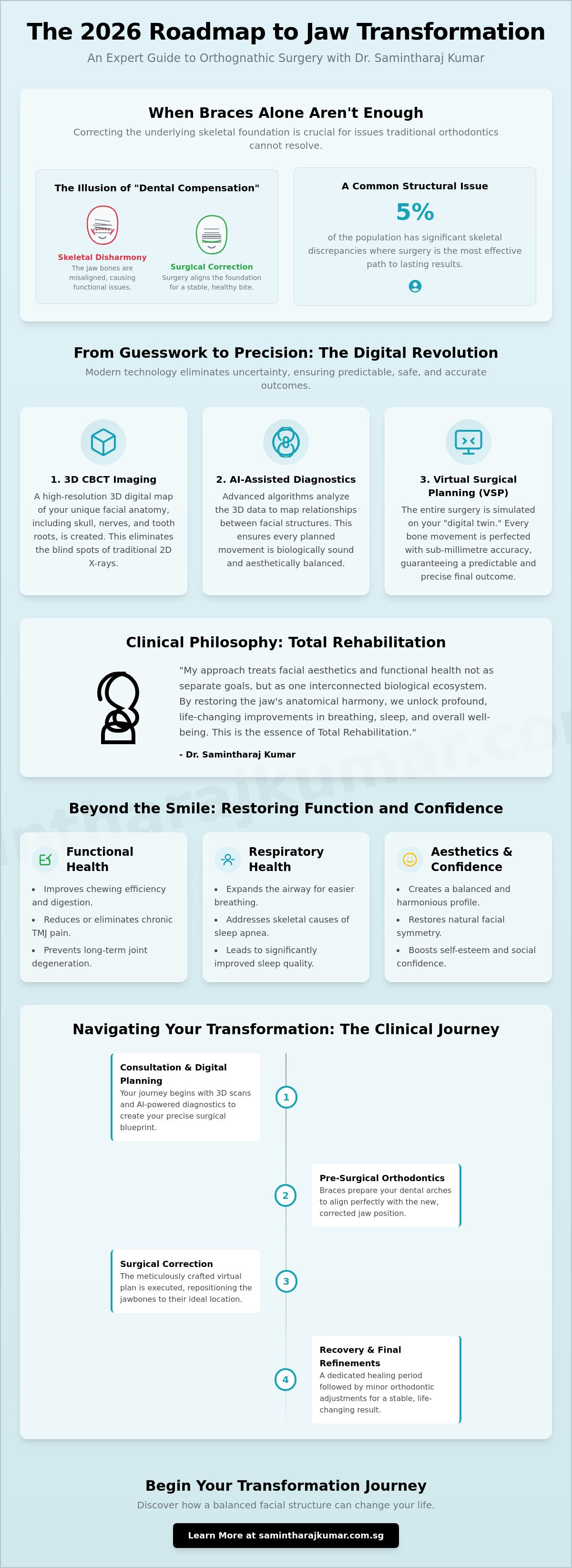
In my clinical experience, orthognathic surgery represents the ultimate bridge between dentistry and medicine. It's a precise corrective procedure designed for skeletal disharmonies that traditional orthodontics alone cannot resolve. While many patients initially seek jaw surgery singapore for facial symmetry, the procedure's true value lies in its ability to rectify the underlying skeletal foundation. This intervention addresses core structural problems, such as underbites, overbites, and crossbites, which frequently impact a patient's daily quality of life and long-term oral health.
From a biological perspective, the alignment of the jaw is intimately linked to total physiological well-being. This includes critical factors like airway management and temporomandibular joint (TMJ) stability. A comprehensive understanding of Orthognathic Surgery involves viewing the face not just as a series of features, but as a complex system where form and function are inseparable. For the 5% of the population with significant skeletal discrepancies, surgery is often the only path to achieving a stable bite and a balanced profile.
To better understand the patient journey and the preparation involved, watch this helpful video:
When Braces Are Not Enough
Dental movement is strictly limited by the underlying skeletal foundation. In many cases, teeth naturally tilt to mask a jaw discrepancy, a process we call "dental compensation." Before surgical intervention, an orthodontist must often reverse this tilt to reveal the true extent of the skeletal issue. This phase is vital for achieving a result that lasts a lifetime. As a clinician and founder, I believe a multidisciplinary approach between the surgeon and the orthodontist remains the gold standard. We don't just move teeth; we reposition the entire facial architecture to achieve a stable, life-changing result.
Functional Benefits of Corrective Jaw Procedures
The advantages of jaw surgery singapore extend far beyond the mirror. Proper alignment significantly improves masticatory efficiency, which is the ability to chew and digest food properly. Patients often report a dramatic reduction in chronic TMJ pain, preventing long-term joint degeneration that can lead to arthritis. Additionally, we see profound improvements in respiratory health. By advancing the jaw, we can often expand the airway, directly addressing the skeletal contributions to Obstructive Sleep Apnoea. This total rehabilitation ensures that our patients breathe better, eat better, and live with renewed confidence.
The Precision of Modern Diagnostics: AI and 3D Planning
As a clinician and founder, I have seen the landscape of jaw surgery singapore undergo a radical shift over the last decade. We have moved decisively past the era of surgical guesswork. In my clinical experience, the transition from traditional 2D X-rays to 3D Cone Beam Computed Tomography (CBCT) represents the most significant leap in patient safety. While 2D images often obscure vital anatomical complexities, a CBCT scan provides a high-resolution, three-dimensional map of the skull, nerves, and tooth roots. This clarity is the foundation of a predictable outcome.
The integration of advanced AI-assisted diagnostics allows us to analyse facial structures with a level of detail that was previously impossible. We no longer rely solely on manual measurements. Instead, we use digital tools to evaluate the relationship between the upper and lower jaws within the context of the entire cranium. This meticulous approach ensures that every movement we plan is biologically sound and aesthetically balanced.
Virtual Surgical Planning (VSP)
I believe the surgery should be performed digitally long before the patient enters the operating theatre. Through virtual surgical planning, we create a precise "digital twin" of the patient's facial structure. This allows us to simulate every osteotomy and bone movement with sub-millimetre accuracy. By rehearsing the procedure in a virtual environment, we can anticipate challenges and refine the plan to achieve the best possible functional result. This process is a core component of modern Corrective Jaw Surgery, offering patients a clear visualisation of their potential transformation.
We then translate this digital plan into reality using 3D printing technology. We produce bespoke surgical guides that sit perfectly on the bone, directing the surgeon's hand with absolute precision. Furthermore, we use these models to create individualised titanium plates for fixation. These custom-milled components fit the patient's unique anatomy exactly, which often leads to shorter operative times and more stable long-term results.
AI in Maxillofacial Assessment
At Nuffield Dental, I have integrated AI-driven algorithms to refine our maxillofacial assessments. Traditional cephalometric analysis, which involves tracing facial landmarks, used to be a time-consuming manual task. Today, AI identifies these landmarks in seconds, providing data-driven insights into facial symmetry and bone density with unprecedented speed. This is particularly vital when planning complex double jaw surgery singapore, where the harmony between multiple skeletal segments is critical.
From a biological perspective, AI also helps us predict post-surgical soft tissue changes. By analysing thousands of data points, the software can estimate how the lips and cheeks will drape over the new skeletal framework. This allows us to manage patient expectations with a high degree of confidence. Looking ahead, the role of AI will extend into the recovery phase, where it will help us monitor skeletal stability and ensure that the life-changing results we achieve remain permanent.
My Perspective:
Technology is never a replacement for surgical intuition; it is a powerful co-pilot. By removing the "art of guessing," we provide a higher standard of care that prioritises the patient's long-term well-being. Understanding the
is the first step toward a successful transformation.
Clinical Philosophy: My Perspective on Corrective Jaw Procedures
In my clinical experience, performing jaw surgery singapore is far more than a mechanical realignment of bone. I believe every surgical intervention must be rooted in a philosophy of biological harmony. As a clinician and founder, I prioritise what I call "Total Rehabilitation." This approach treats the teeth, the underlying bone, and the facial aesthetics as a singular, delicate ecosystem rather than isolated parts. When we alter the foundation of the face, we must ensure the entire system functions in unison.
My methodology is deeply shaped by the rigorous Malo Clinic protocols. These international standards have defined my approach to complex oral surgery, ensuring that every movement of the maxilla or mandible is backed by global clinical evidence. I am committed to minimally invasive techniques that respect the body's natural healing capacity. By using precise, smaller incisions and advanced cooling technologies during osteotomies, I can significantly reduce post-operative swelling and discomfort. The goal is always a seamless transition from clinical planning to physical recovery.
The Biological Perspective
From a biological perspective, surgical success is determined by how effectively the body integrates change. I choose biocompatible materials and fixation plates that promote rapid osseointegration while minimising the risk of chronic inflammation. Your systemic health, including baseline nutrition and inflammatory markers, forms a core part of my surgical success plan. I often find that the integration of wisdom tooth extraction is a necessary precursor to orthognathic work. Removing these teeth early in the planning phase ensures the jaw is structurally sound for the main procedure. To help you prepare, I recommend reviewing this patient's guide to the phases of treatment, which provides an excellent overview of the clinical milestones from pre-surgical orthodontics to the final operation.
Aesthetic Harmony and the V-Shape Profile
I believe functional correction must go hand-in-hand with the patient's desire for a refined, harmonious facial profile. Jaw surgery singapore offers a unique opportunity for sophisticated face recontouring. By strategically advancing or setting back the maxilla and mandible, we can achieve a more balanced V-shape profile or correct deep-seated facial asymmetry.
A "quietly premium" result is my signature. It means the surgery itself is invisible to the casual observer, but the patient's newfound confidence is palpable. We don't just move bone; we sculpt a profile that reflects your best self. In my view, the most successful transformation is one that feels entirely natural to your unique facial features. The best outcomes begin with understanding the root cause of the skeletal disharmony.
Navigating the Journey: Phases of Treatment and Recovery
Embarking on a corrective path requires a shift in mindset. In my clinical experience, the most successful outcomes for jaw surgery singapore patients come from those who view the process as a marathon rather than a sprint. This transformation demands clinical discipline from the surgical team and immense patience from the patient. We don't just move bone; we orchestrate a biological shift that affects speech, mastication, and facial harmony.
The Four Phases of Orthognathic Care
Phase 1: Digital Diagnostic Mapping. We begin with comprehensive treatment planning. Using 3D Cone Beam Computed Tomography (CBCT) and intraoral scans, I create a virtual twin of your craniofacial structure. This allows us to simulate movements with sub-millimetre precision before the first incision is made.
Phase 2: Pre-Surgical Orthodontics. This phase typically lasts 12 to 18 months. Your orthodontist aligns the teeth within their respective jawbones. Paradoxically, your bite might feel worse during this time, but it's a necessary step to ensure the teeth fit perfectly once the jaws are repositioned.
Phase 3: The Surgical Procedure. The surgery itself is performed under general anaesthesia. The critical window is the first 48 hours of recovery. In a specialist Singapore setting, we focus on intensive swelling management and immediate post-operative monitoring to ensure a seamless transition from the theatre to the ward.
Phase 4: Post-Surgical Orthodontics. Approximately six weeks after surgery, we begin the "finishing" phase. This fine-tunes the bite for long-term stability, usually lasting about 6 months.
A Specialist’s Tips for a Seamless Recovery
Recovery is where the science of surgery meets the art of self-care. Managing swelling is the primary objective during the first week. I recommend a disciplined icing protocol: 20 minutes on and 20 minutes off for the first 72 hours. This isn't just for comfort; it reduces the pressure on healing tissues.
Nutrition is the fuel for bone regeneration. You'll start with a strictly liquid diet, transitioning to soft foods like silken tofu or blended congee. I tell my patients to prioritise high-protein intake. Your body requires significant caloric resources to knit bone together. From a biological perspective, skipping meals can actually delay your discharge from the hospital.
My Perspective:
As a clinician and founder, I believe the psychological recovery is just as vital as the physical one. You'll see your face change daily as swelling subsides. Most of my patients return to desk-based work within 14 days, though I advise waiting 6 to 8 weeks before resuming high-impact exercise or contact sports. The structural integrity of the jaw is paramount during this window.
The best outcomes begin with understanding the root cause and committing to the full clinical timeline.
Total Rehabilitation: Restoring Function and Confidence
In my clinical experience, the true success of jaw surgery singapore isn't measured solely by the millimetres of bone movement or the precision of the surgical guide. It's measured by the patient's ability to live a life unencumbered by their anatomy. When we correct a malocclusion or a skeletal discrepancy, we're doing more than aligning teeth; we're opening airways to improve sleep quality, resolving chronic joint pain, and restoring the fundamental mechanics of chewing and speech.
As a clinician and founder, I've observed that the most profound results often occur outside the clinic. I see it in the vibrant social presence of a patient who previously hid their smile, or the renewed energy of someone who can finally breathe deeply through the night. This is the essence of total rehabilitation. It's a holistic restoration where orthognathic surgery often acts as the structural foundation. In complex cases, this surgery complements other advanced treatments, such as a dental implant singapore, to achieve a complete functional and aesthetic result. My vision for the future of maxillofacial care in Singapore and across Southeast Asia is built on this integrated approach, where technology and surgical mastery meet to serve the whole person.
Long-term Impact on Quality of Life
From a biological perspective, the psychological transformation that follows a corrected bite and balanced face is significant. Patients often report a 40% to 60% increase in self-reported confidence scores within the first year post-surgery. We ensure the longevity of these results through meticulous follow-ups and personalised maintenance protocols. Every patient’s success is a cornerstone of the Nuffield legacy. It reflects our commitment to global standards of care and my personal accountability to every individual who walks through our doors.
Your Next Steps Toward Transformation
The journey toward a new profile begins with a thorough, specialist-led consultation. This is where we determine your suitability and begin to individualise a treatment plan that reflects your unique biological needs. We use AI-assisted diagnostics to ensure 100% precision in our planning phase, allowing us to simulate outcomes before the first incision is made. This level of detail allows us to address the root cause of functional issues rather than just treating the symptoms. The best outcomes begin with understanding the root cause.
A Future Defined by Functional Harmony and Renewed Confidence
Choosing to undergo jaw surgery singapore is a significant milestone in your health journey. It's a decision that goes far beyond structural alignment; it's about reclaiming the fundamental functions of breathing, chewing, and speaking with ease. In my clinical experience as the Founder of Nuffield Dental Holdings, I've seen how the integration of AI-driven diagnostics and 3D surgical planning has transformed patient outcomes. By adhering to the global standards of the Malo Clinic protocols, my team and I ensure that every procedure is grounded in world-class precision and specialist expertise in complex maxillofacial surgery.
Total rehabilitation isn't just a clinical goal; it's a personal commitment to your long-term quality of life. We focus on a seamless transition from the initial consultation to the final recovery phase, ensuring you feel supported at every step. My philosophy centres on the belief that surgical excellence must be paired with deep empathy. This approach allows us to deliver life-changing results that stand the test of time. The right diagnosis changes everything. Explore your options for total rehabilitation with Dr. Samintharaj Kumar.
Your path toward a more functional and confident future starts with a single, informed step.
Frequently Asked Questions
Is jaw surgery in Singapore covered by insurance or MediSave?
Yes, jaw surgery in Singapore is often claimable via MediSave and private insurance when performed for functional reasons rather than purely aesthetic ones. Under the Ministry of Health (MOH) Table of Surgical Procedures, orthognathic surgery typically falls under Table 7, which allows for specific withdrawal limits per side or per jaw. In my clinical experience, patients with documented functional issues find that 85% of their surgical fees are covered by comprehensive integrated shield plans.
How long does the entire process from braces to surgery typically take?
The entire process from initial orthodontic preparation to final alignment typically spans 18 to 36 months. Most patients spend 12 to 18 months in "decompensation" braces to align teeth within each jaw before the surgical phase. After the surgery is performed, a final 6 to 12 month period of fine tuning with braces ensures the bite is perfectly stable. This timeline ensures we achieve a result that lasts a lifetime rather than a temporary fix.
Can jaw surgery help with Obstructive Sleep Apnoea (OSA)?
Jaw surgery is a highly effective treatment for Obstructive Sleep Apnoea, particularly through a procedure called Maxillomandibular Advancement (MMA). By moving the upper and lower jaws forward, we physically expand the airway space behind the tongue and soft palate. Clinical data shows that MMA surgery can achieve a success rate of over 90% in reducing the Apnoea-Hypopnoea Index (AHI), providing a permanent alternative to lifelong CPAP therapy for many patients.
What happens if I decide not to undergo surgery for my misaligned jaw?
Deciding not to treat a misaligned jaw can lead to accelerated dental attrition, where teeth wear down 3 times faster than normal due to uneven bite forces. Over time, this often manifests as chronic Temporomandibular Joint (TMJ) disorders or difficulties in efficient mastication, which can impact digestive health. From a biological perspective, leaving a skeletal discrepancy unaddressed means the surrounding musculature must constantly overcompensate, leading to persistent facial tension and headaches.
Will I have visible scars on my face after orthognathic surgery?
You won't have visible external scars because I perform the vast majority of orthognathic procedures through intraoral incisions. By accessing the jawbone from inside the mouth, the facial skin remains entirely intact and unblemished. On rare occasions, a tiny 2 millimetre stab incision might be required near the jaw angle for screw placement; however, these typically heal to become virtually invisible within 6 months of the procedure.
How painful is the recovery process compared to other oral surgeries?
Most patients find the recovery from jaw surgery in Singapore involves more discomfort from swelling and congestion than acute, sharp pain. Unlike a simple tooth extraction where nerves are exposed, orthognathic surgery involves repositioning bone, which often results in temporary numbness. On a scale of 1 to 10, patients typically report pain levels around 3 or 4 during the first week, which is well managed with prescribed analgesics and cold therapy.
What is the difference between single jaw and double jaw surgery?
Single jaw surgery involves operating on either the maxilla (upper jaw) or the mandible (lower jaw), whereas double jaw surgery addresses both simultaneously. I recommend double jaw surgery when the skeletal discrepancy is present in both arches or when moving just one jaw would compromise facial symmetry. About 70% of my orthognathic cases involve both jaws to ensure the most harmonious aesthetic and functional outcome for the patient's long term health.
Can I undergo jaw surgery if I already have dental implants?
You can certainly undergo jaw surgery if you already have dental implants, though it requires meticulous digital planning to ensure the osteotomy lines don't intersect with the implant fixtures. Since implants are fused to the bone and don't move like natural teeth, I use 3D surgical guides to navigate around them safely. If the implants are in the way of the required movement, we may occasionally need to replace them after the jaw is repositioned. The best outcomes begin with understanding the root cause.


Comments