
Long-Term All-on-4 Care: Surgeon's Success Guide (2026)
- Dr Samintharaj Kumar

- Aug 14
- 11 min read
Did you know that approximately 20% of dental implants may be affected by peri-implantitis within ten years if they aren't managed with precision? While the day you receive your new smile feels like the finish line, from a biological perspective, it's actually the commencement of a vital partnership between surgeon and patient. I understand the anxiety that comes with protecting such a significant investment, especially when it comes to the nuances of long term care for all on 4 implants and the fear of future repairs.
In my clinical experience as a founder and surgeon, I've seen how the right maintenance roadmap transforms a surgical procedure into a lifelong legacy of health. The right care changes everything. This guide provides the clinical protocols and personal habits you need to ensure your restoration remains a functional masterpiece for decades. We will examine the role of AI-assisted diagnostics in early detection, the specific tools that keep your implants safe, and the professional milestones that define a successful recovery. By the end, you'll have the clarity and confidence to maintain your oral health with total certainty.
Table of Contents
Beyond the Surgery: The Stewardship of All-on-4 Implants
In my clinical experience, the day of surgery is merely the beginning of a transformative journey. While the immediate result of a "Teeth in a Day" procedure is life-changing, I always remind my patients that success isn't defined by the surgical hour, but by the decades of function that follow. Many people fall into the "set it and forget it" trap, viewing their new smile as an indestructible, inanimate object. This is a dangerous misconception. Full-mouth rehabilitation is a biological integration, and long term care for all on 4 implants requires a dedicated mindset of stewardship rather than passive ownership.
To understand your role, you must distinguish between the titanium implant and the prosthesis. For a comprehensive overview of dental implants, one must see them as artificial roots that anchor into living bone. The bridge on top is the functional masterpiece you use to eat, speak, and smile. Protecting this investment means guarding the interface where medical grade materials meet your living tissue. It's about preserving a legacy of personal health through proactive maintenance.
The Anatomy of Your Restoration
The All-on-4 protocol relies on four strategic points of contact in the jaw. We often tilt the posterior implants to maximise available bone, avoiding the need for extensive grafting. This specific architecture allows the bridge to distribute occlusal forces evenly across the implants, mimicking the function of natural teeth. However, the junction where the bridge meets the gum is the most critical area for care. This is the biological seal. If the environment under the prosthesis isn't kept pristine, bacteria can compromise the stability of the underlying bone.
The First 12 Months: A Critical Window
The first year is a vital period of transition. From a biological perspective, this is when osseointegration occurs, the process where your bone effectively fuses with the titanium surface. During this time, we typically use a temporary bridge to allow the soft tissues to heal and the bone to mature without undue stress. Managing the transition to a final permanent bridge is a delicate phase. It's during these months that we establish your baseline oral health metrics. I use AI-assisted diagnostics to ensure the foundation is robust before the final restoration is fitted. Commitment to long term care for all on 4 implants begins with these foundational habits during the initial healing phase.
The Biological Foundation: Preventing Peri-Implantitis
From a biological perspective, dental implants are sophisticated medical devices, yet they lack the natural ligament barrier that protects real teeth. Natural teeth are suspended by a periodontal ligament which acts as both a shock absorber and a biological shield. Implants are fused directly into the bone. This means the soft tissue seal around each abutment is your primary line of defence against infection. When this seal is breached by bacteria, we encounter peri-implantitis. It's a silent threat to bone stability that can compromise your entire restoration if left unchecked.
In my clinical experience, long term care for all on 4 implants must focus on the prevention of biofilm accumulation. Biofilm is not just "plaque"; it's a resilient community of microorganisms that triggers a persistent inflammatory response in the surrounding tissue. Because implants don't have the same blood supply as natural teeth, the body's immune response in this area is slightly different. Proactive stewardship of your microbiome is essential to keep the bone foundation secure.
Biofilm Management and the Microbiome
Biofilm adheres differently to titanium and zirconia than it does to natural enamel. It's more than a local issue. Your systemic health, including factors like diabetes or Vitamin D levels, directly influences how your body manages the inflammatory response to these bacteria. Chronic inflammation elsewhere in the body can heighten the risk of implant failure. As a clinician and founder, I emphasise that maintaining your implants is an extension of maintaining your total systemic well-being. Effective long term care for all on 4 implants requires more than just brushing; it demands an awareness of these biological nuances.
Warning Signs Every Patient Should Know
Early detection is the key to intervention. You should be able to distinguish between the early stages of peri-implant mucositis and pathological bone loss. Research indicates that peri-implantitis affects 10% to 20% of implants within a decade, making regular monitoring non-negotiable. Watch for these signals:
Bleeding during cleaning: This is a clinical signal that requires immediate attention. Healthy tissue around an implant should never bleed.
Persistent swelling: Any redness or "puffiness" around the bridge junction.
Changes in gum height: If you notice the metal or ceramic abutment becoming more visible.
There is a significant difference between the normal "settling" of tissues and the onset of disease. Because the bone loss associated with peri-implantitis is often painless, many patients don't realise there is a problem until it's advanced. Understanding the root cause of these early symptoms is the best way to ensure the lifelong success of your restoration.
Professional Maintenance and AI-Assisted Diagnostics
As a clinician and founder, I advocate for a technology-led approach to maintenance. Standard hygiene appointments, while valuable for natural teeth, are often insufficient for the complexities of full-arch rehabilitations. Specialist-led reviews are fundamentally different because they focus on the structural and biological integrity of the entire system. In my practice, we utilise AI-assisted diagnostics to monitor sub-millimetre changes in bone density around each implant. This level of precision allows us to detect the earliest markers of instability long before they are visible on traditional radiographs.
A central pillar of long term care for all on 4 implants is what I call the "Deep Clean" protocol. During these sessions, we carefully remove the prosthesis. This allows us to inspect the underlying soft tissue and clean the abutments using specialised ultrasonic instruments that don't scratch the titanium. It's an opportunity to ensure the biological seal remains intact and the environment under the bridge is pristine. This proactive stewardship is what separates a restoration that lasts a decade from one that lasts a lifetime.
The Specialist Review Protocol
During your review, we don't just look at the surface. We verify the torque of the prosthetic screws to prevent mechanical fatigue. Even slight loosening can lead to micro-movements that invite bacteria. We also assess your "occlusal scheme." Your bite must remain perfectly balanced to ensure forces are distributed evenly across all four implants. Using high-definition intraoral scanning, we create a digital map of your soft tissue, allowing us to track changes with mathematical accuracy over time.
Component Replacement Timelines
Mechanical components have finite lifespans. I view prosthetic screws as the "shock absorbers" of the system; they are designed to take the brunt of chewing forces and should be replaced periodically to prevent breakage. The bridge material also dictates the maintenance schedule. Based on current clinical data, acrylic hybrids often require refurbishment or replacement around the 10 to 15 year mark. Zirconia bridges offer greater longevity but still require monitoring for wear. If you exhibit parafunction, such as night-time grinding, your long term care for all on 4 implants will involve more frequent adjustments to protect the structural integrity of the ceramic.
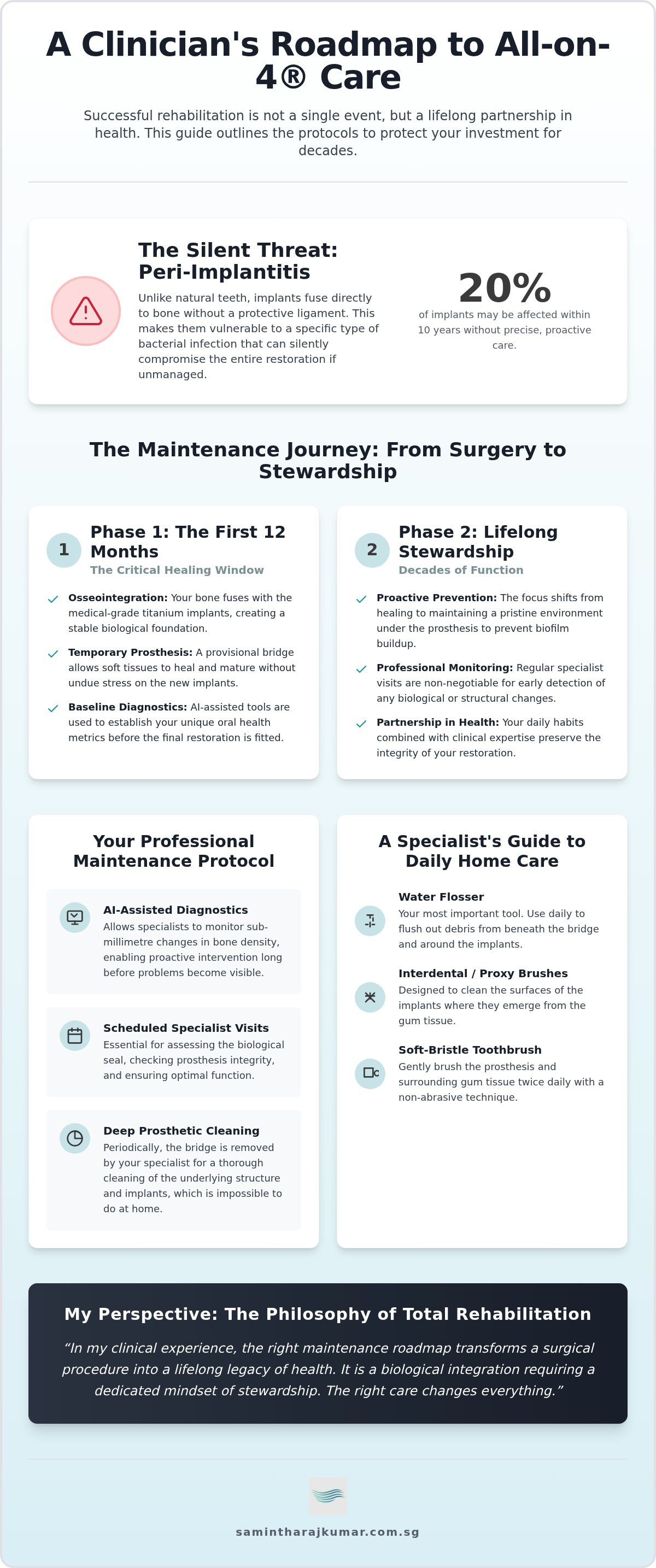
A Specialist’s Guide to Daily Home Care
In my clinical experience, the most successful patients are those who treat their daily hygiene as a ritual of preservation. While your new teeth cannot develop cavities, the biological interface between the bridge and your gums remains a living, breathing environment that requires stewardship. Effective long term care for all on 4 implants requires a routine that reaches the areas a standard toothbrush simply cannot touch. I recommend a systematic approach that focuses on the sub-prosthetic environment, ensuring no biofilm is allowed to mature against the titanium or ceramic surfaces.
The water flosser is non-negotiable. I consider it the cornerstone of home maintenance for full-arch rehabilitations. By using a pulsating stream of water at a 90-degree angle to the gum line, you can flush out microscopic debris from the "bridge-to-gum" interface where traditional floss often struggles to navigate. When choosing your chemistry, avoid abrasive whitening toothpastes. These contain particles that can create micro-scratches on your bridge, providing a foothold for bacteria and dulling the aesthetic finish. Use a non-abrasive gel to keep the surface polished and biocompatible.
The All-on-4 Cleaning Toolkit
You need a specialised arsenal to maintain this level of excellence. Interproximal brushes are excellent for mechanical cleaning, provided you select the correct size. If the wire is too thick, you risk scratching the titanium abutments, which can lead to increased bacterial adhesion. Superfloss is another vital tool; its stiffened end allows you to thread the material through the prosthetic junctions with ease. I also suggest incorporating an alcohol-free antimicrobial mouthwash to help control the local microbiome without drying out your oral tissues. Consult with a specialist to tailor your hygiene protocol to your specific prosthetic design.
Lifestyle Optimisation for Longevity
Your habits outside the bathroom are just as impactful as your technique within it. Smoking is a significant risk factor as it constricts peripheral blood flow, hindering the body's ability to fight infection around the implants. Dietary considerations also play a role. While your restoration is remarkably strong, managing exceptionally hard foods prevents prosthetic chipping and mechanical stress. If you have a history of bruxism, a custom night guard is essential. It acts as a sacrificial barrier, protecting your investment from nocturnal grinding forces. Establishing these habits is a fundamental part of long term care for all on 4 implants, ensuring your restoration remains a masterpiece of both form and function for decades to come.
My Perspective: The Philosophy of Total Rehabilitation
In my clinical experience, a successful implant is one the patient eventually forgets they have. It should feel like a natural extension of the self, both biologically and psychologically. As a clinician and founder, I prioritise biological compatibility and structural integrity in every design. This isn't just about aesthetics; it's about how the materials interact with your living tissue over decades. When we achieve that harmony, the transformative power of a secure smile extends far beyond the mouth, impacting systemic health through improved nutrition and boosting psychological well-being through restored confidence.
My vision for the future of implantology is fundamentally proactive and data-driven. We are moving away from the traditional model of "fix it when it breaks" toward a regime of continuous, technology-led stewardship. By using AI-assisted diagnostics, we can predict maintenance needs before they become clinical issues. This patient-centred approach ensures that long term care for all on 4 implants is not a burden of worry, but a streamlined part of a healthy lifestyle. I want my patients to feel the security of global standards, knowing their health is monitored by a system built for longevity.
The Right Diagnosis Changes Everything
I insist on comprehensive baseline records for every patient. This data acts as a biological "black box" that we can refer to throughout your life. It's a legacy-minded approach to healthcare delivery. We aren't just looking at the next twelve months; we are planning for twenty or thirty years of functional excellence. The journey of oral health is lifelong, and having a precise starting point is what allows us to navigate future changes with absolute certainty. From a biological perspective, the right diagnosis changes everything.
Taking the Next Step
The best outcomes begin with understanding the root cause of any concern, whether it's a minor mechanical shift or a biological change. Through our national network at Nuffield Dental, we support patients through every phase of long term care for all on 4 implants, from the initial surgery to the decades of stewardship that follow. If you are ready to discuss your long term health goals, I invite you to explore a partnership focused on total rehabilitation. Your journey toward a permanent, functional masterpiece is one we take together, prioritising your comfort and peace of mind at every milestone. The best outcomes begin with understanding the root cause.
Securing Your Functional Masterpiece for the Decades Ahead
In my clinical experience, the most profound transformations are those that endure. We have explored how the success of your restoration depends on a transition from patient to steward. By combining meticulous daily habits with specialist-led oversight, you protect the biological foundation of your smile. As a clinician and founder, I remain committed to using advanced AI-assisted diagnostics to catch sub-millimetre changes before they compromise your health. This technology-led approach isn't just a luxury; it's what defines our standard of excellence.
Providing long term care for all on 4 implants is a lifelong journey that requires the right tools and the right partner. As a specialist in Zygomatic and All-on-4 protocols, I believe every patient deserves a legacy of functional excellence. Whether you are just beginning your journey or looking to refine your maintenance routine, remember that precision today prevents complications tomorrow. The best outcomes begin with understanding the root cause. Explore our approach to total rehabilitation.
Frequently Asked Questions
How often do I need to see a specialist for my All-on-4 implants?
I recommend seeing a specialist every 6 to 12 months for a comprehensive review. In my clinical experience, these visits allow us to perform the "Deep Clean" protocol where we remove the prosthesis to inspect the abutments and soft tissue. We also use AI-assisted diagnostics to monitor subtle bone density changes that a standard hygiene appointment might overlook, ensuring your foundation remains secure.
Can I use an electric toothbrush on my All-on-4 bridge?
Yes, you can use an electric toothbrush, but you should select a soft-bristled head and a non-abrasive gel. The mechanical vibration is excellent for disrupting biofilm without the need for aggressive scrubbing. However, a toothbrush alone cannot reach the critical junction between the bridge and the gums. It must be paired with a water flosser to maintain a truly pristine environment.
What happens if a screw or component of my All-on-4 bridge breaks?
If a component breaks, you should contact your specialist immediately to prevent mechanical stress on the remaining implants. In my practice, we view prosthetic screws as sacrificial shock absorbers; they are designed to fail before the implant or bone does. We can typically replace these components during a short clinical visit, restoring the structural integrity of your smile without compromising the underlying implants.
Is it normal for food to get stuck under my All-on-4 implants?
While the bridge is designed to sit flush against the tissue, microscopic food particles can still migrate into the sub-prosthetic space. This is why a water flosser is a non-negotiable tool for long term care for all on 4 implants. Regular flushing prevents these particles from fermenting and triggering the inflammatory response that leads to peri-implantitis, keeping the biological seal healthy and intact.
Will I ever need to replace the entire All-on-4 bridge?
Most patients will eventually require a prosthetic refurbishment or replacement, even though the implants themselves are intended to be permanent. Acrylic bridges typically last 10 to 15 years before the teeth show significant wear. Zirconia options offer greater durability, but we still monitor them for structural integrity during your annual reviews to ensure your bite remains perfectly balanced and the material remains functional.
How do I know if my implants are failing or if it is just a minor gum irritation?
Persistent bleeding, redness, or a "puffy" appearance around the bridge are clinical signals that require a professional diagnosis. From a biological perspective, true implant failure involves bone loss, which is often painless and invisible to the naked eye. We use high-definition intraoral scanning to distinguish between superficial mucositis and the early stages of peri-implantitis, allowing for immediate, proactive intervention.
Does smoking always lead to All-on-4 implant failure?
Smoking doesn't guarantee failure, but it significantly increases the risk by constricting peripheral blood flow to the gums and bone. This delayed healing response makes it harder for the body to fight off the bacteria that cause peri-implantitis. If you do smoke, your long term care for all on 4 implants will require much more frequent professional monitoring and a more rigorous home hygiene protocol to mitigate these risks.
What is the cost of professional All-on-4 maintenance over time?
The long-term cost of maintenance is an investment in the longevity of your restoration, covering specialist reviews, AI diagnostics, and periodic component replacements. While specific fees vary, patients should factor in the cost of annual "Deep Clean" sessions and the eventual refurbishment of the prosthetic bridge. Proactive care is always more cost-effective than managing a late-stage implant failure, which may require complex surgical intervention.


Comments