
Medisave Claimable Dental Procedures and Who Can Claim

MediSave generally applies to eligible surgical dental procedures. In Singapore, citizens and permanent residents may claim for qualifying treatment. The MediSave claimable dental procedures list includes procedures such as wisdom tooth and dental implant surgery, with eligibility and claim limits determined by the procedure’s surgical classification.
It is reasonable to ask whether your treatment qualifies or whether a family member can help fund it. The key question is whether the treatment involves an eligible surgical procedure. Routine dental care, such as scaling and polishing, is not covered in the same way.
This guide explains who can use MediSave for dental treatment, which procedures may qualify, how family members’ accounts can be used and what to expect when making a claim. It also explains why a procedure’s classification matters, so you can plan treatment with a clearer understanding of the available support.
Table of Contents
Who Is Eligible To Use Medisave for Dental Services?
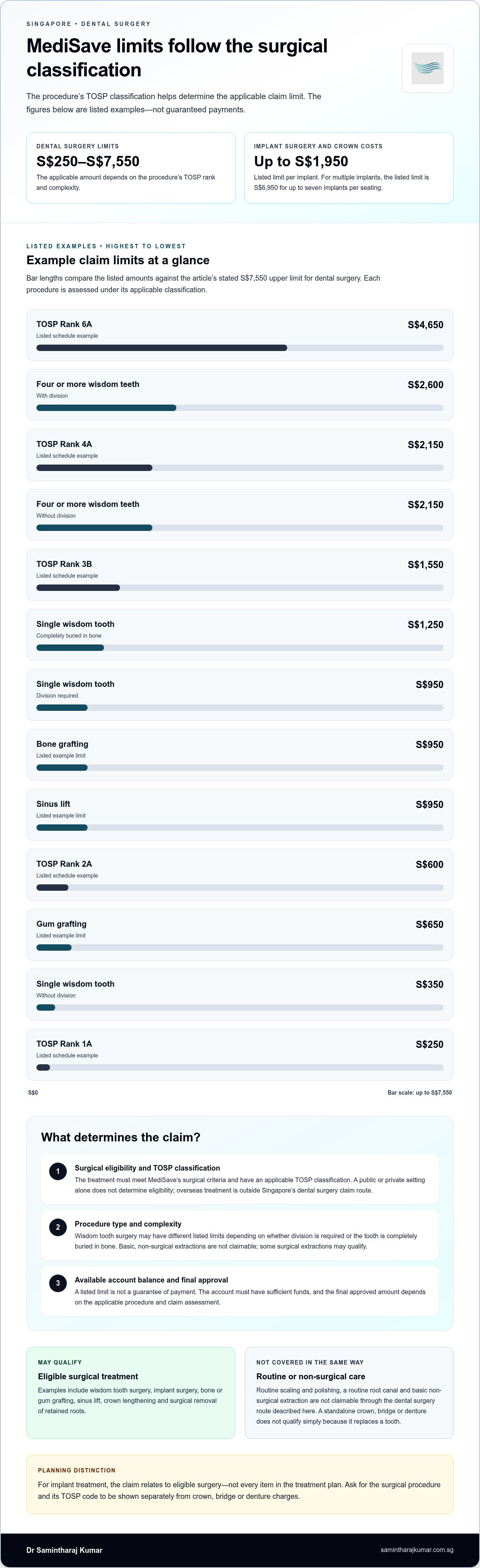
In Singapore, only citizens and permanent residents can claim from Medisave. Current MediSave limits for dental surgery range from S$250 to S$7,550, depending on the procedure’s Table of Surgical Procedures (TOSP) ranking. Dental implant surgery and implant crown costs can be covered up to S$1,950 per implant.
The key distinction is whether the treatment is surgical and has an eligible TOSP code. Dental implant surgery may qualify, while a crown, bridge or denture fitted as routine restorative treatment does not become claimable simply because it replaces a tooth.
For a concise explanation of MediSave rules, surgical limits and dependant accounts, watch this overview:
For implants, the claim relates to the eligible surgery, not a blanket subsidy for every item in a treatment plan. The surgical code and complexity determine the applicable limit. For multiple dental implants, the listed limit is S$6,950 for up to seven implants per seating. The treatment plan should distinguish the implant surgery from separate restorative work.
The TOSP schedule assigns claim amounts according to surgical procedure rank. Listed examples include:
Rank 1A: S$250
Rank 2A: S$600
Rank 3B: S$1,550
Rank 4A: S$2,150
Rank 6A: S$4,650
These are scheduled amounts, not a guarantee that every patient will receive the same withdrawal. The procedure’s code and complexity affect the claim amount, and final approval applies. The account must also have sufficient funds when the claim is made. The eligible amount goes towards the surgical bill; it does not make every dental treatment received during the same visit claimable.
This distinction is especially relevant when an implant plan includes a crown. Implant surgery and implant crown costs can fall within the stated limit of up to S$1,950 per implant. A standalone crown, bridge or denture, however, is among the routine dental treatments not covered by Medisave. The treatment’s purpose alone does not determine eligibility; its surgical classification does.
Separating surgical and restorative stages can make payment discussions clearer. Ask for the treatment plan to identify the surgical procedure and its TOSP code, alongside any crown, bridge or denture charges. This breakdown helps you see which costs may be claimed and which remain separate dental expenses.
Singapore Medisave eligibility for dental surgery
For a Singapore claim, eligibility depends on whether the dental procedure is surgical and how it is classified under the Table of Surgical Procedures (TOSP). A public or private setting alone does not determine eligibility. Overseas treatment falls outside Singapore’s dental surgery claim route.
Dental Surgery Eligibility and Claimable Procedures
To qualify, dental surgery must meet MediSave’s surgical criteria and have an applicable TOSP classification. This matters because some dental treatments qualify while routine care does not, even when both address the same tooth or gum concern.
Procedures that may qualify include wisdom tooth surgery, dental implant surgery, bone grafting, gum grafting or surgery, surgical removal of retained roots, sinus lift and crown lengthening. Basic, non-surgical tooth extractions are not claimable, while some surgical extractions may be. The procedure’s surgical nature and classification are central to the distinction.
Limits vary with the procedure and its complexity. For a single wisdom tooth, the listed limit is S$350 without tooth division, S$950 when division is required, and S$1,250 when the tooth is completely buried in bone. For four or more teeth, the listed limits include S$2,150 without division and S$2,600 with division.
Other examples include a listed S$650 limit for gum grafting, S$950 for bone grafting and S$950 for a sinus lift. These figures describe claim limits, not guaranteed payment of the full treatment expense. The applicable TOSP classification determines the relevant amount.
Submitting a Dental Surgery Claim
A dental surgery claim applies MediSave to an eligible procedure, subject to its classification, the available account balance and final approval. Understanding these factors before treatment helps you separate the surgical expense from other items on the bill.
Start by asking for the proposed surgery and its TOSP classification to be identified in the treatment plan. Then clarify the applicable MediSave limit, the amount payable from the account and any remaining balance. This gives you a clearer picture of payment before proceeding, without assuming that every charge in the plan is claimable.
If the account balance is lower than the bill, it cannot cover the full amount. A claim limit does not increase the funds available in the account.
A clear breakdown makes the process easier to understand: identify the surgical procedure, its code and applicable limit, then separate claimable surgery from related dental expenses. This is especially useful when gum surgery or a surgical extraction is only one part of a broader treatment plan.
Can I use Medisave for my root canal treatment?
In Singapore, a routine root canal is generally not claimable through MediSave. The exception is peri-radicular, or root, surgery; a separate Flexi-MediSave provision also applies to eligible residents aged 60 and above.
Root Canal and Non-Surgical Extraction Eligibility
A non-surgical root canal treats the inside of a tooth but does not qualify as surgical treatment. It is not MediSave-claimable unless peri-radicular surgery is required, so the distinction affects how you plan payment.
Basic, non-surgical tooth extractions are also not claimable. A surgical extraction may qualify under the applicable surgical classification, but removing a tooth without surgery does not become eligible simply because it is clinically necessary.
For example, a routine root canal followed by a filling remains non-surgical treatment. If treatment includes surgery around the root tip, that surgical component is assessed differently from the root canal itself. The procedure’s nature and classification matter, not the tooth’s location or the fact that treatment aims to preserve it.
There is a separate provision for older residents. From mid-2026, Singapore residents aged 60 and above can claim up to S$400 a year through Flexi-MediSave for non-surgical treatments such as root canals and crowns. This annual allowance is distinct from a claim for eligible dental surgery.
This distinction can affect the overall payment plan. A patient below the qualifying age cannot use the Flexi-MediSave provision for a routine root canal. For an eligible older resident, the annual limit applies to non-surgical treatment, so it should not be confused with a procedure-specific surgical limit.
Root Canals, Extractions, and Permanent Crowns
A permanent crown restores a treated tooth; it does not make a routine root canal claimable. This matters because a treatment plan may include separate steps, each with a different MediSave basis.
For example, a plan may include a root canal, a permanent crown and, in another case, surgical removal of a tooth. The routine root canal and crown are non-surgical care, while an eligible surgical extraction is assessed as surgery. For residents aged 60 and above, crowns are among the non-surgical treatments covered by the Flexi-MediSave allowance, up to S$400 a year from mid-2026.
When reviewing an estimate, ask for the root canal, crown and any surgical procedure to appear as separate items. This makes it easier to identify which treatment is non-surgical, whether root surgery is involved and how the relevant MediSave provision applies.
Separating these items can support clearer decisions about preserving a tooth or extracting it. A spouse’s account or another family member’s funds do not change whether a root canal meets the surgical criteria. The procedure itself remains the deciding factor.
Can I use a family member’s Medisave for dental treatment?
Yes. In Singapore, an eligible patient may use an immediate family member’s MediSave if their own account balance is insufficient. The dental procedure must still qualify for a claim. Family access does not make routine treatment claimable.
For eligible dental implant placement, the listed claim limit is up to S$950 per tooth. The procedure’s eligibility remains separate from whose MediSave account is used. A relative’s available balance can help fund an eligible claim, but it does not change the surgical classification or applicable limit.
The immediate family relationships named for this arrangement are spouse, parent or child. Singapore MediSave can also be used for approved dependants, including grandparents and siblings. For grandparents and siblings, the patient must be a Singapore citizen or permanent resident.
First establish whether the dental procedure is eligible. Then identify the relationship between the patient and account holder, and whether the patient’s own balance is insufficient. These are separate parts of the assessment: qualifying treatment determines whether a claim can be made, while the family relationship determines whose account may be used.
A spouse’s account may be used for eligible treatment when the patient’s own balance is insufficient.
A parent or child may provide access to their account under the same immediate-family arrangement.
Grandparents and siblings are included among approved dependants, subject to the citizenship or permanent-residency condition.
What dental procedures are excluded from MediSave claims? Routine procedures such as simple tooth extraction, scaling and polishing, braces or aligners, dentures, crowns and bridges, and non-surgical root canal treatment are not covered. Some surgical extractions may qualify, but a basic, non-surgical extraction does not.
This distinction matters when a treatment plan includes several items. For example, eligible implant surgery and a separate crown should not be treated as one automatically claimable expense. A family member’s MediSave also does not make a denture or routine crown eligible for surgical coverage.
For a family-account claim, make the patient, account holder and treatment relationship clear as part of the claim arrangement. Keep the procedure details separate from other dental expenses, so the claim reflects the eligible treatment rather than the entire plan by default.
Discussing the account relationship alongside the treatment plan helps clarify payment before care begins. The patient’s eligibility, the procedure’s surgical status and the relative’s relationship all matter. Keeping these factors distinct helps families make informed decisions without confusing shared account access with broader dental coverage.
How to submit a Medisave dental claim
A well-prepared claim starts with a clear record of the treatment provided. Keep the proposed plan and final dental bill together, so you can compare the treatment described before care with the charges afterwards.
Use the MediSave claimable dental procedures list as a reference when preparing these details:
Keep a copy of the treatment plan showing the procedure being considered.
Compare the planned treatment with the itemised dental bill after care.
Keep surgery and other dental work identifiable as separate items.
Note any changes made to the treatment plan before the procedure.
Retain the claim-related records alongside the bill for your own reference.
This comparison is useful if a treatment plan changes. The final care may differ from the original proposal if the procedure is revised. Keep both versions so the reason for any difference is clear when you review the bill and related paperwork.
An itemised bill makes it easier to see how the total is made up. Rather than looking only at the final amount, read each description and match it to the treatment plan. If the bill combines several parts of care, note which entries relate to surgery and which describe separate dental work.
Keep the records together, as paper copies or saved files. A simple folder can include the treatment plan, final bill and any claim-related documents provided during the process. These records give you a consistent reference when reviewing your payment arrangements later.
If another person’s account is involved, keep the account holder’s details separate from the treatment records. This helps distinguish information about the patient, the person whose account is used and the dental care received. The earlier discussion of family eligibility explains who may be involved; the practical aim here is to keep the paperwork organised.
In my clinical experience, patients benefit from reviewing the final bill against the care they actually received, rather than relying on an earlier estimate alone. Clear descriptions make that review more straightforward. The Medisave claimable dental procedures list can help frame questions about procedure names, while the documents provide the specific record of the treatment and charges in your case.
Keep the plan, final bill and claim-related records together, with treatment descriptions that are easy to follow. An organised record helps you understand how the claim relates to your dental care.
Dr Samintharaj Kumar: Ceramic Dental Implants
Ceramic Dental Implants are one option I discuss with patients considering tooth replacement. The appropriate approach depends on the clinical picture, including oral health, bone support and the restoration required.
MediSave eligibility and treatment suitability are separate questions. A procedure’s claim status depends on its surgical classification, while choosing an implant approach requires careful assessment of individual needs. I also provide Dental Implants, All on 4/ Teeth in A Day and Zygomatic Dental Implants for patients whose treatment plans call for these options.
Understanding the diagnosis and treatment plan helps patients make clearer decisions about function, restoration and payment. To discuss your dental treatment, contact me or visit samintharajkumar.com.sg.
Make your next decision with clarity
Financial considerations are one part of choosing dental care. Consider the clinical purpose of treatment alongside your priorities for oral health, function and long-term wellbeing. MediSave can inform how care is funded, but it should not be the sole basis for deciding which treatment is right for you.
Use the MediSave claimable dental procedures list as a starting point for thoughtful planning. Before deciding, consider the outcome that matters most to you and how the proposed treatment supports it. Financial questions are easier to weigh when considered alongside your needs and treatment goals.
Take time to reflect on your goals and the questions that matter to you. A considered decision can support confidence today and a healthier foundation for the years ahead.
Frequently Asked Questions
Who Can Claim From Their Medisave?
Singapore citizens and permanent residents may use MediSave for eligible dental care. For practical planning, distinguish the person receiving treatment from the account holder funding it. For example, a child may be the patient while a parent is the account holder. Keeping these roles clear helps the clinic discuss whose treatment and account details apply to the claim.
Can I use Medisave for tooth extraction?
Some tooth extractions may qualify, depending on the surgical procedure involved. The distinction is between removing an accessible tooth through a basic extraction and surgery involving a more complex removal, such as a retained root. If your plan describes an extraction, focus on the procedure name and whether surgery is involved, rather than assuming all extractions are treated alike.
Did you know Medisave can be used for certain dental surgeries?
Yes, MediSave can be used for eligible dental surgery, including certain procedures carried out as day surgery. “Dental surgery” covers different procedures, so the term alone does not show which claim limit applies. The specific operation matters. Its clinical description is useful when discussing the claim and expected payment arrangements.
Which dental procedures are claimable under Singapore MediSave?
Examples include wisdom tooth surgery, implant surgery, bone grafting, gum surgery, sinus lifts, crown lengthening and surgical removal of retained roots. Treat these as examples of procedures that may qualify, not as automatic approval of every treatment plan. A plan can combine different procedures, so understanding each stage helps you interpret the claim discussion.
Are wisdom tooth extraction and impacted tooth surgery MediSave claimable?
Wisdom tooth surgery may qualify, including surgery for a tooth impacted in bone. The tooth’s position and whether it needs to be divided can affect the procedure classification. If an assessment describes an impacted tooth, ask how the planned operation is recorded. This helps distinguish the surgical approach from a straightforward extraction and provides context for the claim assessment.
Can MediSave be used for dental implants or bone grafting?
MediSave may be used for eligible implant surgery and bone grafting. When planning, distinguish the surgical stage from the later restoration that completes the tooth replacement. If both appear in a treatment plan, consider them as separate components when reviewing payment. A claim for surgery does not automatically apply to every part of implant treatment.
How is the MediSave claim limit calculated for dental procedures?
The relevant amount depends on the surgical procedure’s classification and complexity. An everyday procedure name may not describe the operative details that affect classification. Wisdom tooth surgery, for example, can involve different surgical approaches. The treatment description helps explain why procedures in the same broad category may have different claim limits.
What documents are needed to make a MediSave dental claim?
Keep the treatment plan and final itemised bill, and note any changes between them. These records help you compare what was proposed with what was performed. If the procedure description differs from the original plan, the updated wording can clarify the change. The clinic can explain which claim information applies to the procedure being carried out.


Comments