
Non-Surgical Treatment for Jaw Clicking: A Specialist’s Guide to Rehabilitation
- Dr Samintharaj Kumar

- Jun 18
- 12 min read
Updated: Jul 2
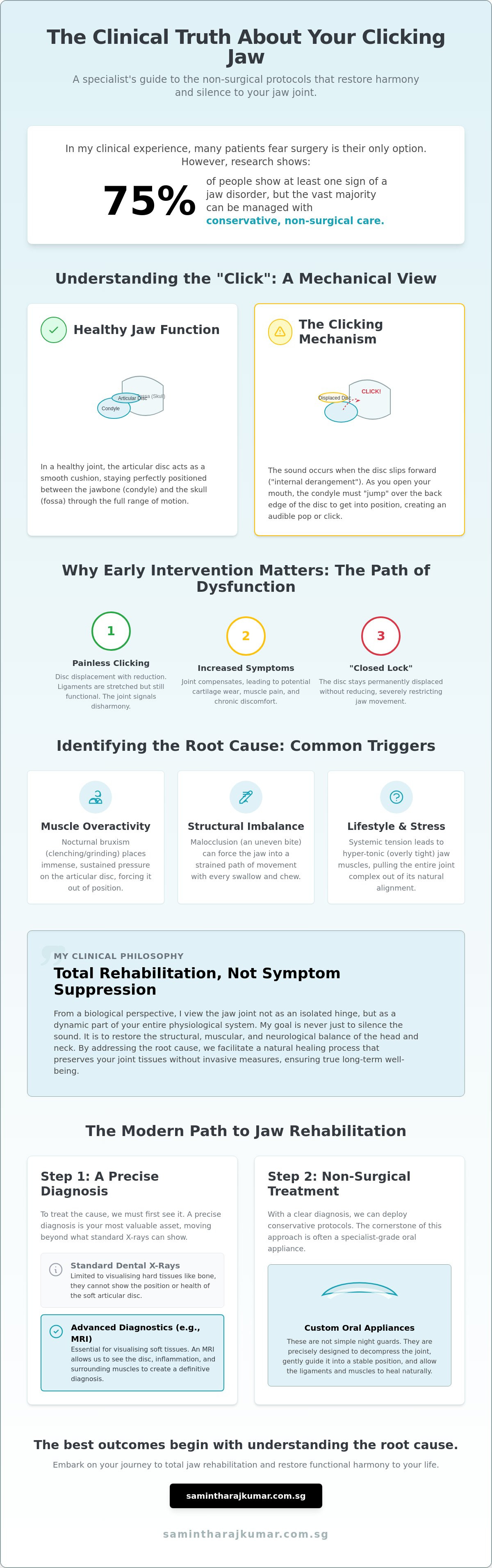
A loud, persistent click in your jaw is not a signal that you're destined for the operating table. In my clinical experience, many patients arrive at my practice with the heavy assumption that surgery is their only path to relief, yet 2026 research indicates that while up to 75% of the population shows at least one sign of a jaw disorder, the vast majority can be managed through conservative care. Fortunately, modern clinical protocols mean that non-surgical treatment for jaw clicking is not only possible but often the most effective route toward long-term functional harmony and joint health.
I understand how socially embarrassing that audible pop can be during a quiet dinner, and I recognise the deep-seated anxiety that comes with chronic joint discomfort. You deserve to eat and speak without the constant reminder of a mechanical misalignment. This guide will show you how we can restore silence and fluidity to your jaw movement using advanced, non-invasive methods. We'll explore the biological reasons behind the clicking, why a precise diagnosis is your most valuable asset, and the structured non-surgical protocols I use to return my patients to a life of lasting comfort.
Table of Contents
Understanding the Mechanism of Jaw Clicking and TMJ Dysfunction
Many people dismiss a clicking jaw as a harmless quirk of their anatomy. However, as a clinician, I view this sound as a clear clinical sign of Temporomandibular joint dysfunction (TMD). Specifically, it often indicates "internal derangement," a term we use to describe a mechanical error within the joint itself. This is not merely a noise; it's a symptom that the delicate structures of your jaw are no longer moving in functional harmony.
To better understand this concept and how it relates to your symptoms, watch this helpful video:
The temporomandibular joint is one of the most sophisticated systems in the human body. Between the condyle, which is the rounded end of your jawbone, and the temporal bone of your skull sits a fibrocartilaginous cushion called the articular disc. This disc acts as a shock absorber. When the disc is displaced, usually forward, the condyle must "jump" over the edge of the disc to allow the mouth to open. This sudden movement creates the audible pop or click you experience. Seeking non-surgical treatment for jaw clicking early is essential because even painless clicking can progress. If the disc stays displaced without "reducing" back into place, the joint can become stuck, leading to a "closed lock" where your range of motion is severely restricted.
The Anatomy of a Functional Click
In a healthy jaw, the disc stays tethered to the condyle throughout its entire range of motion. When the disc slips out of place but snaps back during opening, we call this "disc displacement with reduction." It's a sign that the ligaments are stretched but still functional. In my clinical experience, a click is the joints way of signalling a mechanical disharmony that warrants a biological investigation. If we ignore this signal, the joint compensates in ways that eventually lead to cartilage wear and chronic pain.
Common Triggers: From Bruxism to Structural Imbalance
Effective rehabilitation requires us to look beyond the joint and identify the environmental and biological triggers. Often, the primary driver is muscle overactivity. I frequently see patients who suffer from morning headaches from jaw clenching, a clear indicator that nocturnal bruxism is placing immense pressure on the articular disc. Structural issues like malocclusion, or an uneven bite, can also force the jaw into a strained position every time you swallow. When you combine these physical stressors with modern lifestyle tension, the muscles that control the jaw become hyper-tonic, pulling the joint out of its natural path and making non-surgical treatment for jaw clicking a necessary intervention for long-term health.
My Perspective: The Philosophy of Non-Surgical Jaw Rehabilitation
As a clinician and founder, I've spent years refining my approach to complex oral health, moving beyond traditional mechanical fixes. My philosophy is rooted in Biological Dentistry. This means I view the temporomandibular joint not as an isolated hinge, but as a dynamic component of your entire physiological system. When a patient seeks non-surgical treatment for jaw clicking, my goal is never just to silence the sound. It's to achieve "Total Rehabilitation." This involves restoring the structural, muscular, and neurological balance of the head and neck to ensure long-term well-being.
Why Surgery is Not Always the First Answer
Why is surgery considered the final tier of intervention in my practice? The temporomandibular joint is a delicate, nerve-rich area where over-intervention carries unnecessary risks. In my clinical experience, the success rates for conservative management are exceptionally high. This perspective is supported by the National Institute of Dental and Craniofacial Research, which advocates for reversible, non-surgical treatments as the standard of care for TMD. At Nuffield Dental, we follow a "ladder of care." We start with the most conservative, biological interventions, only moving to more complex procedures if strictly necessary. This patient-centered approach prioritises your safety and comfort above all else.
The Visionary Approach to Joint Health
The right diagnosis changes everything. Modern innovation in diagnostics, particularly high-resolution imaging and AI-assisted analysis, has significantly reduced the need for open-joint surgery. We can now visualise the soft tissue disc and joint space with incredible clarity. This precision is what makes non-surgical treatment for jaw clicking so successful in my practice. I also believe that patient education is a vital part of the healing journey. When you understand how your jaw functions, you become an active participant in your recovery. Achieving lasting relief requires looking at the whole person. If you're ready to explore a biological path to recovery, understanding our approach to TMJ Pain Management is the first step toward functional harmony.
Comparing Non-Surgical Treatment Modalities for Jaw Popping
In my clinical experience, a successful outcome is rarely the result of a single intervention. Effectively delivering non-surgical treatment for jaw clicking requires a multi-layered framework that addresses structural, muscular, and functional imbalances. I often describe this as a synergy of care. We aren't just choosing one "menu item" from a list; we're orchestrating a sequence of therapies that work together to stabilise the joint. This comprehensive approach is echoed by the Mayo Clinic on TMJ treatment, which highlights how combining modalities like physical therapy and specialised appliances often yields the best results.
From a biological perspective, we must distinguish between the structural component (the joint and disc) and the motor component (the muscles). While some patients may only require one form of therapy, most benefit from a combination that resets the muscles while physically protecting the joint from further wear. Restorative dentistry also plays a vital role here. By refining the bite, we can provide the permanent stability necessary to prevent the recurrence of clicking once the initial inflammation has subsided.
Occlusal Splint Therapy vs. Over-the-Counter Guards
One of the most common misconceptions I encounter is the belief that all mouthguards are created equal. They aren't. Store-bought, soft guards are often counterproductive; their "chewy" texture can actually stimulate the brain to clench more, increasing the load on the joint. In contrast, a custom-engineered occlusal splint is a precision medical device. It's designed to offload the temporomandibular joint by repositioning the jaw into its most harmonious relationship. This structural support is essential for allowing the ligaments to heal. For those currently navigating discomfort, I recommend reviewing my guide on at-home care for tmj pain to complement your clinical treatment.
Therapeutic Botox: Beyond Aesthetics
While many associate Botulinum Toxin with aesthetics, its role in non-surgical treatment for jaw clicking is profoundly functional. When the masseter and temporal muscles are hyper-active, they exert a constant, destructive force on the joint. Therapeutic Botox acts as a "reset" button. By strategically relaxing these muscles, we lower the intra-articular pressure, often providing a window of relief that allows other therapies to be more effective. It's important to remember that Botox treats the muscular component, while splints address the structural positioning. Together, they offer a powerful dual-action solution.
Functional Physiotherapy and Rehabilitation
As a clinician and founder, I believe that retraining the body is just as important as any clinical procedure. Functional physiotherapy focuses on "jaw posture" and tongue positioning. The tongue should naturally rest on the roof of the mouth, which helps maintain a neutral jaw position. Specific exercises can strengthen the muscles that support the disc, preventing it from slipping. If you find yourself in an acute phase of discomfort, my checklist for managing tmj flare-ups provides immediate strategies to soothe the system while we work on long-term rehabilitation. The right diagnosis changes everything, and these modalities are the tools we use to build a future of silent, pain-free function.
The Role of Advanced Diagnostics in Determining the Treatment Path
In my clinical experience, the most successful rehabilitations are those where we spend more time on the "why" than the "how". Standard dental X-rays are often the first step in a patient's journey, but for those seeking non-surgical treatment for jaw clicking, they are fundamentally limited. A panoramic X-ray provides a clear view of the hard structures, such as the condyle and the temporal bone, yet it remains blind to the soft tissue. Since jaw clicking is almost always a result of a displaced articular disc, relying solely on bone-based imaging is like trying to diagnose a ligament tear with only a photograph of the skin.
To create a predictable path to recovery, I prioritise the use of Magnetic Resonance Imaging (MRI). This allows us to visualise the articular disc in real-time, observing its position both when the mouth is closed and when it is open. This level of detail is non-negotiable. Without it, any non-surgical treatment for jaw clicking is based on clinical conjecture rather than biological fact. Beyond imaging, I utilise digital bite mapping, known as T-Scan technology. Unlike traditional carbon paper, which only shows where teeth touch, T-Scan reveals the timing and force of every tooth contact. This precision allows me to identify microscopic occlusal interferences that may be triggering joint instability.
AI and Digital Precision in TMJ Care
At Nuffield Dental, we have embraced the next frontier of clinical excellence. AI-assisted diagnostics help my team identify subtle changes in joint space and bone density that might be imperceptible to the human eye. This technology ensures that our assessments are objective and repeatable. We also employ digital impressions to create perfectly calibrated splints that fit with micron-level accuracy. As a clinician and founder, I believe the integration of AI-assisted diagnostics is the future of ethical, precise healthcare. It removes the guesswork, ensuring that every intervention we perform is necessary and targeted.
Identifying the Root Cause: Stress vs. Structure
A critical part of the diagnostic process is distinguishing between myofascial pain, which originates in the muscles, and arthralgia, which is true joint pain. Many patients arrive at my practice confused about what kind of doctor treats TMJ, often because their symptoms overlap with other conditions. A comprehensive clinical consultation allows us to rule out systemic inflammatory issues or referred pain from the cervical spine. By isolating whether the click is driven by structural displacement or stress-induced muscle tension, we can tailor the rehabilitation plan to your specific biological needs. If you are ready to move beyond temporary fixes, a specialist assessment at Nuffield Dental is the first step toward a definitive diagnosis.
Embarking on Your Journey to Total Jaw Rehabilitation
The decision to address a persistent jaw click is a significant step toward reclaiming your daily comfort. In my clinical experience, patients often feel a sense of profound relief simply by having their concerns validated through a specialist lens. At Nuffield Dental, I have designed a patient journey that prioritises clarity, precision, and compassionate reassurance. When you seek non-surgical treatment for jaw clicking, you aren't simply receiving a medical device; you're entering a structured programme of functional restoration designed to last a lifetime.
From a biological perspective, rehabilitation is a process of retraining the body. While some interventions, such as therapeutic Botox, can provide relief within a few days, structural changes through occlusal splint therapy typically require several months of consistent care. I take personal accountability for the protocols we implement, ensuring that every adjustment is data-driven and aligned with your unique physiological response. This measured, rhythmic approach to care allows us to monitor your progress closely, replacing the anxiety of the unknown with the security of expert-led management.
What to Expect During Your Initial Consultation
Your journey begins with a comprehensive specialist consultation. During this time, I perform a detailed clinical examination to assess your jaw's range of motion and the specific timing of any joint sounds. We don't just look at the jaw; I review your medical history and lifestyle factors, such as stress levels and sleep quality, to understand the systemic drivers of your condition. This holistic assessment allows me to create a bespoke "Total Rehabilitation" plan. This roadmap outlines the exact sequence of non-surgical treatment for jaw clicking required to restore functional harmony to your head and neck.
The Future of Your Care
As a clinician and founder, I believe that healthcare should be a lifelong partnership. Once we achieve the initial goals of silence and fluid movement, we transition from active treatment to a long-term maintenance phase. This involves periodic reviews to ensure your bite remains stable and your muscles stay relaxed. The impact of restored jaw function extends far beyond the joint itself. My patients often report improved sleep, fewer tension headaches, and a renewed sense of social confidence. We are committed to providing a premium level of care that respects the complexity of your biology while prioritising your long-term well-being. If you are ready to resolve the underlying issues affecting your jaw, remember that the best outcomes begin with understanding the root cause.
Restoring Functional Harmony and Long-Term Joint Health
Achieving a silent, pain-free jaw is a biological journey that begins with a shift in perspective. We've examined how a displaced articular disc creates the audible click and why advanced diagnostics, such as MRI and AI-assisted mapping, are essential for identifying the mechanical root cause. By prioritising conservative, evidence-based protocols, non-surgical treatment for jaw clicking offers a sophisticated alternative to invasive surgery, focusing on systemic balance and the preservation of your natural joint structures.
As a specialist in complex oral and maxillofacial surgery and a pioneer in AI-assisted dental diagnostics, I've dedicated my career to clinical innovation and ethical care. As the founder of Nuffield Dental Holdings, my mission is to ensure every patient experiences a rehabilitation process that's as precise as it is compassionate. The right diagnosis changes everything. Consult with Dr Samintharaj Kumar for a comprehensive jaw assessment. Your path to lasting comfort and functional excellence is well within reach, and I look forward to guiding you toward a future of silent, effortless movement.
Frequently Asked Questions
Is jaw clicking always a sign of a serious TMJ disorder?
Not necessarily, but it always warrants a professional evaluation to prevent future complications. In my clinical experience, while a large portion of the population shows signs of a jaw disorder, many clicks are relatively stable. However, a click is a clear signal that the articular disc is displaced. Without a proper diagnosis, you risk the condition progressing into chronic pain or restricted movement.
Can non-surgical treatments permanently fix a clicking jaw?
Yes, non-surgical treatment for jaw clicking is often highly successful in achieving long-term stability and silence. By addressing the structural and muscular triggers through biological protocols, we can reposition the joint and retrain the muscles. This approach focuses on total rehabilitation rather than just temporary symptom suppression, ensuring the jaw functions smoothly once functional harmony is restored.
How long does it take for a splint to stop jaw clicking?
Most patients begin to notice a significant change in joint sounds and comfort within four to twelve weeks of treatment. However, complete stabilisation of the joint and the surrounding ligaments usually takes several months of consistent wear. It's a gradual process of offloading the joint and allowing the soft tissues to heal and adapt to a more harmonious position.
Will Botox for TMJ change the shape of my face?
Therapeutic Botox can result in a subtle slimming of the lower face if your masseter muscles are enlarged from chronic clenching. While we use it primarily for functional relief, many patients appreciate this secondary aesthetic refinement. The change isn't a result of altered bone structure but rather the relaxation of overactive, bulky muscles that have grown through constant use.
What happens if I choose not to treat my jaw clicking?
Choosing to ignore a clicking jaw can lead to a condition known as "closed lock," where the jaw becomes physically stuck. This occurs when the displaced disc no longer snaps back into place, blocking the condyle from moving freely. Over time, the constant mechanical friction can also lead to degenerative changes in the joint cartilage and chronic, debilitating myofascial pain.
Can physiotherapy alone resolve a displaced jaw disc?
Physiotherapy is a powerful tool for retraining jaw posture, but it's rarely a standalone solution for a structural disc displacement. In my practice, I find that exercises are most effective when combined with occlusal splint therapy. This combination ensures we're treating both the muscular habits and the physical alignment of the joint simultaneously to achieve a lasting result.
Are non-surgical treatments for jaw clicking covered by insurance?
Insurance coverage for non-surgical treatment for jaw clicking often falls into a complex grey area between medical and dental policies. Some providers classify it as a medical joint issue, while others view it as strictly dental. We often utilise medical cross-coding to help patients navigate these claims, as the diagnosis is fundamentally related to the health of a primary joint.
How do I know if I need a surgeon or a general dentist for my jaw pain?
If your symptoms are limited to minor tooth wear, a general dentist may suffice for a basic night guard. However, if you experience audible clicking, persistent pain, or limited movement, you should consult an Oral and Maxillofacial Surgeon. As a specialist, I possess the advanced diagnostic tools and surgical background required to manage the complex biology of the temporomandibular joint effectively.


Comments