
Who is a Candidate for Pinhole Surgery? A Specialist Surgeon’s Guide to Gum Restoration
- Dr Samintharaj Kumar

- Jun 17
- 12 min read
Updated: Jul 2
The traditional scalpel-based approach to gum grafting is no longer the only path to a healthy, stable smile. In my clinical experience, patients frequently ask who is a candidate for pinhole surgery because they're eager to address receding gums without the invasive nature of conventional tissue grafts. I understand that the prospect of surgery can be daunting, especially when you're already dealing with the discomfort of root sensitivity and aesthetic changes. You shouldn't have to choose between a painful recovery and the long-term health of your teeth.
This guide explores the clinical criteria for the Chao Pinhole® Surgical Technique and explains how its recovery profile differs from traditional methods. From a biological perspective, we'll examine the anatomical foundations required for a successful outcome and how this patented, suture-free technique can restore your gum line with minimal downtime. By understanding the science behind this innovation, you'll gain clarity on whether this sophisticated approach is the right fit for your personal dental journey. My perspective as a clinician and founder is that the best outcomes always begin with a deep understanding of the root cause and the most advanced tools available to treat it.
Table of Contents
Understanding the Chao Pinhole® Surgical Technique (PST)
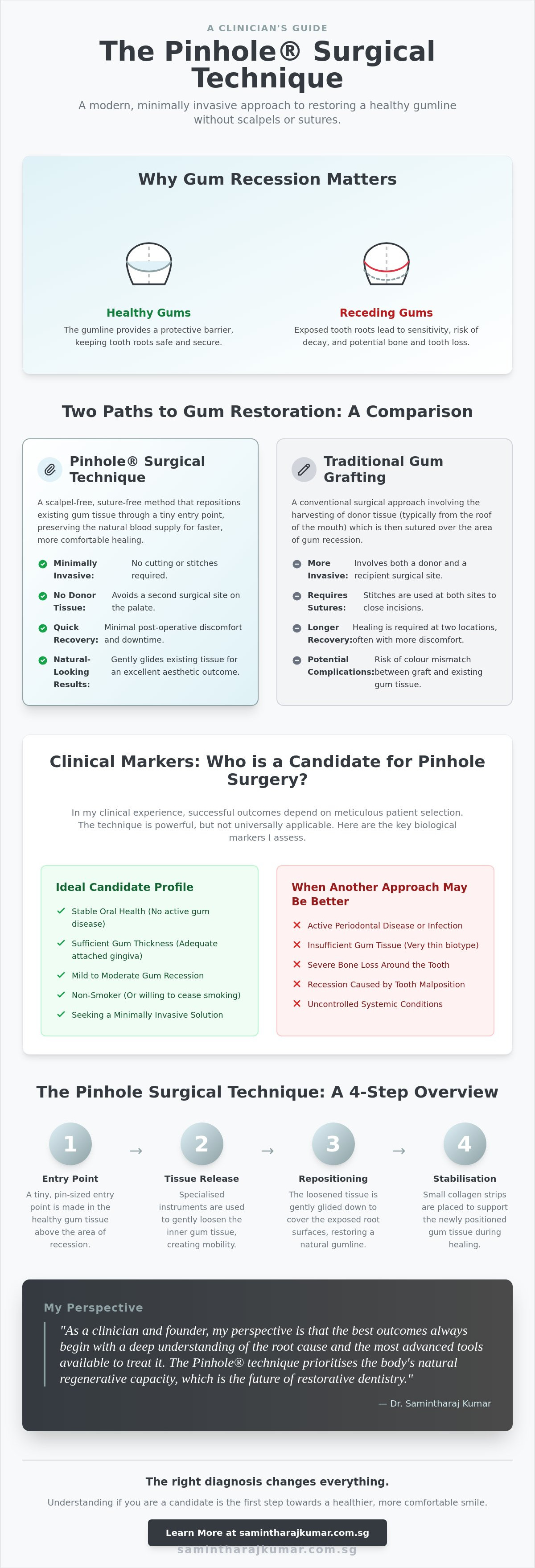
In my clinical experience, the Chao Pinhole® Surgical Technique (PST) represents a fundamental paradigm shift in how we approach gingival restoration. For decades, the gold standard involved harvesting donor tissue from the palate, a process that, while effective, often resulted in significant post-operative discomfort. PST is a scalpel-free and suture-free alternative that allows me to reposition existing gum tissue through a tiny entry point, often no larger than a needle mark. It is a refined method that prioritises patient comfort without compromising on clinical results.
To better understand this concept and see if you might be eligible, watch this helpful video:
The true biological advantage of this technique lies in the preservation of the vascular network. Unlike traditional grafting, which requires large incisions and the creation of tissue flaps, PST keeps the blood supply intact. This is a critical distinction because a healthy blood supply is the engine of healing. By avoiding the trauma of donor site surgery, we significantly reduce the inflammatory response. This is often the primary concern for those asking who is a candidate for pinhole surgery, as they seek a solution that is both effective and gentle on the body's natural systems.
The Problem: Why Gum Recession Matters
Recession isn't merely an aesthetic frustration. It's a functional breakdown of your oral health. When the gums pull away, they leave the cementum of the tooth root vulnerable. Understanding Gum Recession is vital because this exposure leads to sensitivity from exposed tooth roots and an increased risk of root decay. From a biological perspective, your gums are the primary barrier protecting the underlying bone. Once that barrier is compromised, the oral environment becomes unstable, potentially leading to tooth loss if the recession is left unaddressed.
The Science of Tissue Repositioning
The procedure involves using specialised instruments to gently loosen the collagen-rich gum tissue. Once the tissue is sufficiently mobile, I carefully glide it over the exposed areas of the tooth. To ensure long-term stability, I place small collagen strips through the pinhole. These strips act as a temporary internal scaffold, supporting the gums during the initial healing phase while the body naturally produces its own collagen. This methodology aligns perfectly with my philosophy of 'less is more' in surgical intervention. It prioritises the body's natural regenerative capacity over aggressive mechanical reconstruction, making it a sophisticated choice for modern gum restoration.
Clinical Markers: Who is a Candidate for Pinhole Surgery?
As a clinician and founder, I believe that surgical success is rooted in meticulous patient selection rather than just technical execution. Determining who is a candidate for pinhole surgery requires a deep dive into the biological landscape of your oral cavity. The most critical, non-negotiable prerequisite is stable oral health. We cannot successfully reposition tissue in an environment burdened by active periodontal disease. Any underlying infection or inflammation must be fully resolved before we consider PST, as a healthy foundation is essential for the tissue to reattach and thrive in its new position.
Another vital marker I look for is the presence of adequate 'attached gingiva.' For the procedure to be successful, there must be enough existing tissue near the recession site to gently loosen and glide into place. From a biological perspective, if the remaining gum is too thin or sparse, the clinical predictability of the Pinhole Surgical Technique decreases. In my clinical experience, assessing this 'biotype' allows me to tailor the approach to ensure the result is not just aesthetic, but functionally robust for years to come.
I also prioritise a discussion regarding lifestyle habits, particularly smoking. Nicotine is a potent vasoconstrictor that significantly impairs micro-circulation. This reduced blood flow can compromise the delicate healing process required for the gums to stabilise. I typically ask my patients to commit to a temporary cessation period to give their body the best possible chance of a successful restoration. A comprehensive clinical assessment at the outset helps us navigate these factors together.
The Role of Bone Density and Architecture
PST requires a stable underlying bone structure to support the newly positioned tissue. I think of the alveolar bone as the scaffolding for your smile. If the bone height between the teeth has significantly diminished, the tissue lacks the necessary support to maintain its new height. This is why I perform a detailed diagnostic scan before every procedure. We must assess the architecture of the bone to determine the predictability of root coverage. Without this structural integrity, even the most meticulous surgical repositioning will lack long-term biological stability.
Lifestyle and Systemic Health Factors
Managing systemic conditions is equally important for a predictable outcome. Conditions like poorly controlled diabetes can affect micro-circulation and delay the body's natural repair mechanisms. I also look for signs of bruxism, or chronic teeth grinding. The excessive mechanical forces from grinding can jeopardise the delicate positioning of the gums during the initial six-week healing phase. Patient compliance is the final, essential factor. Success depends on your willingness to follow post-operative protocols, such as avoiding brushing the treated area during the early stages of recovery. The best outcomes begin with understanding the root cause and ensuring the patient is fully prepared for the journey ahead.
Recovery Comparison: Pinhole Surgery vs Traditional Grafting
The most significant barrier for many patients seeking gum restoration is the fear of a painful, protracted recovery. In my clinical experience, traditional connective tissue grafting often involves a dual-site surgical approach, requiring a donor site on the palate and a recipient site at the recession area. This effectively doubles the surgical trauma. Conversely, the chao pinhole surgery recovery timeline is remarkably condensed because it eliminates the need for donor tissue harvesting. By avoiding the secondary wound on the roof of the mouth, we remove the primary source of post-operative discomfort.
When I consult with patients regarding who is a candidate for pinhole surgery, I often discuss the subjective pain experience. On a standard scale of one to ten, PST patients typically report a '2', whereas those undergoing traditional grafting often experience a '7' during the first few days. This disparity is due to the absence of sutures and incisions in the pinhole technique. Additionally, PST offers immediate aesthetic gratification. The gum line is repositioned instantly, whereas grafting often involves significant swelling and a period where the surgical site looks quite inflamed before it begins to settle.
The First 24 to 48 Hours
During the initial 48 hours, the differences between the two techniques are most pronounced. With PST, patients experience minimal swelling and no bleeding from the palate, allowing most to return to light activities and social engagements almost immediately. In contrast, traditional grafting requires strict dietary restrictions and carries the risk of minor bleeding from the donor site. Pinhole surgery allows for a 'socially acceptable' appearance within hours of the procedure. This efficiency is a cornerstone of why I advocate for this technique in my practice, as it respects the patient's time and lifestyle.
Long-term Healing and Tissue Integration
From a biological perspective, the healing mechanisms differ fundamentally between the two approaches. In traditional grafting, the body must establish a new blood supply to the donor tissue, a process called vascularisation. With PST, the body integrates the small collagen strips placed during the procedure to stabilise the newly positioned gums. While initial healing is rapid, complete biological maturation of the new gum line typically takes about six months. The chao pinhole surgical technique cost in Singapore reflects this advanced efficiency and the specialised instruments required to achieve such a high standard of care. Ultimately, the goal is long-term stability, which is achieved through a deep respect for the body's natural regenerative cycles.
When Pinhole Surgery May Not Be the Optimal Path
Identifying the boundaries of minimally invasive surgery is, in my view, the hallmark of clinical integrity. While we've discussed the remarkable advantages of PST, it's equally important to understand its limitations. When patients ask who is a candidate for pinhole surgery, they must realise that certain biological constraints can preclude this technique. For instance, severe bone loss presents a significant challenge. Without the underlying 'scaffolding' of healthy alveolar bone, repositioned gum tissue lacks the structural support to remain stable over time. In these scenarios, simply moving the tissue is a temporary cosmetic fix rather than a long-term biological solution.
From a biological perspective, the thickness of your natural gum tissue, or 'biotype', is another critical factor. If the tissue is exceptionally thin, it may not have the resilience required for the PST instrumentation. In such cases, I may recommend traditional grafting first to 'thicken' the foundation before pursuing further restoration. Additionally, active periodontal infection is an absolute contraindication. Performing surgery in an environment of active inflammation is a recipe for clinical failure. We must prioritise the resolution of infection to ensure a predictable and healthy outcome.
Addressing Advanced Recession
In cases of severe, advanced recession where PST may not provide the necessary volume, traditional connective tissue grafts remain the gold standard. However, as an innovator, I often look for ways to enhance these traditional methods. I might combine grafting with biological growth factors to accelerate healing and improve tissue integration. Every patient is unique, and a bespoke treatment plan is far superior to a 'one-size-fits-all' approach. If you're unsure of your status, a specialist consultation is the best way to determine the most stable path forward.
Managing Expectations for Aesthetic Outcomes
It's vital to manage expectations regarding aesthetic results. While PST is transformative, achieving 100% root coverage is not always biologically feasible, especially if there has been significant bone loss between the teeth. I often view PST as just one of the components of a full smile makeover. For some, the goal is functional health and reduced sensitivity rather than purely cosmetic perfection. My philosophy as a clinician and founder is to prioritise the long-term biological stability of your oral environment, ensuring your smile is as healthy as it is beautiful. The right diagnosis changes everything.
My Perspective: Restoring Health through Surgical Innovation
In my clinical experience, the most profound successes in modern dentistry aren't born from technical precision alone. They're rooted in a deep respect for human biology. As a clinician and founder, I've always advocated for a 'less is more' philosophy when it comes to surgical intervention. The Chao Pinhole® Surgical Technique aligns perfectly with this vision. It allows us to achieve comprehensive restoration by working with the body's natural architecture rather than against it. By avoiding the trauma of traditional grafting, we're not just fixing a clinical defect; we're preserving the biological integrity of the oral environment.
The impact of this approach extends far beyond the clinical chair. I've seen how chronic gum recession creates a daily burden of sensitivity and dental anxiety, often causing patients to avoid the very care they need. Restoring the gum line through a minimally invasive method removes these barriers. It offers a path to emotional renewal and functional excellence. From a biological perspective, we're providing long-term stability that allows patients to regain confidence in their smiles. I believe the future of gum restoration lies in this intersection of high-tier technology and empathetic, patient-centered care.
The Founder’s Philosophy on Patient Care
Building an institution at Nuffield Dental has allowed me to prioritise patient comfort alongside clinical mastery. I've made it my mission to invest in international protocols and maintain high-tier affiliations with global medical networks to ensure my patients receive world-class care here in Singapore. We don't just follow standards; we aim to set them. This commitment to excellence ensures that every procedure, from complex implantology to pinhole surgery, is executed with meticulous attention to detail. A healthy smile is a transformative asset, and it deserves a sophisticated, visionary approach to care.
Taking the Next Step in Your Journey
Determining who is a candidate for pinhole surgery requires more than a simple visual check. It necessitates a specialist consultation to map your unique oral architecture with precision. In my practice, we use AI-assisted diagnostics to assess bone density and tissue biotypes, ensuring that our recommendations are based on hard data. This level of accuracy is essential for long-term success. We take personal accountability for your journey, guiding you through every step of the restorative process. The right diagnosis changes everything. Let us help you understand the root cause of your recession and discover the most stable path to health.
Embracing the Future of Gingival Health
Restoring a receding gum line is about more than just aesthetics; it's a commitment to the long-term biological stability of your smile. We've explored how the Chao Pinhole® Surgical Technique offers a sophisticated, minimally invasive alternative to traditional grafting, prioritising your comfort and a rapid return to daily life. Identifying who is a candidate for pinhole surgery is a nuanced process that requires a deep respect for your unique oral architecture and underlying bone health. In my clinical experience, the most successful outcomes are achieved when we combine advanced technology with a personalised, patient-centred philosophy.
As a specialist surgeon with a global clinical presence and the founder of Nuffield Dental Holdings, I've dedicated my career to complex oral rehabilitation and biological dentistry. I believe that every patient deserves access to international standards of care that prioritise both technical excellence and emotional well-being. My goal is to move beyond temporary fixes and provide solutions that stand the test of time. The best outcomes begin with understanding the root cause; consult with Dr Samintharaj Kumar today. Your journey toward a healthy, confident smile is a path we can walk together with clarity and confidence.
Frequently Asked Questions
Is Pinhole Surgery permanent, or will my gums recede again?
The results of the Chao Pinhole® Surgical Technique are intended to be permanent. From a biological perspective, the repositioned tissue reattaches to the tooth root during the healing phase, creating a stable new gum line. However, long-term success depends on addressing the original cause of recession, such as aggressive brushing or untreated bruxism. Maintaining excellent oral hygiene and attending regular specialist reviews will ensure your results remain stable for years to come.
How much does Pinhole Gum Surgery typically cost in Singapore?
Can I have Pinhole Surgery if I have dental implants or crowns?
Yes, Pinhole Surgery is often highly effective for patients with existing dental implants or crowns. In my clinical experience, recession around restorations is a common aesthetic and functional concern. We carefully evaluate the stability of your implants and the margins of your crowns during the diagnostic phase. This ensures the tissue can be successfully repositioned to create a seamless, natural-looking gum line that protects your dental work.
What happens if I am not a candidate for Pinhole Surgery?
If you discover you aren't a suitable match after asking who is a candidate for pinhole surgery, we will explore alternative restorative paths. This might include traditional connective tissue grafting or advanced biological treatments using growth factors to rebuild lost tissue. My goal as a clinician and founder is to find the most predictable solution for your unique case. The right diagnosis changes everything, and we always prioritise long-term stability over a one-size-fits-all approach.
Does Pinhole Surgery hurt during the procedure?
Most patients experience minimal to no pain during the procedure itself. We use local anaesthesia to ensure the treatment area is completely numb and comfortable. Because the technique is scalpel-free and suture-free, the mechanical trauma to your gums is significantly lower than traditional grafting. Many of my patients are surprised by how relaxed they feel throughout the process, often describing it as a much gentler experience than they had originally anticipated.
How soon can I return to work after the Pinhole technique?
Most patients return to their normal professional activities the very next day. While you may experience minor swelling, there are no large incisions or palate wounds to manage, which makes the recovery much faster. I typically advise avoiding strenuous exercise for the first 48 hours to allow the tissue to settle. A 'socially acceptable' appearance is usually achieved immediately after the procedure, allowing you to resume your routine with confidence.
Will my insurance cover the cost of Pinhole Surgical Technique?
Coverage for PST depends entirely on your specific insurance provider and policy details. Some plans categorise gum restoration as a medical necessity when it treats root exposure and prevents decay, while others may view it as an elective procedure. I suggest contacting your insurer to verify if they recognise the Pinhole Surgical Technique under their periodontics coverage. Our team can provide the necessary clinical documentation to assist with your claims process.
What is the success rate of PST compared to traditional gum grafting?
The success rate of PST is highly comparable to traditional methods, with research showing excellent long-term stability. A 33-month study indicated that mean root coverage was achieved in over 90 percent of cases. When determining who is a candidate for pinhole surgery, it's important to remember that success relies on both surgical precision and patient compliance during the initial healing phase. In my practice, I find that the reduced trauma of PST often leads to more predictable healing outcomes.


Comments