
Planning for Full Mouth Dental Restoration in 2026: A Specialist Surgeon’s Perspective
- Dr Samintharaj Kumar

- May 17
- 12 min read
A full mouth restoration is frequently mischaracterised as a mere collection of cosmetic enhancements; however, it is actually a profound act of bio-architectural rehabilitation that determines your functional longevity. I understand that the prospect of such extensive surgery often brings a heavy sense of trepidation. You're likely concerned about the complexity of the timeline or whether the final result will truly feel like a natural part of your identity.
In my clinical experience, successful planning for full mouth dental restoration requires a shift from traditional dental work toward a visionary, biological approach. I've spent my career as a clinician and founder refining how we use AI-assisted diagnostics and high-tier protocols to eliminate guesswork. In this guide, I'll outline the logical roadmap we use at Nuffield Dental to transition from dental instability to a rejuvenated, functional bite. We'll explore how we integrate ceramic implants and precise digital mapping to ensure your outcome is both scientifically sound and aesthetically seamless.
Key Takeaways
Learn why meticulous planning for full mouth dental restoration is the non-negotiable foundation for reversing structural oral collapse and protecting facial aesthetics.
Understand how AI-assisted diagnostics and 3D CBCT imaging provide a precise architectural map to ensure biological integrity and surgical precision.
Discover the biological benefits of metal-free ceramic implants and how zygomatic protocols offer a reliable path forward for patients with severe bone loss.
Gain insight into the strategic timeline of total rehabilitation, including the immediate functional restoration offered by All-on-4 and Teeth in a Day.
Explore the profound long-term impact that a specialist-led, comprehensive restoration journey has on your systemic health and overall quality of life.
Table of Contents
Understanding Total Oral Failure: Why Planning is the Most Critical Stage
The Science of Precision: AI-Assisted Diagnostics and Biological Integrity
Strategic Foundations: From Ceramic Implants to Zygomatic Protocols
My Perspective: Why I Prioritise Long-Term Quality Over Immediate Results
The Restoration Journey: What to Expect and the Impact on Quality of Life
Understanding Total Oral Failure: Why Planning is the Most Critical Stage
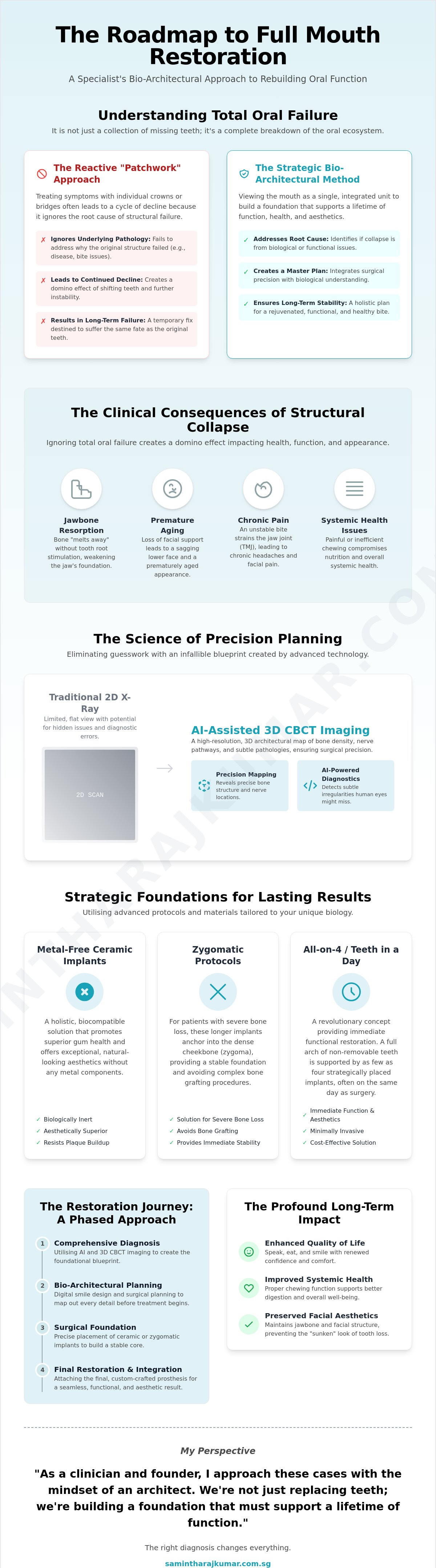
Total oral failure isn't merely a series of missing teeth. In my clinical experience, it represents a complete breakdown of the oral ecosystem where the bone, soft tissue, and mechanical function of the bite no longer work in harmony. When I begin planning for full mouth dental restoration, my primary objective is to move beyond the symptoms and address the underlying pathology. If we don't understand why the original structure failed, any new intervention is likely to suffer the same fate.
Many patients arrive at my practice after years of patchwork dentistry. They've had individual crowns replaced or small bridges fitted, yet their oral health continues to decline. This happens because those treatments were reactive rather than strategic. A comprehensive full mouth reconstruction requires us to look at the mouth as a single, integrated unit. We must determine if the collapse is driven by biological factors like periodontal disease, or functional issues like a misaligned bite that exerts destructive force on the teeth.
To better understand the meticulous nature of this process, watch this helpful video regarding the technical execution of these cases:
The consequences of ignoring this structural collapse extend far beyond the mouth. It affects nutrition because chewing becomes painful or inefficient. It alters speech patterns. Most significantly, it changes the very architecture of the face. Without the support of teeth and healthy jawbone, the lower third of the face can begin to sag, making a person look prematurely aged. This is why I believe total rehabilitation is a medical necessity, not just a cosmetic choice.
The Clinical Consequences of Structural Collapse
When teeth are lost, the jawbone begins a process of resorption. It literally melts away because it's no longer being stimulated by the roots of the teeth. This loss of volume creates a domino effect. The remaining teeth shift, the bite becomes even more unstable, and the temporomandibular joint (TMJ) begins to compensate. This often leads to chronic headaches or facial pain. Planning for full mouth dental restoration must account for this lost volume, often requiring us to look at advanced solutions like zygomatic protocols to find stable anchorage.
Shifting from Dentistry to Bio-Architecture
As a clinician and founder, I approach these cases with the mindset of an architect rather than a general dentist. From a biological perspective, we're building a foundation that must support a lifetime of function. My specialist surgeon perspective ensures that we don't just focus on the final teeth, but on the health of the bone and gums that support them. We create a multi-disciplinary treatment plan that integrates surgical precision with an understanding of how the new structure will interact with your unique facial musculature and systemic health.
The Science of Precision: AI-Assisted Diagnostics and Biological Integrity
In my clinical experience, the most profound advancements in planning for full mouth dental restoration have come from our ability to merge artificial intelligence with surgical expertise. We no longer rely on traditional two-dimensional X-rays. Instead, we utilise 3D CBCT imaging to create a high-resolution map of your bone density and nerve pathways. This data is processed through AI-assisted diagnostic tools that can detect subtle bone irregularities or early-stage pathologies with remarkable accuracy. By removing human error from the initial assessment, we ensure that the process of rebuilding and/or replacing all of the teeth begins with an infallible blueprint.
Digital smile design serves as our aesthetic compass. It allows me to show you the final result before we even begin the physical work. We simulate how your new teeth will support your lips and cheeks, ensuring the result is rejuvenated yet entirely natural. This predictive power is what transforms a complex medical procedure into a journey of personal renewal. It gives you the confidence to move forward, knowing the functional and aesthetic outcomes are already secured.
Digital Mapping and Virtual Surgery
As a clinician and founder, I prioritise a "surgery-first" digital philosophy. This means I perform your entire procedure in a virtual environment before you ever enter the chair. We use this digital plan to 3D print bespoke surgical guides. These guides direct the placement of each implant with absolute precision. This level of accuracy means less trauma to the surrounding tissue, shorter surgery times, and a much more comfortable recovery period for you. It's a standard of care that prioritises your well-being alongside technical excellence.
Material Science: Ceramic vs. Titanium Implants
From a biological perspective, the choice of materials is central to long-term success. While traditional titanium implants are highly reliable, I often recommend ceramic dental implants for patients seeking a metal-free, biocompatible solution. Zirconia implants are non-corrosive and tend to be more "tissue-friendly," encouraging healthy gum attachment and reducing the risk of inflammation. Whether we choose ceramic or titanium depends entirely on your biological profile and aesthetic goals. Every decision is made to ensure your new smile integrates seamlessly with your body's natural systems. True functional excellence begins with comprehensive oral diagnostics tailored to your unique anatomy.
Strategic Foundations: From Ceramic Implants to Zygomatic Protocols
In my clinical experience, the success of planning for full mouth dental restoration hinges entirely on the surgeon’s ability to adapt the protocol to the patient’s unique bone architecture. We don't force a standard solution onto a complex biological landscape. Instead, we select the specific implant system that offers the greatest stability and long-term health. This strategic foundation is what allows us to rebuild a smile that is both resilient and naturally beautiful.
From a biological perspective, every jaw tells a different story of bone density and resorption. As a clinician and founder, I ensure that our surgical approach is as individualised as the patients we treat. Whether we are utilising high-performance titanium or metal-free ceramic options, the goal remains the same: creating a stable, biocompatible anchor for your future smile.
The All-on-4 Protocol for Total Rehabilitation
When we consider the mechanical requirements of a full arch, All-on-4 dental implants represent a transformative milestone in restorative care. This protocol involves tilting the posterior implants to maximise contact with the densest available bone. This strategic orientation often eliminates the need for bone grafting and allows for "Teeth in a Day," where function is restored within 24 hours. It is a sophisticated balance of immediate lifestyle improvement and long-term biological stability.
Advanced Solutions for Complex Bone Loss
Many patients are told elsewhere that they aren't candidates for dental implant surgery due to severe maxillary atrophy. This is where specialist implantology becomes vital. For those with significant bone loss in the upper jaw, I utilise zygomatic and pterygoid implants. These fixtures anchor into the stable bone of the cheek or the pterygoid plate, bypassing the depleted jawbone entirely. This advanced approach provides a predictable path to restoration without the trauma and extended timelines associated with massive bone grafts.
The final layer of a successful restoration is the synergy with cosmetic dentistry. While the implants provide the structural strength, the prosthetic design ensures functional aesthetics. We meticulously plan the tooth position to support your facial musculature, ensuring your new smile looks rejuvenated rather than artificial. By merging surgical mastery with an artistic eye, we achieve outcomes that are as functionally sound as they are visually seamless.
My Perspective: Why I Prioritise Long-Term Quality Over Immediate Results
In my clinical experience, the true measure of a successful surgery isn't found in the immediate "reveal" but in the stability of the restoration a decade later. We live in an era of "fast dentistry," where the pressure for instant gratification often compromises biological integrity. When I am planning for full mouth dental restoration, I refuse to take shortcuts that might jeopardise the longevity of the result. My goal is for you to eventually forget that your teeth were ever replaced because they function so seamlessly within your body.
From a biological perspective, I am particularly meticulous about soft tissue health. While much of the surgical discussion centres on bone volume and implant placement, the gingival seal is what actually protects the implant from the oral environment. If we ignore the health of the gums in favour of speed, we invite complications such as peri-implantitis. I believe that a rejuvenated appearance is only valid if it is supported by a healthy, disease-free biological foundation.
My philosophy is built on the principle of "Functional Aesthetics." In this framework, beauty is the natural consequence of a stable bite and proper mechanical alignment. If the teeth are not positioned to work in harmony with your jaw joints and muscles, even the most beautiful porcelain work will eventually fail. As a clinician and founder, I ensure that every restoration we produce at Nuffield Dental is designed to withstand the physical rigours of daily life while looking entirely indistinguishable from natural dentition.
The Ethical Responsibility of the Surgeon
I believe that specialist mastery comes with a profound ethical responsibility. There are times when I must advise a patient against a specific "Teeth in a Day" protocol if their systemic health or bone quality suggests a higher risk of failure. Patient-centred care means being transparent about what is achievable and choosing the path that offers the highest predictability. Building trust is more important than performing a procedure; it's about ensuring you feel secure throughout your entire journey.
A Vision for the Future of Restoration
I am deeply optimistic about the future of our field, particularly the intersection of AI-driven precision and biological dentistry. At Nuffield Dental, we are not just practitioners; we are institution-builders dedicated to advancing surgical protocols across Southeast Asia. By integrating global standards and international medical networks into our daily practice, we provide a level of care that is both innovative and deeply rooted in clinical excellence. I invite you to discover how specialist-led oral rehabilitation can transform your quality of life through a commitment to long-term health. The right diagnosis changes everything.
The Restoration Journey: What to Expect and the Impact on Quality of Life
Planning for full mouth dental restoration is a phased journey that transforms a complex clinical necessity into a predictable personal outcome. I view this process as a strategic partnership between surgeon and patient. It begins with a comprehensive specialist consultation where we move beyond simple examinations to perform a deep architectural analysis of your oral health. This diagnostic phase is where we identify the root cause of your dental failure, ensuring our strategy is built on biological facts rather than assumptions.
The surgical phase is defined by the precision we established during the digital mapping stage. Because I have already performed the procedure virtually, the actual surgery is efficient and focused on your comfort. We utilise advanced sedation techniques and local anaesthesia to ensure the experience is as stress-free as possible. Once the foundations are set, we move to the restorative phase. This is where your final, custom-crafted teeth are fitted. These are not generic prosthetics; they are bespoke creations designed to match your unique facial proportions and functional needs.
Finally, we establish a protocol for long-term maintenance. The final stage of planning for full mouth dental restoration is the preservation of your investment. Preserving this work requires a commitment to specialised care. In my clinical experience, the longevity of a restoration is directly linked to the quality of the maintenance phase. We don't simply "finish" a case; we transition into a supportive role to protect your new biological and mechanical stability.
Life After Total Rehabilitation
The impact of this journey is often profound. For many of my patients, the most immediate change is the restoration of nutritional freedom. Being able to eat without pain or restriction is a fundamental human joy. Speech clarity often improves as the tongue finds proper support against the new dental arches. Beyond these functional gains, there is a significant emotional shift. A confident, functional smile removes the social anxiety that often accompanies dental failure. From a biological perspective, we are also rejuvenating the facial structure from within, providing the internal support needed to maintain a youthful, healthy appearance.
Maintaining Your Restored Smile
Longevity is achieved through a combination of professional vigilance and personal care. Regular specialist reviews allow us to monitor the health of the bone and soft tissue surrounding your implants. We implement biological hygiene protocols specifically designed for dental restorations, which differ significantly from standard dental cleaning. This meticulous attention to detail ensures that the foundations we've built remain secure for decades. As a clinician and founder, I believe that the best outcomes begin with understanding the root cause.
The Future of Your Oral Health Begins with a Strategic Blueprint
As a clinician and founder of Nuffield Dental Holdings, I've seen how a visionary approach to total rehabilitation can redefine a patient's life. We've explored how AI-assisted diagnostics and 3D mapping remove the uncertainty from complex surgery. We've also discussed the vital role of biological dentistry, where choosing biocompatible materials ensures your new smile harmonises with your body's natural systems. Successful planning for full mouth dental restoration isn't about finding the fastest solution; it's about building a legacy of functional excellence.
Whether your case requires the mechanical precision of All-on-4 protocols or the advanced surgical mastery of zygomatic implants, the focus must remain on long-term stability. By adhering to global standards and prioritising the root cause of oral failure, we ensure your results are as durable as they are beautiful. I believe that every patient deserves a path to restoration that is scientifically sound and deeply personal.
The best outcomes begin with understanding the root cause. Start your journey with a specialist consultation.
Your journey toward a rejuvenated, functional life is a significant investment in yourself. I look forward to helping you navigate this transformation with the care and clinical mastery you deserve.
Frequently Asked Questions
Is a full mouth restoration painful during the surgical phase?
The surgical phase is not painful because we utilise sophisticated sedation and local anaesthesia to ensure your absolute comfort. My "surgery-first" digital philosophy allows me to map the entire procedure virtually before you even enter the chair, which minimises physical trauma and shortens intra-operative time. Most patients describe the sensation as a mild pressure rather than acute pain, and we provide a structured post-operative care programme to manage any minor tenderness during the initial healing days.
How long does the entire planning and restoration process usually take?
The timeline typically ranges from three to nine months depending on your unique biological healing rate. In my clinical experience, the initial planning for full mouth dental restoration takes about two weeks as we integrate AI-assisted diagnostics and 3D digital mapping. After the surgical placement, we allow a period for osseointegration, where the bone fuses with the implants, before fitting your final, custom-crafted teeth to ensure a stable, lifelong result.
Can I have a full mouth restoration if I have severe bone loss?
Yes, you can still achieve a total rehabilitation even with significant jawbone resorption. As a specialist surgeon, I utilise advanced zygomatic and pterygoid implants that anchor into the stable bone of the cheek or pterygoid plate. This approach bypasses depleted areas of the jaw, often eliminating the need for extensive bone grafting and allowing us to restore function for patients who were previously told they weren't candidates for standard dental implants.
What is the difference between a smile makeover and a full mouth restoration?
A smile makeover is primarily a cosmetic project focused on the appearance of the teeth, whereas a full mouth restoration is a functional and structural rehabilitation. While a makeover might involve veneers or whitening, a restoration addresses the health of the bone, the stability of the bite, and the integrity of the entire oral ecosystem. From a biological perspective, we are rebuilding the foundation of your oral health to ensure functional aesthetics that last.
Are ceramic implants better than titanium for full mouth cases?
Neither material is universally "better," as the choice depends on your specific biological profile and aesthetic goals. Ceramic dental implants are an excellent, metal-free option for patients with sensitivities or those seeking a highly biocompatible, holistic solution. Titanium implants have the longest clinical track record for structural strength in complex cases. As a clinician and founder, I meticulously evaluate your bone density and soft tissue health to recommend the material that offers the greatest long-term stability.
How long do the results of a full mouth rehabilitation typically last?
The results can last for decades, and in many cases, a lifetime, provided you commit to regular specialist maintenance. I prioritise "Functional Aesthetics," where the bite is balanced to prevent mechanical stress on the implants and prosthetics. While the prosthetic teeth may eventually require minor updates due to natural wear, the underlying surgical foundations are designed to remain stable for the long term when supported by professional hygiene protocols.
Can I still eat normally during the various phases of treatment?
You will need to follow a modified diet during the initial healing phases to protect the implants while they integrate with your bone. During the "Teeth in a Day" phase, we provide a temporary fixed bridge that allows you to eat soft foods and smile with confidence immediately. Once the final, high-strength restoration is fitted, you will regain full nutritional freedom and the ability to eat all your favourite foods without hesitation or pain.
What happens if I only restore one arch instead of the full mouth?
Restoring only one arch is possible, but it can lead to bite imbalances if the opposing arch is unstable or misaligned. In my clinical experience, the most successful outcomes occur when both arches work in harmony. If the upper and lower teeth don't meet correctly, it can exert destructive forces on the new implants and lead to TMJ discomfort. The right diagnosis changes everything, and we always assess the relationship between both arches during the planning phase.


Comments