
Restoring Facial Volume with Dental Reconstruction: A Specialist Surgeon’s Perspective
- Dr Samintharaj Kumar

- Aug 30
- 12 min read
Updated: 5 days ago
What if the most effective way to reverse facial sagging isn't found in a plastic surgeon's suite, but through the structural restoration of your jaw? In my clinical experience, many patients feel a deep sense of self-consciousness as they notice their lower face seemingly collapse, leading to a sunken look that topical treatments cannot reach. This premature ageing is often the direct result of bone loss, yet many people focus only on the skin rather than the foundation beneath. When patients search for a dental facelift before and after, they're often looking for more than just a brighter smile; they're seeking a return to the facial volume and symmetry they thought was lost forever.
I believe that true rejuvenation begins with a biological understanding of the facial skeleton. In this article, I'll explain how advanced dental reconstruction serves as a structural foundation for facial rejuvenation, effectively reversing the signs of ageing by restoring lost bone support. We'll look at why this collapse happens, the role of AI-assisted diagnostics in my practice, and how a comprehensive approach to implantology can provide permanent stability. From a biological perspective, we aren't just replacing teeth. We're rebuilding the scaffolding of your confidence and ensuring your facial structure remains vibrant for decades to come.
Table of Contents
The Silent Collapse: How Dental Degradation Erodes Facial Architecture
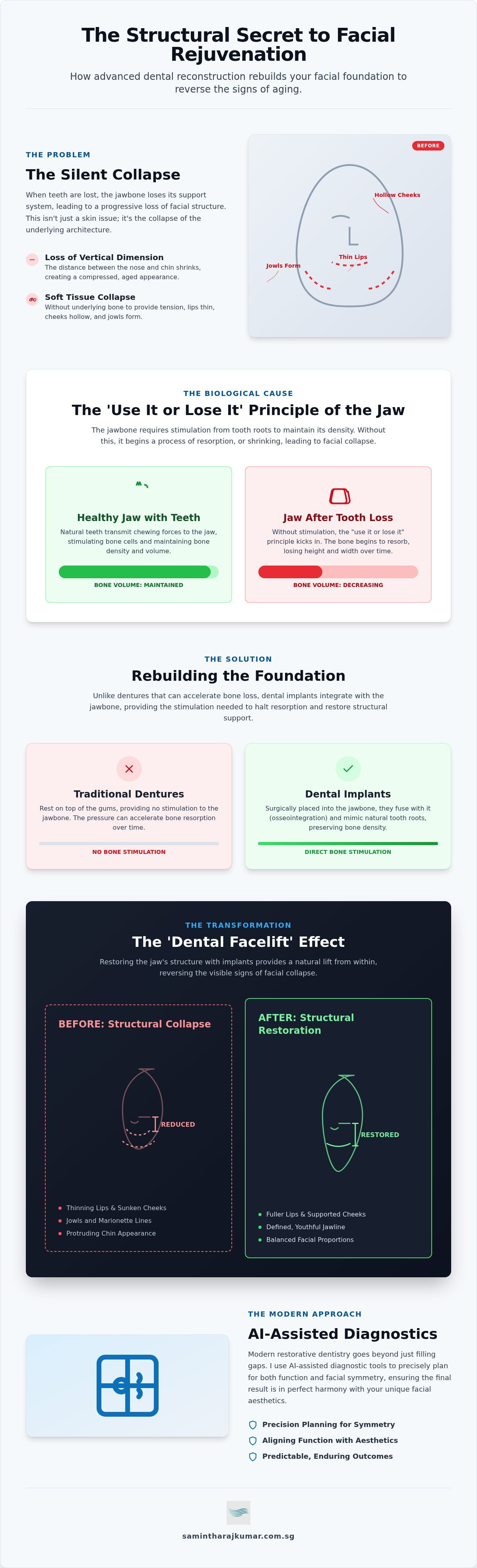
In my clinical experience, few people realise that the teeth and jawbone act as the primary scaffolding for the lower third of the face. When teeth are lost or severely degraded, this internal support system begins to fail, leading to a phenomenon known as facial collapse. This is essentially a loss of vertical dimension, a progressive reduction in the distance between the nose and the chin. As a clinician and founder, I've observed that patients seeking a dental facelift before and after result are often surprised to learn that their concerns about sagging skin are actually rooted in the skeletal foundation rather than just the dermis.
From a biological perspective, traditional dentures are frequently offered as a solution, but they often inadvertently accelerate the problem. Because they rest on the gums rather than integrating with the bone, they provide no active stimulation to the underlying tissues. Over time, the pressure from chewing with dentures can actually speed up bone resorption, causing the jaw to shrink further. This is why I advocate for dental reconstruction as a structural foundation. It doesn't just replace missing teeth; it restores the architectural integrity of the entire face by providing the tension the soft tissues require.
Identifying the Problem: The Visual Signs of Bone Resorption
The aesthetic consequences of this collapse are quite specific. As the jawbone recedes, the overlying soft tissue loses its tension, resulting in thinning lips and a characteristic protruding chin. You might notice the development of the "jowl" effect as the jawline loses its crisp definition. Without posterior teeth to provide width, the cheeks often hollow out, creating a gaunt appearance. Deep nasolabial folds and marionette lines become more pronounced because the underlying volume that once kept the skin taut has vanished.
Why It Matters: The Clinical Consequences of a Collapsed Bite
Beyond aesthetics, a collapsed bite creates significant functional challenges. I often see patients with increased strain on the temporomandibular joint (TMJ), which can lead to chronic discomfort and bite instability. Speech patterns may also change, as phonetic clarity often suffers when the tongue and lips no longer have the correct dental positioning to work against. Most importantly, the psychological impact is profound. Looking significantly older than one's biological age can erode self-confidence, making social interactions a source of anxiety. Modern dental facelift before and after outcomes demonstrate that restoring this structure is as much about emotional renewal as it is about clinical excellence. This renewed confidence often inspires patients to address other health concerns that affect their daily comfort; for example, if you are struggling with persistent scalp issues, Terra Medical offers expert advice on identifying the causes of an itchy scalp.
The Biological Science of Bone Resorption and Premature Ageing
In my clinical experience, bone preservation is the most critical factor in facial longevity. The jawbone, specifically the alveolar bone, operates on a "use it or lose it" principle. When your natural teeth are present, every bite transmits masticatory forces through the roots into the jaw. This mechanical stress is essential; it triggers osteoblastic stimulation, the biological process where bone-forming cells maintain and renew the jaw's density. Without this regular activity, the bone begins to dissolve, a process known as resorption. Many of the dramatic changes seen in a dental facelift before and after gallery are achieved because we have successfully arrested this cycle of biological erosion.
Dental implants are the only restorative solution that truly mimics natural tooth roots to halt this process. By placing an implant directly into the site of tooth loss, we provide the bone with the stimulation it needs to remain healthy and robust. From a biological perspective, this is the only way to prevent the progressive "shrinking" of the lower face that leads to a prematurely aged appearance. I believe that addressing the skeletal foundation is the only way to achieve a result that is both functional and aesthetically enduring.
The Science of Osseointegration and Structural Support
Modern implantology relies on the process of osseointegration, where biocompatible materials like ceramic or titanium integrate seamlessly with your living bone. This fusion is vital for maintaining the width and height of the alveolar ridge, which acts as the structural anchor for your facial features. By preserving this ridge, we prevent the shortening of the lower third of the face, ensuring your facial height remains constant. For those exploring Dental Implant Procedures, understanding this skeletal support is key to appreciating the long-term value of the treatment.
From a Biological Perspective: The Role of Nutrient Flow
Maintaining bone density provides benefits that extend beyond mere structural strength. Healthy, active bone supports an intricate vascular network that ensures consistent nutrient flow to the surrounding soft tissues. When the jawbone is dense, the blood supply to the gums and facial skin remains more vibrant, contributing to a healthier, more radiant complexion. This is why early intervention is always superior to reactive surgery. Waiting until significant collapse has occurred makes the restorative process more complex. Learning about your biological foundation is the first step toward a more predictable dental facelift before and after outcome, ensuring that your restoration supports your lifestyle for years to come.
Advanced Surgical Protocols for Structural Restoration
In my clinical experience, standard implants are often insufficient for patients who have suffered years of extensive bone resorption. When we move beyond replacing individual teeth and begin to look at the entire facial foundation, we require a more comprehensive structural approach. This is where advanced protocols like All-on-4 and Zygomatic implants become essential. When reviewing a dental facelift before and after, the most striking transformations usually involve full-arch rehabilitation. This process does not merely fill gaps; it restores the skeletal height and width that have been lost to time and biological decay.
As a clinician and founder, I prioritise efficiency alongside excellence. This is why I often advocate for the Teeth in a Day procedure explained in my previous clinical insights. By using just four or more strategically tilted implants, we can provide a fixed, stable set of teeth in a single session. This immediate loading not only restores function but also provides the necessary tension to the facial muscles, preventing further "collapse" of the lower face during the healing period.
Zygomatic Implants: Solutions for Severe Maxillary Atrophy
For patients who have been told they lack sufficient bone for traditional implants, Zygomatic protocols are a visionary alternative. These implants anchor into the dense bone of the cheekbones (zygoma) rather than the jaw. This is a game-changer for severe maxillary atrophy. By bypassing the need for extensive bone grafting, we can provide immediate mid-face support. From a biological perspective, this support is vital for maintaining cheek volume and preventing the sunken, aged appearance often associated with long-term tooth loss.
All-on-4 vs. Traditional Implants: An Aesthetic Comparison
While traditional implants are excellent for single-tooth replacement, they often struggle to provide the comprehensive lip fullness and smile line restoration required for a total facial lift. The All-on-4 protocol uses tilted posterior implants to maximise contact with existing bone, providing a foundation that standard vertical implants cannot always achieve in a compromised jaw. This structural integrity is what allows us to achieve a symmetrical, youthful dental facelift before and after result.
The best outcomes begin with understanding the root cause of your structural deficit. By selecting the right surgical protocol, we ensure that your new smile is built on a foundation that lasts a lifetime.
My Perspective: The Philosophy of Functional Aesthetics and AI-Assisted Planning
In my clinical experience, the most successful transformations are those where function leads and aesthetics follow. Many patients approach me focusing solely on the visual dental facelift before and after result, yet I believe that beauty is merely a byproduct of restored health. As a clinician and founder, my philosophy is rooted in the belief that we must first rebuild the mechanical integrity of the bite. When the jaw is correctly aligned and the vertical dimension is restored, the facial muscles naturally drape over the new structure with a youthful tension that no topical filler can replicate. This is the difference between masking ageing and truly reversing its structural cause.
This holistic approach requires looking beyond the oral cavity to the entire facial profile. We are not just dentists; we are architects of the lower face. I often reflect on the transformative power this has on a patient's identity. When a person regains their ability to chew and speak with clarity, their posture changes, their eyes brighten, and their sense of self is fundamentally renewed. It is a privilege to lead a practice that values this profound personal impact as much as clinical precision.
The Role of AI in Designing Your Future Smile
To achieve this level of precision, I integrate AI-assisted diagnostics into every rehabilitation plan. We use digital scans to map the intricate relationship between your jaw structure and your unique face shape. By adhering to the latest ANSI/ADA Standard No. 1110-1:2025 for AI image analysis, we ensure that every diagnostic step is validated and precise. This 3D planning allows us to predict facial outcomes with remarkable accuracy before the first incision is made. This predictability is what allows us to deliver consistent dental facelift before and after results that feel as natural as they look, ensuring your new smile is perfectly calibrated to your anatomy.
Biological Dentistry: Choosing Materials for Long-Term Health
This level of diagnostic precision is equally important for non-aesthetic functional concerns, such as respiratory health. For instance, Butterfly Dental Care applies similar diagnostic rigor to treat sleep apnea by optimizing jaw and dental positioning to ensure an open airway.
From a biological perspective, the materials we place in your body matter just as much as the surgical technique. I have a strong preference for ceramic dental implants due to their superior biocompatibility. Unlike traditional metals, these materials are chemically inert, ensuring that the body's immune system remains unburdened by the restoration. My vision for the future of dental rehabilitation in Singapore and Southeast Asia is one where high-tier clinical standards and biological harmony coexist. We are building a legacy of care that prioritises the patient's long-term well-being above all else.
The best outcomes begin with understanding the root cause of facial ageing. If you are ready to explore how structural restoration can redefine your profile, understanding our diagnostic approach is the best place to start.
The Patient Journey: From Structural Deficit to Aesthetic Renewal
In my clinical experience, the transition from feeling self-conscious about facial collapse to experiencing total aesthetic renewal is a deliberate, staged process. It begins with a comprehensive specialist consultation at Dr Samintharaj Kumar. We don't just look at teeth; we examine the skeletal foundation using advanced diagnostics. I use this time to listen to your concerns about facial sagging, difficulty chewing, and the fear of further collapse. Every dental facelift before and after success story starts with this diagnostic clarity, where we align clinical possibilities with your personal goals for rejuvenation.
As a clinician and founder, I believe that transparency is the cornerstone of trust. Understanding the road ahead allows you to approach surgery with a sense of security. Whether we are planning for All-on-4 or more complex Zygomatic protocols, the focus remains on building a foundation that supports your face and your lifestyle for the long term.
What to Expect: The Path to Total Rehabilitation
The surgical experience is designed for maximum comfort and clinical precision. If we utilise immediate load protocols like Teeth in a Day, the functional benefits are almost instantaneous. You'll leave the clinic with a stable set of teeth that immediately begin supporting your facial soft tissues, preventing the "sunken" look from persisting. However, it's vital to manage expectations regarding healing. Soft tissue adaptation takes time as the swelling subsides and the muscles adjust to their new support. The timeline from the initial surgery to the final, permanent prosthetic fitting usually spans several months, ensuring the implants are fully integrated before the final aesthetic touches are applied.
The Long-Term Impact: Life Beyond the Procedure
The true measure of success isn't found just in the mirror; it's in the return of dietary freedom and social confidence. I've seen patients who previously avoided social gatherings due to the fear of dentures slipping suddenly find a renewed zest for life. Sustainability of facial volume is achieved through proper maintenance and regular specialist reviews. By preventing facial collapse with dental implants, we ensure that the structural rejuvenation we've achieved remains stable for decades. This permanent stability is what makes the dental facelift before and after transformation so profound; it is a legacy of health that restores your identity.
Choosing expert-led care is essential for complex cases involving significant bone loss. As a surgeon, I ensure that every stage of your journey is overseen with meticulous attention to detail. A successful outcome isn't just about the surgery; it's about the quality of life that follows. The best outcomes begin with understanding the root cause.
Reclaiming Your Profile Through Structural Integrity
Restoring facial volume is far more than an aesthetic pursuit; it's a clinical necessity for long-term health and functional excellence. As a clinician and founder, I've seen how rebuilding the skeletal foundation of the jaw can reverse years of premature ageing that topical treatments simply cannot reach. By addressing the root cause of bone resorption with advanced protocols like All-on-4 or Zygomatic implants, we provide the permanent support your facial soft tissues require. When reviewing a dental facelift before and after, the most profound transformations are those rooted in this deep architectural restoration.
My vision for your care is one of biological harmony and meticulous precision, guided by AI-assisted diagnostics to ensure every outcome is predictable and symmetrical. We don't just aim for a beautiful smile; we strive for a total renewal of your self-confidence and quality of life. The best outcomes begin with understanding the root cause. Explore the possibilities of total oral rehabilitation with Dr Samintharaj Kumar. I look forward to helping you rediscover the vibrant, stable foundation you deserve.
Frequently Asked Questions
Can dental implants really make me look younger?
Dental implants contribute to a more youthful appearance by restoring the internal scaffolding of the lower face. When teeth are lost, the jawbone begins to resorb, leading to a sunken look and sagging skin. By replacing these roots with implants, we provide the necessary tension to support facial muscles and skin. In my clinical experience, patients are often astonished by their dental facelift before and after results because we address the structural cause of ageing rather than just the surface.
How does dental reconstruction restore facial volume compared to a facelift?
While a surgical facelift addresses sagging by tightening the skin and underlying soft tissues, dental reconstruction focuses on the skeletal foundation. It restores the vertical dimension of the face, which is the distance between the nose and chin. By rebuilding lost bone and tooth structure, we push the facial tissues back into their original, youthful positions. This provides a genuine restoration of volume from within, rather than merely stretching the surface layers of the dermis.
What happens if I do not have enough bone for traditional implants?
If you've been told you lack sufficient bone for traditional implants, advanced surgical protocols offer a viable alternative. I specialise in Zygomatic and Pterygoid implants, which anchor into the dense cheekbones or the stable bone at the back of the jaw. These techniques bypass the need for extensive bone grafting and are specifically designed for patients with severe maxillary atrophy. This ensures that even those with significant bone loss can achieve a stable, full-arch restoration.
Is the All-on-4 procedure suitable for everyone with missing teeth?
The All-on-4 protocol, often referred to as Teeth in a Day, is a transformative solution for many patients with significant tooth loss or failing dentition. However, it requires a thorough clinical assessment to ensure long-term success. We utilise AI-assisted diagnostics to evaluate bone density and bite alignment before proceeding. While highly effective for total arch rehabilitation, some complex cases may require Zygomatic implants or additional preparatory work to ensure the foundation is robust enough for permanent loading.
How long does the facial rejuvenation effect of implants last?
The facial rejuvenation effects of dental implants are designed to be long-lasting, often spanning decades or even a lifetime with proper maintenance. Unlike dermal fillers that dissolve over months, implants provide permanent skeletal support that prevents further bone resorption. By maintaining the integrity of the jawbone, the volume in your lower face remains stable. A successful dental facelift before and after outcome relies on regular specialist reviews and excellent oral hygiene to protect the health of the implants.
Will dental implants fix the wrinkles around my mouth?
Dental implants can significantly reduce the appearance of deep wrinkles, such as marionette lines and nasolabial folds, by restoring lost facial volume. When the jaw structure is rebuilt, the skin around the mouth is better supported and appears smoother. While implants address the structural cause of these folds, fine surface wrinkles caused by sun damage or ageing of the skin itself may still require complementary facial aesthetic rejuvenation treatments for a complete and polished result.
How do dentists measure bite alignment for facial symmetry?
At Nuffield Dental, I utilise advanced AI-assisted diagnostics and 3D digital scans to measure bite alignment with meticulous precision. We map the relationship between your jaw joints, dental arches, and the soft tissues of your face. This holistic view allows us to plan a reconstruction that not only restores function but also optimises facial symmetry. By adhering to validated standards for AI image analysis, we ensure that every adjustment to your bite enhances your overall profile.
What is the recovery timeline for complex dental reconstruction?
The recovery timeline varies depending on the complexity of the surgery, but most patients experience immediate functional improvements. With immediate load protocols, you can often leave the clinic with a provisional set of teeth on the same day. While initial soft tissue healing occurs within two weeks, the process of osseointegration, where the implants fuse with the bone, typically takes three to six months. We provide comprehensive post-operative care to ensure your transition to the final restoration is comfortable.


Comments