
Signs of a Failing Dental Implant: A Surgeon’s Perspective on Total Rehabilitation
- Dr Samintharaj Kumar

- Sep 1
- 12 min read
Imagine waking up to a persistent, throbbing sensation in your jaw months after your procedure. You might find yourself questioning if this is a normal part of the healing journey or if something more serious is occurring. In my clinical experience, this uncertainty is often the most taxing part of the process. Many patients I see at Nuffield Dental feel a deep sense of anxiety regarding the potential for further bone loss or the financial implications of a revision. Understanding the clinical signs of a failing dental implant is essential to move past this fear and toward a predictable solution.
As a clinician and founder, I view implant failure not as a finality, but as a biological signal that requires a specialist's restorative vision. In this article, I'll help you recognise the specific warning signs that demand attention and explain the sophisticated steps we take to salvage or replace a restoration. We'll explore how modern techniques, such as AI-assisted diagnostics and ceramic implants, allow for total oral rehabilitation. My aim is to provide you with a clear, logical path toward health, ensuring you feel secure in the knowledge that a functional, beautiful smile is still well within your reach.
Table of Contents
The Science of Osseointegration: Why Dental Implants Falter
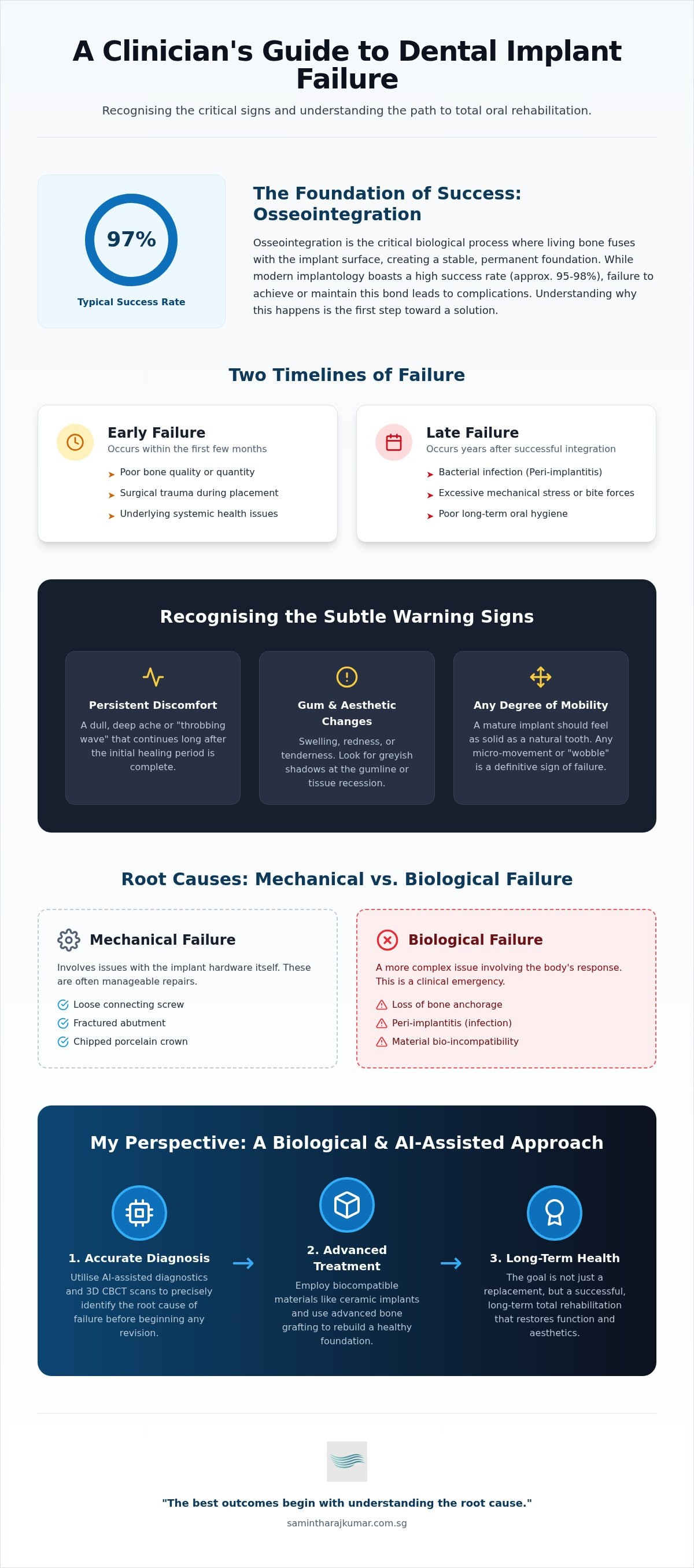
Osseointegration is the bedrock of modern implantology. It is the structural and functional connection between living bone and the surface of a load-bearing artificial implant. The Science of Osseointegration dictates whether an implant remains a permanent fixture or becomes a source of chronic inflammation. While long-term studies show a success rate of approximately 95-98 per cent, the remaining small percentage of cases require a deep understanding of biological triggers. When this bond fails to form or is later compromised, the patient begins to experience the clinical signs of a failing dental implant.
In my clinical experience, we must distinguish between "Early Failure" and "Late Failure." Early failure typically occurs within the first few months, often due to poor bone quality, surgical trauma, or an underlying systemic issue that prevents the bone from knitting to the implant. Late failure occurs years after successful integration, usually triggered by bacterial infection or excessive mechanical stress. Recognising the early signs of a failing dental implant during these phases allows us to intervene before the damage becomes irreversible.
To better understand these symptoms and how they present clinically, watch this helpful video:
Mechanical vs. Biological Failure
From a biological perspective, I categorise failures into two distinct camps. Mechanical failure involves the hardware; a loose screw, a fractured abutment, or a chipped porcelain crown. These are often manageable repairs that don't involve the bone. Biological failure is more complex, involving the loss of bone anchorage or peri-implantitis, a site-specific infectious disease. While a loose crown is a simple fix, a loose implant is a clinical emergency that threatens the integrity of the entire dental arch.
The Role of Bio-incompatibility
As a clinician and founder of Nuffield Dental, I've observed that the body's reaction to materials is often overlooked. Some patients possess sensitivities to the metal alloys found in traditional titanium implants, leading to chronic low-grade inflammation. This is why I often recommend ceramic dental implants for revision cases. These metal-free alternatives offer superior biocompatibility, encouraging healthier soft tissue integration and reducing the risk of the body rejecting the implant as a foreign object. Material choice is not just an aesthetic preference; it's a fundamental pillar of long-term osseointegration.
Recognising the Subtle Signs of a Failing Dental Implant
In my clinical experience, the earliest signs of a failing dental implant are often the most overlooked by patients. Many expect failure to be a sudden, catastrophic event, but the biological reality is usually a slow, progressive decline. You might notice a "throbbing wave" of discomfort that persists long after the initial surgical phase has ended. While post-operative soreness is expected to subside within a week or two, a dull, deep ache that flares up during rest or physical activity suggests that the bone is not integrating correctly.
Aesthetics also provide a vital clue. I often tell my patients to look for greyish shadows appearing at the gumline or a visible recession of the soft tissues. These changes indicate that the underlying bone is retreating, leaving the substructure exposed to the oral environment. If you notice these shifts, a comprehensive assessment of your oral health is the most prudent next step to prevent further complications.
Persistent Discomfort and Mobility
Any degree of mobility in a mature implant is a definitive sign of failure. In a healthy state, the implant should feel like a natural part of your jaw. During a clinical examination, I perform what we call the "wobble" test. Using specialised instruments, I look for micro-movements that you might not even feel yet. If the implant moves even a fraction of a millimetre, it indicates that the biological bond has been lost. This loss of stability often manifests as difficulty chewing on the affected side or a strange "clicking" sensation when you bite down. Research into implant failure and retrieval techniques confirms that once mobility is present, the focus must shift from salvage to a structured revision protocol.
Peri-implantitis: The Silent Threat
Peri-implantitis is effectively the implant equivalent of gum disease, and it remains a leading cause of late-stage failure. It is a silent threat because it often progresses without significant pain until the bone loss is advanced. You should be vigilant for symptoms such as bleeding during brushing, a discharge of pus from the gum pocket, or persistent bad breath that doesn't resolve with hygiene. These are clear signs of a failing dental implant caused by bacterial colonisation. Left untreated, this inflammation acts as a catalyst for rapid bone resorption, destroying the very foundation that supports your smile and potentially compromising neighbouring healthy teeth.
Clinical Consequences: Why Early Detection is Critical
Identifying the signs of a failing dental implant is only the first step in protecting your long-term health. In my clinical experience, the most significant danger isn't the loss of the implant itself, but the cascading damage to the surrounding oral environment. A failing implant doesn't just sit idle; it can act as a catalyst for rapid bone resorption. When the biological seal around the post is breached, bacteria infiltrate the jawbone, leading to a localized inflammatory response that consumes the very foundation of your smile. While the risks of dental implants are statistically low, the biological impact of an unaddressed failure can be profound.
Adopting a "wait and watch" approach is often a strategic error. Delaying intervention allows the infection to spread, potentially compromising the stability of neighbouring healthy teeth and turning a straightforward revision into a complex, multi-stage surgical process. From a biological perspective, early detection is the difference between a simple salvage and a total reconstruction of the dental arch.
Bone Loss Progression and Site Collapse
When an implant fails due to peri-implantitis, the infection effectively "eats away" at the surrounding jawbone. This loss of bone volume doesn't just affect the current site; it compromises the structural integrity of the entire jaw. If the bone has already begun to recede, we must focus on rebuilding that foundation before any new restorative work can begin. For instance, in cases where the upper jawbone has thinned significantly, I often find that sinus lift surgery is required to create enough bone depth for a successful replacement. Preserving bone volume is essential for maintaining your future restorative options and ensuring the longevity of any new implant.
Impact on Facial Structure and Harmony
As a clinician and founder, I view the jawbone as the essential scaffolding for the face. When significant bone loss occurs, the facial soft tissues lose their underlying support, which can lead to a "sunken" or prematurely aged appearance. This aesthetic decline is a direct result of the loss of dental structure. Our philosophy at Nuffield Dental is deeply rooted in preventing facial collapse with dental implants. We don't just look at a single tooth; we consider how total rehabilitation can restore the youthful proportions and structural harmony of your face. Acting quickly when you notice symptoms ensures we can preserve the natural contours that define your appearance.
My Perspective: A Biological and AI-Assisted Approach to Implant Salvage
From a biological perspective, I believe we must first identify the root cause of the failure before attempting a fix. In my clinical experience, simply placing a new screw into a compromised site is a recipe for further disappointment. We don't just replace a tooth; we rebuild a healthy biological environment. When a patient presents with the signs of a failing dental implant, my priority is to understand whether the issue is mechanical, bacterial, or a result of bio-incompatibility. This investigative phase is what allows us to transition from a state of failure to a successful total rehabilitation.
As a clinician and founder, I've seen that the decision to salvage or remove an implant requires a delicate balance of surgical expertise and technological precision. We must be honest about the long-term viability of a restoration. If the biological foundation is too far gone, a strategic removal followed by a sophisticated reconstruction is often the kindest and most effective path for the patient.
Advanced Diagnostics in My Practice
The days of relying solely on 2D X-rays to assess implant health are behind us. In my practice, I utilise 3D CBCT scans integrated with Artificial Intelligence to gain a comprehensive view of the jawbone's architecture. AI-assisted diagnostics is the new gold standard for implant safety in 2026. This technology helps me detect minute bone density changes that are invisible on standard radiographs, allowing for earlier intervention. This level of 3D imaging is also indispensable when planning a removal; it allows me to navigate the surgical site with such precision that we preserve the maximum amount of healthy bone for the next stage of care.
When Removal is the Best Path Forward
There are instances where removal is not just necessary, but the most visionary choice for long-term health. When we reach this conclusion, my focus shifts to how we can restore function as efficiently as possible. For many revision cases, I apply the teeth in a day philosophy. If the site can be thoroughly cleared of infection and sufficient primary stability is achieved, we can often replace the failing unit and provide a stable restoration in a single visit. This minimises the emotional and physical toll on the patient. Managing expectations is a vital part of this journey. I ensure my patients understand that while the path to revision is complex, our goal is a permanent, biocompatible solution that feels like a natural part of their body. If you are experiencing discomfort, scheduling a specialist evaluation is the first step toward regaining your confidence.
Restoring Excellence: Long-term Outcomes After Implant Revision
Restoring excellence after a clinical setback requires more than just technical skill; it demands a visionary approach to total oral health. Once you've recognised the signs of a failing dental implant, the path to recovery begins with a meticulous reconstruction of the biological foundation. This typically involves advanced bone grafting to replace lost volume and precise soft tissue management to create a resilient barrier against future infection. In my clinical experience, the success of a revision depends entirely on our ability to create an environment where the body can truly heal. Identifying the signs of a failing dental implant early allows us to pivot toward these biocompatible solutions before the structural damage becomes irreversible.
Ceramic Alternatives for Biological Success
From a biological perspective, I frequently select ceramic (Zirconia) implants for revision cases. While titanium has been the industry standard for decades, some patients exhibit a subtle bio-incompatibility that contributes to initial failure. Ceramic materials are inherently hypoallergenic and offer a "soft-tissue friendly" surface that encourages superior gum attachment. They also demonstrate significantly lower plaque accumulation compared to metal alternatives, which is a critical advantage in preventing a recurrence of peri-implantitis. Beyond the biological benefits, ceramic restorations provide unparalleled aesthetics in the "smile zone," as there is no dark metal substructure to shadow the gumline. This holistic choice aligns with my commitment to using materials that support the body's natural harmony.
The Journey to Functional Renewal
The transition from a failed restoration to a stable, permanent result is a journey of functional renewal. To ensure your second implant lasts a lifetime, we implement a rigorous maintenance protocol. This includes meticulous oral hygiene and regular specialist reviews to monitor the health of the bone and surrounding tissues. As a clinician and founder, my goal is to see you return to a life of confident eating, speaking, and smiling without the constant shadow of discomfort.
Total rehabilitation is about more than just a single tooth; it's about the profound personal impact of a healthy, functional smile. We don't settle for "fixed." We strive for a result that is both functionally perfect and biologically sound, allowing you to move forward with absolute security. The best outcomes begin with understanding the root cause.
A Vision for Total Oral Renewal
As a clinician and founder, I've dedicated my career at Nuffield Dental to mastering complex implantology. Recognising the signs of a failing dental implant is not a moment for despair; it's an opportunity for a more precise, scientifically advanced intervention. By integrating AI-assisted diagnostics with specialised Zygomatic and All-on-4 protocols, we can rebuild what was lost with greater predictability than ever before. We've moved beyond simple fixes toward a philosophy of total rehabilitation.
We've explored how early detection and the superior biocompatibility of ceramic materials allow us to restore not just your teeth, but the structural harmony of your face. This approach ensures that your revision is built on a foundation of long-term health and functional excellence. The path to renewal is always available to those who prioritise understanding the biological root cause of their discomfort. It's about reclaiming the quality of life you deserve.
I firmly believe that with the right expertise, every patient can achieve a smile that is both beautiful and biologically enduring. You deserve a future defined by confidence, comfort, and lasting health. I look forward to helping you begin that journey.
Frequently Asked Questions
How do I know if my dental implant is failing or just healing?
Normal healing involves temporary soreness and mild swelling that resolves within 7 to 14 days. If you experience persistent throbbing pain, pus discharge, or any mobility, these are clinical signs of a failing dental implant. In my clinical experience, normal healing should follow a predictable, downward curve of discomfort. If the pain intensifies or returns months later, it indicates a biological breakdown that requires immediate specialist evaluation to protect your jawbone.
Can a failing dental implant be saved without removal?
It is possible to save an implant in the very early stages of peri-implantitis through intensive decontamination and laser therapy. However, once significant bone loss has occurred or the implant becomes mobile, salvage is rarely predictable. From a biological perspective, trying to "patch" a failing foundation often leads to larger complications. In such cases, I usually recommend a strategic removal followed by a thorough site reconstruction to ensure a successful long-term outcome.
Is it normal for a dental implant to feel slightly loose?
No, any degree of mobility in a dental implant is a definitive sign of failure. Unlike natural teeth, which are held by a flexible ligament, an implant must be fused directly to the bone through osseointegration. If you feel a "wobble" or clicking sensation, the bond has been compromised. In my practice, I use AI-assisted diagnostics to confirm if the loss of stability is due to bone resorption or a simple loose prosthetic screw.
What happens if I ignore the signs of a failing implant?
Ignoring the signs of a failing dental implant can lead to rapid bone resorption and the spread of infection to neighbouring healthy teeth. This chronic inflammation doesn't just affect your mouth; it can cause the surrounding jawbone to collapse, leading to a sunken facial appearance. Delaying treatment often turns a manageable revision into a far more complex surgical process requiring extensive bone grafting and multiple procedures to restore your oral health and facial harmony.
Why would a dental implant fail after several years of success?
Late failures typically occur due to peri-implantitis, which is a bacterial infection similar to gum disease, or excessive mechanical stress from teeth grinding. Changes in your systemic health, such as developing diabetes or starting certain medications, can also impact how your bone maintains its bond with the implant. As a clinician and founder, I emphasise that long-term success requires both meticulous home care and regular professional reviews to catch these subtle shifts early.
Can I get a new dental implant immediately after a failure is removed?
Immediate replacement is often possible through our "Teeth in a Day" protocol, provided the surrounding bone is healthy and free of acute infection. If there is significant bone loss or active suppuration, we may need a healing period of several months combined with bone grafting. Every case is unique. My priority is always to ensure that the new foundation is biologically sound before we proceed with a permanent, load-bearing restoration.
Are ceramic implants more successful than titanium for revision surgery?
Ceramic implants are an excellent choice for revision surgery, particularly for patients with metal sensitivities or thin gum tissues. Their surface is highly biocompatible, which encourages healthy soft tissue attachment and results in less plaque accumulation compared to titanium. In my clinical experience, using ceramic materials for a second attempt often resolves the underlying "foreign body" response that may have contributed to the initial failure, leading to a more stable result.
What is the cost involved in fixing a failing dental implant in Singapore?
The cost of fixing a failing implant in Singapore varies based on the complexity of the revision and the restorative materials chosen. Fees generally encompass the specialist consultation, diagnostic imaging like 3D CBCT scans, and the surgical procedures required, such as bone grafting or sinus lifts. As a founder, I focus on providing a transparent breakdown of the necessary steps for total rehabilitation, ensuring you understand the investment required for a lasting, functional smile. For patients in other regions looking for accessible care, Stoddard Dental Square is a WINZ approved clinic that provides free quotes to help make essential dental services more accessible.


Comments