
Signs You Need Full Mouth Reconstruction: A Specialist Surgeon’s Perspective

Updated: May 14
What if the persistent discomfort you feel while eating isn't just a sign of a single "bad tooth," but a signal that your entire oral ecosystem is in a state of collapse? In my clinical experience, many patients spend years patching up individual issues, only to find that their oral health continues to decline. It's a frustrating cycle that often leads to embarrassment and a genuine fear of what the future holds for their smile. If you've found yourself hiding your teeth or avoiding your favourite foods, you aren't alone. With nearly 120 million people missing at least one tooth, the need for specialised intervention is a common reality that requires a visionary approach to care.
Recognising the signs you need full mouth reconstruction is about more than just aesthetics; it's about restoring a biologically compatible foundation for your life. I've written this guide to help you identify the clinical indicators that necessitate comprehensive rehabilitation and to demystify the specialist path to total function. We'll explore the vital difference between elective cosmetic dentistry and functional reconstruction. I'll also share my perspective on how modern surgical protocols, such as All-on-4 and AI-assisted diagnostics, provide a permanent solution that returns your confidence and long-term quality of life.
Key Takeaways
Understand the fundamental difference between a cosmetic smile makeover and the clinical necessity of full-arch rehabilitation to restore your mouth's biological harmony.
Learn to identify the primary signs you need full mouth reconstruction, such as posterior bite collapse from missing teeth or severe dental wear caused by chronic bruxism.
Discover how the "Domino Effect" of a single failing tooth can destabilise your entire oral ecosystem, leading to complex functional decline if left unaddressed.
Gain insight into a specialist's approach to total rehabilitation, prioritising biocompatible materials like ceramic dental implants for a seamless, health-focused transformation.
Recognise how investing in comprehensive reconstruction can permanently restore your ability to eat, speak, and smile with absolute confidence.
Table of Contents
Defining Full Mouth Reconstruction: Why Signs Matter for Total Rehabilitation
In my clinical experience, patients often arrive at my practice requesting a smile makeover when their underlying clinical needs are far more complex. While a makeover primarily addresses the visible aesthetics of the front teeth, full mouth reconstruction is a comprehensive restorative process that involves every tooth in both the upper and lower arches. It's a journey from instability to a state of permanent, biological health. To truly understand What is Full Mouth Reconstruction?, we must view the mouth as a living ecosystem where the teeth, jawbone, and gums must function in absolute synchronicity.
To help you visualise the specific indicators that suggest your oral health requires this level of intervention, I recommend watching this brief overview:
From a biological perspective, successful rehabilitation relies on the synergy between hard and soft tissues. We aren't just placing crowns; we're managing the health of the jawbone and the integrity of the gingival tissues to ensure long-term stability. The ultimate goal of any reconstruction is to achieve functional harmony, where your bite is balanced and your oral health is biologically stable for decades to come.
Reconstruction vs. Cosmetic Dentistry
Aesthetics are a natural byproduct of functional success, not the primary driver of the treatment plan. As a clinician and founder, my "Total Rehabilitation" philosophy dictates that we build from the foundation upwards. A specialist surgeon manages the complex oral architecture, including bone volume and nerve pathways, which a general cosmetic approach might overlook. When we restore the correct vertical dimension of your bite, the "facelift" effect on your facial features happens naturally because the underlying structure finally supports the soft tissues of the face.
The Clinical Necessity of Early Recognition
Recognising the signs you need full mouth reconstruction at an earlier stage is vital for preserving your remaining bone structure. If you ignore these indicators, the bone continues to resorb, often necessitating more complex surgical procedures like zygomatic implants or extensive grafting in the future. There's also a significant link between chronic oral infection and systemic health; leaving a collapsing mouth untreated can place an unnecessary burden on your immune system. Full mouth reconstruction is a multi-disciplinary surgical protocol designed to restore total oral health through the integration of biological dentistry and advanced surgical precision.
The Six Clinical Signs You Need Full Mouth Reconstruction
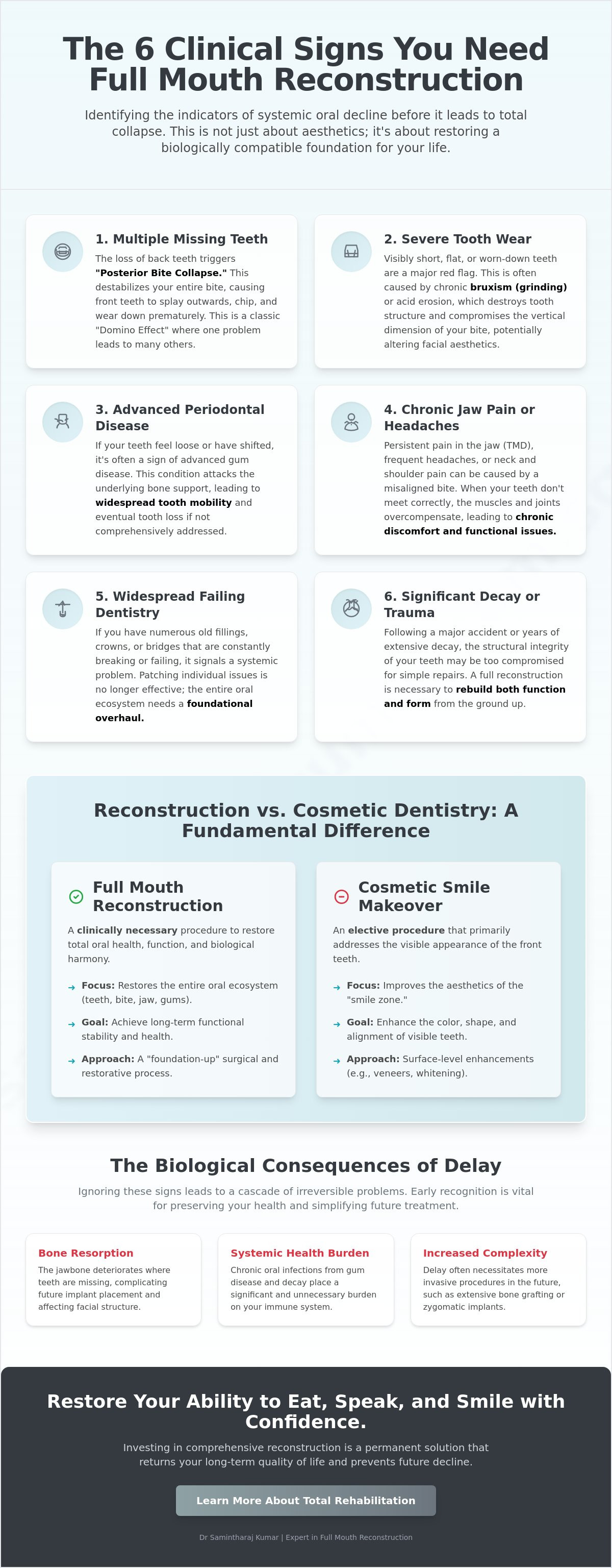
Identifying the specific signs you need full mouth reconstruction is a process that requires both clinical precision and a deep understanding of oral mechanics. It isn't merely about treating one or two cavities; it's about addressing the systemic failure of the dental arches. In my clinical experience, patients often wait until the pain becomes unbearable before seeking help. However, the signs are usually present long before the discomfort peaks. It's a silent progression.
I typically look for six primary indicators during a specialist consultation. These include multiple missing teeth leading to "posterior bite collapse," where the loss of back teeth causes the front teeth to splay or wear down prematurely. We also see severe tooth wear or "short teeth" resulting from chronic bruxism or acid erosion. Advanced periodontal disease is another critical sign, often manifesting as widespread tooth mobility. According to the American College of Prosthodontists, comprehensive rehabilitation is also necessary when existing work, such as leaking bridges or unstable dentures, begins to fail across the entire mouth.
Structural Failures and Bone Loss
From a biological perspective, the loss of teeth triggers rapid jawbone resorption. Without the stimulation of natural tooth roots or implants, the bone begins to melt away. This leads to a "collapsed" facial profile, where the distance between the nose and chin decreases. This loss of vertical dimension isn't just an aesthetic concern; it signifies a deep structural failure that compromises the entire facial architecture. In advanced cases, hyper-mobile teeth indicate that the supporting foundation is no longer viable, necessitating a total rehabilitation approach to restore stability.
Chronic Pain and Functional Obstructions
Structural failure often manifests as persistent TMJ discomfort or a misaligned bite. When the teeth don't meet correctly, the muscles of the jaw and neck work overtime to compensate. This frequently results in chronic headaches or even neck pain that patients don't initially link to their dental health. Beyond pain, the inability to chew efficiently impacts your nutritional intake and overall vitality. As a clinician and founder, I believe the best outcomes begin with understanding the root cause of these functional obstructions to ensure a life-changing result.
The Biological Consequences of Delayed Intervention
From a biological perspective, the mouth functions as a delicately balanced ecosystem. It is not merely a collection of independent teeth, but a complex arrangement of bone, soft tissue, and neuromuscular pathways working in synchronicity. When one component fails, it triggers a cascade of deterioration. I often see patients who have overlooked the initial signs you need full mouth reconstruction, only to find that their oral health has entered a state of rapid collapse. It is a silent erosion. One that often goes unnoticed until the damage is extensive.
The "Domino Effect" is a very real clinical phenomenon. When a single tooth is lost, the neighbouring teeth begin to shift and tilt into the empty space. This movement destabilises the entire dental arch, leading to abnormal wear patterns and a misaligned bite. Simultaneously, the underlying jawbone begins to resorb because it is no longer receiving the mechanical stimulation of a tooth root. This progressive bone loss is the most significant consequence of delay, as it directly impacts your future candidacy for traditional dental implants.
Beyond the physical structure, we must acknowledge the psychological toll. Deteriorating oral health often leads to a withdrawal from social situations. I have met many patients who have stopped smiling in photos or who feel a sense of embarrassment when eating in public. This loss of confidence is just as detrimental to your quality of life as the functional failures themselves. For those seeking more information on the process, I recommend reading a comprehensive guide to full mouth reconstruction to understand the full scope of treatment.
Why 'Wait and See' Is a Risky Clinical Strategy
In my clinical experience, adopting a "wait and see" approach often complicates the eventual surgery. What might have started as a straightforward case for standard implants can quickly transition into a need for complex zygomatic dental implants if the bone volume is allowed to diminish. The cost and complexity of surgical bone grafting also escalate the longer you wait. Furthermore, delayed treatment often compromises the final prosthetic outcome, making it more difficult to achieve the seamless, natural look we strive for in total rehabilitation.
Impact on Systemic Health
The consequences extend far beyond the jawline. Chronic oral inflammation is closely linked to cardiovascular health, as bacteria from the mouth can enter the bloodstream. Additionally, impaired mastication leads to nutritional deficiencies because you are forced to avoid fibrous, nutrient-dense foods. Delayed rehabilitation often necessitates more advanced protocols like Zygomatic or Pterygoid implants. As a clinician and founder, I believe in addressing these issues before they impact your systemic well-being. The best outcomes begin with understanding the root cause of the decline.
My Perspective: A Specialist Approach to Total Rehabilitation
As a clinician and founder, I have always maintained that identifying the signs you need full mouth reconstruction is only the beginning of a transformative journey. The true challenge lies in the execution of a treatment plan that respects the biological integrity of the patient while achieving a world-class functional result. My practice is rooted in the principles of Biological Dentistry. This philosophy dictates that we prioritise biocompatible materials that work in harmony with your unique physiology, rather than simply placing "spare parts" into a living system.
In many cases, I advocate for the use of ceramic dental implants. These are particularly beneficial for patients who have concerns about metal sensitivity or those who desire a more holistic approach to their care. From a biological perspective, ceramic materials are highly resistant to plaque accumulation and offer exceptional gum health outcomes. They provide a seamless, natural appearance that traditional metal implants sometimes struggle to match. These decisions are never made in isolation; they are part of a meticulous planning process that considers your long-term well-being alongside technical excellence.
To achieve this level of precision, we integrate AI-assisted diagnostics into our workflow. This technology allows me to analyse bone density and nerve pathways with incredible accuracy, facilitating a "Teeth in a Day" transformation that is both predictable and safe. This commitment to innovation is a hallmark of the Nuffield legacy. It reflects my dedication to uncompromising clinical standards and my role as an educator in the field of advanced implantology. I believe that every patient deserves access to the global protocols that define the future of dental care.
This level of precision is mirrored by leading practices worldwide; for instance, you can learn more about Nova Premier Dental and their use of advanced prosthodontic techniques for total rehabilitation.
Innovation in Full-Arch Protocols
When a patient presents with significant dental failure, we often utilise All-on-4 dental implants to provide immediate functional restoration. This protocol is a cornerstone of modern rehabilitation, allowing us to bypass the need for extensive bone grafting in many instances. By employing digital surgical guides, I can ensure that every implant is placed with sub-millimetre precision. This focus on digital accuracy significantly reduces recovery time and post-operative discomfort. Furthermore, I look beyond the dental arch to the "V-Shape" facial aesthetic. We aim to restore the structural support of the lower face, which naturally rejuvenates your appearance by providing the foundation your soft tissues require.
The Human Element of Surgery
I recognise that the prospect of complex surgery can be intimidating. This is why I prioritise patient comfort through advanced sedation techniques, ensuring a calm and painless experience. Total rehabilitation is a collaborative journey between the surgeon, our specialised laboratory technicians, and the patient. We work together to design a smile that feels as natural as it looks. My philosophy has always been that the right diagnosis changes everything. If you are ready to move beyond temporary fixes, the best outcomes begin with understanding the root cause of your oral health challenges.
The Long-Term Impact: Life After Full Mouth Reconstruction
Recognising the signs you need full mouth reconstruction marks the end of a period of compromise and the beginning of a life-changing restoration. In my clinical experience, patients often view the procedure as a daunting hurdle. However, once the rehabilitation is complete, they describe it as a strategic investment in their future quality of life. It is a profound shift. The ability to engage in spontaneous speech without hiding your smile or to experience the simple joy of eating without restriction cannot be understated. These are the human outcomes that define success in my practice.
From a biological perspective, the long-term benefits extend deep into your physical health. A stable, correctly aligned bite is your primary defence against future jaw joint (TMJ) degeneration. When the forces of mastication are distributed evenly across a restored arch, the stress on your jaw muscles and joints is significantly reduced. This often resolves chronic issues like tension headaches or facial pain that patients had previously accepted as permanent. Beyond the physical, there is a psychological "reset" that occurs. Reclaiming a healthy, functional mouth allows you to re-engage with your social and professional life with a level of confidence that has often been missing for years.
What to Expect During the Journey
The path to total rehabilitation follows a deliberate and highly organised progression. It begins with a comprehensive diagnostic phase where we utilise AI-assisted imaging to map your unique oral architecture. This is followed by the surgical phase, where we may employ protocols like All-on-4 or ceramic dental implants to establish a new foundation. The transition is designed to be as seamless as possible. While there is a period of adaptation as you grow accustomed to your new prosthetic, the modern materials we use are engineered to feel and function like natural teeth. Maintenance is straightforward; the longevity of ceramic restorations depends on the same meticulous oral hygiene and regular specialist reviews that sustain a natural smile.
The Best Outcomes Begin with Understanding
I have always believed that the initial specialist consultation is the most critical step in this entire process. It is during this time that we align your personal goals with a bespoke treatment plan tailored to your unique biology. We don't just look at the teeth; we look at the person. Total rehabilitation is about reclaiming your identity and your health from the cycle of dental decay. It is a visionary approach to care that prioritises your well-being for the decades to come. If you are ready to address the root cause of your discomfort, the right diagnosis changes everything. The best outcomes begin with understanding the root cause.
A Vision for the Future of Your Oral Health
We've explored how a failing oral ecosystem is more than just a dental concern; it's a systemic challenge that impacts your nutrition, speech, and social confidence. In my clinical experience, the most successful transformations occur when we move beyond reactionary "patchwork" dentistry and embrace a state of biological harmony. Whether we're utilising All-on-4 dental implants or advanced Zygomatic protocols, the goal remains the same: a permanent, life-changing result. I've dedicated my career as the founder of Nuffield Dental to ensuring every patient benefits from these global standards of care.
Recognising the clinical signs you need full mouth reconstruction allows you to take control of your health before bone loss or functional decline becomes irreversible. As a pioneer in ceramic dental implants and a specialist in complex rehabilitation, I am committed to a philosophy that prioritises your long-term well-being. I invite you to transition from a place of dental anxiety to one of absolute confidence in your smile's foundation. The journey to total rehabilitation is one of restoration, not just of teeth, but of your identity.
The best outcomes begin with understanding the root cause. Discover how total rehabilitation can transform your life.
Frequently Asked Questions
Is full mouth reconstruction painful?
Modern full mouth reconstruction is not a painful experience because we utilise advanced sedation techniques and local anaesthetics to ensure your absolute comfort throughout the procedure. In my clinical experience, patients often find the recovery phase much more manageable than they initially anticipated. We provide a comprehensive post-operative care plan to manage any minor swelling or tenderness as your tissues heal. My goal is to replace anxiety with a sense of security by prioritising a painless surgical environment.
How long does the entire full mouth rehabilitation process take?
The timeline for total rehabilitation varies significantly based on your unique clinical needs, ranging from a few months to over half a year for final completion. While "Teeth in a Day" protocols provide immediate functional results, the final integration of permanent prosthetics usually occurs three to six months after the initial surgery. This period allows the jawbone to heal and the implants to stabilise biologically. We provide a detailed, sequential timeline during your consultation so you understand every stage of your transformation.
What is the difference between a smile makeover and full mouth reconstruction?
A smile makeover is primarily an elective cosmetic procedure focusing on the aesthetic appearance of the front teeth, whereas a reconstruction is a functional necessity. Recognising the signs you need full mouth reconstruction involves identifying structural and functional failures across both dental arches, such as bite collapse or widespread decay. Reconstruction addresses the root cause of these issues, ensuring that your new aesthetics are built upon a foundation of total biological health and long-term stability.
Can I get full mouth reconstruction if I have significant bone loss?
Yes, significant bone loss does not disqualify you from total rehabilitation because we can utilise specialised surgical protocols to create a stable foundation. As a specialist in complex cases, I often employ zygomatic or pterygoid implants that anchor into denser bone structures beyond the traditional jawline. These advanced techniques allow us to bypass the need for extensive bone grafting in many instances. We use AI-assisted diagnostics to map your available bone volume and plan a precise, secure result.
How much does full mouth reconstruction cost in 2026?
In 2026, the total cost for a full mouth reconstruction typically ranges from $15,000 to over $80,000 depending on the complexity of the case. For surgical restorations involving a full set of dental implants, the investment generally falls between $60,000 and $90,000. These figures reflect the premium biocompatible materials, specialist expertise, and advanced digital technology required for a permanent solution. We provide transparent, itemised breakdowns during the planning phase to help you understand the value of this life-changing investment.
What materials are used in modern full mouth rehabilitation?
We prioritise biocompatible materials such as zirconia and ceramic dental implants to ensure a seamless and healthy integration with your body. From a biological perspective, these materials are superior because they resist plaque accumulation and prevent the metal sensitivity often associated with traditional titanium. Modern restorations are crafted using high-tier porcelain to mimic the natural translucency of enamel. This combination ensures your new teeth are as durable as they are beautiful, supporting both function and aesthetics.
How long do the results of a full mouth reconstruction last?
The results of a comprehensive reconstruction are designed to last for decades, and in many cases, they provide a lifetime of function. While the prosthetic components may eventually require minor maintenance, the underlying implants offer a permanent foundation if cared for correctly. Your long-term success depends on meticulous oral hygiene and regular specialist reviews at our practice. We view this as a legacy of health that preserves your facial structure and quality of life for the long term.
Can I have all my teeth replaced in a single day?
Yes, you can receive a full set of functional teeth in a single day through our "Teeth in a Day" or All-on-4 protocols. This process involves placing the implants and attaching a high-quality temporary bridge during the same appointment. It allows you to leave the clinic with the ability to smile and speak with immediate confidence. Understanding these signs you need full mouth reconstruction specialists is the first step toward reclaiming your oral health in a remarkably short timeframe.


Comments