
Sinus Lift Surgery for Dental Implants: A Surgeon’s Perspective on Building a Lasting Foundation

The success of your smile depends less on the porcelain tooth itself and more on the invisible architecture supporting it. I understand that being told you require sinus lift surgery for dental implants can feel like a daunting setback, often sparking valid concerns about invasive procedures or the mystery of bone loss in the upper jaw. It's entirely natural to feel anxious when a restorative goal evolves into a more complex surgical journey. However, as a clinician and founder, I view this procedure not as an obstacle, but as a vital biological investment in your long-term health.
In this article, I will help you understand the clinical necessity of sinus augmentation and how we use advanced techniques to ensure a predictable, successful outcome. We'll explore the science of bone integration and how recent 2026 FDA clearances for AI-driven surgical navigation are currently enhancing the precision of these delicate procedures. I'll also outline what you can realistically expect during recovery, replacing uncertainty with a clear, expert-led path forward. My goal is to provide the clarity you need to move from a place of apprehension to one of quiet confidence in the future of your smile.
Key Takeaways
Discover why bone naturally thins after tooth loss and how we reconstruct this architecture to support a stable, permanent restoration.
Compare the clinical differences between open and closed techniques to understand which surgical approach best suits your unique anatomical requirements.
Learn how I utilise advanced 3D imaging and AI diagnostics to ensure sinus lift surgery for dental implants is performed with meticulous precision.
Identify the critical recovery steps, such as managing sinus pressure, that safeguard your biological foundation during the initial healing phase.
Understand my philosophy of "Total Rehabilitation," which prioritises long-term structural health and functional excellence over temporary aesthetic fixes.
Table of Contents
Understanding the Maxillary Sinus and the Necessity of Bone Augmentation
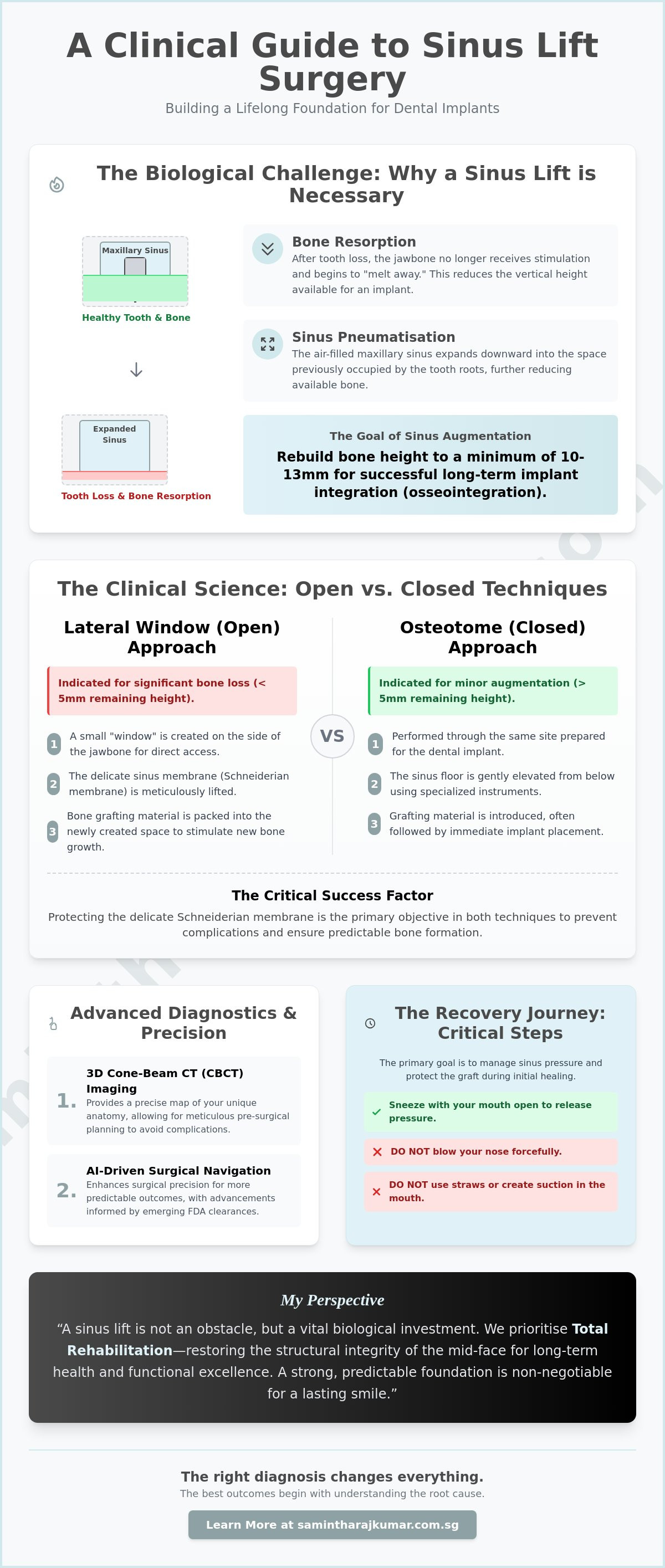
The maxillary sinus is an air-filled space positioned directly above your upper molar and premolar teeth. While these cavities serve essential functions for breathing and vocal resonance, they present a unique challenge in restorative dentistry. When you lose a tooth in this region, the surrounding alveolar bone no longer receives the mechanical stimulation it needs to maintain its density. Consequently, the bone begins to resorb or "melt away." From a biological perspective, this process is often coupled with sinus pneumatisation, where the sinus cavity actually expands downwards into the space where the tooth roots used to be.
To better understand this concept, watch this helpful video:
In my clinical experience, this dual action of bone loss from below and sinus expansion from above creates a biological thinness that makes traditional implant placement impossible without intervention. A Sinus lift becomes mandatory when the remaining bone height falls below the threshold required to anchor a titanium or ceramic implant securely. Without sufficient vertical height, we risk the implant failing to integrate or, worse, penetrating the delicate sinus membrane. For many patients, sinus lift surgery for dental implants is the only predictable way to reclaim their oral health.
Why Bone Loss Occurs in the Upper Jaw
Bone is a dynamic tissue that requires constant use to stay healthy. When a tooth is removed, the lack of functional load triggers a rapid decline in bone volume. If periodontal disease was the cause of the tooth loss, chronic inflammation has likely already compromised the ridge. Additionally, I often see patients with anatomical variations where the sinus is naturally large, leaving very little room for even the most conservative implant protocols. Understanding these factors is the first step in crafting a personalised treatment plan that respects your unique anatomy.
The Role of Sinus Augmentation in Total Rehabilitation
As a clinician and founder, I believe that sinus lift surgery for dental implants is about more than just filling a gap; it's about restoring the structural integrity of the mid-face. To achieve a predictable result, we typically look for a vertical bone height of 10mm to 13mm. This ensures the implant has enough surface area to fuse with the bone, a process known as osseointegration. By carefully lifting the sinus floor and introducing high-quality grafting material, we create a robust environment that supports the implant for a lifetime, ensuring your restoration feels as natural and stable as your original teeth.
The Clinical Science: Open vs. Closed Sinus Lift Techniques
The surgical choice between an open or closed approach is never arbitrary. In my clinical experience, the decision is dictated entirely by the volume of existing bone and the specific topography of your maxillary sinus. At the heart of both techniques lies the protection of the Schneiderian membrane, the thin, bi-layered lining of the sinus cavity. My primary objective is to gently elevate this membrane to create a secluded space where new bone can thrive, ensuring a stable foundation for your future restoration. Protecting this delicate lining is the most critical factor in preventing post-operative complications and ensuring long-term success.
The Lateral Window Approach
I typically recommend the lateral window technique for patients facing significant bone resorption, where the residual bone height is less than 5mm. This "open" procedure involves creating a small, precise entry point in the side of the jawbone. Through this window, I have direct vision and access to the sinus lining, allowing for a controlled, meticulous elevation. Once the membrane is safely lifted, we pack the space with high-quality grafting material to stimulate osteogenesis. This Sinus augmentation procedure is a cornerstone of complex oral rehabilitation, providing the necessary vertical dimensions for sinus lift surgery for dental implants even in the most challenging cases.
Minimally Invasive Crestal Sinus Lifts
When a patient retains a moderate amount of bone, perhaps 6mm to 8mm, a more conservative "closed" approach is often viable. This is known as a crestal or internal lift. Instead of an external window, I access the sinus floor through the same site prepared for the dental implant. By using specialised instruments to gently "tap" the bone upward, we can increase height without the need for larger incisions. This technique significantly reduces post-operative swelling and accelerates the healing timeline. It is a refined, elegant solution for internal augmentation that minimises discomfort while achieving the same biological goal.
From a biological perspective, the success of these techniques relies on the body's incredible capacity to heal and integrate new tissue. Whether we utilise a lateral or crestal approach, the goal remains the same: a predictable, lasting result. Every patient's journey is unique, and I believe the best outcomes begin with understanding the root cause of your specific needs before selecting a surgical path. By prioritising precision and membrane integrity, we ensure that your sinus lift surgery for dental implants serves as a resilient foundation for years to come.
Advanced Diagnostics: How AI and 3D Imaging Redefine Surgical Precision
Modern surgery isn't just about steady hands; it's about the data that guides them. As a clinician and founder, I've seen how the integration of AI-assisted diagnostics has fundamentally changed the safety profile of sinus lift surgery for dental implants. By 2026, the FDA had cleared over 1,100 AI-enabled radiology devices, reflecting a global shift toward precision-led care. I prioritise Cone Beam Computed Tomography (CBCT) for every case because it allows me to see what a standard X-ray cannot: the subtle density of your bone and the exact health of the sinus lining. These scans are the blueprint for everything we do.
I use these 3D models to conduct virtual surgical planning for every sinus lift surgery for dental implants. This means I've already performed the procedure digitally before you arrive at the clinic. We can identify potential hurdles, such as the exact location of the alveolar-antral artery, and plan around them with mathematical certainty. This digital rehearsal reduces time in the chair and ensures a much smoother recovery. I believe that a predictable path to success is built on this foundation of clinical mastery and technological innovation.
The Power of 3D Bone Mapping
We don't just look at the bone; we measure its quality. By assessing bone density in Hounsfield units, I can predict how your jaw will respond to an implant. This mapping is vital for a successful Sinus Augmentation. It eliminates the guesswork that used to be common in traditional surgery. When we know the exact landscape of your maxillary sinus, we can operate with a level of confidence that traditional methods simply cannot match. It’s about ensuring the implant has a stable, dense environment to call home.
Biological Materials and Bone Grafting Innovation
From a biological perspective, the materials we use must act as a perfect scaffold for your body's natural healing. I often utilise xenografts or high-grade synthetic materials to provide the necessary structure. However, the real innovation lies in growth factors like Platelet-Rich Fibrin (PRF). By using a small sample of your own blood, we can create a concentrated membrane of healing cells. This not only accelerates bone maturation but ensures the graft is biologically accepted by your body. This synergy between technology and biology is what creates a lasting foundation.
In my clinical experience, the combination of AI-driven diagnostics and advanced biologics is what defines modern excellence. The best outcomes begin with understanding the root cause, and our technology ensures we see everything clearly from the very first consultation.
The Recovery Journey: What to Expect After Sinus Augmentation
The success of sinus lift surgery for dental implants isn't determined solely in the operating theatre. It's a biological partnership between my surgical technique and your body's ability to heal. In my clinical experience, the first 48 hours are the most critical for stabilising the graft. During this window, I advise patients to prioritise rest and strictly avoid any activity that creates pressure within the nasal cavities. This means no nose-blowing and sneezing with your mouth open; these simple precautions prevent the displacement of the bone graft or the disruption of the delicate Schneiderian membrane we worked so hard to protect.
From a biological perspective, the timeline for recovery is longer than many expect. While the initial soft tissue healing occurs within two weeks, the process of osseointegration, where the graft transforms into solid, living bone, typically requires four to nine months. I often find that patients who have previously navigated an impacted wisdom tooth surgery recovery find the post-operative discomfort of a sinus lift to be quite manageable by comparison. However, the requirement for patience is much higher here, as we're building a foundation that must last a lifetime.
Managing Discomfort and Swelling
Swelling is a natural part of the inflammatory response. I recommend applying a cold compress to the cheek in 20-minute intervals during the first two days to minimise this. I also prescribe a specific course of antibiotics and nasal decongestants to keep the sinus environment sterile and clear. While some minor bruising is normal, you should contact the clinic if you experience a persistent foul taste, high fever, or pain that doesn't respond to medication. Monitoring these signs ensures we stay on a predictable path toward successful dental implant integration.
Lifestyle Adjustments During Healing
Your diet should consist of soft, nutrient-dense foods that don't require heavy chewing near the surgical site. Hydration is equally vital, though I must insist you avoid using straws, as the suction can disturb the healing site. One of the most common questions I receive is when can I resume exercise after oral surgery?. For a sinus lift, I generally advise waiting at least seven to ten days before returning to light activity. Elevating your heart rate too soon can lead to throbbing or bleeding at the graft site, which risks compromising the entire procedure.
As a clinician and founder, I believe that the best results come from a shared commitment to the recovery protocol. If you have concerns about your specific healing timeline, contact our surgical team for a personalised review of your progress. The best outcomes begin with understanding the root cause of any discomfort and addressing it with clinical precision.
My Perspective: Why a Strong Foundation is Non-Negotiable
As a clinician and founder, I have always maintained that the most enduring medical outcomes are those built with a long-term vision. In my clinical experience, patients are often understandably eager to reach the final result of their restorative journey. However, rushing into work without addressing structural deficiencies is a compromise I simply won't make. From a biological perspective, we must respect the intricate anatomy of the face. Sinus lift surgery for dental implants is not merely a technical prerequisite; it's a strategic biological intervention that prevents future bone collapse and ensures the longevity of your oral health.
I believe in a philosophy of "Total Rehabilitation." This means looking beyond the immediate gap in your smile to consider the health of the entire maxillary complex. While the required healing period for a bone graft can range from 4 to 12 months, this investment of time is what separates a temporary fix from a lifetime of stability. By reconstructing the ridge, we provide the necessary support for ceramic dental implants to integrate fully. My goal is to ensure that your restoration stands the test of time, both functionally and aesthetically.
The Intersection of Science and Artistry
The benefits of a sinus lift extend beyond the surgical site. When we restore bone volume in the upper jaw, we're also supporting the mid-face structure. This prevents the sunken appearance that often accompanies long-term tooth loss, effectively balancing clinical requirements with facial aesthetics. There's a profound sense of confidence that comes with a stable, functional smile. It is the intersection where meticulous surgical science meets the artistry of facial rejuvenation, allowing for a result that feels as natural as it looks.
Your Journey Toward Total Rehabilitation
The right diagnosis changes everything in implantology. I personally oversee the diagnostic phase for every complex case because I know that precision at the start dictates the success of the finish. By utilising the AI-assisted workflows and 3D mapping discussed earlier, we eliminate ambiguity. We don't just place implants; we build a legacy of health. The best outcomes begin with understanding the root cause, and I am committed to guiding you through every step of this transformative journey with transparency and clinical mastery.
Securing the Future of Your Restorative Journey
A successful smile is built on more than aesthetics; it requires a deep respect for the biological landscape of the jaw. As the founder of Nuffield Dental, I've dedicated my career to mastering complex rehabilitations, from Zygomatic protocols to All-on-4 systems. We've explored how sinus lift surgery for dental implants serves as the essential bedrock for these procedures, ensuring that your restoration is supported by living, integrated bone. By combining AI-assisted diagnostic precision with meticulous surgical technique, we remove the guesswork from your care, replacing anxiety with a predictable path toward health.
In my clinical experience, the most transformative results occur when we refuse to take shortcuts. My commitment to you is a journey defined by transparency, innovation, and an uncompromising focus on your long-term well-being. The best outcomes begin with understanding the root cause. Learn more about our approach to total rehabilitation. Your path to a functional, confident smile is a partnership, and it's one I'm honoured to lead. Trust in the process, for the right foundation truly changes everything.
Frequently Asked Questions
Is sinus lift surgery painful?
The procedure itself is typically not painful as we use local anaesthesia or intravenous sedation to ensure your total comfort. In my clinical experience, most patients describe the post-operative sensation as a dull pressure or mild discomfort rather than acute pain. We provide a comprehensive management protocol, including anti-inflammatories and cold compresses, to manage any swelling. Most individuals return to their normal routines within a few days of undergoing sinus lift surgery for dental implants.
How long do I have to wait for dental implants after a sinus lift?
The healing timeline generally ranges from four to nine months to allow the bone graft to fully integrate with your natural jaw. This period of osseointegration is vital because the new bone must be strong enough to support the mechanical loads of chewing. In specific cases where you have enough existing bone to stabilise an implant initially, I may be able to perform the lift and implant placement during the same clinical session.
Can I have a sinus lift if I have chronic sinusitis?
You can have the procedure, but any active inflammation or infection must be resolved before we proceed. From a biological perspective, a healthy sinus environment is essential for the bone graft to successfully integrate. I often work alongside ENT specialists to ensure your chronic sinusitis is managed through appropriate treatment first. This collaborative approach ensures that your sinus lift surgery for dental implants is performed on a stable, healthy foundation.
What happens if the sinus membrane tears during surgery?
If the Schneiderian membrane tears, I can usually repair it immediately using a specialised collagen patch or fine sutures. Small tears are a known clinical occurrence and typically don't compromise the final outcome if addressed with surgical precision. However, if a tear is particularly significant, I may choose to stop the procedure and allow the membrane to heal for several months. We then reschedule the augmentation once the tissue has regained its integrity.
Are there alternatives to sinus lift surgery for dental implants?
Yes, there are several advanced alternatives depending on your unique bone morphology. For patients with severe resorption who wish to avoid augmentation, I often recommend zygomatic dental implants, which anchor into the cheekbone instead of the jaw. Other options include using shorter implants or angled protocols like All-on-4. The most appropriate choice depends on a thorough diagnostic review of your jaw structure and your long-term functional goals.
Will a sinus lift change the shape of my face or nose?
No, a sinus lift will not alter the external appearance of your nose or facial features. The procedure is performed entirely within the internal structure of the upper jawbone. In fact, by providing the necessary bone volume to support dental implants, we actually help maintain the natural contours of your mid-face. This prevents the "sunken" appearance that often follows the progressive loss of bone and teeth in the molar region.
How long does the actual sinus augmentation procedure take?
The surgical procedure typically takes between 45 and 90 minutes to complete. This duration varies based on whether we utilise a minimally invasive crestal approach or a more comprehensive lateral window technique. My priority is always clinical precision rather than speed. By using AI-assisted planning beforehand, we streamline the process in the operating theatre, which often leads to a more efficient and comfortable experience for my patients.
What are the risks of not getting a sinus lift when recommended?
Proceeding with implants without a recommended lift significantly increases the risk of early implant failure or accidental sinus penetration. Without adequate bone height, the implant cannot achieve the stability required for long-term function. Over time, the lack of structural support can lead to the loss of adjacent teeth and further resorption of the jawbone. Following an expert recommendation ensures we build a foundation that respects your facial biology and long-term health.


Comments