
Teeth in a Day Procedure Explained: A Surgeon’s Perspective on Total Rehabilitation

The traditional six-month wait for dental implants is no longer a clinical necessity, but a relic of a pre-digital era. In my clinical experience, the most profound barrier to treatment isn't the surgery itself, but the fear of being without teeth for months on end. This is why the teeth in a day procedure explained in this guide represents such a vital shift in restorative dentistry. By leveraging primary stability and advanced immediate-load protocols, we can now bypass the lengthy, multi-stage processes that once defined oral rehabilitation. From a biological perspective, we are working with the body's natural healing capacity to provide immediate function.
I understand the social anxiety and functional frustration that come with failing or missing teeth. It's exhausting to hide your smile or avoid your favourite foods because of dental instability. This article provides a comprehensive surgeon’s perspective on how we achieve total rehabilitation in a single session. I will walk you through the biological science of immediate loading, which currently boasts a ten-year survival rate of approximately 95 percent for full-arch cases. You will learn about the surgical roadmap for All-on-4 and what you can realistically expect for your long-term quality of life.
Key Takeaways
Understand the biological mechanics of the teeth in a day procedure explained here, which allows for immediate loading and functional restoration in a single clinical session.
Learn why achieving primary stability through cortical bone engagement is essential for the mechanical success of immediate-load implants.
Discover how meticulous digital planning and preoperative diagnostics create a predictable roadmap for complex oral rehabilitation.
Explore my philosophy on how total rehabilitation addresses both functional chewing capacity and the long-term preservation of facial aesthetics.
Identify the key stages of the patient journey, from initial medical clearance to the final integration of a permanent, life-changing prosthesis.
Table of Contents
Demystifying the 'Teeth in a Day' Concept: From Terminal Dentition to Total Rehabilitation
The Clinical Science of Immediate Loading: How We Achieve Stability in 24 Hours
My Perspective: The Surgical Artistry Behind Immediate Dental Implants
Preparation, Procedure, and Recovery: Navigating the Patient Journey
Beyond the Surgery: The Impact of Full-Mouth Restoration on Quality of Life
Demystifying the 'Teeth in a Day' Concept: From Terminal Dentition to Total Rehabilitation
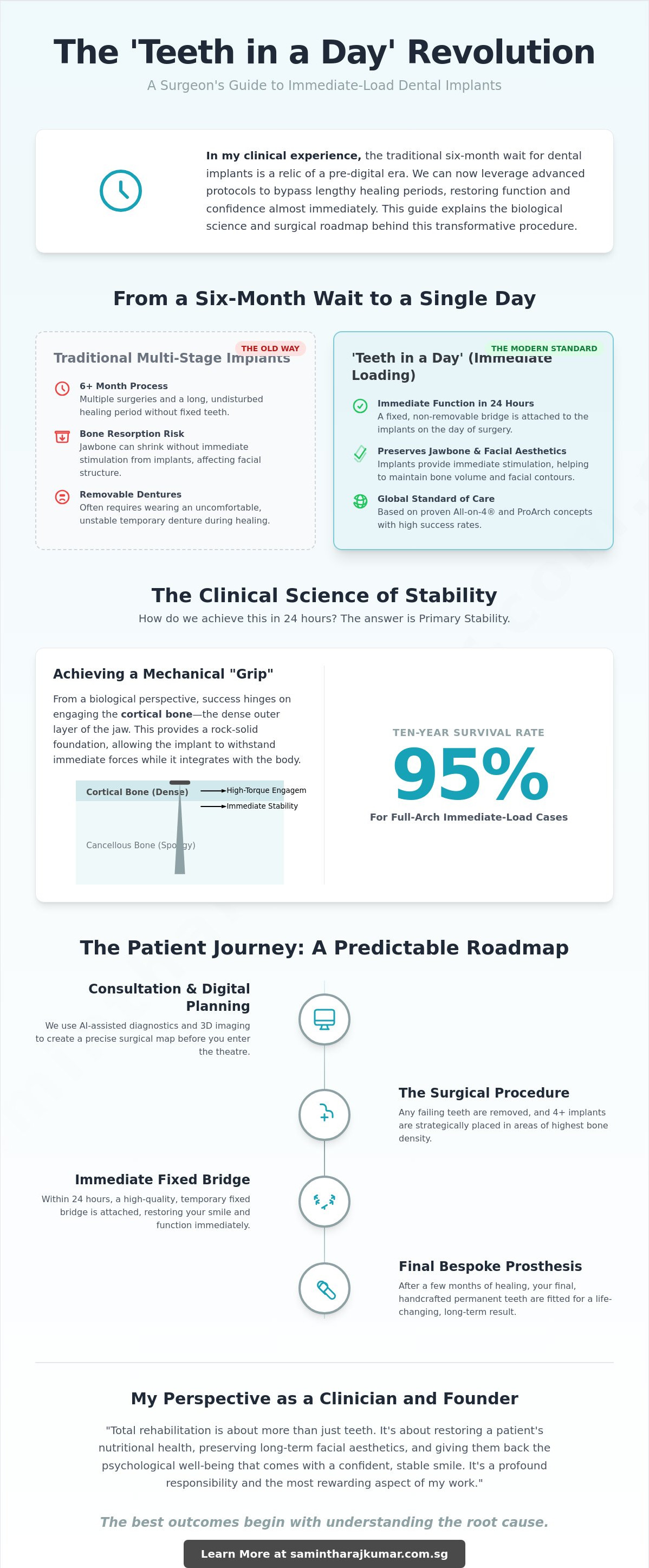
As a clinician and founder, I've often seen the "Teeth in a Day" concept dismissed as a mere marketing catchphrase. In reality, it represents a sophisticated surgical protocol formally known as immediate loading. This teeth in a day procedure explained simply means that a fixed, non-removable bridge is attached to dental implants within 24 hours of the surgical phase. At Nuffield Dental, we view this not as a shortcut, but as a meticulously planned intervention for patients facing terminal dentition, where the remaining teeth are no longer functional or salvageable.
The evolution of the Dental Implant has allowed us to move away from the traditional, multi-stage approach that once required patients to wait six months for their new smile. In my clinical experience, the ability to provide immediate function isn't just about aesthetics; it's about maintaining the patient's nutritional health and psychological well-being from the very first day. We use advanced digital diagnostics to ensure that the implants are positioned with the precision required to support immediate weight-bearing.
To better understand how this transformation is possible in such a short timeframe, watch this helpful video:
The Problem: Why Traditional Dentures Often Fail Patients
From a biological perspective, the loss of natural teeth leads to a process called bone resorption. Without the stimulation of tooth roots, the jawbone begins to shrink, which fundamentally changes the shape of the face. Traditional removable dentures do nothing to stop this. In fact, they often accelerate the process. Many of my patients describe the social anxiety caused by "floating" dentures that slip during speech or meals. This instability isn't just a physical inconvenience; it's a constant reminder of a lost quality of life. Immediate intervention with implants provides the necessary stimulation to preserve bone volume and restore confidence.
The Solution: A New Standard in Implantology
The introduction of All-on-4 and Proarch concepts has set a new global standard for total rehabilitation. We transition from failing teeth to a fixed restoration in just a few hours by strategically placing four or more implants in areas of the highest bone density. This approach relies heavily on AI-assisted diagnostics and 3D imaging to map out the surgical site before the patient even enters the theatre. It's important to understand that the "teeth" you receive on day one are a high-quality temporary bridge. This allows your gums to heal and the implants to fuse with the bone before we fit your final, bespoke prosthesis several months later. The best outcomes begin with understanding the root cause of dental failure and addressing it with precision.
The Clinical Science of Immediate Loading: How We Achieve Stability in 24 Hours
The success of immediate loading hinges on a concept we call primary stability. This is the mechanical "grip" the implant achieves within the bone at the moment of placement. While traditional methods rely on a period of undisturbed healing, this teeth in a day procedure explained through a surgical lens relies on high-torque engagement. From a biological perspective, we aren't waiting for the bone to grow into the implant before we use it; instead, we are securing the implant so firmly that it can withstand functional forces immediately.
To achieve this, we prioritise engagement with the cortical bone. This is the dense, outer layer of the jaw that provides far more structural integrity than the softer, sponge-like cancellous bone found in the centre. By anchoring implants into this high-density bone, we create a foundation capable of immediate weight-bearing. It's a precise architectural feat that allows the biological process of osseointegration, the permanent fusing of bone to the implant surface, to occur even as you begin to eat and speak with your new teeth.
A critical component of this stability is the fixed bridge itself. I view the bridge not just as a cosmetic addition, but as a surgical splint. By connecting multiple implants together with a rigid restoration, we eliminate the risk of micro-movements. These tiny shifts are the primary risk factors for immediate dental implants, as they can interfere with the delicate healing process. When the implants are locked together, they support one another, distributing the force of your bite across the entire arch.
The Role of AI and Digital Diagnostics
In my clinical experience, the margin for error in immediate loading is virtually zero. This is why I've integrated AI-assisted diagnostics and 3D CBCT scans into every case. We map your bone density with incredible precision, identifying the exact coordinates for optimal cortical engagement. This digital roadmap allows us to create a bespoke surgical guide, which ensures the implants are placed exactly where the pre-surgical plan dictates. This level of accuracy significantly reduces surgical time and minimises trauma to the surrounding tissues.
Biocompatibility and Material Selection
As a clinician and founder, I believe material choice is just as vital as surgical technique. While titanium remains a global standard, many of my patients now opt for ceramic dental implants due to their exceptional biocompatibility. These metal-free alternatives are highly resistant to plaque accumulation and support faster soft-tissue healing. Whether we choose titanium or zirconia, our goal is to use materials that the body accepts readily, ensuring a long-term legacy of health. Understanding the biological requirements of your jaw is the first step toward a successful restoration, and comprehensive diagnostic clarity remains the cornerstone of my practice.
My Perspective: The Surgical Artistry Behind Immediate Dental Implants
As a clinician and founder, I view every case of total rehabilitation as a unique architectural challenge. It isn't simply about placing screws into bone; it's about rebuilding a foundation that has often been compromised by years of infection or structural decay. When I approach the teeth in a day procedure explained to my patients, I emphasise that we are restoring more than just a smile. We are reconstructing the vertical dimension of the face and providing the essential lip support that prevents a premature aged appearance. In my clinical experience, the synergy between functional chewing capacity and facial aesthetics is what defines a successful surgical outcome.
I prioritise this immediate-load protocol for patients facing total tooth loss because the psychological transition is just as important as the biological one. There is a profound personal impact when a patient enters the clinic with failing dentition and leaves with a secure, fixed bridge. This immediate transformation lowers the emotional barriers to surgery and allows the patient to reclaim their social confidence without the indignity of a removable denture. From a biological perspective, this approach allows us to capitalise on the existing bone volume before further resorption occurs, ensuring a stable and long-lasting result.
Beyond Standard Protocols: Zygomatic and Pterygoid Implants
For some patients, the journey to restoration is complicated by severe bone loss in the upper jaw. In these complex cases, standard implants may not have enough bone for a secure "grip." This is where the surgical artistry of Zygomatic dental implants becomes essential. By anchoring longer implants into the cheekbones (the zygoma) or the pterygoid plates, we can bypass the need for extensive, painful bone grafting. My philosophy has always been to work with the body's existing anatomy. These advanced protocols ensure that even those told they were "not a candidate" for implants can still benefit from a total rehabilitation in a single day.
The Founder’s Principle: Quality Over Speed
While the name suggests a rapid process, my principle as a founder is that "one day" refers specifically to the surgical transformation, not a rushed clinical journey. A successful teeth in a day procedure explained from a leadership perspective requires a meticulously coordinated multi-disciplinary team. In the operating theatre, we bring together surgeons, anaesthetists, and master technicians to ensure every detail is perfect. We adhere strictly to global standards and international protocols, ensuring that the legacy of your health is never compromised for the sake of speed. Our commitment is to a level of excellence that matches the world's leading medical networks, providing a premium experience that prioritises your long-term well-being. The best outcomes begin with understanding the root cause, and our institutional heritage is built on that very foundation.
Preparation, Procedure, and Recovery: Navigating the Patient Journey
While the physical transformation happens in a single session, the success of the teeth in a day procedure explained here relies on meticulous preoperative planning. As a clinician and founder, I ensure that every patient undergoes a rigorous medical clearance process. We evaluate systemic health, focusing on factors like bone density and controlled blood sugar levels, to guarantee the body is ready for immediate loading. Digital impressions and 3D imaging are used to create a virtual model of your jaw, allowing us to design your new smile before you even enter the surgery suite.
On the day of transformation, our priority is your absolute comfort. We manage the surgical environment through advanced sedation and anaesthesia protocols, ensuring a state of calm and security. This is not merely about pain management; it's about lowering the physiological stress that can interfere with early healing. In my clinical experience, a relaxed patient recovers more predictably. By the time the anaesthesia wears off, the foundational work of your rehabilitation is already complete.
The Surgical Day: Step-by-Step
Step 1: Precise Extraction and Preparation. We carefully remove any remaining failing teeth and prepare the site. This involves cleaning the sockets and smoothing the bone to create a healthy environment for the implants.
Step 2: Strategic Implant Placement. We place between 4 and 6 implants into the pre-planned positions. By using a surgical guide, we ensure each implant engages the dense cortical bone for maximum primary stability.
Step 3: Fitting the Temporary Bridge. Once the implants are secured, we attach a custom-milled temporary bridge. This provides immediate function and aesthetics while your jawbone begins the process of osseointegration.
The Recovery Roadmap
The first 48 hours are a critical window for managing minor swelling and ensuring the surgical sites remain undisturbed. I advise patients to follow a strict soft-food diet during the initial healing phase. This prevents excessive force on the new implants while they are in the early stages of fusing with the bone. You'll gradually transition from liquids to soft proteins like fish or eggs over several weeks. From a biological perspective, this "mechanical rest" is essential for long-term success.
Oral hygiene remains paramount. We provide specific protocols for cleaning around the bridge using specialized brushes and water flossers. Regular follow-up appointments allow us to monitor the healing of the soft tissues and the stability of the implants. After approximately four to six months, once the biological integration is complete, we replace the temporary restoration with your final, bespoke bridge. If you're ready to begin this journey, understanding your specific clinical needs is the first step toward a predictable outcome.
Beyond the Surgery: The Impact of Full-Mouth Restoration on Quality of Life
The conclusion of the surgical phase is merely the beginning of a profound personal renewal. While we have already seen the teeth in a day procedure explained through its mechanical and biological components, the true measure of success lies in the restoration of the patient's facial architecture. In my clinical experience, chronic tooth loss often leads to a "collapsed bite," where the distance between the nose and chin decreases. This loss of vertical dimension causes the skin to sag and the lips to thin, creating a prematurely aged appearance. By precisely calculating the ideal bite position during the restorative phase, we can rejuvenate the face shape and restore lost volume from within.
This synergy between surgery and aesthetics is a hallmark of my practice. The principles of cosmetic dentistry in Singapore are not separate from implantology; they are deeply integrated. We don't just provide teeth; we design a smile that complements your unique facial features and supports your soft tissues. The emotional impact of looking in the mirror and seeing a vibrant, healthy version of yourself is often the most rewarding part of the journey for my patients. It's a moment of emotional renewal that transcends clinical metrics.
Functional Excellence and Systemic Health
From a biological perspective, the ability to chew effectively is the foundation of systemic wellbeing. When patients suffer from terminal dentition, they often drift toward a diet of soft, processed carbohydrates because they cannot break down fibrous vegetables or lean proteins. This nutritional shift can have significant consequences for long-term health, impacting everything from digestion to energy levels. Total rehabilitation allows you to return to a diverse, nutrient-dense diet. I view the teeth in a day procedure explained in this article as a strategic investment in your future self, ensuring that your later years are defined by vitality rather than physical limitation.
Final Thoughts: The Right Diagnosis Changes Everything
As a clinician and founder, my vision has always been to build a healthcare institution where no patient is ever deemed "untreatable." We rely on global standards and a rich institutional heritage to solve the most complex dental challenges, ensuring that every patient receives a world-class level of care. The transformative power of modern implantology means that social anxiety and functional pain do not have to be your permanent reality. Every successful transformation I have witnessed reinforces my belief that the right diagnosis changes everything. The best outcomes begin with understanding the root cause, and I am committed to guiding you through that journey with both technical excellence and compassionate care.
Reclaiming Your Quality of Life Through Total Rehabilitation
Total oral rehabilitation is more than a clinical procedure; it's a profound transition toward a life free from the constraints of failing teeth. As the teeth in a day procedure explained throughout this guide demonstrates, we can now leverage immediate-load protocols to restore function and facial volume in a single day. This transformation is underpinned by meticulous digital planning and a biological understanding of primary stability. Even for those facing severe bone loss, our expertise in complex Zygomatic protocols ensures that a fixed restoration remains a viable reality.
As a clinician and founder, I'm proud to lead a specialist practice that adheres to the highest international clinical standards. We don't just focus on the mechanics of surgery; we prioritise the long-term legacy of your health and confidence. By choosing a team with deep institutional heritage, you ensure that every aspect of your journey is managed with precision and care. The best outcomes begin with understanding the root cause. Explore our approach to total rehabilitation and take the first step toward a functional, vibrant future. You deserve a smile that reflects your true self.
Frequently Asked Questions
Is the 'Teeth in a Day' procedure actually completed in 24 hours?
Yes, the surgical placement of your implants and the attachment of a fixed temporary bridge occur within a single day. While the teeth in a day procedure explained in this guide involves several months of total biological healing, you will leave the clinic on the day of surgery with a functional, non-removable smile. This immediate transformation is what distinguishes this protocol from traditional methods that often require months of wearing removable dentures.
Can I really eat straight after the procedure?
You can eat immediately after the surgery, but you must adhere to a strict soft-food diet for the first three to four months. In my clinical experience, the implants need this period of mechanical rest to fuse with the bone without the interference of heavy biting forces. You should focus on nutrient-dense, soft proteins like eggs, flaky fish, and well-cooked vegetables until we transition you to your final, permanent bridge.
What is the success rate of immediate load dental implants?
The success rate is exceptionally high and comparable to traditional implant methods. Research indicates that immediate load implants have a 10-year survival rate between 90 and 95 percent. For full-arch cases specifically, systematic reviews report a cumulative survival rate of approximately 95 percent at the 10-year mark. These outcomes are highly dependent on meticulous surgical planning and the patient's commitment to oral hygiene protocols.
How much pain should I expect during and after the surgery?
You should feel no pain during the surgery because we use advanced sedation and anaesthesia to ensure your absolute comfort. After the procedure, most of my patients describe the sensation as a dull ache similar to a tooth extraction. This discomfort is typically manageable with prescribed medication and usually peaks within the first 48 to 72 hours before subsiding as the soft tissues begin to heal.
Am I a candidate if I have significant bone loss?
Significant bone loss does not automatically disqualify you from this procedure. From a biological perspective, we can often bypass areas of low bone density by using Zygomatic dental implants, which anchor into the dense bone of the cheekbones. This advanced protocol allows us to provide total rehabilitation to patients who were previously told they were not candidates for traditional implants due to severe resorption.
What is the difference between All-on-4 and Teeth in a Day?
All-on-4 is a specific surgical technique that uses four tilted implants to support a full arch of teeth. "Teeth in a Day" is a broader clinical term for the immediate-loading protocol, which could involve anywhere from four to six implants depending on the patient's unique anatomy. As a clinician and founder, I select the specific configuration that provides the highest level of primary stability for your individual case.
How do I clean and maintain my new implants?
Maintaining your implants requires a dedicated hygiene routine using specialized tools like water flossers and soft-bristled interproximal brushes. You must clean the space between the bridge and the gumline to prevent peri-implantitis, an infection that affects roughly 5 to 10 percent of implants over a decade. Regular professional cleanings at our clinic are essential to ensure the long-term health of the supporting bone and tissue.
What happens if an implant fails to integrate?
If an implant fails to integrate with the bone, which occurs in a small minority of cases, we typically remove the failing implant and allow the site to heal. Once the bone has regenerated, we can usually place a new implant to restore the foundation. While such instances are rare, my focus on AI-assisted diagnostics and precise surgical guides is designed to minimize these risks and ensure a predictable, lifelong result.

Comments