
The Benefits of Botox for Teeth Grinding: A Surgeon’s Perspective on Neuromuscular Relief

What if the most effective tool to save your dental implants from the destructive force of night-time grinding isn't a plastic guard, but a precision-engineered neuromodulator? Many of my patients arrive at the clinic feeling frustrated by chronic tension headaches and the discomfort of bulky night guards that fail to address the root cause of their pain. In my clinical experience, it's heartbreaking to see patients invest in beautiful ceramic crowns only to witness visible wear and tear caused by involuntary muscle activity. I understand the desire for a solution that doesn't just mask the symptoms but actually restores functional harmony to the jaw.
In this article, I'll share why I view the benefits of botox for teeth grinding as a vital component of modern rehabilitative dentistry. While currently considered an "off-label" application by the FDA, it's a medically accepted practice that I've seen transform the quality of life for my patients. You'll discover how botulinum toxin serves as a sophisticated clinical tool to alleviate bruxism, protect your dental structures, and restore jaw function. I'll take you through the science of neuromuscular relief, explaining how we can reduce jaw tension and even refine a "square" jawline caused by muscle hypertrophy. We'll look at what you can expect from this treatment and how it fits into a comprehensive plan for long-term oral health.
Key Takeaways
Discover why I view bruxism as a neuromuscular habit rather than a simple dental issue, focusing on the role of the masseter muscles in generating excessive force.
Understand the clinical benefits of botox for teeth grinding, particularly its ability to preserve natural enamel and protect complex restorations such as ceramic dental implants.
Learn the truth behind common myths to gain confidence that botulinum toxin, when administered by a specialist, is a safe tool that won't compromise your natural facial expressions.
Explore the patient journey from the initial specialist consultation to the injection process, ensuring you know exactly what to expect during this minimally invasive procedure.
Gain insight into my biological philosophy of care, where we prioritise total oral rehabilitation and long-term functional excellence over temporary fixes.
Table of Contents
The Science of Neuromodulation: How Botox Addresses Bruxism
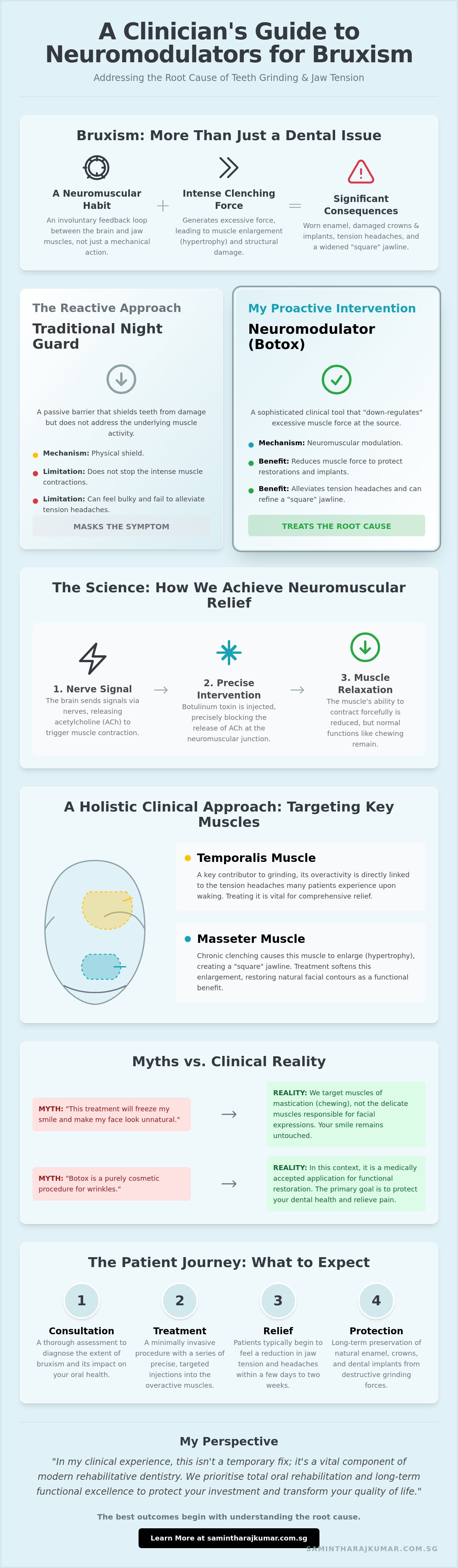
Bruxism is far more than a simple dental concern. It's a complex, involuntary neuromuscular habit that originates in the brain and manifests through the intense clenching and grinding of the teeth. While many patients view it as a mechanical issue to be blocked by a plastic guard, The Science of Bruxism reveals a deeper biological story. It involves a repetitive feedback loop between the central nervous system and the primary muscles of mastication. From a biological perspective, we must address the driver of this force, not just the resulting damage to the teeth.
In my clinical experience, the most effective way to break this cycle is to address the source of the force itself. By utilising botulinum toxin type A, we can precisely interrupt the release of acetylcholine, the chemical messenger that tells your muscles to contract. We aren't seeking to paralyse the jaw. Instead, we aim for a sophisticated modulation of the muscle's power. One of the key benefits of botox for teeth grinding is this ability to "down-regulate" the motor units, providing a level of physical relief and structural protection that passive mouthguards simply cannot achieve. It's a proactive clinical intervention rather than a reactive one.
To better understand this concept, watch this helpful video:
The Masseter Muscle and Hypertrophy
When the masseter muscles are constantly engaged in nocturnal grinding, they undergo significant hypertrophy. Just like any other muscle subjected to heavy lifting, they become enlarged and dense. This often results in a noticeably "square" or widened jawline; this is a direct biological consequence of chronic bruxism rather than a purely aesthetic trait. As a clinician and founder, I focus on targeted injections to soften this enlargement and restore a more natural facial contour. The goal is a meticulous balance. We reduce the destructive clenching force while fully maintaining your ability to chew and speak naturally. This refinement of the jawline is a welcome functional byproduct of reducing muscle strain.
Beyond the Surface: Temporalis Muscle Involvement
Treating only the masseter is often an incomplete strategy for patients suffering from chronic tension headaches upon waking. The temporalis muscle, situated on the side of the head, is frequently a silent partner in the grinding process. There's a clear biological link between temporalis overactivity and referred pain that radiates across the cranium. A truly comprehensive protocol must account for this. By including the temporalis in our neuromuscular reset, we achieve a more balanced and profound reduction in overall jaw tension. This holistic approach ensures the patient isn't just protecting their teeth, but also reclaiming their daily comfort and freedom from persistent cranial pressure.
Busting Common Myths About Botox for Teeth Grinding
Misconceptions often cloud the clinical reality of neuromodulators, preventing many from accessing effective relief. Most patients I meet have encountered conflicting information online that frames botulinum toxin as either a purely cosmetic "hack" or a risky procedure. In my clinical experience, these fears are almost always rooted in a misunderstanding of how we apply this tool in a dental context. The benefits of botox for teeth grinding are grounded in functional restoration, not just surface-level aesthetics.
A frequent concern is that the treatment will "freeze" your smile or leave you looking expressionless. This myth persists because of high-profile cases of over-treatment in the upper face. However, when we address bruxism, we focus on the masseter and temporalis muscles. These are muscles of mastication, not the delicate muscles responsible for your smile or social expressions. When administered correctly, your ability to laugh, smile, and speak remains entirely unaffected.
Precision over Paralysis
As a clinician and founder, I advocate for a philosophy of precision over paralysis. We don't aim to stop the muscle from functioning. Instead, we use a carefully calibrated dosage strategy: enough to inhibit the destructive, involuntary clenching, but not enough to stop the chew. You'll still be able to enjoy your favourite foods without any loss of function. By precisely targeting the overactive muscle fibres, we reset the jaw's baseline tension without compromising your natural facial dynamics. This balanced approach is why the expertise of a specialist is so critical.
Another common myth is that Botox is a "dangerous toxin" that shouldn't be used in the jaw. From a biological perspective, botulinum toxin type A has one of the most extensively researched safety profiles in modern medicine. It's been used for decades to treat complex conditions like cervical dystonia and chronic migraines. It isn't a permanent or systemic change; your body naturally metabolises the protein over three to six months. This temporary nature is actually a safety feature, allowing us to adjust your treatment plan as your neuromuscular health improves.
The Safety Profile of Botulinum Toxin
Some patients worry that regular injections will cause their jaw muscles to atrophy to a point of weakness. While it's true that the masseter will "de-bulk" or slim down, this is actually a therapeutic goal for those with hypertrophy. We're reducing the muscle to its healthy, natural size, not causing it to waste away. To ensure your safety and the longevity of your results, it's vital to consult a tmj specialist singapore who understands the complex anatomy of the jaw joint and its surrounding tissues.
Choosing to address bruxism with Botox isn't just about pain management; it's about preserving your dental heritage. Stripping away these myths allows us to focus on the biological reality of your care. The best outcomes begin with understanding the root cause of your tension and choosing a specialist who prioritises your long-term functional well-being.
The Clinical Benefits: Protecting Your Dental Investment
Investing in your smile is a significant commitment. Whether you've undergone minor restorative work or a total oral rehabilitation, the longevity of that work depends on a stable environment. In my clinical experience, bruxism is the single greatest threat to dental longevity. The benefits of botox for teeth grinding extend far beyond pain relief; they provide a vital safeguard for the physical structures of your mouth. Without intervention, decades of grinding can lead to a "collapsed bite," where the vertical dimension of the face shortens as teeth are worn down to the gum line. This doesn't just affect your ability to chew; it prematurely ages the entire facial profile by causing the chin to move closer to the nose.
Safeguarding Complex Restorations
For patients who have received ceramic dental implants, managing bite force is non-negotiable. Unlike natural teeth, implants are fused directly to the bone and lack the periodontal ligament that acts as a natural shock absorber. This means any excessive force is transmitted directly to the implant and the surrounding bone, significantly increasing the risk of ceramic fracture or marginal bone loss. I often use botulinum toxin as a "safety valve" during the healing phase, especially when the teeth in a day procedure explained is involved. By reducing the peak intensity of involuntary clenching, we create the necessary stability for the bone to integrate with the implant. This synergy between neuromuscular relaxation and prosthetic engineering is the hallmark of a truly biological approach to dentistry.
Functional Aesthetics and Jaw Slimming
While my primary focus is functional restoration, the aesthetic outcomes of this treatment are profound. As the overdeveloped masseter muscle returns to a more natural, healthy size, the lower face takes on a softer, more refined contour. This reduction in "bulkiness" is a key element of modern facial aesthetics. It’s about more than just looking better; it's about looking as relaxed as you feel. When the physical evidence of tension is removed from your jawline, the result is a more youthful and rested appearance. This transformation serves as a visible reminder of your restored comfort, often providing a psychological boost that matches the physical relief of a pain-free jaw. From a biological perspective, we're not just changing how you look, but how your facial muscles interact with the world.
The Patient Journey: What to Expect During Treatment
The path to relief begins long before the first injection. In my clinical experience, the most successful outcomes are rooted in a meticulous diagnostic process. We don't simply treat the jaw in isolation. Instead, we look at the entire craniofacial system to determine if you require broader jaw rehabilitation or if botulinum toxin is the appropriate standalone tool. This initial consultation is vital to ensure we aren't just masking a symptom of a deeper structural or skeletal misalignment.
The Diagnostic Phase
From a biological perspective, every face is unique. As a clinician and founder, I utilise AI-assisted diagnostics to map your specific muscle activity. This technology allows us to identify precise trigger points in the masseter and temporalis muscles with a level of accuracy that manual palpation alone cannot match. By analysing these digital maps, I can tailor the dosage and placement to your unique anatomy, ensuring we maximise the benefits of botox for teeth grinding while preserving your natural range of motion. We assess your bite alignment and muscle strength to create a baseline, ensuring the treatment plan is as unique as your smile.
The actual injection process is remarkably swift and minimally invasive. Most patients describe it as a minor pinch, taking less than fifteen minutes to complete. While you won't feel an immediate change, the neuromodulator begins its work within days. You'll typically notice the heavy tension in your jaw lifting and waking up without those characteristic "morning headaches" within the first week. However, the visible "slimming" effect on the masseter muscle usually takes about six weeks to fully manifest as the muscle gradually reduces in volume from a state of hypertrophy.
Post-Treatment Care and Expectations
To maintain these results, treatments are generally spaced between four and six months apart. This cadence allows the muscle to remain in a relaxed state without losing its functional integrity for chewing. After your session, I advise avoiding strenuous exercise or lying down for at least four hours; this prevents the toxin from migrating to unintended areas. While minor bruising can occur, it's rare and typically resolves quickly. For those seeking long-term relief, a structured plan for TMJ Pain Management ensures that we are managing the condition effectively over time. The best outcomes begin with understanding the root cause.
My Perspective: Integration into Total Oral Rehabilitation
As a clinician and founder, I've always believed that dentistry should transcend the boundaries of the tooth itself. We aren't just mechanics fixing a single unit; we are guardians of a complex biological system. In my clinical experience, the benefits of botox for teeth grinding represent a shift towards this more integrated, holistic model of care. It's a sophisticated tool that allows us to manage the soft tissues with the same precision we apply to bone and enamel. Understanding the multifaceted benefits of botox for teeth grinding is essential for any modern practitioner committed to total oral rehabilitation. It allows us to treat the driver of dental destruction, not just the symptoms.
The Biological Dentistry Philosophy
From a biological perspective, muscle health, bone density, and dental alignment are inextricably linked. If the muscles are in a constant state of hyper-tension, the bone and teeth will inevitably suffer, regardless of how well a restoration is placed. This is why a surgeon-led approach is superior to a purely aesthetic clinic. At Nuffield Dental, we don't just look for wrinkles; we look for the underlying neuromuscular dysfunction. By adhering to international-standard protocols, we ensure that every intervention is grounded in safety and clinical evidence. We are building a legacy of care that prioritises the patient's long-term well-being over temporary fixes, ensuring that every smile we restore is built on a foundation of functional harmony.
The future of our profession lies in the convergence of AI-assisted diagnostics, advanced surgical techniques, and neuromodulation. As we expand our reach across Southeast Asia, I'm focused on building institutions that embrace these innovations to provide superior patient outcomes. This isn't just about innovation for the sake of it; it's about creating a sustainable ecosystem of health. We are entering an era where we can predict failures before they happen and intervene with biological precision. This level of care is what distinguishes a specialised practice from a generalist one, as we constantly point toward a higher tier of expertise.
The Long-Term Impact on Quality of Life
The true measure of our success is the profound impact on a patient's daily life. It’s about more than just protecting a ceramic implant or a bridge. It’s about the energy you regain when you're no longer fighting chronic tension every morning. I've seen patients transform once the burden of jaw pain is lifted; they become more present, more productive, and more confident in their social interactions. There is a quiet freedom in a pain-free smile that many haven't experienced in years. Restoring function is always the first step toward true aesthetic renewal. When the jaw is finally at rest, the entire face follows, leading to a more vibrant and authentic version of oneself. The best outcomes begin with understanding the root cause.
Reclaiming Functional Harmony and Personal Comfort
As a clinician and founder of Nuffield Dental, I've seen how the strategic use of botulinum toxin can transition a patient from a state of chronic discomfort to one of profound relief. We've explored how this precise intervention protects your dental investment, particularly those complex ceramic implants, by modulating the excessive force of the masseter muscles. By integrating AI-assisted diagnostics, we move beyond the limitations of traditional mouthguards to provide a tailored neuromuscular reset.
The benefits of botox for teeth grinding go far beyond the surface; they represent a fundamental commitment to your long-term oral health and facial aesthetics. My role as a specialist in complex oral surgery is to ensure that every treatment is grounded in biological precision and international safety standards. Restoring your jaw function is the essential first step towards reclaiming your quality of life and waking up with a renewed sense of energy. The right diagnosis changes everything. Discover how we approach total jaw rehabilitation. Your journey toward a pain-free, functional smile is a legacy worth building.
Frequently Asked Questions
How long do the benefits of Botox for teeth grinding last?
The therapeutic effects of the treatment typically last between three to six months. In my clinical experience, the exact duration depends on your individual metabolic rate and the initial strength of your masseter muscles. As the protein is naturally metabolised by the body, you'll notice a gradual return of muscle activity, which is why I generally recommend maintenance sessions twice a year to sustain your relief.
Can Botox for bruxism change my face shape?
Yes, it can lead to a more refined and softened lower face profile. When we treat chronic grinding, the overdeveloped masseter muscles gradually return to a natural, healthy size through a process of "de-bulking." This reduction in muscle volume slims a square jawline, often restoring a more balanced facial contour that had been altered by years of involuntary clenching.
Is the procedure for jaw Botox painful?
Most patients find the injections remarkably comfortable and describe the sensation as a minor, fleeting pinch. We use extremely fine needles to deliver the neuromodulator precisely into the targeted muscle groups. Because the entire procedure takes less than fifteen minutes and requires no anaesthesia, you can return to your daily activities immediately without any significant downtime.
How many units of Botox are typically needed for teeth grinding?
A standard treatment for bruxism usually requires between 40 to 80 units in total, which is distributed across both sides of the jaw. The specific dosage depends on the severity of your condition and the density of your masseter muscles. I utilise AI-assisted diagnostics to ensure we achieve the full benefits of botox for teeth grinding while maintaining your ability to chew and speak naturally.
Will I still need to wear my night guard after getting Botox?
Many patients find they can eventually move away from relying on a bulky night guard as their primary source of relief. While the injections address the muscular driver of the grinding, I may still recommend a thin guard as a secondary "safety net" to protect expensive ceramic restorations. We'll evaluate your bite during follow-up appointments to determine if continued use is necessary for your specific case.
What are the potential side effects of masseter Botox?
Side effects are rare and generally limited to minor, localised issues at the injection site. You might experience slight tenderness or very faint bruising that resolves within a couple of days. From a biological perspective, some patients notice a temporary change in the "strength" of their chew during the first week as the muscles adjust, but this doesn't interfere with eating your favourite foods.
How soon will I feel relief from my jaw pain after the injections?
You'll typically begin to feel the tension lifting and a reduction in morning headaches within three to seven days. While the neuromuscular reset happens quickly, the visible benefits of botox for teeth grinding, such as the slimming of the jawline, take longer to manifest. You can expect to see the maximum aesthetic change in your facial contour after about six weeks.
Can anyone with bruxism get Botox, or are there contraindications?
Most adults suffering from bruxism are excellent candidates, but there are specific medical exceptions. Individuals with certain neuromuscular disorders, such as Myasthenia Gravis, or those who are pregnant or breastfeeding, should avoid this treatment. A specialist consultation is vital to rule out these contraindications and ensure that your jaw pain isn't being caused by an underlying skeletal misalignment that requires a different surgical approach.


Comments