
The Components of a Full Smile Makeover: A Specialist Surgeon’s Perspective
- Dr Samintharaj Kumar

- Jun 13
- 12 min read
A truly life-changing smile isn't found in a catalogue of veneers, but in the precise calibration of your underlying facial architecture. I understand the anxiety that often accompanies the thought of invasive surgery, and the common fear that a transformation might look artificial or lack longevity. In my clinical experience, achieving a result that is both breathtaking and biologically sound requires a meticulous understanding of the components of a full smile makeover from the foundation up.
As a clinician and founder, I believe that true aesthetic success is inseparable from structural integrity. This article will guide you through the essential clinical and aesthetic elements that transform a smile, moving beyond surface-level changes to focus on long-term oral health. From a biological perspective, we'll explore how specialist techniques and advanced diagnostics work together to create a natural-looking, functional result that restores your confidence and ensures lasting stability.
Key Takeaways
Learn why a successful transformation requires a comprehensive approach that prioritises facial harmony and functional stability over surface-level aesthetics.
Discover the essential components of a full smile makeover, including the strategic use of advanced implantology and bespoke ceramic restorations.
Understand how AI-assisted diagnostics and 3D imaging are used to create a meticulous, predictable clinical roadmap for your surgical journey.
Explore the biological benefits of using biocompatible materials, such as ceramic dental implants, to support long-term oral health and physiological well-being.
Gain a deeper understanding of how "Total Rehabilitation" can profoundly impact your confidence, nutritional health, and overall quality of life.
Table of Contents
Redefining the Full Smile Makeover: Beyond Surface Aesthetics
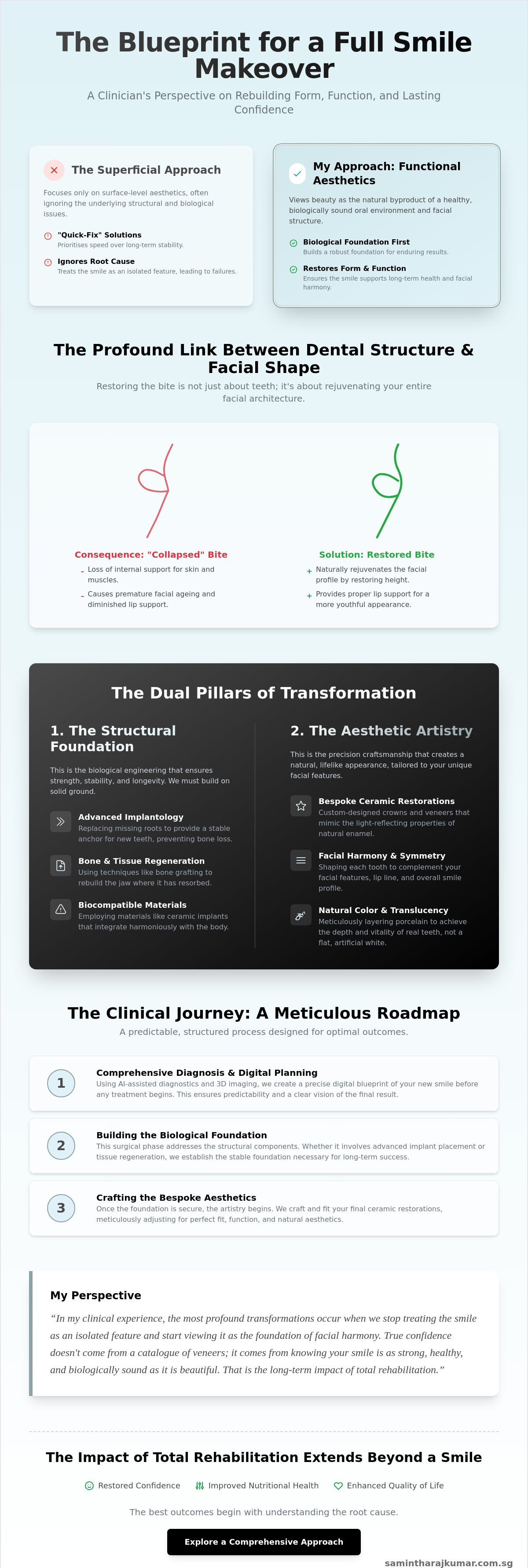
Many patients come to me thinking a smile makeover is simply a series of cosmetic enhancements designed to brighten their teeth. While Cosmetic dentistry provides the essential tools for aesthetic change, a truly successful outcome relies on a much deeper structural philosophy. I define a full smile makeover as the comprehensive restoration of both form and function. It's a process of rebuilding the lower third of the face to ensure that every restoration supports your long-term health. When we discuss the components of a full smile makeover, we're talking about a biological reconstruction that respects the unique geometry of your face.
I've seen many "quick-fix" solutions that prioritise speed over stability. These often fail because they treat the smile as an isolated feature rather than the foundation of facial harmony. My approach centres on "Functional Aesthetics." This means I view beauty as the natural byproduct of a healthy, biologically sound oral environment. When we address the fundamental components of a full smile makeover, we aren't just changing your appearance; we're restoring your physiological wellbeing. True confidence comes from knowing your smile is as strong as it is beautiful.
To better understand the timeline and process involved in this comprehensive transformation, watch this helpful video:
The Interplay Between Dental Structure and Facial Shape
The relationship between your teeth and your face is profound. When teeth are lost or severely worn, the vertical dimension of the bite decreases, leading to what we call a "collapsed" bite. This structural loss often results in premature facial ageing, as the skin and muscles of the lower face lose their internal support. By restoring dental height through specialised techniques, I can naturally rejuvenate the facial profile. Proper tooth position also provides essential lip support, which can significantly alter how youthful and vibrant a person appears. It's about restoring the architecture that time or trauma has diminished.
Identifying the Root Cause of Smile Dissatisfaction
In my clinical experience, patients often focus on the symptoms of dental decline, such as staining or minor chips. However, these are frequently indicators of deeper issues. We must address underlying problems like bite misalignment or gum disease before considering any aesthetic finishes. I always begin with a comprehensive diagnostic phase to understand the biological "why" behind the dissatisfaction. This ensures that the work we do isn't just beautiful, but also sustainable for decades to come. A meticulous assessment is the only way to avoid the disappointment of failing restorations. The best outcomes begin with understanding the root cause.
The Structural Components: Building a Biological Foundation
In my clinical experience, the most enduring transformations are those built on a robust biological foundation. While many view cosmetic dentistry procedures as purely aesthetic, the structural components of a full smile makeover are what truly determine its success. If the underlying bone or tooth roots are compromised, even the most beautiful porcelain work will eventually fail. I approach these cases with a surgeon's eye, ensuring that every element we add is supported by a healthy and stable environment.
For patients with significant tooth loss or bone resorption, advanced implantology becomes the primary structural pillar. This may involve complex rehabilitations such as bone grafting or sinus lifts to create a stable site for restoration. In cases where time and efficiency are paramount, I often recommend the Teeth in a Day procedure explained as a comprehensive way to achieve immediate functional and aesthetic stability. This protocol allows us to provide a fixed bridge on the same day as surgery, bypassing months of waiting while maintaining high clinical standards. The right diagnosis changes everything when planning your smile makeover.
Ceramic Dental Implants and Biocompatibility
From a biological perspective, I prioritise the use of ceramic dental implants made from zirconia. Unlike traditional titanium, ceramic is entirely metal-free and highly biocompatible. It integrates seamlessly with the soft tissue, promoting a much more natural-looking gum line without the dark shadows often seen with metal components. This material choice is a cornerstone of my philosophy because it minimises the risk of inflammation and ensures the body accepts the restoration as part of its own system. It's about choosing materials that work with your biology, not against it.
Soft Tissue Integrity and Gum Health
Healthy gums are the essential frame for any new smile. Before we begin aesthetic work, we must ensure the soft tissues are stable and free from disease. Often, patients suffer from sensitivity from exposed tooth roots, which indicates gum recession that must be addressed. We stabilise this biological foundation first. When the gum health is secure, the final result is not only more comfortable but far more resilient. I believe that total rehabilitation is only possible when we respect the relationship between the teeth, the bone, and the surrounding tissues.
The Aesthetic Components: The Artistry of Precision
Once the biological foundation is secure, we transition to the visible artistry of the reconstruction. This phase involves the most recognisable components of a full smile makeover: porcelain veneers and crowns. However, my approach isn't about simply placing shells over teeth. I use Digital Smile Design (DSD) to ensure that every proportion, angle, and edge matches the unique architecture of your facial features. By mapping out the journey digitally before we begin, I can calibrate the restorations to align with your pupils, the midline of your face, and the natural curve of your lower lip. This level of precision ensures the result is bespoke, not templated.
Precision in aesthetics also requires a sophisticated understanding of colour theory. In my clinical experience, the most successful results are those that don't look like "work" at all. We avoid the monochromatic, opaque look in favour of multi-layered restorations that mimic the translucency of natural enamel. I've observed that refrigerator-white teeth often look artificial because they lack the subtle gradients found in nature. My goal is to create a smile that reflects light naturally, resulting in a rejuvenated appearance that feels authentic to who you are.
Advanced Gum Contouring and the Pinhole Technique
The teeth are only half of the aesthetic equation. The gums act as the "frame" for the smile; if they are uneven or excessively prominent, the final result will never look balanced. Correcting a "gummy smile" or treating recession is often a critical step in my process. I frequently utilise the Pinhole Surgical Technique to restore the gum line without the need for traditional grafting or sutures. When considering the Chao Pinhole Surgical Technique cost in Singapore, it's vital to view it as an investment in the long-term symmetry and health of the makeover. Additionally, the Chao Pinhole surgery recovery timeline is remarkably swift, often allowing patients to return to their routine within 24 hours.
Material Selection: Porcelain vs. Composite
From a biological perspective, the choice of material is non-negotiable. While composite bonding is a useful tool for minor repairs, I prefer high-grade porcelain for full-scale makeovers. Modern porcelain veneers can last 15 to 20 years with proper care, and their resistance to staining is unparalleled compared to porous resins. Crucially, the material strength must be calibrated to match your bite force. If we use materials that are too soft or too brittle for your specific occlusion, the work will fail prematurely. I select durable ceramics that provide the perfect balance of resilience and lifelike aesthetics. The best outcomes begin with understanding the root cause of dental wear and selecting materials that offer a permanent solution.
The Clinical Journey: What to Expect During Transformation
A common misconception in the industry is that a total transformation can be completed in a mere fortnight. While some general practices might suggest a two-to-four-week timeline, my perspective as a specialist surgeon is that complex rehabilitation requires a more deliberate, logical progression. We simply cannot build the house before the foundation is set. In my clinical experience, the components of a full smile makeover must be sequenced with precision, often involving a multi-stage approach that respects biological healing times. This ensures that the final result isn't just a temporary aesthetic fix, but a lifelong restoration.
As a clinician and founder, I've integrated AI-assisted diagnostics and high-resolution 3D imaging into every planning phase. This technology allows me to map out your oral architecture with sub-millimetre accuracy, identifying bone density and nerve pathways that traditional scans might miss. By using these advanced tools, we eliminate guesswork and ensure that the final result is both predictable and safe. This level of meticulous planning is what distinguishes a specialist-led journey from a standard cosmetic procedure.
Phase 1: Digital Smile Design and Prototyping
Before we make any permanent alterations, we enter the prototyping phase. We create a digital mock-up that allows you to "test drive" your new smile. This is a deeply collaborative process between the surgeon and the patient, where we refine the proportions and aesthetics together. By seeing the potential result in your own mouth through a physical or digital prototype, we can make adjustments to the tooth length or shape before any permanent work begins. This precision planning is essential to prevent aesthetic regrets and ensure the final restorations align perfectly with your facial symmetry.
Phase 2: Surgical and Restorative Execution
The transition from temporary restorations to final, high-strength prosthetics is the culmination of our planning. During the "try-in" phase, I am meticulous about fit and occlusion. We don't just look at the teeth; we look at how they interact with your bite force and soft tissues. Once the final ceramics are placed, follow-up appointments are scheduled to monitor the integration and ensure the long-term success of the work. I also understand that the surgical nature of these procedures can cause anxiety. To ensure your comfort, I offer several sedation options that allow you to undergo complex treatments in a relaxed, stress-free state. If you are ready to explore a specialist-led approach to your dental health, I invite you to learn more about our smile makeovers.
My Perspective: The Long-Term Impact of Total Rehabilitation
In my clinical experience, the term "smile makeover" is often reduced to a menu of cosmetic treatments. I prefer to view it through the lens of "Total Rehabilitation." When we meticulously plan the components of a full smile makeover, we aren't just altering the appearance of the teeth. We're restoring the lower third of the facial skeleton and ensuring the masticatory system functions with absolute excellence. From a biological perspective, a stable bite is the gateway to improved systemic health. I've seen patients experience a profound shift in their nutritional intake and digestive comfort simply because their ability to chew has been properly restored.
The psychological impact of this work is where the true transformation lies. There is a specific type of confidence that emerges when a patient no longer fears the structural failure of their dental work or the unnatural look of artificial materials. It's an emotional renewal. My vision for the future of dental aesthetics is one where we continue to marry advanced AI diagnostics with biological integrity. We're moving toward an era where we can predict the 20-year outcome of a rehabilitation before we even begin, ensuring that every intervention is purposeful and permanent.
The Longevity of Your Investment
A comprehensive reconstruction is a significant commitment, and its longevity depends on the marriage of specialist skill and patient stewardship. I often tell my patients that choosing a specialist surgeon is a strategic decision for their lifelong health. While high-grade porcelain and ceramic implants are incredibly durable, they still require a disciplined maintenance routine to remain in peak condition. Regular professional monitoring allows us to ensure that the relationship between the restorations and the living tissue remains harmonious. I view these transformations as a legacy of health that serves the patient for decades, provided the foundation was built with precision from the start.
A Visionary Approach to Care
As a clinician and founder, I've always believed that the best outcomes begin with understanding the root cause of dental decline. At Nuffield Dental, we integrate the latest technological innovations to ensure the patient journey is as seamless as it is clinically rigorous. We don't just treat symptoms; we build institutions of care that prioritise long-term well-being over immediate, surface-level results. By combining my background in implantology with a commitment to biological dentistry, I aim to provide a standard of care that is globally minded and uncompromising in quality. The best outcomes begin with understanding the root cause.
Securing Your Legacy of Health and Confidence
Achieving a smile that is both biologically sound and aesthetically stunning is a journey of meticulous precision. As a clinician and founder, I've spent my career perfecting the delicate balance between structural integrity and visual harmony. We've explored how the essential components of a full smile makeover extend far beyond the surface, requiring a deep understanding of facial architecture, biocompatible materials, and advanced surgical sequencing. Whether I am utilising biocompatible ceramic implants for their superior integration or applying specialist zygomatic and All-on-4 protocols, the goal is always a result that feels as natural as it looks.
My work at Nuffield Dental Holdings is rooted in the belief that every patient deserves a restoration that supports their overall quality of life. By integrating AI-assisted diagnostics with a human-centred philosophy, I ensure that your transformation is predictable, comfortable, and enduring. You don't have to settle for "quick fixes" that ignore the underlying biology of your smile. True rehabilitation is about creating a legacy of health that lasts a lifetime.
The best outcomes begin with understanding the root cause. Explore our approach to Total Rehabilitation. Your journey toward a functional, radiant smile starts with a foundation built on expertise and care.
Frequently Asked Questions
How long does a full smile makeover typically take?
The timeline varies significantly depending on the complexity of your clinical needs. While minor aesthetic changes might be completed in a few weeks, a comprehensive transformation involving the surgical components of a full smile makeover can take several months. I prioritise a logical progression that allows for proper biological healing, ensuring your restorations are built on a stable and permanent foundation.
Is a smile makeover a painful process?
I focus intensely on patient comfort to ensure the experience is as stress-free as possible. We utilise advanced local anaesthesia and offer various sedation options to manage anxiety and eliminate pain during the procedure. Most of my patients report only mild tenderness during the initial recovery phase, which is easily managed with standard aftercare protocols.
What is the difference between a smile makeover and full mouth reconstruction?
A smile makeover primarily focuses on enhancing the aesthetic appearance of a healthy mouth, whereas a full mouth reconstruction addresses extensive functional and structural decline. In my practice, I often merge these concepts into "Total Rehabilitation." I believe that the aesthetic components of a full smile makeover are only successful when the underlying functional issues are resolved first.
Can I get a smile makeover if I have gum disease?
Active gum disease must be treated and stabilised before any restorative work begins. From a biological perspective, placing veneers or implants in an inflamed environment is a recipe for clinical failure. I work with you to restore your periodontal health first, creating a clean and healthy "frame" that ensures the longevity of your new smile.
Will my new smile look natural or too white?
Your results will look entirely natural because I utilise sophisticated colour theory and multi-layered ceramics. We avoid the monochromatic, opaque look of traditional "refrigerator-white" teeth. By mimicking the translucency and subtle gradients found in natural enamel, I create a smile that reflects light beautifully and complements your unique facial features.
How much does a full smile makeover cost in Singapore?
The investment for a transformation depends on the specific combination of surgical and restorative procedures your case requires. Because every patient has a unique oral architecture, I provide a bespoke treatment plan following a comprehensive diagnostic phase. Factors such as the choice of biocompatible materials and the necessity of structural work like bone grafting will influence the final roadmap.
How long will the results of my smile makeover last?
In my clinical experience, high-grade porcelain restorations and ceramic implants can last 15 to 20 years or longer with diligent care. The longevity of your investment is directly tied to the precision of the initial surgery and your commitment to regular professional maintenance. I view these makeovers as a lifelong legacy of health and confidence.
Are there any non-surgical alternatives to a smile makeover?
Less invasive options such as professional whitening, clear aligners, or composite bonding can certainly improve your appearance. However, these alternatives often lack the structural durability and transformative power of a specialist-led surgical approach. If you have significant tooth wear or loss, a comprehensive rehabilitation is typically the only way to achieve lasting functional excellence.


Comments