
The Silent Fracture: Treating a Cracked Tooth from Grinding and Chronic Jaw Pain
- Dr Samintharaj Kumar

- 2 minutes ago
- 12 min read
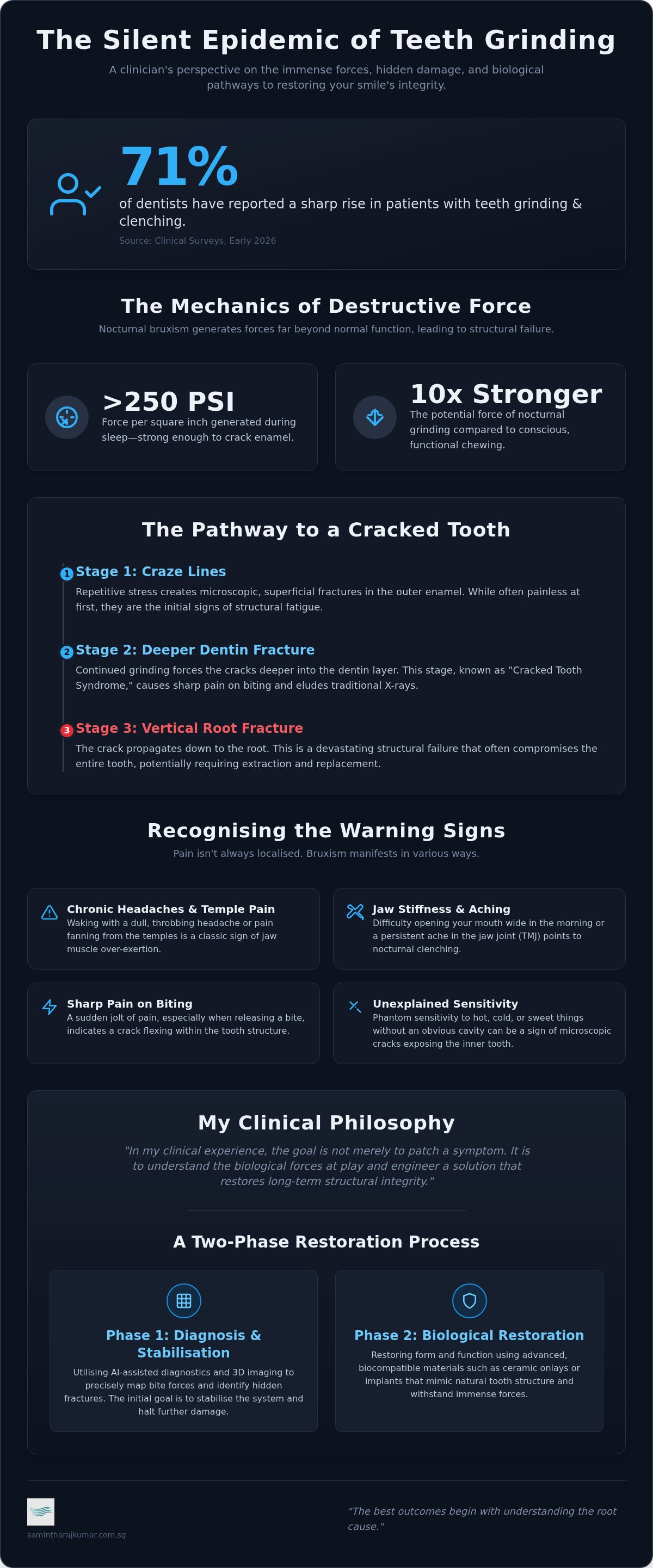
Did you know that recent surveys from early 2026 show a staggering 71% of dentists have reported a sharp rise in teeth grinding and clenching? It's a silent epidemic that often only reveals itself when you experience that sudden, sharp jolt of pain while chewing or wake up with a dull, throbbing headache that refuses to shift. I understand the anxiety that comes with discovering a cracked tooth from grinding, especially when you fear it might mean losing the structural integrity of your smile forever.
In my clinical experience, these fractures are rarely isolated incidents. They're the result of immense biological forces, sometimes exceeding 250 pounds per square inch, acting on your dentition while you sleep. I want to show you that this cycle of structural fatigue can be broken. From a biological perspective, we'll explore the mechanics of nocturnal bruxism, how we use AI-assisted diagnostics to map these forces, and the specialist pathways, including ceramic implants, that restore both function and peace of mind.
Table of Contents
Understanding the Link Between Nocturnal Grinding and a Cracked Tooth
The Mechanics of Force: Why Your Jaw Muscles Can Fracture Enamel
Structural Consequences: From Micro-cracks to Facial Volume Loss
My Perspective: Why I Advocate for Biological Rehabilitation Over Symptomatic Relief
Restoring Function: Specialist Pathways to Repair a Cracked Tooth from Grinding
Understanding the Link Between Nocturnal Grinding and a Cracked Tooth
In my clinical experience, many patients are surprised to learn that their teeth are under siege while they sleep. This condition, medically known as Bruxism, involves the involuntary clenching or grinding of teeth. Unlike functional chewing, which is controlled and cushioned by food, nocturnal grinding occurs with raw, unchecked intensity. From a biological perspective, the forces generated during sleep can be up to ten times stronger than normal chewing. These forces often exceed 250 pounds per square inch. This relentless pressure is the primary architect of a cracked tooth from grinding, a structural failure that often begins long before the first pang of pain is felt.
To better understand the physical impact of these forces and what to look for, watch this helpful video:
We often use the term "Cracked Tooth Syndrome" to describe the elusive nature of these injuries. These are microscopic fractures that frequently elude standard two-dimensional X-rays. They hide within the complex internal architecture of the tooth, making them difficult to detect without advanced diagnostics. Patients often present with phantom sensitivity or sharp pain only when releasing a bite. These are classic indicators of a flexed, fractured structure that requires immediate clinical attention.
The Anatomy of a Fracture
Repetitive stress initially manifests as "craze lines" in the enamel. While these are often superficial at first, continued grinding forces them deeper into the dentin. Eventually, a superficial crack can transition into a devastating vertical root fracture. This progression may compromise the entire tooth beyond simple repair. Molars are particularly susceptible to a cracked tooth from grinding because they act as the primary shock absorbers for the jaw. They are positioned directly under the strongest part of the masseter muscle, bearing the brunt of every clench.
Identifying Sleep-Related Jaw Tension
Waking with temple pain, jaw stiffness, or a dull headache is often the first sign of structural dental fatigue. It's vital to differentiate between awake bruxism, often a response to daytime stress, and nocturnal clenching, which is tied to disrupted sleep cycles. During sleep, the brain may recruit jaw muscles as a primitive response to airway instability or neurological triggers. This unconscious recruitment means you are effectively performing a heavy duty workout with your jaw for hours every night. The result is chronic morning pain and eventual dental failure.
The Mechanics of Force: Why Your Jaw Muscles Can Fracture Enamel
In my clinical experience, the masseter muscle is a marvel of biological engineering, but it's also a source of significant structural risk. It's the strongest muscle in the human body by weight. During a nocturnal clenching episode, it can generate pressures exceeding 250 pounds per square inch. When your bite is misaligned, this immense force isn't distributed evenly across your smile. Instead, a single tooth often bears the brunt of the impact. This concentration of pressure is what ultimately leads to a cracked tooth from grinding.
The trigeminal nerve is the primary pathway for both jaw movement and facial sensation. It acts as the electrical grid for your face. When the jaw is forced out of its natural alignment, this nerve transmits signals that can manifest as sharp dental pain or broader cranial discomfort. Understanding this neurological link is essential when diagnosing a cracked tooth. If your bite is imbalanced, your nervous system may over-fire at night, perpetuating a cycle of tension that damages enamel.
Muscle Referral Patterns and Morning Headaches
Pain isn't always felt exactly where the injury occurs. Tension in the temporalis muscle, which fans across the side of your head, often refers pain to the temples or behind the eyes. I've observed that chronic clenchers frequently develop central sensitisation. This is a state where the nervous system becomes hyper-reactive to stimuli. A structural misalignment makes your muscles work overtime, leading to those characteristic morning headaches. I believe that comprehensive TMJ pain management is the first step toward lasting relief and structural stability.
Anatomical Vulnerability of the TMJ
The Temporomandibular Joint (TMJ) relies on a delicate fibrocartilage disc to function smoothly. Chronic grinding forces the jaw out of its natural physiological rest position, compressing this disc and straining the surrounding ligaments. Over time, this leads to joint degeneration and audible clicking or popping sounds. If we don't address the mechanical cause of a cracked tooth from grinding, we risk long-term damage to the joint architecture itself. True restoration requires us to look beyond the fracture and balance the entire stomatognathic system to ensure your smile remains functional for decades.
Structural Consequences: From Micro-cracks to Facial Volume Loss
In my clinical experience, the damage from chronic bruxism extends far beyond a single fracture. It represents a progressive erosion of the entire oral architecture. Dental attrition is the gradual "shortening" of the teeth as enamel is worn away by relentless friction. This leads to a collapse of the bite, a clinical state we refer to as the loss of vertical dimension. When the teeth no longer support the jaw at its natural height, the lower third of the face begins to compress. This often results in thinning lips and a "sunken" appearance that mimics premature ageing. A cracked tooth from grinding is frequently the final signal that the system can no longer withstand this structural collapse.
This path toward tooth loss is often a slow, silent one. Micro-cracks weaken the tooth's core until a significant fracture occurs, often necessitating complex oral rehabilitation. If we ignore these signs, we aren't just risking a single tooth; we're risking the functional harmony of the entire mouth. From a biological perspective, every millimetre of tooth height lost contributes to a less stable and more painful jaw position. Without intervention, the teeth eventually fail to meet properly, creating a cycle of pain that affects everything from nutrition to speech.
The Impact on Facial Aesthetics
Chronic clenchers often develop masseter hypertrophy. This is where the jaw muscles enlarge due to constant over-exercise, creating a noticeably "square" or heavy jawline. I believe that understanding how dental structure affects facial aesthetics is a vital consideration in restorative surgery. We aren't just fixing teeth; we're restoring the scaffolding of the face. The psychological impact of a changing smile and chronic pain shouldn't be underestimated. It can erode one's confidence as much as it erodes the enamel, making comprehensive restoration a matter of emotional renewal as well as physical health.
Joint Derangement and Arthritic Changes
We must also recognise the transition from simple clicking to a "bone-on-bone" grinding sensation. This shift indicates advanced joint derangement, often involving arthritic changes within the Temporomandibular Joint. Early intervention is critical to avoid irreversible damage to the delicate fibrocartilage disc. If the disc is displaced or worn through, the resulting inflammation can lead to permanent mobility issues. As a clinician and founder, I prioritise preserving the biological integrity of the jaw through precise, specialist-led intervention. Addressing a cracked tooth from grinding early allows us to halt this degenerative cycle before it requires more invasive surgical measures.
My Perspective: Why I Advocate for Biological Rehabilitation Over Symptomatic Relief
In my clinical experience, a cracked tooth is rarely an isolated accident; it's a profound structural warning. When I encounter a cracked tooth from grinding, I don't see a surface that simply needs a patch. I see a stomatognathic system in significant distress. My philosophy as a clinician and founder is rooted in Biological Dentistry. This approach dictates that we must identify and remove the underlying mechanical stressors before we can successfully restore function. If we simply place a crown on a fractured tooth without addressing the nocturnal forces that caused the break, we're merely waiting for the next structural failure.
Many patients come to me after trying generic, soft mouthguards from a chemist. From a biological perspective, these can often be counterproductive. The brain frequently perceives the soft material as something to chew, triggering what I call the "chewing gum" effect. This actually increases masseter muscle activity and intensifies the clenching habit. I believe in moving beyond these temporary fixes toward a state of functional health that supports quietly premium aesthetics. True restoration must be as durable as it is beautiful.
The Specialist Diagnostic Journey
My diagnostic journey is intentionally comprehensive. I look far beyond the fracture to assess the cervical spine and airway health. Frequently, nocturnal clenching is the body's compensatory mechanism for restricted breathing during sleep. By utilising AI-assisted diagnostics, we can map muscle activity and jaw movement with incredible precision. This allows us to predict future failure points before they manifest as a cracked tooth from grinding. A first-person specialist consultation is essential for complex jaw pain, ensuring we're treating the human being, not just the dental X-ray.
Precision-Engineered Solutions
Rehabilitating the entire stomatognathic system requires a move away from traditional "drill and fill" dentistry. We utilise digital impressions to create a perfectly balanced bite, ensuring that forces are distributed evenly across the dental arch. Hard occlusal splints are vital in this process. They serve to "deprogram" the jaw muscles, breaking the neurological cycle of chronic clenching and allowing the joint to find its physiological rest position. Our goal is to transition from merely fixing damage to total oral rehabilitation. If you are struggling with persistent discomfort, the right TMJ pain management protocol can be the key to preserving your long-term dental heritage.
Restoring Function: Specialist Pathways to Repair a Cracked Tooth from Grinding
In my clinical experience, successful oral rehabilitation requires a disciplined, phased approach. We cannot simply address the aesthetics of a smile while the underlying mechanical forces remain chaotic. My treatment protocol for a cracked tooth from grinding follows three distinct stages designed to ensure both immediate comfort and long-term structural success. This methodology moves beyond the "patchwork" dentistry of the past, focusing instead on the biological restoration of the entire mouth.
Phase 1: Immediate Stabilisation. Our first priority is pain management and stopping the progression of the fracture. This may involve temporary splinting or the use of sedative fillings to calm the dental pulp.
Phase 2: Structural Restoration. Once the tooth is stable, we restore its integrity using biocompatible ceramic materials. These materials are chosen for their ability to mimic the natural flex and strength of human enamel.
Phase 3: Physiological Balance. The final phase involves fine-tuning the bite to ensure that nocturnal forces are distributed evenly, preventing future fractures.
The transformative impact of this process is profound. There is a specific sense of relief that comes when a patient wakes up for the first time in years without jaw stiffness or the fear of a sudden, sharp pain while eating. From a biological perspective, we're not just repairing a tooth; we're restoring the patient's quality of life.
Restorative Options for Severe Fractures
There are instances where a cracked tooth from grinding has progressed so far that the fracture reaches the root. In these complex cases, a simple crown is no longer a viable solution. As a clinician and founder, I often recommend ceramic dental implants for these scenarios. Unlike traditional metal implants, ceramic options offer superior biocompatibility and a more natural aesthetic, particularly for patients with thin gingival biotypes. For those who have suffered from a completely collapsed bite due to years of attrition, the All-on-4 treatment protocol can provide a total rehabilitation of the dental arch in a single day, restoring both function and facial volume.
The Path to Total Jaw Rehabilitation
Achieving a pain-free morning is the ultimate goal of specialised TMJ care. We must look at the jaw as a dynamic system where the teeth, muscles, and joints must work in harmony. If one element is out of sync, the entire structure is at risk. I believe that restoring your bite is the foundation of long-term health and facial harmony. By addressing the root cause of the structural failure, we ensure that your restorative journey is a permanent one. The best outcomes begin with understanding the root cause.
Restoring Your Foundation for a Pain-Free Future
The journey from chronic jaw pain to total oral health begins with a shift in perspective. We've explored how a cracked tooth from grinding isn't just a dental emergency; it's a structural warning from a system out of balance. By looking beyond the fracture to the biological mechanics of the jaw, we can halt premature facial ageing and restore the functional harmony of your smile. True restoration is about more than just repair; it's about reclaiming your comfort and long-term well-being through meticulous, expert-led care.
As a clinician and founder, I'm committed to visionary care that adheres to the highest international clinical protocols. At Nuffield Dental, my focus remains on biological standards and complex TMJ rehabilitation to ensure your results are both enduring and aesthetically premium. We don't just patch cracks; we rebuild foundations to support your future health and facial aesthetics. This approach ensures that every intervention serves your legacy of health.
The right diagnosis changes everything. Explore specialist jaw rehabilitation with Dr Samintharaj Kumar and take the first step toward waking up with absolute confidence. The best outcomes begin with understanding the root cause, and I look forward to guiding you toward a lasting recovery and a secure, functional smile.
Frequently Asked Questions
Is it normal to have a headache every single morning?
Waking with a headache every morning is a definitive sign of nocturnal bruxism rather than a normal part of waking up. In my clinical experience, this pain usually originates in the temporalis muscles due to sustained clenching throughout the night. This chronic tension creates a state of central sensitisation where your nervous system remains hyper-reactive. Addressing the structural cause of this tension is the only way to break the cycle and restore your morning comfort.
How can I tell if my tooth is cracked if I cannot see it?
You can identify a potential crack through specific symptoms even if it remains invisible to the naked eye. Sharp, intermittent pain when you release a bite or sudden sensitivity to cold temperatures are primary indicators of "Cracked Tooth Syndrome". Because these fractures are often microscopic, I utilise AI-assisted diagnostics and high-magnification transillumination to locate them. Early detection is vital to prevent a cracked tooth from grinding from progressing into a full vertical root fracture.
Will a regular mouthguard from a chemist stop my teeth from cracking?
A generic mouthguard from a chemist is often insufficient and can actually worsen the problem. These soft materials often trigger a "chewing gum" effect, where the brain encourages the jaw to clench more frequently. From a biological perspective, I recommend precision-engineered hard occlusal splints. These devices are designed to "deprogram" the masseter muscles and distribute forces evenly, providing the necessary protection to prevent a cracked tooth from grinding while you sleep.
Can grinding my teeth really change the shape of my face?
Persistent grinding can significantly alter your facial aesthetics over time. Chronic clenching leads to masseter hypertrophy, which creates a wider, more "square" jawline due to muscle over-development. As your teeth wear down and lose height, your bite collapses, leading to a loss of vertical dimension. This often results in thinning lips and a sunken facial appearance. Restoring your dental structure is therefore essential for maintaining both functional health and facial harmony.
What kind of specialist should I see for a cracked tooth from grinding?
You should seek a specialist dental surgeon who has specific expertise in TMJ pain management and complex oral rehabilitation. General dentistry often focuses on the individual tooth, but treating a fracture caused by bruxism requires an understanding of the entire stomatognathic system. As a clinician and founder, I prioritise a comprehensive approach that balances the jaw's biological forces. This ensures that any restorative work, such as ceramic implants, can withstand the unique pressures of your bite.
Are ceramic implants better than titanium for grinding patients?
Ceramic implants are often my preferred choice for patients with a history of grinding due to their exceptional biocompatibility. Unlike titanium, ceramic materials are chemically inert and don't trigger the same inflammatory responses in the surrounding tissue. They also offer superior aesthetics, particularly if the grinding has caused gum recession. In my clinical experience, the structural integrity and tissue-friendly nature of ceramic make them the gold standard for long-term oral rehabilitation in complex cases.
How long does it take for morning headaches to stop after treatment?
Most patients begin to feel a significant reduction in morning headaches within two to four weeks of starting a specialised treatment protocol. This timeline depends on how quickly we can "deprogram" the jaw muscles using a precision-engineered hard splint. Once the muscles are no longer in a state of constant tension, the referral pain to your temples and eyes will subside. True relief comes from stabilising the bite and allowing the nervous system to return to a rest state.
Can stress management alone cure nocturnal bruxism?
While stress management is a vital component of treatment, it is rarely enough to cure nocturnal bruxism on its own. Research indicates that stress is a predictor in up to 70% of cases, but the grinding habit often becomes a self-perpetuating neurological cycle. Stress management alone cannot repair the physical damage already done to your enamel. A comprehensive plan must combine behavioural changes with mechanical protection and structural restoration to ensure long-term dental health.


Comments