
The Specialist’s Guide to the Annual Checkup for Dental Implants: Ensuring Lifelong Stability
- Dr Samintharaj Kumar

- May 26
- 12 min read
A dental implant isn't a "set it and forget it" procedure. It's a sophisticated biological integration that requires meticulous, specialist-led oversight to remain viable for a lifetime. In my clinical experience, many patients assume that because an implant cannot develop a cavity, it's immune to the typical risks of oral disease. This is a misconception that can lead to quiet, avoidable complications. Prioritising an annual checkup for dental implants is the cornerstone of protecting your investment and ensuring the bone surrounding your restoration remains healthy. It's a clinical risk-mitigation protocol rather than a simple cleaning.
I recognise the underlying anxiety many feel regarding potential implant failure or hidden infections like peri-implantitis. It's natural to want absolute certainty when you've invested in advanced dental restoration. In this guide, I'll share why a specialist diagnostic process is vital for long-term stability. You'll learn about the latest protocols, including AI-assisted diagnostics and specialised instrumentation, that we use to safeguard your health. From a biological perspective, the right maintenance doesn't just clean a surface; it preserves the foundation of your smile for decades to come.
Key Takeaways
Understand why a specialist-led annual checkup for dental implants is a comprehensive surgical assessment, far beyond a routine hygiene visit, designed to mitigate long-term biological risks.
Learn how I use advanced 3D CBCT imaging to monitor volumetric bone changes and ensure the structural integrity of your restoration remains secure beneath the gum line.
Discover the specific diagnostic protocols required for complex full-arch rehabilitations, including All-on-4 dental implants, to maintain functional excellence.
Explore my clinical philosophy on proactive maintenance as an ethical commitment to preventing peri-implantitis and protecting your initial investment.
Gain clarity on the specialist diagnostic journey and how consistent oversight preserves both your facial aesthetics and your quality of life for the long term.
Table of Contents
The Clinical Necessity of the Annual Checkup for Dental Implants
In my clinical experience, the most dangerous misconception a patient can hold is that a dental implant is a "set it and forget it" solution. While modern implantology offers incredible success rates, these titanium or ceramic foundations are still subject to the laws of biology. Unlike natural teeth, which are suspended by a shock-absorbing periodontal ligament, an implant is fused directly to the bone through osseointegration. This lack of a natural ligament means the body doesn't signal pain or pressure in the same way, often allowing issues to develop in total silence. For a detailed Dental implant overview, one can see how the surgical integration process is just the beginning of a lifelong journey.
As a clinician and founder, I view the annual checkup for dental implants as a specialised surgical assessment rather than a simple hygiene visit. We aren't just looking for surface-level cleanliness; we're monitoring the delicate interface where the implant meets your living tissue. Without this proactive oversight, bone loss can progress undetected until the stability of the restoration is compromised.
To better understand what happens during these essential reviews, watch this helpful video:
Peri-implantitis: The Primary Threat to Longevity
Peri-implantitis is a site-specific inflammatory disease that remains the leading cause of implant failure. It's particularly insidious because it rarely presents with the sharp pain associated with a toothache. By the time a patient notices bleeding or swelling, irreversible bone resorption may have already occurred. From a biological perspective, early detection through specialised probing and diagnostic imaging is the only way to intercept this process. My treatment philosophy prioritises identifying these early inflammatory markers to prevent the need for complex corrective surgeries later. A missed annual checkup for dental implants is often the point where a manageable issue transforms into a significant clinical challenge.
Biological vs. Mechanical Stability
A successful restoration requires both biological health and mechanical integrity. During a specialist review, I evaluate the Bone-to-Implant Contact (BIC) ratio to ensure the foundation remains robust. Simultaneously, we must verify the mechanical components. For patients with complex restorations like All-on-4 dental implants, verifying screw torque and prosthetic fit is essential. Even a microscopic shift in the prosthesis can create uneven pressure, leading to hardware fatigue or accelerated bone loss. We check for signs of wear and ensure every component is calibrated correctly, which is how we guarantee lifelong stability. The best outcomes always begin with understanding the root cause of even the smallest mechanical shift.
The Science of Implant Longevity: What I Look For
In my clinical experience, relying solely on a visual inspection during an annual checkup for dental implants is insufficient for total rehabilitation. While the porcelain crown may appear pristine to the naked eye, the most critical biological markers are hidden beneath the gum line. As a clinician and founder, I've seen how subtle changes in the foundation can lead to significant issues if left unaddressed. We utilise advanced 3D imaging, specifically Cone Beam Computed Tomography (CBCT), to monitor volumetric bone changes. This level of detail is essential because it allows us to track the bone-to-implant contact ratio with millimetre precision, ensuring the structural integrity is maintained year after year.
Innovation in my practice also involves AI-assisted diagnostics. These tools allow us to detect microscopic density shifts in the jawbone that might be missed by the human eye alone. By comparing historical scans with current data, the AI identifies trends in bone health, providing an early warning system for potential failure. This rigorous approach aligns with FDA guidance on dental implants, which highlights the importance of professional oversight in managing the long-term risks of these medical devices. I also pay close attention to the soft tissue seal, or the "biological width." This barrier is your first line of defence against infection, and its health is a primary indicator of long-term stability.
Assessing the Biocompatibility Response
From a biological perspective, the body's reaction to an implant can evolve. I monitor the surrounding gingiva for any signs of chronic low-grade inflammation or metal sensitivity. While titanium is the gold standard for many, some patients require a different approach to achieve total health. For those with specific immunological needs or aesthetic concerns, I often discuss the benefits of ceramic dental implants. Ensuring your body remains in harmony with the restoration is a key part of our annual review.
Occlusal Load and Force Distribution
Implant longevity is as much about physics as it is about biology. I meticulously measure how bite forces are distributed across your entire dental arch. Natural teeth have a slight degree of mobility, but implants are rigid. Over time, as your natural teeth shift, "heavy spots" can develop on the implant restoration. This uneven pressure can lead to mechanical fatigue, screw loosening, or even fracture of the implant post. By precisely adjusting the occlusion during your annual checkup for dental implants, we protect the hardware from unnecessary stress. Maintaining this balance is essential for functional excellence. The best outcomes begin with understanding the root cause of these mechanical changes.
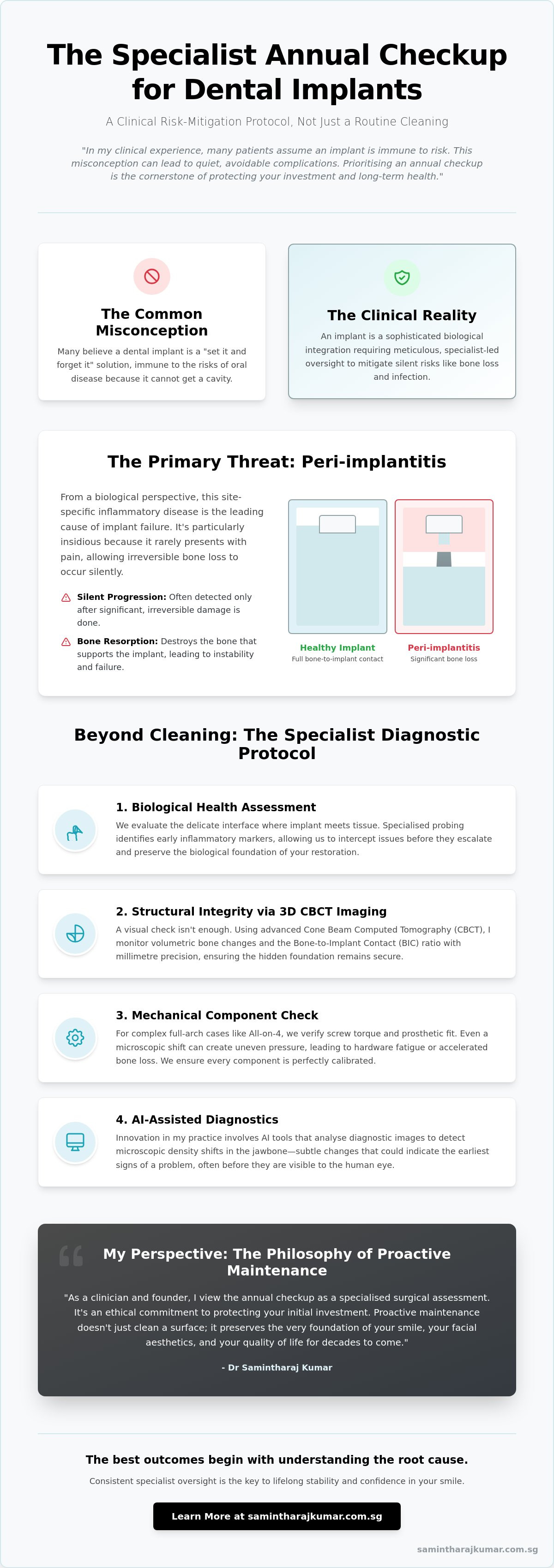
Beyond Cleaning: The Specialist Diagnostic Protocol
A standard dental cleaning is designed to remove plaque from enamel. However, an annual checkup for dental implants is a far more rigorous engineering and biological audit. In my clinical experience, a general hygiene visit often lacks the specialised tools and surgical insight required to evaluate a complex restoration. As a clinician and founder, I ensure my protocol goes beneath the surface. We meticulously examine the mucosal cuff, the ring of gum tissue that forms a biological seal around the implant. If this seal is breached by bacteria, the risk of infection increases exponentially. I also test the stability of the abutment-to-implant connection to ensure no microscopic vibrations are compromising the bone.
The process is even more involved for patients with full-arch restorations. When managing All-on-4 dental implants, we don't just clean around the bridge. We often remove the prosthetic entirely. This allows us to inspect the health of the underlying soft tissue and clean the titanium foundations with absolute precision. It's a level of care that prioritises the longevity of the entire system rather than just the aesthetics of the smile.
Monitoring Complex Surgical Sites
For patients who have undergone advanced procedures, such as Zygomatic or Pterygoid implants, the diagnostic requirements are unique. These implants anchor into dense bone structures beyond the traditional jawbone. I personally evaluate the health of the maxillary sinuses and the integrity of any previous bone grafts or sinus lift sites. From a biological perspective, these areas must remain clear of inflammation to ensure the implants stay stable for decades. We use 3D imaging to confirm that the bone volume hasn't shifted and that the surgical sites remain healthy and integrated.
The Role of Professional Hygiene for Prosthetics
The materials used in implant maintenance are just as important as the technique. Traditional metal scalers can scratch the surface of a titanium or ceramic post, creating microscopic grooves where bacteria can thrive. In my practice, we prohibit the use of stainless steel on implants. Instead, we utilise carbon fibre instruments and glycine air polishing. This technology gently removes biofilm without damaging the implant's surface. I also take the time to customise your home-care routine. The architecture of every restoration is different; what works for a single crown won't suffice for a full-arch bridge. We provide the specific tools and education needed to maintain your restoration between visits. The right diagnosis changes everything, but the right maintenance preserves it.
My Perspective: The Philosophy of Proactive Maintenance
As a clinician and founder, I view the long-term care of my patients as an ethical commitment that extends far beyond the day of surgery. An annual checkup for dental implants isn't merely a clinical appointment; it's a partnership in preserving the transformative results we've achieved together. In my clinical experience, the most successful outcomes occur when we shift our mindset from reactive repairs to proactive preservation. We don't wait for a problem to surface before taking action. Instead, we seek to understand the root cause of even the most subtle biological shifts to ensure your restoration remains a permanent part of your life.
From a biological perspective, an implant is not an isolated component; it's part of a complex systemic environment. During our reviews, I often look beyond the mouth to consider factors like Vitamin D levels and glycemic control. If a patient's diabetes isn't well-managed, the risk of inflammatory complications around the implant increases. By monitoring these systemic markers during your annual checkup for dental implants, we ensure your body has the necessary resources to maintain high bone density. It's about total oral rehabilitation, ensuring the foundation is as healthy as the smile itself.
The Founder’s Commitment to Quality
At Nuffield Dental, I've implemented international protocols that mirror the highest global standards of care. I believe in the importance of continuity. Seeing the original surgical team for your annual review ensures that we are monitoring your progress against the specific clinical baseline established on the day of your procedure. We don't just look at the hardware; we look at the legacy of your health. This meticulous attention to detail is what distinguishes a specialist practice, prioritising the human outcome alongside technical excellence.
AI and the Future of Maintenance
Innovation is a core pillar of my practice. We're now using longitudinal data and AI-assisted diagnostics to predict which patients might be at a higher risk of future complications before they manifest. This is particularly vital following a teeth in a day procedure, where the immediate loading of implants requires precise, ongoing monitoring. Digital tracking allows us to provide you with transparent, data-driven diagnostic reports, empowering you to take ownership of your health journey. The future of care is predictive, personalised, and deeply rooted in science. Experience the difference that specialist oversight makes for your long-term stability and peace of mind.
Navigating Your Maintenance Journey: What to Expect
In my clinical experience, patients often feel a profound sense of relief once they understand that maintenance is a structured, predictable, and entirely manageable process. The transition from the active surgical phase to lifelong care is a milestone in your health journey. An annual checkup for dental implants is the primary mechanism we use to ensure that the "Teeth in a Day" or complex bridge you received remains as stable and functional as the day it was fitted. It's not just about verifying the hardware; it's about confirming that your body's biological response remains optimal. This regular oversight is also essential for preserving any structural warranties and the long-term integrity of the restoration.
Before your visit, I encourage you to reflect on any subtle changes in your oral health. I need to know if you've started any new medications, such as bisphosphonates or blood thinners, or if you've noticed changes in your bite sensation. Even minor shifts in systemic health can influence the bone surrounding your implants. From a biological perspective, being proactive with this information allows us to tailor our diagnostic approach to your current physiological state.
Step-by-Step of the Annual Specialist Review
Our protocol is designed to be thorough yet comfortable, mirroring the pace of a professional consultation. You can expect the following sequence during your visit:
Clinical Examination: I personally assess the "mucosal cuff" and the stability of the prosthetic components to ensure the seal remains intact.
Diagnostic Imaging: We utilise low-dose digital radiographs or CBCT scans, which our AI software then analyses to detect microscopic changes in bone density.
Functional Bite Assessment: We measure occlusal forces to ensure your bite is balanced, making precise adjustments to prevent mechanical fatigue.
Specialised Hygiene: Our team performs a gentle, deep clean using glycine air polishing and carbon fibre instruments, which are safe for titanium and ceramic surfaces.
Long-Term Quality of Life and Renewal
The impact of a well-maintained restoration extends far beyond the ability to eat and speak with confidence. As a clinician and founder, I'm deeply aware of how dental implants serve as the scaffolding for your facial structure. By preventing the bone resorption that typically follows tooth loss, a successful annual checkup for dental implants helps to prevent premature facial ageing and maintains your natural profile. This is the essence of total rehabilitation: restoring not just a smile, but a sense of self and systemic wellness. The peace of mind that comes from knowing your restoration is clinically sound is a vital component of your long-term well-being. The best outcomes begin with understanding the root cause of health, and a commitment to maintenance is a commitment to your future. The right diagnosis changes everything.
Securing the Future of Your Restoration
As a clinician and founder, I believe that true clinical excellence is measured by the longevity of the results we achieve together. We've explored how a specialised annual checkup for dental implants acts as a vital safeguard, moving beyond surface-level cleaning to evaluate the biological and mechanical integrity of your smile. At Nuffield Dental, my team and I utilise advanced AI-assisted diagnostic technology to monitor bone density with precision that was previously impossible. Whether you've received a single crown or complex Zygomatic and All-on-4 protocols, this proactive oversight is what preserves your investment and protects your systemic health.
My perspective is that the best outcomes begin with understanding the root cause of any shift in your oral environment. By prioritising this yearly review, you're not just maintaining a prosthetic; you're ensuring the continued harmony of your facial aesthetics and functional well-being. I invite you to take this essential step in your health journey. The best outcomes begin with understanding the root cause. Schedule your specialist review today. Your smile is a legacy worth protecting, and we're here to ensure it remains stable for the decades ahead.
Frequently Asked Questions
How often do I really need a checkup for my dental implants?
You should attend a specialist review at least once every twelve months to ensure the long-term stability of your restoration. For patients with a history of periodontal disease or specific systemic risk factors, I often recommend a recall every three to six months. This frequency allows me to intercept microscopic biological changes before they compromise the osseointegration of the implant.
What happens if I skip my annual dental implant checkup?
Skipping an annual checkup for dental implants allows inflammatory conditions like peri-implantitis to progress without any noticeable symptoms. Because implants lack the sensory nerves of natural teeth, you won't feel the early stages of bone loss. By the time pain or mobility occurs, the damage is often irreversible, potentially leading to total implant failure and the need for complex reconstructive surgery.
Can a general dentist perform my annual implant review?
While a general dentist can perform a basic assessment, a specialist review offers a significantly higher tier of diagnostic precision. In my clinical experience, complex restorations like Zygomatic or All-on-4 protocols require the advanced 3D imaging and AI-assisted diagnostics found in a specialised practice. We use specific instrumentation designed to prevent damage to the implant surface, which is often unavailable in generalist settings.
Do dental implants need to be professionally cleaned like natural teeth?
Professional maintenance is essential for implants, but the protocol differs significantly from the cleaning of natural teeth. We utilise glycine air polishing and carbon fibre instruments to remove biofilm without scratching the titanium or ceramic posts. Traditional metal scalers are strictly prohibited in my practice; they create microscopic grooves where bacteria thrive, increasing the risk of site-specific infection.
How does a specialist check if my implant is still fused to the bone?
I use a combination of advanced 3D CBCT imaging and AI-driven software to measure the bone-to-implant contact ratio. This allows me to see the volumetric density of the bone surrounding the post with millimetre precision. From a biological perspective, I also perform clinical stability tests to ensure the abutment-to-implant connection remains rigid and free from any microscopic vibrations that could signal bone loss.
Will I need X-rays at every annual implant checkup?
Diagnostic imaging is typically required annually to monitor the bone levels that remain invisible to the naked eye. We use low-dose digital radiographs or CBCT scans to create a longitudinal record of your health. This data allows us to compare density shifts over several years, ensuring that the foundation of your restoration remains robust and integrated according to international clinical protocols.
Is the annual checkup for dental implants painful?
The review is a non-invasive and comfortable procedure that mirrors the steady pace of a professional consultation. Because we use specialised, gentle technology like air polishing rather than aggressive scraping, there is minimal discomfort. My goal is to lower the emotional barriers often associated with dental visits by providing a calm experience where you feel in capable, experienced hands throughout the assessment.
Can an annual checkup prevent dental implant failure?
Consistent attendance at an annual checkup for dental implants is the single most effective way to prevent failure. Early detection of peri-implantitis allows us to treat inflammation while it is still in a reversible state. By adjusting the bite force and maintaining the soft tissue seal during these visits, we mitigate the mechanical and biological risks that lead to long-term complications.


Comments