
The Zirconia Bridge: A Specialist Surgeon’s Guide to Biocompatible Total Rehabilitation
- Dr Samintharaj Kumar

- 1 day ago
- 13 min read
The most sophisticated medical intervention in your mouth shouldn't look like an intervention at all. In my clinical experience, I've found that many patients carry a deep-seated anxiety about the durability of their dental work or the unnatural, "fake" appearance of traditional metal-based restorations. You deserve a solution that doesn't just fill a gap but integrates seamlessly with your living tissue. This is why I believe the zirconia bridge is the definitive choice for patients seeking total oral rehabilitation. It's a material that balances incredible flexural strength with a translucency that mimics natural enamel, ensuring your smile remains structurally sound for the long term.
I've written this guide to help you understand why zirconia represents the pinnacle of modern restorative science. You'll discover how we use these biocompatible materials to restore your natural chewing function while providing the necessary support for your facial volume and structure. From a biological perspective, we'll examine what you can realistically expect during your journey toward a permanent, metal-free smile. My goal is to replace your uncertainty with a sense of security, showing you how modern innovation can finally deliver the uncompromising health outcomes you've been looking for.
Table of Contents
The Evolution of Dental Restoration: Why Zirconia is My Preferred Choice
The Science of Zirconia: Strength, Biocompatibility, and Aesthetics
Zirconia vs. Traditional Alternatives: A Clinical Comparison
The Clinical Journey: What to Expect During Your Rehabilitation
My Perspective: Why Total Rehabilitation Demands Uncompromising Quality
The Evolution of Dental Restoration: Why Zirconia is My Preferred Choice
In my clinical experience, the transition from metal-based restorations to all-ceramic solutions marks one of the most significant advancements in modern dentistry. For decades, we relied on materials that were functional but biologically compromised. Today, as a clinician and founder, I prioritise materials that don't just "fix" a problem but restore the mouth to its natural, healthy state. A zirconia bridge represents this shift perfectly, combining the structural integrity of metal with the light-reflecting properties of natural enamel.
Choosing the right material is a decision that impacts your health for years to come. We've moved away from simply filling gaps toward a philosophy of total rehabilitation. This means looking at how a restoration interacts with your bone, your gums, and your overall facial harmony. My goal is always to provide a solution that feels like a part of you, rather than a foreign object in your mouth.
The Problem with Traditional Metal Bridges
Traditional Porcelain Fused to Metal (PFM) bridges have long been the industry standard, yet they carry inherent flaws. The most common complaint I hear from patients is the appearance of a dark, unsightly "grey line" at the gum margin. This occurs because the metal substructure becomes visible as the gum tissue naturally recedes over time. It creates an artificial look that many find distressing.
Beyond aesthetics, some patients experience metal sensitivities or allergic reactions to base metals like nickel or chrome. From a biological perspective, these metals can sometimes irritate the surrounding periodontal tissue, leading to chronic inflammation that compromises the very foundation of the restoration. This chronic irritation can eventually lead to bone loss, which is exactly what we want to avoid in a high-tier clinical setting.
The Clinical Shift Toward All-Ceramic Solutions
To overcome these limitations, the field has moved toward high-performance ceramics. Zirconium dioxide, often referred to as "ceramic steel" due to its incredible fracture toughness, has revolutionised how we approach total rehabilitation. Unlike metal, zirconia is entirely biocompatible. This means the body accepts it as a friendly material, allowing the gums to heal and seal tightly against the restoration. This biological seal is vital for preventing bacteria from reaching the underlying structure.
When I design a zirconia bridge, I am not just replacing teeth. I am using AI-assisted diagnostics to ensure the new structure supports the facial profile and integrates with the patient's unique bite. This metal-free approach is essential for optimal healing, especially when we combine it with ceramic dental implants to create a truly holistic, biological result. It allows us to achieve a level of translucency and vitality that was previously impossible, ensuring your new smile looks as vibrant as it feels. We aren't just looking at the teeth in isolation; we're looking at how the bridge supports the lips and cheeks, maintaining the youthful contours of the face.
The Science of Zirconia: Strength, Biocompatibility, and Aesthetics
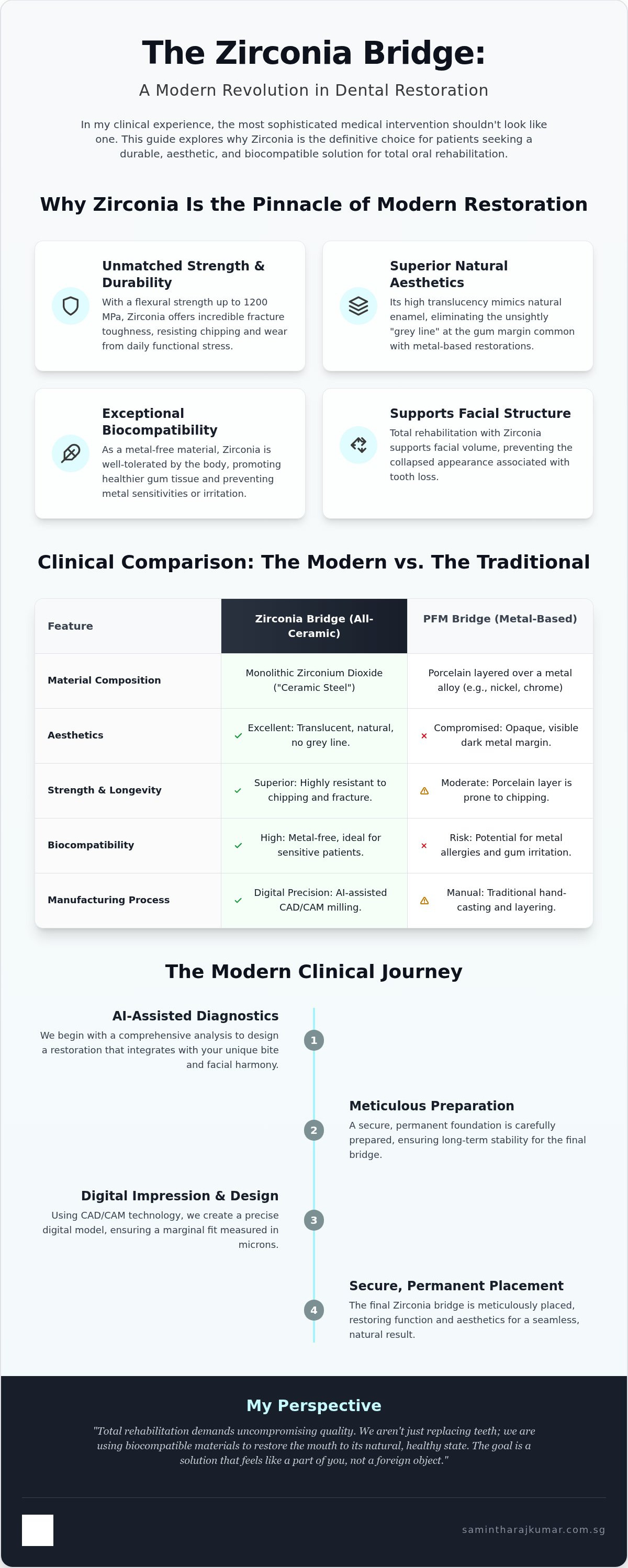
Zirconia is a material of remarkable physical properties. It is a high-performance ceramic that undergoes a process called transformation toughening. This essentially means the material resists the spread of microscopic cracks, giving it a fracture toughness that far exceeds traditional dental porcelains. In my clinical experience, using a monolithic zirconia bridge crafted from 3Y-TZP grade material provides a flexural strength of up to 1200 MPa. This is crucial for posterior restorations where biting forces are at their peak. By using a single, solid block of material, we eliminate the risk of porcelain chipping, which was a frequent failure point in older, layered designs.
As a clinician and founder, I've seen how digital precision has transformed our outcomes. We use CAD/CAM milling to carve each restoration from a pre-sintered block, ensuring a marginal fit measured in microns. This level of accuracy is impossible to achieve with traditional hand-casting methods. It results in a bridge that sits perfectly against the gum line, preventing food trapment and supporting the longevity of the underlying foundation.
Why Biocompatibility Matters in Restoration
From a biological perspective, the way a material interacts with your soft tissue is just as important as its mechanical strength. Zirconia is chemically inert. Unlike metal alloys, it doesn't corrode or release ions into the oral environment. This is a cornerstone of biological dentistry. Research, including a 5-year clinical study on zirconia bridges, shows that these restorations maintain excellent survival rates while being exceptionally gentle on the surrounding tissue.
Zirconia also has a lower affinity for bacterial plaque than titanium or stainless steel. This significantly reduces the risk of chronic inflammation and peri-implantitis around the supporting structures. When we plan these cases, we're looking for a biological integration that supports lifelong oral health. I've found that the best outcomes begin with understanding the root cause of previous dental failures, allowing us to select materials that the body truly accepts.
Aesthetic Superiority and Light Transmission
One of the most profound benefits of modern zirconia is its ability to mimic the light-scattering properties of natural tooth structure. Older ceramics often looked opaque or chalky, but the latest multi-layer and high-translucency grades allow light to pass through and reflect from within. This creates a vitality that looks indistinguishable from natural enamel. We achieve a bespoke finish through custom staining techniques, carefully matching the bridge to your remaining teeth. This ensures that the colour remains stable for decades. Because the material is non-porous, it's highly resistant to staining from coffee, tea, or tobacco, maintaining its brilliance over time.
Zirconia vs. Traditional Alternatives: A Clinical Comparison
In my clinical experience, patients often find themselves at a crossroads when choosing the material for their total mouth rehabilitation. While several options exist, the functional and biological outcomes vary significantly over time. As a clinician and founder, I believe it's my responsibility to look beyond the immediate result and consider how a restoration will perform a decade from now. When we compare a zirconia bridge to traditional alternatives, the differences in durability, hygiene, and tissue response become remarkably clear.
Zirconia Bridge vs. Hybrid Acrylic Bridge
One of the most common comparisons in full-arch cases is between zirconia and hybrid acrylic restorations. There's a persistent myth in some dental circles that zirconia is "too heavy" for the jaw. From a biological perspective, this isn't supported by clinical data. While zirconia is denser than acrylic, the precision of our digital planning ensures the weight is perfectly distributed across the supporting implants. The real difference lies in longevity. Acrylic is a porous material; it naturally absorbs fluids and bacteria over time, which can lead to unpleasant odours and a gradual loss of structural integrity.
Zirconia is entirely non-porous. This means it resists staining and prevents the accumulation of plaque much more effectively than composite resins. In my practice, I've seen hybrid bridges require frequent repairs for chipped or worn-down teeth within just three to five years. Conversely, a zirconia bridge maintains its surface texture and height, providing a stable bite that doesn't degrade with daily use. This stability is essential for maintaining the correct vertical dimension of your face and supporting your jaw joints.
Zirconia vs. PFM (Porcelain Fused to Metal)
When comparing zirconia to traditional Porcelain Fused to Metal (PFM) options, the advantages are primarily biological and aesthetic. PFM bridges require a metal substructure for strength, which necessitates thicker connectors between the teeth. This often results in a bulkier appearance that's harder to clean. Because zirconia possesses such high inherent strength, we can design more delicate, natural-looking connectors that allow for better airflow and easier flossing.
Metal Sensitivity: Zirconia eliminates the risk of nickel or base-metal allergies, which can cause chronic gum irritation.
Thermal Conductivity: Unlike metal, zirconia doesn't conduct heat or cold rapidly, reducing tooth sensitivity for patients with remaining natural abutments.
Gingival Health: Gums tend to recede away from metal margins, but they remain stable and healthy when in contact with biocompatible zirconia.
There's also the consideration of material hardness. Some worry that zirconia might be too abrasive for opposing natural teeth. However, when zirconia is polished to a high-gloss finish using specialist protocols, it's actually less abrasive than traditional dental porcelain. It glides against natural enamel without causing the "sandpaper" effect often seen with older ceramic materials. Daily maintenance remains straightforward; because the material doesn't stain or wear, your hygiene routine focuses purely on maintaining the health of the supporting gums and bone, rather than managing the decay of the prosthetic itself.
The Clinical Journey: What to Expect During Your Rehabilitation
Embarking on a journey toward a zirconia bridge is a transformative experience that requires both clinical precision and a deep understanding of your personal goals. In my clinical experience, the most successful outcomes are rooted in a partnership between the surgeon and the patient. As a clinician and founder, I ensure that every step of this journey is guided by advanced technology to remove guesswork and prioritise your comfort. We begin with a comprehensive diagnostic phase where we assess not just your teeth, but the entire architecture of your smile.
The transition from tooth loss to a fully restored smile is a logical progression of healing and engineering. From a biological perspective, we must ensure the surrounding tissue is healthy and the underlying bone is stable enough to support a permanent restoration. This process is never rushed. Instead, it flows with a measured confidence that ensures your long-term well-being is the primary focus of every clinical decision we make.
Planning for Success with Advanced Diagnostics
We start with a detailed consultation using AI-assisted diagnostics and 3D imaging. This allows me to visualise the final result before we even begin the physical preparation. By assessing bone density and gum health in a three-dimensional space, I can identify the most secure foundation for your bridge. For eligible patients, we often employ 'Teeth in a Day' protocols, which allow for an immediate transition to a functional, temporary smile while your final zirconia structure is being crafted.
The use of intraoral scanners has completely changed the patient experience. These high-definition digital impressions allow us to create a virtual model of your mouth with incredible accuracy, marking the end of messy, uncomfortable traditional moulds. During the 'Try-in' phase, we use a prototype of your bridge to verify aesthetics and phonetics. This step is non-negotiable in my practice; it allows us to make micro-adjustments to the shape and position of the teeth before the final zirconia is milled to perfection.
Fitting and Adjusting Your Final Prosthesis
When it's time for the final fitting, we choose between screw-retained and cement-retained designs based on your specific clinical needs. Screw-retained bridges are often my preference for full rehabilitation as they allow for easier maintenance and retrieval if ever necessary. Verifying the 'occlusion', or how your teeth meet, is perhaps the most critical part of this final appointment. If the bite is even slightly off, it can lead to jaw strain or TMJ issues over time. We meticulously adjust the bridge to ensure biting forces are distributed evenly across your jaw.
Post-operative care is straightforward, and the first 48 hours are primarily about allowing the soft tissues to settle. Most patients find they can return to their normal routine with a renewed sense of confidence almost immediately. I believe that the best outcomes begin with understanding the root cause of your dental concerns, ensuring your new smile is built to last a lifetime.
My Perspective: Why Total Rehabilitation Demands Uncompromising Quality
As a clinician and founder, I've spent my career pursuing a standard of care that transcends conventional dentistry. I believe the right diagnosis and the selection of superior materials change everything for a patient. A zirconia bridge is not merely a prosthetic; it is a 20-year investment in your quality of life. In my clinical experience, the most profound transformations occur when we stop looking at teeth in isolation and start viewing the oral cavity as the foundation of facial health. This is the difference between a simple repair and a true rehabilitation.
Total rehabilitation is a meticulous process that requires a visionary approach. It's about restoring the harmony between function and aesthetics. When I design a restoration, I'm thinking about how you'll feel during a business dinner, how you'll look in family photographs, and how your jaw will feel after a long day. We don't settle for "good enough" because your long-term comfort depends on our precision today.
Beyond Teeth: Restoring Facial Volume
One of the most overlooked aspects of tooth loss is the gradual change in facial structure. From a biological perspective, the loss of teeth leads to bone resorption, which can cause the lower third of the face to lose its support. A correctly engineered zirconia bridge acts as a structural scaffold. It provides the necessary projection to support the lips and cheeks, effectively preventing facial collapse with dental implants that serve as its anchor.
This holistic approach to structural rejuvenation is a cornerstone of cosmetic dentistry singapore. We aren't just creating a "pretty" smile. We're rebuilding the architectural support of your face. By restoring the correct vertical dimension, we can soften lines around the mouth and restore a more youthful, vibrant profile. It's a blend of surgical science and artistic vision that ensures your results are both functional and life-changing.
The Future of Biocompatible Dentistry
My commitment to international protocols and global standards of care drives me to continue innovating in the field of metal-free restorations. I'm particularly focused on the synergy between zirconia prosthetics and ceramic dental implants. This combination represents the future of biocompatible dentistry, offering a completely inert, tissue-friendly environment that promotes optimal healing and longevity. It's an uncompromising approach that prioritises your biological health alongside technical excellence.
As I reflect on the hundreds of rehabilitations I've performed, one principle remains constant: the best outcomes begin with understanding the root cause. We don't just treat symptoms; we build legacies of health. Whether we're using AI-assisted diagnostics or the latest in ceramic science, our goal is to provide you with a sense of security and a smile that truly reflects your vitality. The right diagnosis changes everything.
Restoring Your Quality of Life through Biocompatible Innovation
Total oral rehabilitation is about more than just replacing teeth. It's about reclaiming your self-assurance and biological health. We've explored how a zirconia bridge provides a metal-free, high-strength solution that supports your facial volume and integrates seamlessly with your body. By combining my expertise in All-on-4 and Teeth in a Day protocols with a visionary approach to biological dentistry, I've seen how these materials transform lives. As the founder of Nuffield Dental Holdings, I remain committed to bringing global standards of care to every patient journey.
The right diagnosis changes everything. Begin your journey toward total rehabilitation with a specialist consultation.
Your path to a functional, natural smile starts with understanding the root cause of your dental needs. I look forward to helping you rediscover the joy of a healthy, confident smile that supports your well-being for years to come.
Frequently Asked Questions
How long does a zirconia bridge typically last?
A zirconia bridge typically lasts between 10 and 15 years, though many of my patients maintain theirs for much longer with excellent oral hygiene. Its longevity is rooted in its high fracture toughness and resistance to the acidic environment of the mouth. In my clinical experience, the survival of the restoration depends heavily on the health of the supporting foundation, whether that be natural teeth or ceramic implants.
Is a zirconia bridge better than a porcelain bridge?
Zirconia is generally superior to traditional porcelain because it offers significantly higher flexural strength. While porcelain is aesthetic, it's prone to chipping under heavy biting forces. Zirconia provides the "ceramic steel" durability required for posterior teeth while maintaining the light-reflecting properties of natural enamel. It allows for a thinner yet stronger restoration, which often means we can preserve more of your natural tooth structure.
Can a zirconia bridge be used with dental implants?
Yes, zirconia is the gold standard material for implant-supported restorations. Its biocompatibility ensures that the surrounding gum tissue remains healthy and free from the inflammation often seen with metal components. Whether you're receiving a single bridge or a full-arch rehabilitation, zirconia provides the structural integrity needed to withstand the mechanical stresses of daily chewing while looking completely natural and integrated with your jaw.
Does a zirconia bridge look natural?
A modern zirconia bridge looks remarkably natural because we use multi-layered materials that mimic the translucency of real teeth. Unlike older metal-based restorations, there's no dark line at the gum margin. The material allows light to pass through and reflect from within, creating a vitality that blends seamlessly with your remaining dentition. We custom-stain each piece to match your unique tooth shade and facial character.
Is the procedure for a zirconia bridge painful?
The procedure for placing a bridge isn't painful as we use advanced local anaesthesia or intravenous sedation to ensure your total comfort. Most patients describe the sensation as a feeling of pressure rather than pain. After the preparation or implant placement, any mild tenderness can usually be managed with standard relief. My goal is always to make the clinical journey as stress-free and comfortable as possible for every patient.
How do I clean and maintain my zirconia bridge?
You should maintain your bridge exactly as you would your natural teeth. Brushing twice daily with a non-abrasive toothpaste and using interdental brushes or a water flosser is essential to keep the area under the bridge clean. Because zirconia is non-porous, it doesn't stain or harbour bacteria as easily as acrylic. However, regular professional cleanings are still vital to monitor the health of the supporting gums and bone.
Are there any disadvantages to choosing zirconia?
The primary consideration with zirconia is its inherent hardness, which requires a specialist's touch to ensure it doesn't wear down opposing natural teeth. If the bridge isn't polished to a high-gloss finish, it can be abrasive. This is why I prioritise digital precision and meticulous hand-polishing in our laboratory. It's a high-performance material that demands expert handling and correct occlusal alignment to achieve its full biological potential.
What is the cost difference between zirconia and traditional bridges?
Zirconia represents a premium investment in your long-term oral health compared to traditional metal-fused or acrylic options. The total cost is influenced by the grade of zirconia used, the complexity of the digital design, and whether it's supported by natural teeth or implants. While the initial commitment is higher, the reduced need for frequent repairs or replacements often makes it a more cost-effective choice over several decades of use.


Comments