
Treating Gum Recession Before Dental Implants: A Surgeon’s Perspective on Biological Foundations
- Dr Samintharaj Kumar

- Aug 11
- 11 min read
A dental implant is only as permanent as the biological foundation that supports it. In my clinical experience, the success of a restoration depends less on the hardware and more on the health of the surrounding tissue, which is why treating gum recession before dental implants is often the most critical stage of the journey. I recognise that the prospect of multiple procedures can feel daunting, especially if you're anxious about the discomfort of traditional grafting or the risk of your implant failing due to receding gums.
In this article, I'll share how we prioritise your comfort and long-term stability by establishing a healthy "pink foundation" first. From a biological perspective, we must ensure a robust seal of keratinised tissue to protect your investment from bacteria and ensure a natural appearance. I will explain how I utilise advanced, minimally invasive techniques like CHAO Pinhole® surgery to rejuvenate your gum line without the need for traditional scalpels. We'll explore the clinical sequence of total rehabilitation, providing you with a clear roadmap toward a stable, confident smile that feels as good as it looks.
Table of Contents
The Critical Role of Soft Tissue in Dental Implantology
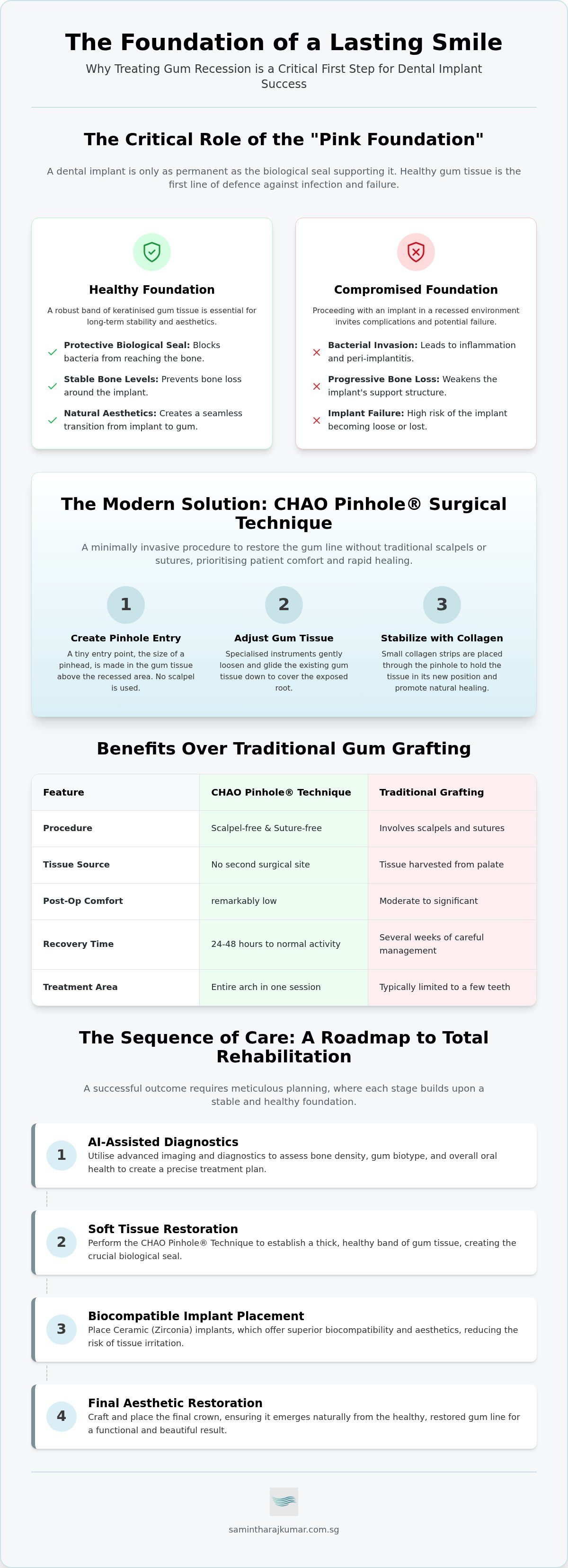
In my clinical experience, the success of a dental implant is dictated as much by the quality of the gums as by the density of the bone. While many patients focus on the strength of the jawbone, I often remind them that the soft tissue acts as the first line of defence. From a biological perspective, we require a specific type of tissue called keratinised gum tissue. This is the firm, resilient pink tissue that surrounds healthy teeth. It doesn't just look better; it acts as a protective gasket or "seal" around the implant abutment. If we bypass treating gum recession before dental implants, we risk leaving the underlying bone vulnerable to bacterial invasion. Proceeding in a recessed environment often leads to bone loss, which can eventually cause the implant post to become visible or even fail entirely.
Why Gum Recession Happens Before Surgery
Before we can restore a smile, we must understand why the foundation shifted. Gum recession isn't merely an aesthetic concern; it's often the result of chronic periodontal disease or mechanical trauma from aggressive brushing. However, a significant factor I see at Nuffield Dental is the physiological collapse that occurs after tooth loss. Without a root to support, the gingival architecture naturally recedes. Patients with "thin biotypes", which refers to genetically delicate gum tissue, are particularly susceptible. Identifying these root causes allows us to tailor a plan that isn't just a quick fix but a long-term biological investment. As a clinician and founder, I believe that sustainable results require addressing these underlying triggers before any restorative work begins.
The Clinical Necessity of a Healthy Gum Line
The primary reason I advocate for treating gum recession before dental implants is to prevent peri-implantitis. This is an inflammatory condition that mirrors gum disease but affects the area around an implant; it remains the leading cause of long-term implant failure. A robust band of keratinised tissue creates a tight cuff around the restoration, preventing food debris and bacteria from migrating toward the bone. Beyond function, there's the matter of aesthetic harmony. A dental implant should be indistinguishable from a natural tooth. This requires symmetry where the crown appears to emerge naturally from the gum line, rather than looking like a floating porcelain unit. True rehabilitation balances functional health with aesthetic harmony, ensuring your new smile feels as natural as it looks.
Modern Approaches to Tissue Restoration: The CHAO Pinhole® Technique
As a clinician, I prioritise techniques that offer profound results while minimising patient trauma. Traditional gum grafting often involves harvesting tissue from the roof of the mouth, which can be the most uncomfortable part of the recovery process. In contrast, the CHAO Pinhole® Surgical Technique (PST) represents a significant shift in how we approach soft tissue restoration. It allows us to rejuvenate the gum line without the need for scalpels or sutures, relying instead on the body’s innate ability to heal through collagen-guided pathways. I often recommend this method as the primary corrective measure when treating gum recession before dental implants, as it establishes the necessary biological seal with far less physiological stress.
The Pinhole Process: What Patients Should Expect
The procedure is elegant in its simplicity but requires meticulous surgical precision. Unlike traditional methods, it follows a logical, sequential progression:
Step 1: I create a tiny entry point, roughly the size of a pinhead, in the existing gum tissue above the area of recession.
Step 2: Using specialised instruments, I gently loosen the internal tissue and glide it downward to cover the exposed root or the future implant site.
Step 3: I then place small collagen strips through the pinhole. These strips stabilise the tissue in its new position and serve as a scaffold to encourage natural reattachment.
Benefits Over Traditional Gum Grafting
The most immediate advantage for my patients is the significantly reduced downtime. While traditional grafting might require weeks of careful management, most PST patients return to their normal activities within 24 to 48 hours. Because we avoid a "donor site" on the palate, the post-operative discomfort is remarkably low. We can also address multiple teeth or an entire arch in a single session, providing an instant aesthetic improvement that traditional methods struggle to match. If you're concerned about the health of your foundation, consulting with an experienced surgeon can help clarify if this minimally invasive route is right for you.
From a biological perspective, this technique is ideal for treating gum recession before dental implants because it preserves the blood supply to the tissue. This leads to more predictable outcomes and a healthier environment for your final restoration. It's a cornerstone of my philosophy at Nuffield Dental: achieving technical excellence through innovation that respects the patient’s comfort and long-term well-being.
Ceramic Implants and Gum Health: A Synergistic Relationship
From a biological perspective, the material we introduce into the oral ecosystem is a decisive factor in the long-term success of any restoration. While titanium has been the historical standard, I've observed that Ceramic (Zirconia) implants offer a far superior response from the surrounding soft tissue. This is particularly relevant when treating gum recession before dental implants, as our goal is to ensure the newly restored tissue remains stable and resilient. In my clinical experience, Zirconia acts as a "gold standard" for patients who are naturally prone to recession or have delicate gingival architecture.
The primary advantage lies in what we call the "Hemidesmosomal" attachment. Unlike metal, which the gums merely sit against, ceramic allows the soft tissue to form a more effective biological bond. This tighter attachment creates a robust seal that acts as a primary barrier against bacteria. For a patient who has already struggled with receding gums, this enhanced bond provides an extra layer of security against future tissue loss. It's not just about replacing a tooth; it's about selecting a material that actively supports the health of the foundation we've worked so hard to restore.
Biocompatibility and Bacterial Resistance
Zirconia is inherently resistant to the accumulation of plaque and biofilm, which are the primary drivers of gum inflammation. Because the surface of a ceramic implant is less "sticky" for pathogens, the surrounding tissue tends to remain in a much calmer, healthier state. For my patients with complex medical histories or sensitivities, I often recommend biocompatibility testing for dental materials. This ensures that the components we place in your jaw support a positive inflammatory response and align with your body's unique biological requirements. At Nuffield Dental, this level of precision is fundamental to our philosophy of total rehabilitation.
Aesthetics in the Aesthetic Zone
Achieving a natural result is especially challenging in the "aesthetic zone" at the front of the mouth. If a patient has a thin gum biotype, a metal implant can sometimes cast a dull, grey shadow through the tissue. By choosing ceramic, we eliminate this issue entirely. The white material mimics the natural colour of a tooth root, allowing for a beautiful "emergence profile" where the crown appears to grow naturally from the gum line. When we combine the minimally invasive restoration of the gums with the biological harmony of ceramic foundations, the result is a smile that looks, feels, and functions like your own. The best outcomes begin with understanding how these materials interact with your living tissue.
The Sequence of Care: Planning for Total Rehabilitation
I believe that the best outcomes begin with understanding the root cause through advanced diagnostics. As a clinician and founder, I've seen that the debate between "Gum-First" and "Bone-First" is rarely a matter of preference; it's a biological necessity determined by your unique anatomy. When treating gum recession before dental implants, we must also consider the underlying bone volume. In cases where recession is accompanied by bone loss in the upper jaw, I may need to integrate sinus lift surgery for dental implants to create a stable environment for the post. From a biological perspective, these two foundations, bone and soft tissue, are co-dependent and must be managed with equal precision.
Diagnostic Precision with AI
At Nuffield Dental, we utilise 3D CBCT scans coupled with AI-assisted diagnostics to measure gum thickness and bone density simultaneously. This level of precision allows us to predict potential recession sites before they even manifest. By developing a bespoke digital roadmap, I can visualise the entire surgical journey before we even begin. This foresight ensures that every step, from tissue restoration to implant placement, is logically sequenced to protect the longevity of your smile. We don't just look at the gap; we look at the entire ecosystem of your mouth.
Managing the Healing Timeline
Patience during the soft-tissue phase is often the difference between a restoration that lasts a decade and one that lasts a lifetime. Once we've established a healthy gum foundation, we can transition toward the restorative phase, such as the teeth in a day procedure. During this transition, I often use temporary prosthetics to "train" the gum tissue. These temporaries act as a template, guiding the healing gums to form a natural, aesthetic cuff that will perfectly frame the final crown.
Post-operative protocols are equally vital to ensure the newly established gum line remains stable. This structured approach is what I call Total Rehabilitation. It's a commitment to the patient journey that prioritises long-term health over immediate, short-term fixes. The right diagnosis changes everything. I invite you to discuss your rehabilitation plan with our specialist team to see how we can secure your dental future.
My Perspective: Orchestrating the Journey to Total Rehabilitation
In my clinical experience, patients often arrive focusing exclusively on the gap where a tooth used to be. They want an immediate solution to restore their appearance. As a surgeon, however, my mind immediately goes to the architectural integrity of the site. I founded Nuffield Dental on the principle of Total Rehabilitation; this means we look far beyond the immediate gap to assess the entire biological landscape. If we don't prioritise the health of the surrounding tissue, we're merely placing a crown on a foundation that cannot sustain it. Treating gum recession before dental implants is therefore a commitment to longevity rather than a temporary fix. As an innovator and educator, I view every case as a unique puzzle that requires both clinical mastery and a visionary approach to rehabilitation.
There's a specific kind of emotional renewal that I witness in my patients when their smile finally feels biologically "right." It's more than just aesthetics; it's the confidence that comes from a stable, healthy mouth. My commitment to global standards drives me to bring innovative protocols like CHAO Pinhole surgery to my patients in Singapore. By avoiding the trauma of traditional grafting, we lower the emotional barriers to care. It allows the journey toward total health to be as restorative for the spirit as it is for the body. This journey isn't just about surgery; it's about building an institution where quality is uncompromising and the patient's long-term well-being is the ultimate metric of success.
The Future of Biological Implantology
We're seeing a significant shift away from traditional metal-centric dentistry toward bio-neutral solutions. As a clinician and founder, I believe the future lies in materials and techniques that mimic nature. This is why I advocate for zirconia foundations and minimally invasive tissue restoration. It's also essential to choose a surgeon who understands the relationship between dental structure and face shape. The way we manage your gums and bone volume directly influences the structural rejuvenation of your face, preventing the sunken appearance often associated with ageing and tooth loss. From a biological perspective, we're not just replacing teeth; we're preserving the very framework of your facial identity.
My perspective is that we aren't just fixing teeth; we're building an ecosystem for health. The best outcomes begin with understanding the root cause. This philosophy of meticulous planning and biological respect is what sets a premium clinical journey apart. The right diagnosis changes everything for your long-term well-being, ensuring that the smile we build today remains a legacy for your future.
Securing Your Smile’s Biological Future
In my clinical experience, the most successful restorations are those where we respect the natural architecture of the mouth. By prioritising the health of your soft tissue, we ensure that your dental implants aren't just a functional replacement but a seamless part of your biology. We've explored how treating gum recession before dental implants creates a protective seal, and how innovations like CHAO Pinhole® surgery allow us to achieve this without the discomfort of traditional grafting.
As a specialist in these advanced protocols and founder of Nuffield Dental, I'm committed to a pathway of total rehabilitation that is both technically excellent and patient-centred. We've seen that the synergy between healthy gums and biocompatible ceramic foundations is the key to longevity. The best outcomes begin with understanding the root cause. Consult with Dr Samintharaj Kumar to discuss your tailored rehabilitation plan. Your journey toward a stable, natural-looking smile is a significant investment in your quality of life, and I look forward to helping you build a foundation that lasts.
Frequently Asked Questions
Can I get dental implants if I have severe gum recession?
Yes, you can still receive dental implants, but we must restore the soft tissue foundation first. Severe recession often means there is insufficient keratinised tissue to protect the implant site. In my clinical experience, treating gum recession before dental implants is essential to create a stable biological seal. We typically address this using minimally invasive techniques to ensure the long-term success of your restoration.
Is gum recession treatment painful before an implant procedure?
Modern techniques have significantly reduced the discomfort associated with gum restoration. While traditional grafting involves harvesting tissue from the palate, I frequently utilise the CHAO Pinhole Surgical Technique. This method requires no scalpels or sutures, which greatly minimises post-operative pain. Most of my patients report only minor sensitivity and find the process far less daunting than they initially anticipated.
How long do I have to wait for implants after gum grafting or Pinhole surgery?
The waiting period depends on the technique used and your individual healing rate. With traditional grafting, we often wait four to six months for the tissue to mature. However, the CHAO Pinhole technique often allows for faster physiological integration. From a biological perspective, we must ensure the new tissue is stable before placing the implant to avoid compromising the final result.
What happens if I ignore gum recession and get implants anyway?
Ignoring recession increases the risk of peri-implantitis, which is a leading cause of implant failure. Without a thick band of healthy gum, bacteria can easily reach the underlying bone. This often leads to bone loss and a visible grey shadow or exposed metal threads. Ensuring a robust foundation is a prerequisite for a restoration that looks natural and lasts for decades.
Are ceramic implants better for people with thin gums?
Ceramic implants are often the superior choice for patients with thin gum biotypes. Because they are tooth-coloured, they don't create the dark metallic shadow that titanium can sometimes produce through delicate tissue. Additionally, the soft tissue tends to form a tighter biological attachment to zirconia. This synergy helps maintain the gum line and supports overall gingival health over time.
Can gum recession happen after the dental implant is already placed?
Yes, recession can occur post-surgery if the initial band of keratinised tissue was too thin or if oral hygiene is neglected. This is precisely why treating gum recession before dental implants is so vital. We aim to build a resilient foundation that can withstand natural physiological changes. Regular maintenance and a gum-first surgical approach are the best defences against future recession.
How much does it cost to treat gum recession before implants in Singapore?
The cost of treatment varies based on the severity of the recession and the number of sites requiring restoration. Factors such as the choice between traditional grafting and the CHAO Pinhole technique also influence the final investment. I recommend a comprehensive consultation at Nuffield Dental, where we use AI-assisted diagnostics to provide a clear and transparent breakdown of your bespoke treatment plan.
What is the success rate of implants in patients who have had gum restoration?
Success rates are exceptionally high when we establish a healthy soft tissue foundation before placement. Clinical data suggests that implants surrounded by a robust band of keratinised tissue have a much lower incidence of inflammatory complications. By meticulously planning the sequence of care, we ensure that your dental implant remains a permanent and aesthetic part of your smile for many years.


Comments