
Understanding the Gummy Smile: A Specialist Surgeon’s Guide to Excessive Gingival Display

What if the secret to a balanced smile isn't found in the teeth at all, but rather in the delicate architecture of the lips and jaw? In my clinical experience, nearly 10% of adults between the ages of 20 and 30 experience what we define as a gummy smile, leading many to feel that their teeth appear disproportionately small. I understand the quiet hesitation that comes with being photographed. It's often a result of confusion over whether a simple injection or a complex surgery is the right path forward.
This guide is designed to provide you with the clinical clarity you deserve, moving beyond surface-level aesthetics to address the biological root causes of excessive gingival display. I'll take you through the advanced treatment pathways I use in my practice, from lip repositioning to total facial rehabilitation. By the end of this article, you'll have a comprehensive understanding of how modern surgical protocols can restore both facial harmony and your personal confidence.
Key Takeaways
Gain a clinical understanding of the "golden proportion" and the specific measurements that define a gummy smile within the context of total facial harmony.
Identify the four primary anatomical triggers and developmental growth patterns that influence your unique smile architecture.
Explore the biological link between excessive gum display and underlying functional jaw issues to ensure long-term periodontal health and stability.
Compare modern 2026 treatment modalities, ranging from non-invasive refinements to permanent surgical interventions designed for clinical precision.
Understand my specialist approach to bespoke treatment planning, focusing on a seamless journey toward life-changing results and enhanced quality of life.
Table of Contents Defining the Gummy Smile: More Than Just Aesthetics The Root Causes: Why Excessive Gingival Display Occurs Clinical Consequences and My Perspective on Harmony Modern Treatment Modalities: From Botox to Surgical Precision The Journey Toward Total Rehabilitation and Quality of Life
Defining the Gummy Smile: More Than Just Aesthetics
In my clinical experience as a specialist surgeon, a smile represents much more than just dental alignment; it is a vital component of facial harmony. When a patient presents with what we clinically term Excessive Gingival Display (EGD), they are often referring to what is colloquially known as a gummy smile. This condition occurs when the proportions between the teeth, the gingival tissue, and the upper lip are out of balance, creating a visual disharmony that draws focus away from the eyes and the rest of the face.
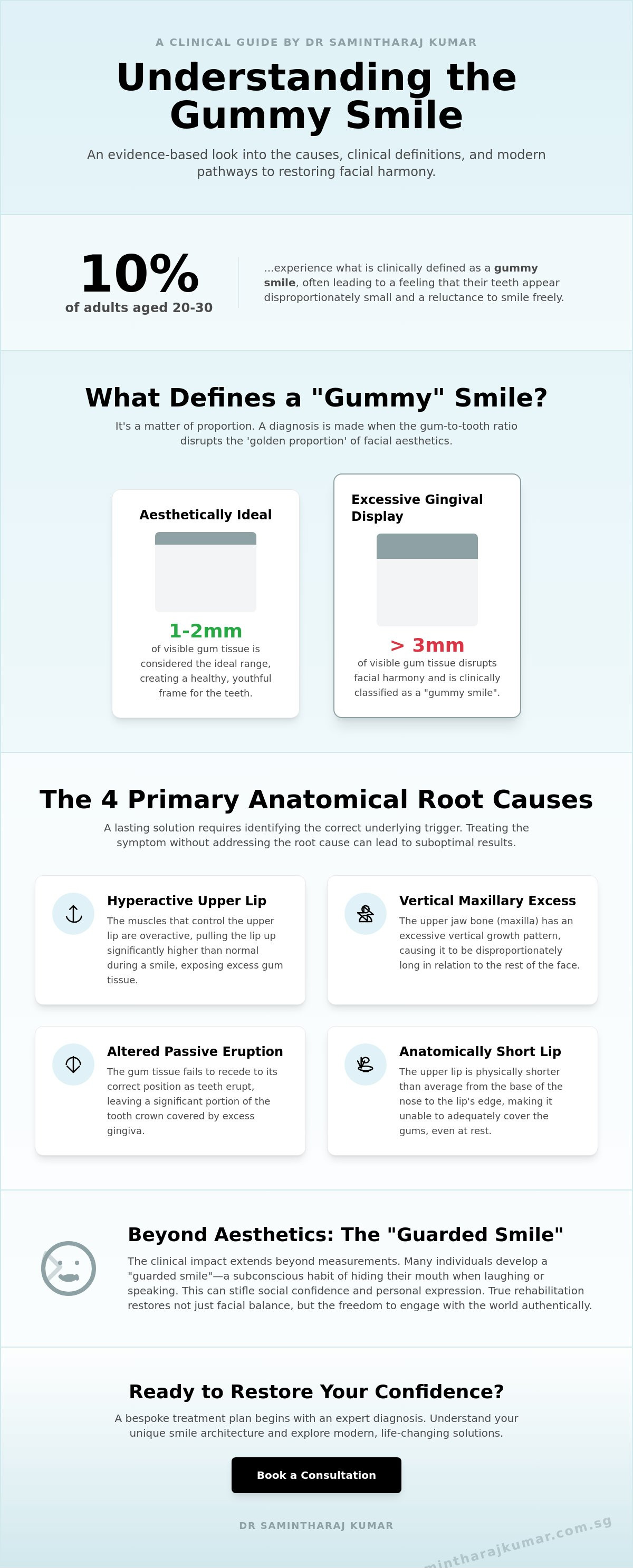
From a biological perspective, we define a smile as "gummy" when more than 3 millimetres of gum tissue is visible during a full, natural smile. While a small amount of pink tissue is healthy and provides a youthful appearance, exceeding this threshold often disrupts the "golden proportion." This mathematical ratio is a cornerstone of aesthetic medicine used to ensure facial symmetry. When the gingiva dominates the smile, it can make the teeth appear unnaturally short, even if they are of a standard anatomical length.
To better understand the visual dynamics of this condition, watch this helpful video:
The 2mm Threshold: When is a Smile "Gummy"?
During a consultation at Nuffield Dental, I use precision tools to measure the vertical display of the gingiva. A display of 1 to 2 millimetres is typically considered aesthetically ideal by most specialists. However, these standards are not static. Data suggests that gender and age influence these perceptions. For instance, women generally have higher lip lines than men, often showing more gum tissue without it being perceived as an issue. As we age, the upper lip naturally loses elasticity and drops by approximately 1 millimetre every decade, which can naturally mask a previously prominent gummy smile. A diagnosis must therefore consider the entire facial profile, including the skeletal relationship of the maxilla to the skull.
The Psychological Impact of Excessive Gingival Display
The impact of EGD extends far beyond clinical measurements. I often observe the "guarded smile" phenomenon in my patients. This is a subconscious habit where individuals tension their facial muscles or use their hands to hide their teeth when laughing. This lack of social confidence can stifle professional presence and personal joy. Total rehabilitation isn't just about surgical precision; it's about moving a patient from a state of self-consciousness to one of total oral and facial confidence. Moving toward a balanced smile allows the patient’s personality to shine through without the filter of insecurity.
My Perspective: The Intersection of Art and Anatomy
As a clinician and founder, I believe that treating a gummy smile requires a marriage of art and science. In my experience, we cannot look at the mouth in isolation. We must evaluate the hypermobility of the lip muscles, the vertical height of the jawbone, and the biological width of the soft tissue. True excellence in maxillofacial surgery comes from understanding that we aren't just removing tissue; we are restoring a patient's willingness to engage with the world. The right diagnosis changes everything, as it allows us to address the root cause rather than just the symptoms. The best outcomes begin with understanding the root cause.
The Root Causes: Why Excessive Gingival Display Occurs
In my clinical experience, patients often approach me focused solely on the aesthetic appearance of their gums, yet a lasting solution rarely begins with the soft tissue alone. Achieving a truly harmonious result requires us to look deeper than the surface. We must identify which of the four primary anatomical triggers is at play. Genetics and developmental growth patterns dictate your smile architecture; they determine how your bone, teeth, and lips interact. When we treat the symptom without identifying the underlying cause, the results are almost always suboptimal and temporary.
A multi-disciplinary assessment is the cornerstone of my practice. From a biological perspective, we must understand the "why" before we can decide on the "how." Without this diagnostic rigour, a patient might receive a treatment that doesn't address their specific anatomy. You can explore various treatment options for a gummy smile, but the success of these interventions hinges entirely on an accurate diagnosis of the root cause.
Skeletal Factors: Vertical Maxillary Excess
Vertical Maxillary Excess, or VME, occurs when the upper jaw bone is overdeveloped in a vertical direction. This skeletal disharmony pushes the entire gumline and tooth row downward, often resulting in what clinicians describe as "long face syndrome." In these cases, the gummy smile isn't a dental issue but a structural one. Interestingly, skeletal disharmony can often mirror other complex issues, such as an underbite, where the relationship between the maxilla and mandible is misaligned. Correcting this requires a sophisticated understanding of maxillofacial harmony to ensure the face remains balanced in profile and the proportions are restored to a natural state.
Soft Tissue and Muscular Dynamics
Beyond the bone, the movement of the lips and the position of the gums play a vital role. I frequently see three specific soft tissue factors that contribute to excessive display:
The Hyperactive Lip: This occurs when the elevator muscles, specifically the levator labii superioris, pull the upper lip too high during a smile. This exposes excessive gingiva even if the jaw and teeth are perfectly proportioned.
Delayed Passive Eruption: This is a developmental quirk where the gum tissue fails to recede properly as permanent teeth emerge during childhood. It leaves the teeth looking "short" because they're partially buried under the thick curtain of the gums.
Short Upper Lip Anatomy: Sometimes, the lip itself is simply too short to cover the gums and teeth at rest or during speech, a condition that is often genetic.
As a clinician and founder, I believe that life-changing results come from precision. Every patient's anatomy is a unique puzzle. The best outcomes begin with understanding the root cause, ensuring that our path toward total rehabilitation is both predictable and permanent. If you're concerned about how your smile presents, consulting with a specialist is the first step toward clarity.
Clinical Consequences and My Perspective on Harmony
In my clinical experience, a gummy smile is rarely just an aesthetic preference; it's often a clinical indicator of underlying structural or functional discrepancies. When a patient presents with more than 3mm of exposed gingival tissue, we must investigate whether this stems from Vertical Maxillary Excess, an overactive levator muscle, or altered passive eruption. From a biological perspective, the health of the periodontium is our primary concern. The American Academy of Periodontology highlights that Cosmetic periodontal procedures must be grounded in a deep understanding of the patient's unique anatomy to ensure long-term stability.
As a clinician and founder, I view the correction of excessive gingival display as a fundamental pillar of total oral rehabilitation. We don't simply look at the teeth in isolation. Instead, we evaluate how the hard and soft tissues interact during speech and laughter. If we treat the "pink" without considering the "white" and the underlying bone, the result will always feel disconnected. My philosophy is built on the belief that true harmony is achieved when the biological foundation is as robust as the final visual outcome.
Why the Root Cause Matters for Longevity
The distinction between a camouflage treatment and a definitive clinical solution is significant. Temporary masks, such as neuromodulators to freeze the upper lip, provide short-term relief but fail to address skeletal issues. In my practice, I've seen how an incorrect diagnosis leads to relapse or, worse, an unnatural facial expression that lacks character. We must ensure that any intervention, whether it's a gingivectomy or orthognathic surgery, supports the long-term health of the alveolar bone. By respecting the biological width, we prevent chronic inflammation and ensure the gummy smile correction remains stable for a lifetime.
A Holistic Approach to Facial Aesthetics
Achieving a natural result requires a blend of technology and artistry. We utilise Digital Smile Design (DSD) to create a virtual blueprint of the intended outcome before any procedure begins. This allows us to balance the "pink" gingival architecture with the "white" tooth proportions for a seamless transition. I firmly believe that "less is more" in facial aesthetics. Our goal isn't to eliminate every millimetre of gum tissue, but to create a sophisticated balance that reflects health and vitality. By integrating these digital protocols, we can offer patients a predictable path toward a transformation that enhances their natural features rather than replacing them.
Precision Diagnostics: Using 3D imaging to assess bone height and tooth position.
Functional Stability: Ensuring the bite and jaw alignment are not compromised.
Symmetry: Aligning the gingival zeniths to create a balanced frame for the teeth.
The right diagnosis changes everything. When we address the root cause, we don't just change a smile; we restore a patient's confidence through a scientifically sound, biologically respectful approach.
Modern Treatment Modalities: From Botox to Surgical Precision
In my clinical experience, the landscape of 2026 treatment protocols has shifted entirely toward digital precision. We no longer rely on visual estimation; instead, I use AI-assisted diagnostics to map the ideal gingival margins with sub-millimetre accuracy. This data-driven approach allows us to plan the perfect balance between the lip, the teeth, and the gingiva before any procedure begins. By integrating Er:YAG laser technology, we can now perform sculpting that is virtually bloodless, significantly reducing recovery times compared to traditional scalpel techniques used in the past.
Non-Surgical and Minimally Invasive Options
For patients seeking immediate results with minimal downtime, Botulinum Toxin (Botox) injections provide a 10-minute solution for a gummy smile caused by hyperactive lip muscles. By precisely targeting the levator labii superioris, we relax the upper lip's elevation to ensure it sits at a more aesthetic level. This effect typically lasts four to six months. I also frequently utilise the "Lip Flip," which involves micro-injections to subtly roll the lip outward for a fuller appearance. When the issue is dental rather than muscular, orthodontic intrusion using clear aligners can move teeth upward into the alveolar bone, correcting the display at its source over 12 to 18 months.
Advanced Surgical Excellence
When a permanent correction of a gummy smile is required, I look toward surgical interventions that offer life-changing results. Gingivectomy and functional crown lengthening involve sculpting the gumline to reveal the natural tooth structure hidden beneath. For those with a hypermobile lip, Lip Repositioning Surgery remains a cornerstone of my practice; it's a permanent procedure that limits the upward travel of the lip during a smile. In cases of vertical maxillary excess, orthognathic surgery stands as the gold standard. This involves repositioning the upper jaw to address severe skeletal imbalances, a process that requires the highest tier of specialised expertise.
My Perspective:
As a clinician and founder, I've seen how the integration of AI and laser precision has transformed patient confidence. We've moved away from "one-size-fits-all" dentistry toward a bespoke biological model. My philosophy is rooted in total rehabilitation, ensuring that every adjustment respects the natural harmony of your facial features. Modern medicine allows us to be both meticulous and empathetic, prioritising your comfort alongside technical perfection.
The best outcomes begin with understanding the root cause of your unique smile profile.
The Journey Toward Total Rehabilitation and Quality of Life
In my clinical experience, the correction of a gummy smile is never just about the teeth. It's about the sophisticated harmony between the lips, the gingiva, and the underlying skeletal structure. When you visit me for a specialist consultation, we begin with a comprehensive facial analysis. I don't just look at your mouth; I look at how your muscles move when you laugh and how your profile sits at rest. This bespoke approach ensures the results look natural and last for decades. Every face is unique, and your treatment plan must reflect your specific anatomy to achieve true facial balance.
Planning Your Transformation
We utilize high-resolution 3D imaging and digital smile design to map out your journey before we even begin. This allows us to visualize the final result with clinical precision. If your path involves surgical crown lengthening, you might expect a recovery period of 7 to 14 days for initial tissue healing. For those opting for non-surgical lip repositioning or muscle-relaxing injections, the downtime is often less than 48 hours. I prioritize your comfort by integrating advanced intravenous sedation protocols, ensuring a seamless and anxiety-free experience throughout the procedure.
Life After Correction
The shift in self-perception is often the most rewarding part of my work as a surgeon. Correcting a gummy smile is frequently the final, critical step in a smile makeover. Once the proportions are balanced, patients often report a profound boost in confidence that carries into their professional and social lives. From a biological perspective, maintaining this result requires a commitment to oral hygiene excellence. We provide a tailored maintenance programme to preserve your aesthetic investment and ensure the soft tissues remain healthy and stable for the long term.
As a clinician and founder, I believe that a successful transformation is rooted in both technical rigour and empathy. We don't just treat symptoms; we restore the natural balance that allows your true personality to shine through. My goal is to provide a level of care that honours your trust and delivers life-changing results. The best outcomes begin with understanding the root cause.
Restoring Balance Through Clinical Precision
Achieving a harmonious result is about more than just adjusting tissue; it's about understanding the unique biological architecture of your face. In my 20 years of surgical practice as the founder of Nuffield Dental, I've seen how a gummy smile affects more than just aesthetics. It often impacts a patient's fundamental confidence and social comfort. My philosophy centres on total rehabilitation, where I specialise in complex maxillofacial and oral surgery to address the underlying structural causes of excessive gingival display. By utilising advanced 3D digital smile design, I can provide predictable outcomes that align with your natural features before any procedure begins.
I believe that every patient deserves a treatment plan rooted in both science and empathy. We don't just look for a quick fix; we look for a lifetime of stability and health. My focus remains on delivering international standards of care through meticulous planning and a deep respect for facial symmetry. The right diagnosis changes everything. Begin your journey toward a harmonious smile with a specialist consultation.
Your path to a transformed quality of life starts with understanding the root cause of your concerns. I look forward to helping you achieve the lasting confidence you deserve.
Frequently Asked Questions
Is a gummy smile a medical problem or just a cosmetic concern?
In my clinical experience, a gummy smile is primarily a cosmetic concern, though it can sometimes signal underlying functional issues. Research suggests that approximately 10% of adults between 20 and 30 years old present with excessive gingival display. While it doesn't always impact oral health, it can lead to self-consciousness. If the cause is related to mouth breathing or jaw misalignment, I may recommend treatment to prevent future periodontal complications.
Can a gummy smile be fixed without surgery using Botox?
Botox is an effective non-surgical alternative for patients whose excessive display is caused by a hyperactive upper lip. By injecting the botulinum toxin into the levator muscles, I can temporarily reduce the lift of the lip when you laugh. Results usually appear within 7 days and last for 3 to 4 months. It's a fantastic entry point for those who aren't ready for a permanent surgical commitment or more invasive procedures.
How much gum should show when you smile normally?
An aesthetically pleasing smile typically shows 2 millimetres or less of gum tissue. Clinical studies in aesthetic dentistry indicate that a display of 3 to 4 millimetres or more is when most people begin to perceive their smile as having excessive display. In my practice, I aim for a balanced proportion where the upper lip sits just at the top of the teeth, ensuring a natural and harmonious appearance for the patient.
What is the recovery time for a surgical gummy smile correction?
Recovery from surgical correction is remarkably swift; most patients resume normal activities within 48 to 72 hours. While the initial soft tissue healing takes about 14 days, any minor swelling typically subsides within the first week. I advise patients to stick to a soft food diet for 5 days to protect the surgical site. This ensures the delicate contours of the new gum line remain undisturbed during the critical healing phase.
Are the results of a gingivectomy or crown lengthening permanent?
Gingivectomy and crown lengthening results are considered permanent because we are physically reshaping the oral architecture. Unlike temporary solutions, these procedures involve the precise removal of excess tissue or the recontouring of the underlying bone. Once I've established the new height of the gum line, the tissue won't grow back in the traditional sense. This provides a lifetime of confidence through a single, well-planned clinical intervention that transforms your appearance.
Can braces or Invisalign fix a gummy smile?
Orthodontic interventions like Invisalign can indeed address certain types of a gummy smile. If the excessive display is caused by the position of your teeth or a minor jaw discrepancy, braces can move the teeth upward into a more favourable position. This process, known as intrusion, can often reduce gum visibility by 2 or 3 millimetres. It's a gradual transformation that typically takes between 12 and 18 months to complete fully.
Is gummy smile correction painful?
Patients don't find the correction process painful because I use advanced local anaesthetic protocols to ensure total numbness throughout the procedure. You might feel some minor pressure, but the experience is generally quite comfortable and controlled. After the numbness wears off, any tenderness is easily managed with standard over-the-counter analgesics for 48 hours. My goal is to make the journey toward your new smile as seamless and stress-free as possible.
What happens if I choose not to treat my gummy smile?
Choosing not to treat the condition won't usually compromise your systemic health if the cause is purely genetic. However, there are instances where excessive gum tissue makes oral hygiene more difficult. Data shows that individuals with significant gingival overgrowth may have a 15% higher risk of developing localised gingivitis. If you're comfortable with your appearance and can maintain good hygiene, leaving it untreated is a perfectly valid choice for your long-term care.


Comments