
Zirconia vs Titanium Implants: A Specialist Surgeon’s Analysis of Success Rates (2026)
- Dr Samintharaj Kumar

- May 11
- 12 min read
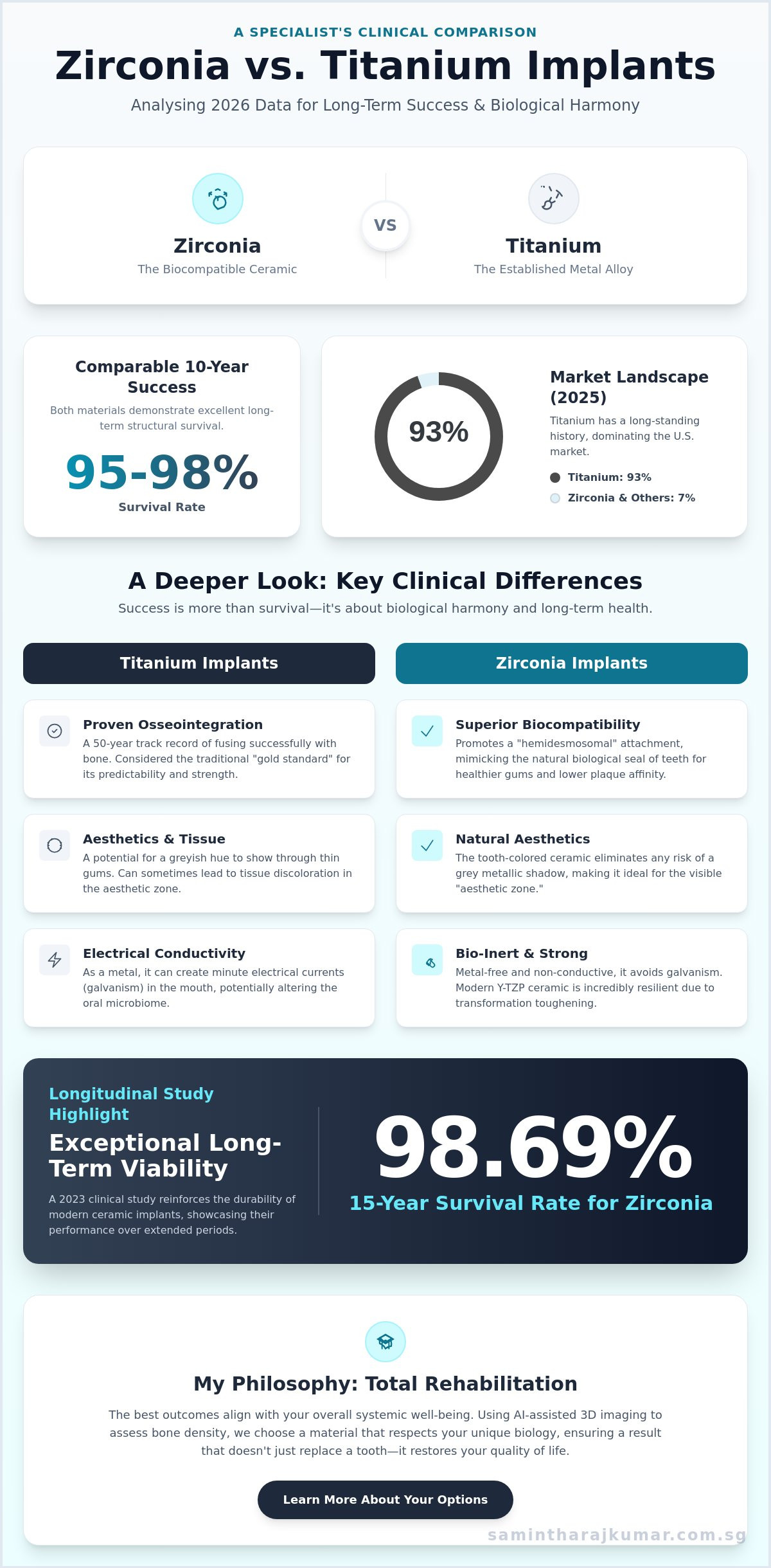
While titanium held a 93% share of the U.S. market as of 2025, recent clinical data suggests that the traditional "gold standard" is no longer the only path to a permanent smile. In my clinical experience as a surgeon and founder, I've seen that the choice between metal and ceramic is rarely about which material is better in a vacuum. Instead, it's about which one respects your systemic health while ensuring structural longevity. It's natural to feel anxious when comparing the zirconia vs titanium implants success rate, especially when a 2023 study reports a 98.69% 15-year survival rate for zirconia while a January 2026 analysis highlights specific risks in immediate placement protocols.
I've written this analysis to provide the clinical certainty you need to overcome the fear of implant failure or metal sensitivities. We'll examine the latest 2026 retrospective data and how modern two-piece systems have transformed restorative flexibility for the aesthetic zone. By the end of this review, you'll understand the biological impact of each material and receive my clear specialist recommendation for achieving total rehabilitation. My philosophy is rooted in the belief that the best outcomes begin with understanding the root cause; we aren't just replacing teeth, we're restoring your quality of life through science and precision.
Key Takeaways
Understand how molecular differences between titanium and zirconia influence long-term stability and why traditional metal may not suit every patient's unique biological profile.
Discover why the zirconia vs titanium implants success rate remains comparable at 95-98% over ten years, while newer longitudinal studies highlight zirconia's unique advantages for soft tissue health.
Learn about the science of galvanism and how metal-free ceramic implants promote a "hemidesmosomal" attachment to the gums, mimicking the natural biological seal of your teeth.
Explore the essential role of AI-assisted 3D imaging in assessing bone density to ensure your chosen material can withstand specific mechanical load requirements.
Gain insight into my "Total Rehabilitation" philosophy, which looks beyond the individual tooth to ensure your restorative journey aligns with your overall systemic well-being.
Table of Contents
The Evolution of Implantology: Why Material Choice Defines Success
Comparative Success Rates: Analysing Zirconia and Titanium Data in 2026
The Biological Imperative: Why Success Is More Than Just Integration
Clinical Considerations: How I Determine the Right Material for You
My Perspective: Total Rehabilitation and the Future of Metal-Free Dentistry
The Evolution of Implantology: Why Material Choice Defines Success
In my clinical experience, the foundation of a successful restoration isn't found in the crown, but in the interface between the bone and the choice of material. For decades, the industry relied almost exclusively on metal. However, as we move through 2026, I've observed a significant shift towards biological harmony. Choosing a dental implant material is no longer just a mechanical decision; it's a physiological one. If we ignore the body's unique immune profile, we risk long-term tissue instability, regardless of how "strong" the material claims to be.
Analysing the zirconia vs titanium implants success rate requires us to look beyond simple osseointegration. We must examine how the material respects the surrounding soft tissue and the patient's systemic health. My philosophy as a clinician and founder is to prioritising materials that mirror the body’s natural structures, ensuring that the final result feels seamless and life-changing rather than like a foreign object.
To better understand this concept, watch this helpful video comparison:
Titanium: The Legacy of Osseointegration
Titanium has been the cornerstone of implantology since its discovery in the 1950s. Its 50-year track record provides a level of predictability that is difficult to ignore. Medical-grade titanium alloys, specifically Grade 5, achieve the high mechanical strength necessary for full-mouth rehabilitation. This strength is vital for complex procedures like Zygomatic implants, where the implant must traverse the maxillary sinus to engage the cheekbone. While titanium accounted for over 93% of the U.S. market in 2025, I always ensure that this choice aligns with a patient’s specific sensitivity profile.
Zirconia: The Rise of Biocompatible Ceramics
From a biological perspective, zirconia represents the next frontier. Technically known as Yttria-stabilised Tetragonal Zirconia Polycrystal (Y-TZP), it's a high-performance, metal-free ceramic. I've found it's becoming the preferred choice for biological dentistry because it doesn't conduct electrical currents and carries a lower risk of plaque accumulation. There's a common myth that ceramic is too brittle for the mouth. In reality, modern engineering uses transformation toughening to ensure these implants are incredibly resilient. Since its FDA clearance in 2011, zirconia has matured into a sophisticated tool for achieving aesthetic excellence, particularly in the front of the mouth where gum thinness might otherwise reveal a grey metallic shadow.
Comparative Success Rates: Analysing Zirconia and Titanium Data in 2026
I define success as the seamless combination of structural survival and long-term functional health within the oral ecosystem. When we examine the zirconia vs titanium implants success rate in 2026, we see a fascinating convergence in clinical data. Contemporary studies now show that both materials consistently achieve 10-year survival rates between 94% and 98%. However, a high survival rate doesn't always equate to biological harmony. As a clinician and founder, I've observed that while an implant may remain "survived" in the bone, its success depends on how the surrounding tissues respond over a decade or more.
The variance in recent data highlights the importance of surgical precision. For instance, a retrospective analysis published in January 2026 reported a lower 5-year survival rate for zirconia at 83.8%. This specific dip was largely attributed to immediate placement protocols in high-risk cases rather than a failure of the material itself. In contrast, a 2023 longitudinal study on 1,828 zirconia implants reported a 15-year survival rate of 98.69%. These figures suggest that when ceramic is placed with the correct protocol, its longevity is exceptional. It's why I believe the best outcomes begin with understanding the root cause of a patient's dental needs before selecting the material.
Titanium Success Metrics
Titanium remains a formidable choice due to its predictable marginal bone loss patterns. A 2023 systematic review covering over 45,000 cases confirmed a 95.7% success rate at the 10-year mark. This predictability is especially valuable for patients with controlled systemic conditions, such as diabetes, where bone healing may be slower. The FDA guidance on dental implants acknowledges titanium's long history of safety. In my practice, I find that modern surface treatments on titanium alloys have significantly optimised integration speeds, making them reliable for full-arch rehabilitations.
Zirconia Success Metrics
From a biological perspective, zirconia offers unique advantages that titanium cannot match. Clinical evidence shows significantly reduced bacterial adhesion on ceramic surfaces compared to metal. This characteristic is a primary driver for zirconia's superior performance in the "aesthetic zone," where maintaining healthy, pink gum tissue is paramount. Because zirconia is one solid, tooth-coloured piece, it avoids the grey shadowing often seen with metal. Furthermore, the lack of metallic corrosion contributes to lower rates of peri-implantitis, a common cause of late-stage implant failure. I often recommend zirconia for patients who prioritising soft tissue health and a metal-free biological profile.
The Biological Imperative: Why Success Is More Than Just Integration
Success in implantology is often measured by a binary outcome: did the implant integrate with the bone or did it fail? In my clinical experience, this perspective is far too narrow. While the zirconia vs titanium implants success rate is comparable when looking purely at bone-to-implant contact, true success requires biological harmony. If an implant stays in the bone but causes chronic inflammation or systemic stress, it hasn't achieved the standard of care I demand for my patients. As a clinician and founder, I believe we must look beyond the mechanical and prioritise the body's total physiological response.
From a biological perspective, one of the most overlooked factors is galvanism. This occurs when different metals, such as a titanium implant and a gold crown or an amalgam filling, coexist in the mouth. Saliva acts as an electrolyte, creating small electrical currents that can lead to a metallic taste, oral discomfort, or even systemic fatigue. Zirconia, being a non-conductive ceramic, eliminates this risk entirely. It allows the oral environment to remain electrically neutral, which is a cornerstone of my approach to "Total Rehabilitation."
The soft tissue response is equally critical. Zirconia is unique because it promotes a "hemidesmosomal" attachment. This means the gum tissue doesn't just sit next to the implant; it actually adheres to the ceramic surface. This creates a biological seal similar to that of a natural tooth, protecting the underlying bone from bacterial invasion. When we choose a material that doesn't respect this biological imperative, we often see chronic inflammation and gum recession, which can compromise the long-term stability of the restoration.
Aesthetics and the Gum Line
In the aesthetic zone, the material you choose defines the final result. Titanium, while strong, can sometimes create "grey shadows" at the gum line, especially in patients with thin biotypes. This metallic hue can make the restoration look artificial. Because zirconia is tooth-coloured, it ensures a seamless, natural smile that remains vibrant even if minor gum recession occurs over time. For patients seeking this level of precision, I often discuss how we integrate these materials into Cosmetic Dentistry in Singapore to achieve functional aesthetics.
Biocompatibility and Systemic Health
I always consider a patient's systemic health before recommending a material. While titanium allergies are rare, estimated at roughly 0.6% of the population, metal sensitivities are more common. I often suggest the MELISA test for patients who suspect a titanium allergy. For those who prefer a completely metal-free approach, zirconia provides peace of mind. This biological focus is central to how I perform All-on-4 Dental Implants, ensuring that the full-arch rehabilitation is as healthy for the body as it is functional for the smile.
Clinical Considerations: How I Determine the Right Material for You
Clinical decision-making is never a matter of personal preference; it's a rigorous process of matching material properties to a patient's unique physiological needs. In my clinical experience, the diagnostic phase is the most critical part of the journey. As a clinician and founder, I rely on a fully digital workflow that includes 3D Cone Beam Computed Tomography (CBCT) and AI-powered software for virtual surgery planning. This allows us to achieve millimetre-level placement accuracy, ensuring that whether we choose metal or ceramic, the foundation is structurally sound.
When I evaluate the zirconia vs titanium implants success rate for an individual, I must first assess bone density and volume. We have to determine the mechanical load requirements of the specific site. For example, a molar that endures heavy chewing forces has different structural needs than a front tooth. I also examine the patient’s immune profile and history of sensitivities. Success isn't just about the first year; it's about planning for a lifetime of maintenance and ensuring your quality of life remains high for decades to come.
When Titanium is the Strategic Choice
Titanium remains the indispensable choice for cases involving extreme bone loss where Zygomatic protocols are required. These complex procedures involve engaging the cheekbone, a task that demands the mechanical resilience and tensile strength of medical-grade titanium alloys. I also recommend titanium for patients requiring complex multi-unit bridges where specific mechanical constraints make ceramic less ideal. This commitment to using the most effective tool for the most difficult cases is a hallmark of the Nuffield legacy in oral surgery.
When Zirconia is the Optimal Solution
Zirconia is often the superior solution for patients with a thin "biotype," where the gum tissue is naturally delicate. In these instances, the white colour of the ceramic ensures that no greyish metallic tint is visible through the gums, which is essential for a seamless aesthetic result. I also find it's the optimal choice for individuals seeking a strictly metal-free, holistic health lifestyle. If a patient has a known or suspected sensitivity to metals, zirconia provides a biocompatible alternative that eliminates the risk of an adverse immune response. The right diagnosis changes everything, and I invite you to begin your journey with a specialist consultation to find the material that best serves your long-term health.
My Perspective: Total Rehabilitation and the Future of Metal-Free Dentistry
Reflecting on my journey as a clinician and founder of Nuffield Dental, I've seen the field of implantology undergo a profound transformation. We've moved away from a purely mechanical era into one defined by biological precision. When we discuss the zirconia vs titanium implants success rate, we're really discussing the future of how humans interface with medical technology. In my clinical experience, a successful implant is one that the patient eventually forgets is there. It should feel like a natural extension of their own body, both in function and in spirit.
As a clinician and founder, I've built my practice on the principle of "Total Rehabilitation." This means looking beyond the individual tooth to the whole person. We aren't just filling a gap in a dental arch; we're restoring a patient's ability to eat, speak, and smile with absolute confidence. As we move through 2026, the convergence of AI-assisted diagnostics and advanced material science is allowing us to reach new heights of predictability. Whether it's the development of nano-textured surfaces or the refinement of metal-free ceramic protocols, our goal is always to reduce the biological cost of surgery while maximising the longevity of the result.
Innovation at Nuffield Dental
Our commitment to excellence is reflected in our adherence to rigorous international protocols. At Nuffield Dental, every procedure is governed by the quality standards of ISO 13485:2016 and the latest European Medical Device Regulations. This ensures that every component we use, from a single ceramic post to a complex full-arch bridge, meets a global tier of safety. We've integrated biological dentistry into our standard of care because I believe that systemic health begins in the mouth. By prioritising continuous education, my team and I stay at the cutting edge of these innovations, ensuring our success standards remain among the highest in the region.
The Long-Term Impact on Quality of Life
The true measure of my work isn't found in a clinical study, but in the life-changing results my patients experience. Transformation goes far beyond the smile. It's about restoring nutritional health and the quiet confidence that comes with a seamless restoration. A visionary approach to dentistry requires us to think in decades, not just months. I've seen how the right material choice, backed by a specialist's eye for detail, can fundamentally alter a person's quality of life. Your journey to health deserves this level of meticulous care and a deep understanding of your unique biological needs. The best outcomes begin with understanding the root cause.
Achieving Lasting Biological Harmony
The clinical evidence for 2026 confirms that the zirconia vs titanium implants success rate remains exceptionally high for both materials, with 10-year survival consistently falling between 94% and 98%. However, true success isn't just about an implant staying in place; it's about how it respects your soft tissue and systemic health over a lifetime. We've seen that titanium remains the bedrock for complex All-on-4 and Zygomatic protocols, while zirconia offers a superior biological seal and aesthetic finish for those prioritising a metal-free profile.
As a clinician and the founder of Nuffield Dental, my specialist focus is always on total rehabilitation. I believe that your restoration should be a seamless integration of science and aesthetics. By combining my expertise in maxillofacial surgery with advanced AI diagnostics, we ensure that your treatment plan is as unique as your biology. The best outcomes begin with understanding the root cause of your dental needs and choosing the material that supports your long-term well-being.
The right diagnosis changes everything. Begin your journey toward total rehabilitation with a specialist consultation.
Your path to a confident, healthy smile starts with the right foundation and a specialist who understands the future of care.
Frequently Asked Questions
Is zirconia more likely to crack than titanium implants?
Modern zirconia, specifically Yttria-stabilised Tetragonal Zirconia Polycrystal (Y-TZP), is engineered for high fracture toughness and is not "more likely" to crack under normal physiological loads. In my clinical experience, while titanium has higher tensile strength for extreme mechanical demands, zirconia is incredibly resilient. The myth of brittleness stems from early one-piece designs, but the two-piece systems I use in 2026 are designed to withstand standard biting forces over the long term.
Can I have a zirconia implant if I have bone loss?
You can certainly have a zirconia implant if you have bone loss, provided we perform the necessary regenerative procedures first. I often use bone grafting or sinus lifts to create a stable foundation for the ceramic post. However, if the bone loss is extreme and involves the upper jaw, I may recommend titanium zygomatic implants instead, as they are specifically designed to engage the cheekbone where ceramic options are currently less suitable.
How do I know if I have a titanium allergy?
Clinical symptoms of a titanium allergy can include localised gum inflammation, skin rashes, or even chronic fatigue, though these cases are rare, affecting roughly 0.6% of the population. If you suspect a sensitivity, I recommend the MELISA test. This specialized blood test is the most accurate way to measure your immune system's reactivity to specific metals before we proceed with your "Total Rehabilitation" plan.
Is the recovery time different for zirconia vs titanium?
The osseointegration period for both materials is remarkably similar, typically requiring between three and six months for the bone to fully bond with the implant surface. From a biological perspective, some patients find that their gum tissue heals more comfortably with zirconia. This is because the ceramic material is highly biocompatible and promotes a healthy soft tissue seal, which can lead to a more seamless recovery experience.
Are zirconia implants more expensive than titanium in 2026?
Zirconia implants remain approximately 15% to 30% more expensive than titanium counterparts due to the complex manufacturing and material costs associated with high-performance ceramics. As a clinician and founder, I believe this investment reflects the specialized engineering required to produce a metal-free, aesthetic result. While the upfront cost is higher, the long-term biological benefits for certain patients often outweigh the price difference.
What happens if a dental implant fails?
If an implant fails to integrate, I focus on identifying the root cause, such as infection or insufficient bone density. We carefully remove the implant, debride the site, and often perform a bone graft to restore the area. After a healing period of roughly three to four months, we can typically place a new implant with a high expectation of success, ensuring your journey toward a healthy smile remains on track.
Can I replace my existing titanium implants with zirconia?
I don't advise replacing healthy, integrated titanium implants simply to switch materials, as removing a stable implant causes unnecessary bone trauma. However, if an existing metal implant is failing or if you have a verified metal sensitivity, replacing it with a ceramic alternative is a viable option. In these cases, we prioritize preserving as much natural bone as possible during the transition to a metal-free solution.
How do I maintain my implants for a 99% success rate?
Achieving a high zirconia vs titanium implants success rate depends heavily on your commitment to oral hygiene and regular professional maintenance. I recommend bi-annual check-ups where we use specialized, non-metallic instruments to clean your implants without scratching the surface. Maintaining your systemic health and avoiding smoking are also critical factors in ensuring your restoration lasts for decades, providing you with life-changing results and lasting confidence.


Comments