
All-on-4 Cleaning and Maintenance: A Surgeon’s Guide to Lasting Rehabilitation
- Dr Samintharaj Kumar

- 11 minutes ago
- 12 min read
What if I told you that the long-term success of your new smile depends less on the day of your surgery and more on the daily rituals you perform at your bathroom sink? As a clinician and founder, I've seen how the right approach to all on 4 cleaning and maintenance transforms a standard procedure into a lifelong restoration. It's common to feel a sense of trepidation regarding food trapping or the risk of infection; these are valid concerns for anyone who has invested in their functional and aesthetic future.
I understand the confusion surrounding which tools, such as a Waterpik or specialised floss, are truly effective for your unique anatomy. In this guide, I'll provide a clear, expert-approved framework for preserving your All-on-4 investment through clinical-grade home care and professional oversight. From a biological perspective, we'll examine why these implants require a specific touch and outline the exact schedule of professional maintenance needed to prevent peri-implantitis. You'll gain the confidence to manage your oral health with the same precision I used to design your smile.
Table of Contents
The Foundation of Longevity: Why Maintenance is a Biological Necessity
Understanding the Science: Biofilm, Peri-implantitis, and Clinical Consequences
The Daily Stewardship Protocol: My Recommended Home Care Routine
Professional Maintenance Standards: The Role of Advanced Diagnostics
My Perspective: The Intersection of Clinical Mastery and Patient Commitment
The Foundation of Longevity: Why Maintenance is a Biological Necessity
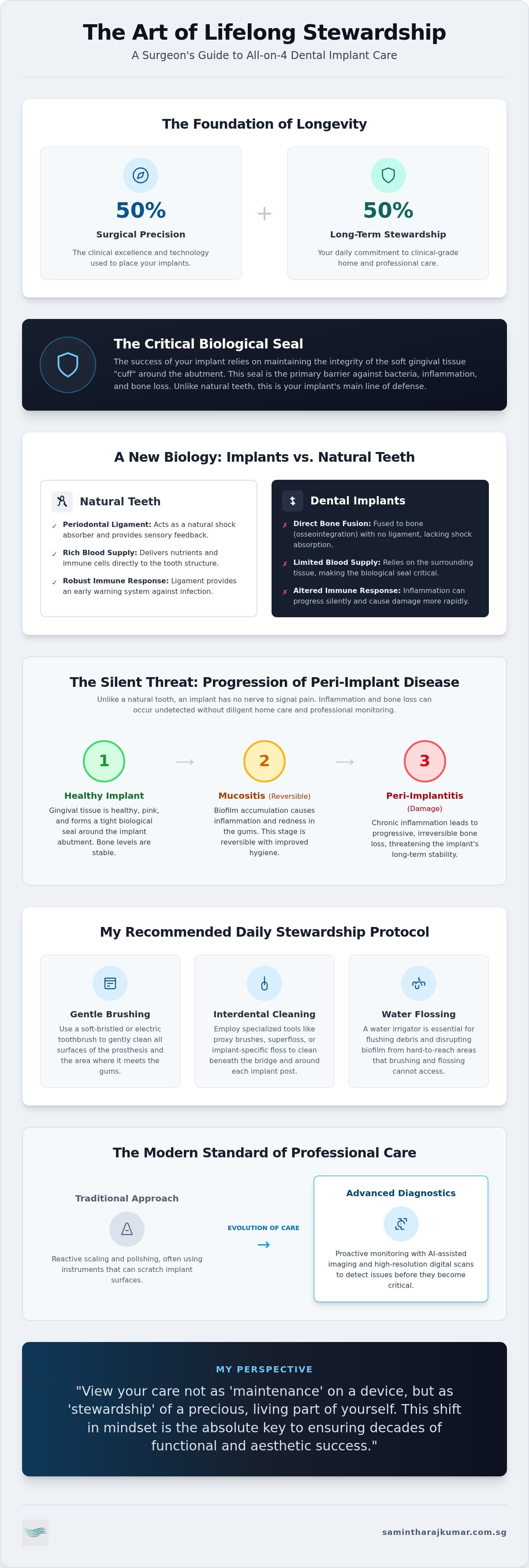
In my clinical experience, the success of an All-on-4 dental implants procedure is 50% surgical precision and 50% long-term stewardship. As a clinician and founder, I often tell my patients that the day their final bridge is fitted is not the end of their journey, but the beginning of a new phase of care. We must view all on 4 cleaning and maintenance as the ongoing management of the "biological seal" between the prosthetic and the gingival tissue. This seal is the gateway to your systemic health and the primary barrier against bone loss.
The concept of "Total Rehabilitation" is central to my philosophy. It's a holistic transition that doesn't terminate when you leave the surgery. For those undergoing the teeth in a day procedure explained in my previous clinical guides, the hygiene mindset must shift immediately. You aren't just cleaning a device. You're protecting a biological-mechanical fusion that requires dedicated, daily attention from the moment you leave the clinic.
The Shift from Natural Teeth to Implants
From a biological perspective, implants are fundamentally different from natural teeth. Natural teeth are suspended by a periodontal ligament, a complex structure that acts as a shock absorber and a sensory organ. Implants, however, are fused directly to the bone. This means they lack the rich blood supply and immune-response triggers provided by that ligament. The "cuff" of gum tissue around the implant abutment is your primary line of defence. Because the body's immune response is different here, preventing inflammation in this specific area is far more critical than it ever was with natural teeth. Modern dental implant technology has advanced significantly, but it still relies on your body's ability to maintain this soft-tissue barrier through meticulous care.
Stewardship vs. Maintenance
I prefer to use the term "stewardship" rather than maintenance. Maintenance sounds like a chore you perform on a piece of machinery; stewardship implies the careful management of something precious and living. When you view your prosthesis as a permanent part of your self, your approach to all on 4 cleaning and maintenance changes. It becomes a ritual of preservation. By adopting this proactive stance, you significantly reduce the risk of bone loss and the need for invasive corrective surgeries later. It's about protecting the investment you've made in your quality of life and ensuring your functional excellence remains uncompromised for decades to come.
Understanding the Science: Biofilm, Peri-implantitis, and Clinical Consequences
In my clinical experience, the most formidable challenge we face isn't the surgery itself, but the microscopic battle against biofilm. Biofilm is a resilient, organised colony of bacteria that thrives in the sheltered spaces between your prosthesis and the gum line. From a biological perspective, if this biofilm isn't regularly disrupted, it initiates a cascade of inflammation known as peri-implant mucositis. While this initial stage is reversible, neglecting your all on 4 cleaning and maintenance allows it to evolve into peri-implantitis, where the body’s own immune response begins to resorb the supporting bone.
I often describe inflammation in the jawbone as a silent threat. Unlike a natural tooth, which alerts you to decay through sharp pain or sensitivity, an implant has no internal nerve. You won't feel the bone receding. This is why my treatment philosophy focuses on the root cause of bacterial accumulation. We look at the architecture of the restoration and the patient's biological response to ensure the environment remains hostile to pathogens but welcoming to healthy tissue. Understanding the Hygiene protocol for All-on-4 is the first step in this management.
The Anatomy of Peri-implantitis
Peri-implantitis is defined as the progressive loss of supporting bone caused by chronic, bacteria-driven inflammation. Peri-implantitis is the primary cause of late-stage implant failure in the 21st century. Because it's often painless, you must be vigilant for subtle warning signs. These include persistent redness of the gingiva, bleeding during your daily routine, or a distinct metallic taste that suggests bacterial activity. If you notice these changes, a comprehensive clinical assessment is the best way to safeguard your investment before bone loss becomes irreversible.
The Impact of Prosthetic Design on Cleaning
The All-on-4 bridge creates a "transition zone" where the prosthetic meets your natural gum line. This area is a primary site for biofilm adhesion. The science shows that materials like zirconia or high-grade porcelain are more resistant to bacterial colonisation than traditional acrylic. However, regardless of the material, a smooth, mirror-like finish on the underside of the bridge is essential. It prevents the mechanical trapping of food particles and ensures that your daily all on 4 cleaning and maintenance remains effective. As a clinician and founder, I ensure our prosthetics are designed with these biological requirements in mind to facilitate lasting health and functional excellence.
The Daily Stewardship Protocol: My Recommended Home Care Routine
As a clinician and founder, I've developed a rigorous daily protocol to ensure your restoration remains as pristine as the day it was fitted. In my clinical experience, patients who follow the teeth in a day procedure explained in our surgical guides achieve the best outcomes when they commit to a clinical-grade hygiene routine. Brushing alone is insufficient for full-arch restorations; you must achieve consistent mechanical disruption of the bacteria that settle beneath the bridge. This is the cornerstone of effective all on 4 cleaning and maintenance.
Selecting the right tools is paramount. I advise against using abrasive toothpastes, which can micro-scratch the aesthetic glaze of your prosthesis, making it more prone to staining and bacterial adhesion. Instead, choose a non-abrasive gel. From a biological perspective, our goal is to maintain the smooth surface of the zirconia or ceramic to facilitate easy cleaning. High-quality implant-supported denture care requires a combination of fluid irrigation and physical contact to ensure no area is left neglected.
Morning and Evening Essentials
Your daily ritual should follow these three essential steps:
Step 1: Precision Brushing. Use a soft-bristled manual or specialised electric toothbrush. Hold it at a 45-degree angle to the gum line, focusing on the "transition zone" where the bridge meets your natural tissue.
Step 2: The Water Flosser. I consider a Waterpik or similar water flosser mandatory. Flush the space between the bridge and the gums at least twice daily. This irrigation removes debris from areas a brush simply cannot reach.
Step 3: Mechanical Flossing. Use Superfloss or a dedicated "implant floss" to clean around the individual implant posts. This provides the physical friction necessary to scrub away stubborn deposits.
Advanced Cleaning Aids
For patients with larger gaps or specific anatomical challenges, I often recommend interproximal (TePe) brushes. These allow for targeted cleaning in spaces where biofilm tends to accumulate. To complement this, an alcohol-free antimicrobial mouthwash can be beneficial. I specify alcohol-free formulas because they protect the delicate soft tissue from drying out or becoming irritated. The goal is not just to remove food, but to disrupt the microscopic biofilm layer. Consistent disruption of this layer is what prevents the inflammatory cascade that leads to bone loss. If you find certain areas difficult to reach, a consultation at a Nuffield Dental centre can help us refine your technique.
Professional Maintenance Standards: The Role of Advanced Diagnostics
As a clinician and founder, I believe professional maintenance must go beyond a simple scale and polish. While your daily efforts at home are the primary defence, professional intervention serves as the ultimate safeguard for your investment. In my clinical experience, the most successful long-term outcomes are achieved when we transition from simple cleaning to a comprehensive clinical audit. This is where all on 4 cleaning and maintenance meets advanced surgical oversight.
I recommend an annual "deep maintenance" visit for my patients. During this appointment, we may remove the prosthesis to allow for thorough disinfection of both the implant abutments and the internal surfaces of the bridge. This level of access is impossible during routine home care. We also meticulously monitor the "occlusal load." Ensuring your bite remains perfectly balanced is critical. If the force of your bite is unevenly distributed, it creates mechanical stress that can lead to screw loosening or even structural failure of the prosthesis over time.
The Annual Clinical Audit
The necessity of digital radiographs or CBCT scans cannot be overstated. We use these tools every 12 to 24 months to monitor bone levels around each implant post with high precision. This allows us to verify the integrity of the titanium screws and the stability of the prosthetic fit. During these sessions, we also evaluate preventing facial collapse with dental implants through detailed structural assessments. We ensure the restoration is still providing the necessary support for your facial architecture and muscle tone.
AI and Innovation in Maintenance
Innovation is at the heart of our maintenance protocols. We utilise specialised AI software that helps us track millimetre-level changes in bone density over time. This technology identifies subtle trends that might be invisible to the human eye, allowing for early intervention before a minor issue becomes a clinical complication. For the cleaning process itself, we often employ airflow therapy using glycine powder. This method is exceptionally gentle yet highly effective at removing biofilm without scratching the premium zirconia or ceramic surfaces of your bridge. Specialist-led clinics offer a higher tier of maintenance than generalist practices because we possess the specific surgical data and diagnostic tools required to manage complex rehabilitations. Understanding the state of your oral health begins with a specialist clinical review at one of our centres.
My Perspective: The Intersection of Clinical Mastery and Patient Commitment
In my clinical experience, the most profound transformations I witness aren't measured by the shade of a porcelain tooth or the torque of a titanium screw. They are measured by the return of a patient's confidence and their ability to engage with the world without the shadow of dental anxiety. However, as a clinician and founder, I'm acutely aware that this impact is only as permanent as the care that follows the surgery. I often share a core philosophy with those I treat: I provide the foundation, but you provide the future of your smile. The success of all on 4 cleaning and maintenance is a shared legacy between my surgical precision and your daily commitment.
From a biological perspective, we cannot view the mouth in isolation. Chronic inflammation around dental implants, if left unchecked, isn't just a local issue; it has implications for your systemic well-being. This is the heart of biological dentistry. By managing the microbial environment through meticulous hygiene, we aren't just saving a bridge. We're reducing the inflammatory burden on your entire body. The best outcomes in healthcare always begin with understanding the root cause of health, which, in this case, is the active prevention of pathogenic colonisation.
The Legacy of a Healthy Smile
Diligent maintenance does more than just keep the gums healthy. It preserves the functional aesthetics of your face as you age. When we prevent bone resorption through consistent all on 4 cleaning and maintenance, we maintain the structural support that keeps the lower third of the face from collapsing. This structural rejuvenation is what allows for true emotional renewal. You aren't just wearing a prosthesis; you're inhabiting a healthy mouth that feels like a natural part of your self. My commitment to patient education is a cornerstone of the Nuffield Dental mission because I believe an informed patient is a protected patient.
Final Clinical Reflections
As we conclude this guide, I want to reinforce the importance of the stewardship mindset. Your restoration is a masterpiece of modern engineering, but it exists within a living, changing biological system. Acknowledge that the right diagnosis changes everything, and that includes the diagnosis of your ongoing hygiene needs. The journey of total rehabilitation is long, but it's one we travel together. Ensuring your smile remains a source of pride requires both clinical mastery and a lifelong dedication to care. The best outcomes begin with understanding the root cause, and I invite you to continue this journey with the specialist oversight your health deserves.
Securing the Future of Your Clinical Transformation
The journey of total oral rehabilitation is a profound commitment to your long-term well-being. As a clinician and founder, I've seen that the most enduring results occur when surgical excellence is met with dedicated stewardship. By adopting a precise daily protocol and engaging with professional all on 4 cleaning and maintenance, you protect the biological seal that preserves your jawbone and facial structure. My practice remains dedicated to this legacy of care through specialist-led protocols for Zygomatic and All-on-4 systems, ensuring every patient benefits from our focus on biological dentistry.
Innovation continues to lead our approach. We utilise advanced AI-assisted clinical diagnostics to monitor your health at a level of detail that ensures total security. This proactive stance allows us to detect subtle changes before they compromise your comfort or aesthetics. Your smile is an investment in your quality of life; it deserves the highest tier of specialised oversight to thrive as you age.
The best outcomes begin with understanding the root cause. Explore our specialised approach to total rehabilitation. I remain committed to guiding you through every stage of this transformative journey with clarity and clinical mastery.
Frequently Asked Questions
Can I use a regular electric toothbrush on All-on-4 implants?
Yes, you can use an electric toothbrush, provided it has soft bristles and a pressure sensor. In my clinical experience, high-frequency oscillations are effective at disrupting biofilm. However, you must avoid aggressive scrubbing that could irritate the delicate "cuff" of gum tissue. I recommend using a low-power setting and focusing on the junction where the bridge meets the gingiva. This ensures effective cleaning without causing mechanical wear on the aesthetic glaze of your prosthesis.
How often do All-on-4 implants need professional cleaning?
I typically recommend a professional hygiene visit every four to six months for life. During the first year after surgery, I may advise more frequent visits, perhaps every three months, to monitor the biological integration of your restoration. These sessions are a vital component of all on 4 cleaning and maintenance. Once a year, we also perform a more intensive clinical audit, which may include digital radiographs to track bone density and verify the stability of the titanium screws.
What happens if I don't clean under my All-on-4 bridge?
Neglecting the space beneath your bridge leads to the rapid colonisation of pathogenic bacteria. This biofilm triggers peri-implant mucositis, which is the inflammation of the soft tissues. If left untreated, it progresses to peri-implantitis, a destructive condition where your immune system attacks the supporting jawbone. Because implants lack the sensory nerves of natural teeth, this bone loss is often painless until the implant becomes loose, potentially leading to the complete failure of the rehabilitation.
Is it normal for my gums to bleed when cleaning my implants?
Bleeding is never considered normal and is a primary clinical indicator of inflammation. If you notice blood while brushing or flossing, it suggests that biofilm has accumulated and initiated an immune response. From a biological perspective, this is a warning sign that your current home care routine needs adjustment. While it may be tempting to stop cleaning the area to avoid bleeding, you must actually increase your focus on that site and seek a professional assessment immediately.
Do I still need to see a dentist if I have no natural teeth left?
Absolutely. Even without natural teeth, your jawbone and soft tissues require ongoing monitoring. As a clinician and founder, I use these visits to check the structural integrity of your implants and perform oral cancer screenings. We also evaluate the "occlusal load" to ensure your bite remains balanced. Maintaining a relationship with a specialist centre ensures that any subtle changes in bone density are caught early through advanced diagnostics, preserving your long-term health.
Can food get stuck under my All-on-4 prosthesis?
Yes, food particles can occasionally become trapped in the "transition zone" between the prosthesis and your gums. This is a common occurrence due to the bridge's design, which must leave a small space for hygiene access. I recommend using a high-quality water flosser twice daily to flush these areas. This irrigation is the most effective way to remove debris and disrupt the microscopic biofilm layer that forms in these sheltered, hard-to-reach spaces.
How do I know if my All-on-4 implants are failing?
The most obvious sign of failure is mobility, as a healthy implant should be fused solidly to the bone. Other red flags include persistent pain, swelling, or the presence of pus around the implant site. You might also notice a recurring bad taste or persistent bad breath that doesn't improve with cleaning. In many cases, failure is silent and only detectable through millimetre-level changes in bone density visible on digital radiographs or CBCT scans during your checkup.
What is the best mouthwash for dental implants?
I recommend using an alcohol-free, antimicrobial mouthwash to support your all on 4 cleaning and maintenance routine. Alcohol-based formulas can dry out the oral mucosa and irritate the soft tissue cuff surrounding your implants. From a biological perspective, a gentle, non-staining antimicrobial rinse helps reduce the bacterial load without disrupting the natural balance of your oral microbiome. It should be used as a supplement to, not a replacement for, mechanical cleaning with brushes and floss.


Comments