
What Kind of Doctor Performs Zygomatic Implant Surgery? A Specialist’s Perspective (2026)
- Dr Samintharaj Kumar

- 1 day ago
- 11 min read
What if the "no" you received from your dentist wasn't a final verdict on your smile, but simply a reflection of their own clinical boundaries? Many of my patients arrive at my practice after being told their bone loss is too severe for treatment, leaving them wondering what kind of doctor does zygomatic implants and why the standard approach failed them. I recognise the anxiety that comes with these complex conversations; it's a heavy burden to carry when you're simply seeking to eat and speak with confidence again.
In my clinical experience, the turning point is moving beyond general dentistry into the realm of advanced maxillofacial surgery. I've written this guide to help you understand the specific surgical qualifications and clinical expertise required to safely anchor implants into the cheekbone. We'll explore the sophisticated training necessary for these "rescue" cases, providing you with a clear roadmap to find a specialist you can trust. By the end, you'll see how the right expertise transforms a "no" into a predictable, life-changing outcome without the need for extensive bone grafting.
Table of Contents
The Challenge of Severe Maxillary Bone Loss: When Traditional Implants Fail
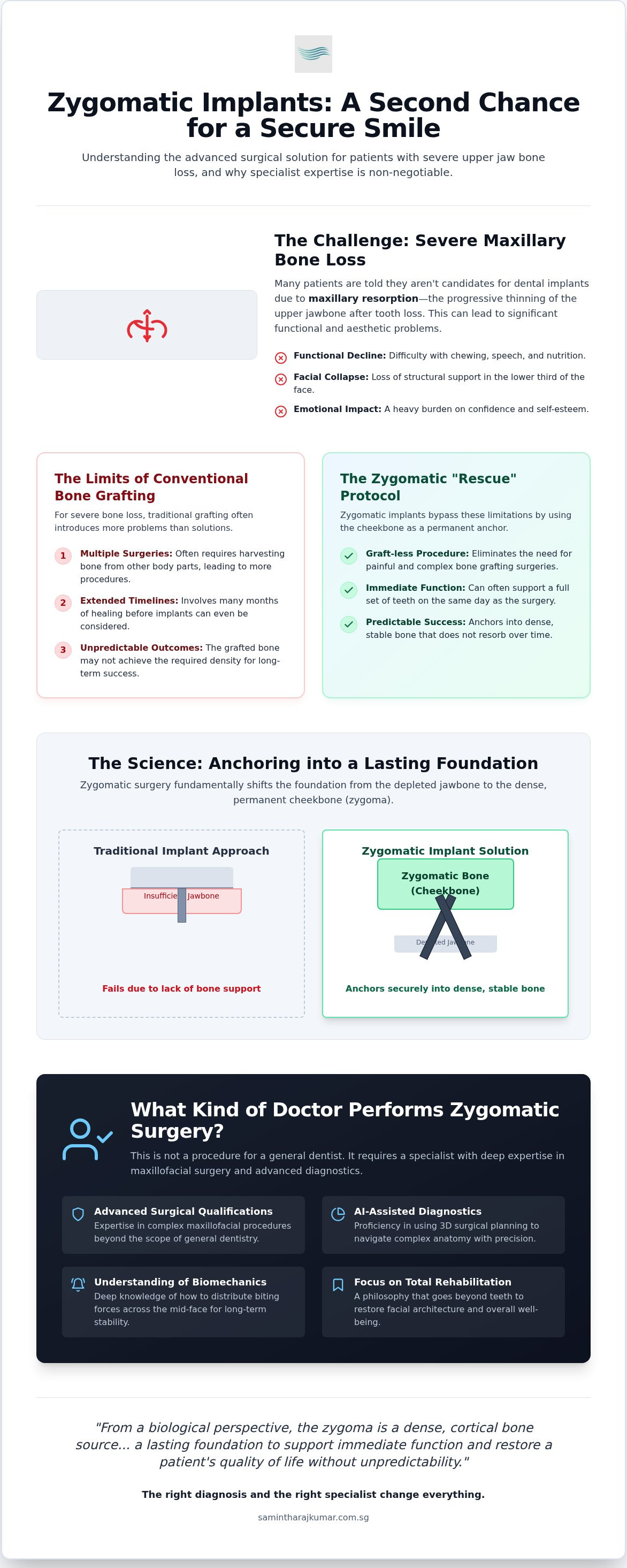
In my clinical experience, many patients arrive at Nuffield Dental feeling profoundly discouraged. They've often spent years being told by various dentists that they simply aren't candidates for dental implants. This rejection usually stems from a condition known as maxillary resorption. This is the progressive thinning of the upper jawbone that occurs naturally after tooth loss or long-term denture wear. When the jawbone is no longer stimulated by tooth roots, the body begins to reabsorb the minerals, leading to a significant loss of volume and density.
The consequences of this bone loss go far beyond the inability to chew. Without the structural support of the jawbone, the lower third of the face begins to lose its height, a process often described as facial collapse. It's a functional decline that affects speech, nutrition, and self-esteem. For these individuals, the search for a solution often leads to the question: what kind of doctor does zygomatic implants? This is because a Zygoma implant serves as a sophisticated "rescue" protocol, providing a secure foundation where traditional methods have failed.
The Limitations of Conventional Bone Grafting
For patients with extreme bone deficiency, traditional bone grafting often presents more hurdles than solutions. These procedures frequently require multiple surgeries, involving bone harvested from other parts of the body, followed by many months of healing before an implant can even be considered. The physical and emotional toll of this extended timeline is immense. In many cases, the grafted bone doesn't achieve the density required for a successful outcome. Transitioning from a narrative of "no options" to a specialised zygomatic alternative allows us to bypass these limitations entirely.
Biological Perspectives on Structural Integrity
From a biological perspective, bone is a dynamic tissue that requires constant stimulation to maintain its integrity. When the alveolar bone of the jaw has resorbed to the point of insufficiency, we must look elsewhere for stability. This is where the zygomatic bone, or the cheekbone, becomes invaluable. Unlike the jawbone, the zygoma is a dense, cortical bone source that remains remarkably stable throughout a person's life. By anchoring into this lasting foundation, we can support immediate function and restore the patient's quality of life without the unpredictability of extensive grafting. Understanding what kind of doctor does zygomatic implants is the first step in accessing this high-tier level of surgical care.
The Science of the Zygoma: Anchoring into a Lasting Foundation
The zygomatic bone, commonly known as the cheekbone, is one of the most resilient structures in the human face. In my clinical experience, it represents a biological sanctuary for dental restoration. While the alveolar bone of the upper jaw is "tooth-dependent" and begins to resorb almost immediately after tooth loss, the zygoma remains remarkably stable throughout a person's life. It's part of the facial skeleton's primary pillars of resistance, designed by nature to withstand the significant forces of chewing and facial expression. This is why I view the zygoma as the ultimate "spare tire" for dental rehabilitation; it's a high-quality, permanent foundation that remains available even when the jawbone has seemingly disappeared.
When patients inquire about what kind of doctor does zygomatic implants, they're often looking for a specialist who understands the sophisticated biomechanics of the mid-face. Unlike traditional implants that sit vertically in the jaw, zygomatic implants follow a long-axis trajectory. This allows us to distribute biting forces across the dense, cortical bone of the cheekbone rather than relying on a thin or porous maxillary ridge. This shift in load distribution is a fundamental principle of advanced oral surgery, ensuring the longevity of the restoration.
Anatomy of the Zygomatic Arch
The zygoma is composed of dense cortical bone, which offers far greater mineral density than the spongy, cancellous bone typically found in the upper jaw. From a biological perspective, this density provides an ideal environment for implant integration. During the planning phase, we use advanced 3D diagnostics to navigate the sinus cavity, ensuring the implant trajectory engages the thickest part of the zygomatic arch. This precision allows us to bypass deficient areas entirely, creating a structural framework that is inherently more stable than traditional grafting sites.
Achieving Primary Stability for Immediate Loading
The exceptional density of the cheekbone allows us to achieve high "primary stability" at the moment of placement. This means the implant is anchored so securely that it's "rock solid" from the outset. Because of this immediate mechanical grip, these implants are a vital component of a Teeth in a Day procedure explained within my clinical protocols. We can often attach a fixed, functional bridge within hours of the surgery, allowing patients to regain their oral function almost instantly. This stability is the cornerstone of patient confidence, as it removes the uncertainty often associated with traditional bone maturation periods.
Understanding these biological principles is essential for anyone facing severe bone loss. I believe that the best outcomes begin with understanding the root cause of your dental challenges and selecting a foundation that is built to endure.
The Specialist Qualifications: What Kind of Doctor is Required?
As a clinician and founder, I believe it's vital for patients to understand that zygomatic surgery isn't simply an "advanced" version of standard implant dentistry. It's a significant surgical intervention that requires a deep understanding of facial architecture. When patients ask what kind of doctor does zygomatic implants, the answer lies in the distinction between general dental care and the highly specialised field of Oral and Maxillofacial Surgery (OMFS). This procedure involves navigating the complex structures of the mid-face, including intimate proximity to the orbit of the eye, the maxillary sinus, and critical cranial nerves.
A surgeon's expertise must extend beyond the mouth to the entire facial skeleton. I've always maintained that clinical mastery is built on a foundation of global medical standards. This is why I prioritise affiliations with international medical networks and maintain a presence in global medical hubs. It ensures that our protocols are not just local best practices, but world-class standards of care that prioritise patient safety and long-term well-being above all else.
Oral & Maxillofacial Surgeons vs. General Dentists
When determining what kind of doctor does zygomatic implants, the primary credential to look for is the completion of a dedicated Oral and Maxillofacial residency. An OMFS has completed a rigorous surgical programme, typically spanning four to six years beyond dental school. This training occurs in hospital environments, where surgeons manage complex trauma and reconstructive cases. Zygomatic protocols demand hospital-grade sterile environments and advanced sedation or general anaesthesia management. The risks of seeking this treatment from a generalist are substantial; without specific training in maxillofacial anatomy, there is a higher likelihood of nerve damage or chronic sinus complications.
Credentialing and Clinical Mastery
When evaluating a specialist, look for board certification and a documented history of managing complex "rescue" cases. At Nuffield Dental, we integrate AI-assisted diagnostics to ensure millimetre-level precision in our surgical planning. This technology allows us to visualise the implant trajectory long before the procedure begins, ensuring we avoid vital structures and achieve primary stability. I view my role as a mentor and a healer, guiding you through the credentials that matter for your safety and confidence. Total rehabilitation is a journey that requires an uncompromising commitment to quality, and the best outcomes begin with understanding the root cause.
The Clinical Journey: From AI Diagnostics to Total Rehabilitation
The journey toward total rehabilitation is a meticulous progression from data-driven insights to clinical execution. In my clinical experience, the initial consultation is where we bridge the gap between your previous dental frustrations and a predictable future. We begin with advanced diagnostics, utilising Cone Beam Computed Tomography (CBCT) to create a high-resolution 3D map of your facial skeleton. This is where the distinction of what kind of doctor does zygomatic implants becomes clear; a specialist doesn't just look at teeth, but at the entire structural integrity of the mid-face.
I've integrated artificial intelligence into our diagnostic workflow to analyse bone density with a level of granularity that was previously impossible. This technology allows me to predict how the zygomatic bone will respond to the implant and plan the ideal trajectory before you even enter the surgical suite. To address the anxiety many feel, we employ bespoke sedation protocols tailored to your biological profile, ensuring a calm, painless experience that prioritises your comfort and safety throughout the procedure.
Precise Planning: The Blueprint for Success
Virtual surgical planning is a non-negotiable standard in my practice for zygomatic protocols. By creating a digital blueprint, I can visualise the precise relationship between the implant, the sinus cavity, and the facial nerves. This level of foresight significantly reduces time spent in surgery and improves the predictability of the healing process. We aren't guessing; we're executing a plan that has been validated by millimetre-precise data, which is essential for achieving a successful long-term outcome.
The Surgical Experience and Immediate Recovery
On the day of your procedure, the process follows a calm, logical sequence from arrival to the fitting of your new teeth. We often utilise the synergy between All-on-4 dental implants and zygomatic anchors to provide a full-arch restoration. Within hours, you'll leave with a fixed, functional smile. The first 48 hours are focused on gentle recovery, and we provide comprehensive post-operative support to manage minor swelling and ensure you feel secure in your new foundation. If you're ready to explore these advanced options, you can learn more about our surgical protocols during a personal consultation.
My Perspective: Restoring More Than Just a Smile
As a clinician and founder, I view every zygomatic procedure as a profound act of restoration that transcends traditional dentistry. When we discuss what kind of doctor does zygomatic implants, we aren't just talking about technical skills. We're talking about a specialist who understands how the facial skeleton supports the soft tissues of the face. My vision for Nuffield Dental has always been to create an institution that prioritises this holistic, biological perspective. This ensures that our patients have access to ethical, high-tier surgical care that respects the complexity of human anatomy.
In my clinical experience, the most rewarding aspect of this work is witnessing the "rescue" of a patient's confidence. Many have spent years in a state of dental despair, told by others that their cases were impossible. My mission is to lead a team that is not only at the cutting edge of science but also deeply rooted in personal care. As we continue to expand our clinical excellence across Southeast Asia, we're building an ecosystem where innovation and clinical mastery are standard, ensuring that every patient receives a world-class outcome.
Structural Rejuvenation and Facial Harmony
From a biological perspective, the loss of teeth and bone leads to a reduction in the vertical dimension of the face. By utilising zygomatic anchors, we aren't just replacing missing teeth; we're actively preventing facial collapse with dental implants. This restoration of the correct bite height provides immediate support to the mid-face and cheeks. It often results in a subtle yet significant structural rejuvenation that non-surgical aesthetic treatments alone cannot achieve. It's the intersection where functional dentistry meets facial harmony, creating a result that feels natural and biologically integrated.
Long-term Impact on Quality of Life
The shift I see in my patients is often psychological as much as it is physical. They move from being a "dental patient" burdened by failure to a confident individual who no longer fears the social implications of their oral health. I view every full-mouth rehabilitation as a contribution to the patient’s personal legacy of health. It's a privilege to lead a team that values innovation and clinical excellence, always remembering that the best outcomes begin with understanding the root cause of the structural failure. The right diagnosis changes everything.
Your Path to Total Rehabilitation
Choosing to undergo a complex maxillofacial procedure is a significant step toward reclaiming your quality of life. As a specialist in complex zygomatic and pterygoid systems, I've dedicated my career to these "rescue" cases, ensuring that patients once told they had no options can finally find a permanent solution. Understanding what kind of doctor does zygomatic implants is the essential first step in your journey. It ensures you're placing your trust in an Oral and Maxillofacial Surgeon with the residency training and clinical mastery required for such sophisticated work.
As the founder of Nuffield Dental Holdings, I maintain an international clinical presence in Singapore and London to bring global standards of innovation to every patient. We use AI-driven diagnostics and 3D planning to ensure your outcome is predictable and your recovery is smooth. You don't have to let bone loss dictate your future or your confidence. The right diagnosis changes everything. Contact my team to discuss your journey toward total rehabilitation. I look forward to helping you restore the foundation of your smile.
Frequently Asked Questions
Is zygomatic implant surgery more painful than regular dental implants?
You won't feel any pain during the procedure because we use bespoke sedation or general anaesthesia to ensure your total comfort. In my clinical experience, patients often report less post-operative discomfort than expected. This is because we avoid the invasive bone harvesting required for traditional grafting. We manage the recovery phase with tailored analgesics, ensuring your journey toward a new smile is as smooth and stress-free as possible.
How long do zygomatic implants typically last?
Zygomatic implants are designed to be a permanent, lifelong solution for dental restoration. Clinical data shows high survival rates, with studies from Nobel Biocare reporting an average success rate of 96.1% after more than 10 years of follow-up. From a biological perspective, the dense cortical bone of the cheekbone provides a remarkably stable foundation. With regular maintenance and professional care at Nuffield Dental, these implants are intended to support your facial structure for decades.
Can any oral surgeon perform zygomatic implant surgery?
Technically, many dentists place implants, but zygomatic surgery is a sub-specialist field that requires advanced maxillofacial training. When considering what kind of doctor does zygomatic implants, you should look for an Oral and Maxillofacial Surgeon with a history of complex cases. This procedure demands a mastery of mid-facial anatomy that standard dental residency does not cover. I recommend choosing a clinician who follows established international protocols to ensure your safety and success.
What is the recovery time for a zygomatic implant procedure?
The initial recovery is surprisingly rapid, often allowing us to attach a functional bridge within 48 hours of surgery. While the soft tissues heal within a few weeks, the full biological integration of the implants into the bone takes several months. I advise patients to follow a soft-food diet during this time to protect the new foundation. Most individuals find they can return to their normal daily routines within three to five days post-procedure.
Are there specific risks associated with anchoring implants in the cheekbone?
Specific risks include sinus congestion, temporary nerve paresthesia, or proximity to the orbital floor, but these are significantly mitigated through advanced planning. I use AI-assisted diagnostics and CBCT scans to map your anatomy with millimetre precision before the surgery begins. This allows me to plan a trajectory that avoids vital structures entirely. Choosing a specialist who understands these complexities is the most effective way to ensure a safe and predictable surgical outcome.
Do I need a general anaesthetic for zygomatic implant placement?
Most patients undergo this procedure under general anaesthesia or deep intravenous sedation in a controlled, hospital-grade environment. Because we are anchoring into the dense zygomatic bone, ensuring you are completely relaxed is essential for both your comfort and my surgical precision. In my practice, we tailor the anaesthetic protocol to your specific health profile. This approach helps lower the emotional barriers and anxiety often associated with complex oral and maxillofacial surgery.
What happens if I have a sinus infection before or after the surgery?
Any pre-existing sinus infection must be fully resolved before we proceed to ensure a sterile surgical environment. If an infection occurs after the procedure, it is typically managed with a course of antibiotics and close clinical monitoring. Because the implant trajectory passes near the maxillary sinus, I use 3D imaging to assess your sinus health during the planning phase. This proactive approach prevents complications and ensures the long-term stability of your restoration.
How do zygomatic implants compare to traditional bone grafting in terms of cost?
Zygomatic implants are often a more efficient investment because they eliminate the need for multi-stage bone grafting surgeries. While the initial fee reflects the specialist expertise required, you avoid the costs and healing time associated with secondary donor sites and months of maturation. Many patients find that our "Teeth in a Day" protocol offers superior value by restoring oral function in a significantly shorter timeline. The right diagnosis changes everything.


Comments